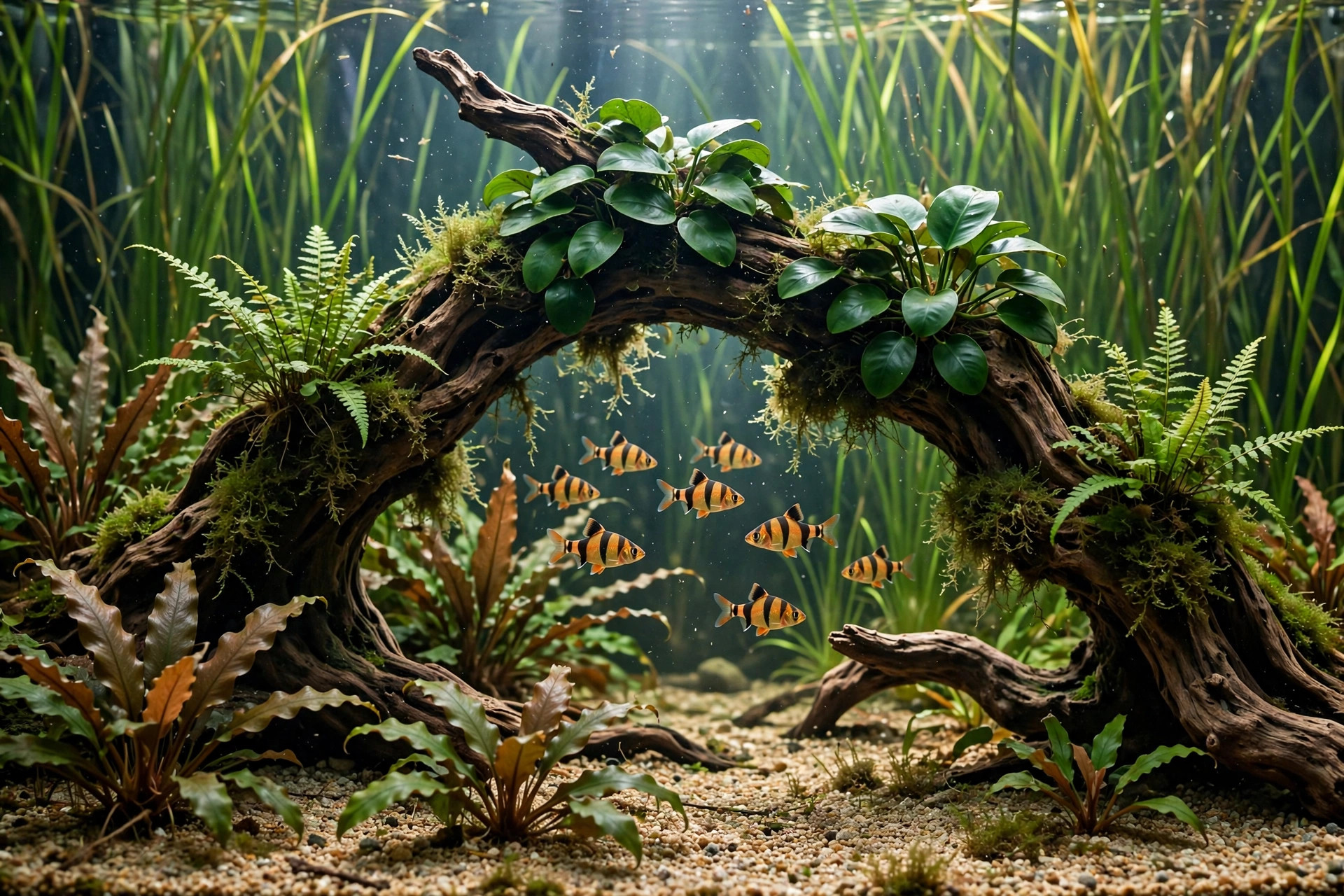
Stock a tiger barb tank with delicate stem plants and you'll watch your aquascape turn into green confetti within a week. These orange-striped schooling fish are curious, constant grazers — they mouth, tug, and sample every leaf in the tank, and anything soft comes back shredded.
That doesn't mean tiger barbs and planted tanks can't mix. It means you plant for a tank of toddlers: tough, leathery, or fibrous species the fish can't be bothered to destroy. Here are the best aquarium plants for tiger barb tanks, the species they'll wreck, and the planting tricks that make the survivors stick.
Why tiger barbs shred soft plants
Tiger barbs are omnivores, and grazing is hardwired behavior. In the wild they pick at algae, biofilm, and plant matter between meals — in your tank, every new leaf gets investigated by mouth. Soft, thin leaves tear under that attention; the fish doesn't even have to be hungry. Underfed or bored schools nip more, so a varied diet twice a day doubles as plant protection.
The upside: the same habit makes barbs decent algae grazers. They keep biofilm off slow-growing leaves, which actually helps plants like anubias stay clean. Your job is to give them leaves they can't damage — "plant-proof" doesn't exist, only "barb-boring."
The 6 nip-proof plant picks
Every plant below has survived real tiger barb tanks: thick cuticles, fibrous tissue, or growth habits that outpace the damage. For a 30-gallon tank, start with 2–3 anubias or java fern portions tied to wood, a background wall of vallisneria, 3–5 crypts midground, one amazon sword, and moss patches in the corners.
| Plant | Placement | Why it survives barbs |
|---|---|---|
| Anubias barteri | Tied to wood/rock, midground | Leathery leaves — barbs taste it once and lose interest |
| Java fern (Microsorum pterotpus) | Tied to wood/rock, midground | Fibrous, nearly indestructible fronds; multiplies via plantlets |
| Cryptocoryne wendtii | Midground, rooted | Dense rosettes with sturdy leaves; established colonies resist tugging |
| Vallisneria spiralis | Background, rooted | Sends runners faster than barbs can nibble the old leaves |
| Amazon sword (Echinodorus) | Background corner, rooted | Thick, broad leaves on a plant too big to bully |
| Java moss (Taxiphyllum barbieri) | Wood, corners | Expendable grazing moss — barbs pick at it without killing the colony |
All six are low-tech plants: no CO2 injection needed, and they thrive under the standard LED lighting most barb tanks already run. If you want the full care routine for the two epiphytes, our anubias care guide and java fern care guide cover attachment and feeding in detail.
Plants tiger barbs will destroy
Anything with thin, soft stems is a salad bar. Rotala, cabomba, and fine-leafed ludwigia varieties come back looking like torn confetti after a week with a curious school — new growth tips are the first to go. Delicate foreground carpets struggle for a different reason: barbs don't eat them so much as uproot the plugs while foraging along the substrate. Water wisteria is the borderline case — it can outgrow nibbling, but expect ragged edges.
Affiliate disclosure: AquaVerdia is reader-supported. When you buy through the links below, we may earn a commission at no extra cost to you — it keeps the guides free.
Plant them so they survive
Two planting rules decide whether your picks thrive or melt. First, the rhizome rule: anubias and java fern must never be buried in substrate. Tie them to driftwood or rocks with thread, or use a dab of Seachem Flourish Glue ★4.3 on the hardscape and press the rhizome against it for a few seconds. Buried rhizomes rot, and a rotting plant in a barb tank gets torn apart in days.
Second, feed the roots. Swords, crypts, and vallisneria are heavy root feeders, and tank bioload doesn't replace real substrate nutrition. Push Seachem Flourish Tabs ★4.6 into the substrate around each crown at planting — fast establishment is the whole game, because a well-rooted plant survives tugging that would uproot a fresh plug.
Feeding, layout, and fewer nips
Layout does as much work as plant choice. Keep the center open as a swim lane and pack the edges with your tough plants plus driftwood and rocks — those sightline breaks stop chases from crossing the whole tank (our tiger barb planted tank setup guide covers the full layout).
The epiphytes in your picks drink from the water column, not the substrate. A lean dose of Seachem Flourish ★4.7 once or twice a week keeps anubias and java fern deep green — heavy dosing in a barb tank just grows algae on slow leaves.
FAQs
Will tiger barbs eat all my aquarium plants?
No — they're nibblers, not herbivores. They mouth soft, thin-leaved plants out of curiosity and graze algae and biofilm off hardscape. Tough-leaved species like anubias, java fern, and amazon swords get sampled once and left alone.
Can I keep stem plants with tiger barbs?
It's risky. Fast growers like water wisteria can outpace the damage, but expect ragged edges. Delicate stems like rotala and cabomba will be shredded — put that effort into the nip-proof picks instead.
Do these plants need CO2 injection?
No. All six picks thrive in low-tech setups with standard aquarium lighting. CO2 speeds growth, but none of them require it to stay healthy in a barb tank.
How many plants does a 30-gallon tiger barb tank need?
Plant heavily from day one: 2–3 anubias or java fern portions on wood, a background wall of vallisneria, 3–5 crypts midground, one amazon sword, and moss in the corners — dense edges with an open center swim lane.