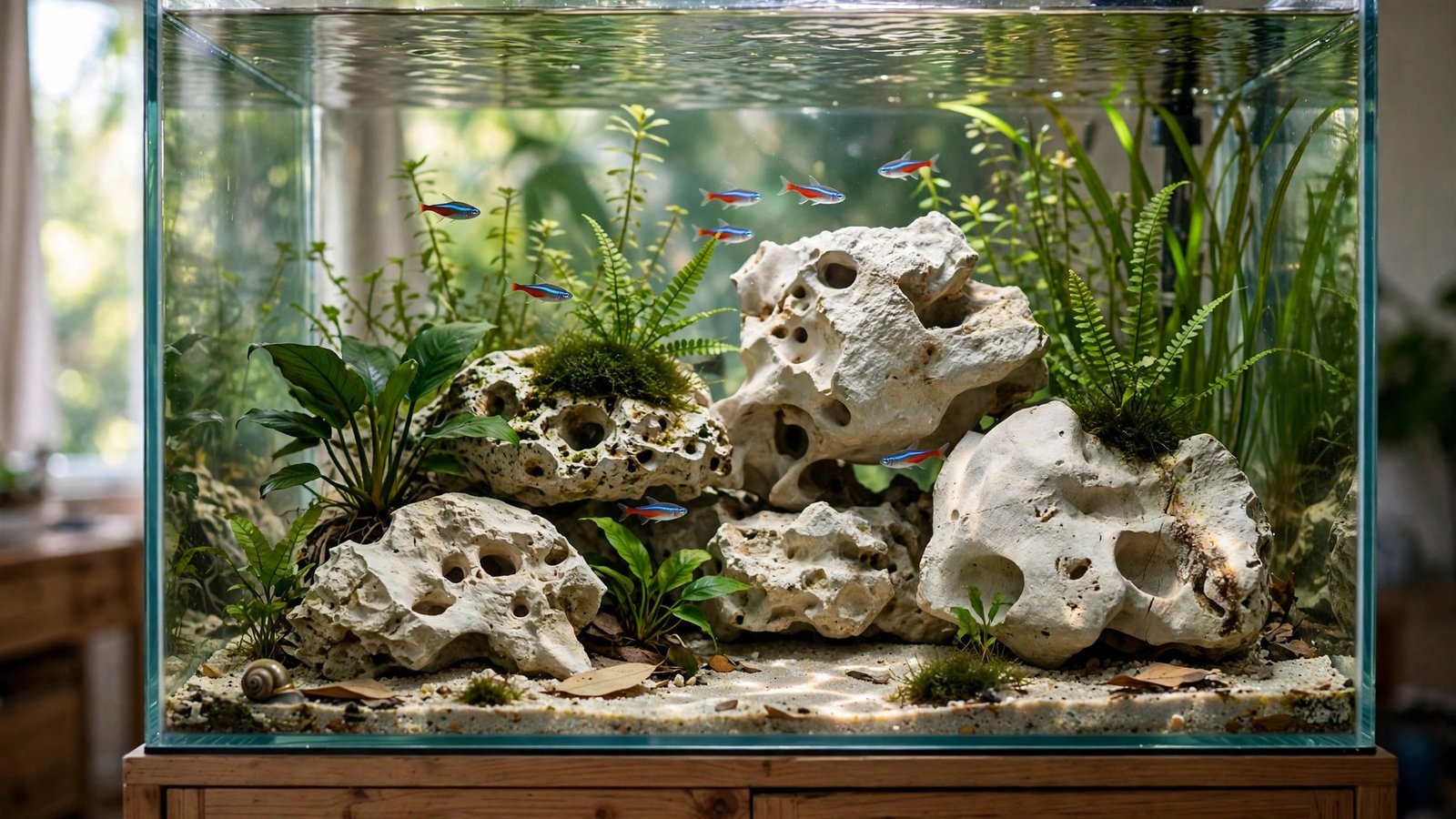
Texas holey rock can quietly sabotage your planted tank. Drop a few striking limestone pieces into a soft-water aquascape and the pH can climb from 6.8 to 8.0 within two weeks — sensitive stems stall, and no CO2 tweak restores balance. For the right setup, though — an African cichlid tank or hard-water planted scape — this Texas holey rock aquarium staple is one of the most characterful stones you can buy. This guide explains how it shifts your water chemistry, which plants thrive and which fail, and how to clean, stack, and anchor it safely.
What Texas holey rock actually is
Texas holey rock isn't a brand or a manufactured product — it's natural Texas limestone, pitted with honeycomb holes formed by eons of water erosion. Quarries sell it as a byproduct, and the aquarium trade adopted it because those cavernous holes look like miniature cave systems — genuine territory breaks for rock-dwelling African cichlids.
What sets it apart from inert stones like dragon stone or lava rock is the chemistry. It's nearly pure calcium carbonate, so it slowly dissolves, releasing carbonate and bicarbonate ions that raise general hardness (GH) and, more importantly, carbonate hardness (KH), which buffers pH upward. The acid-fizz test proves it in ten seconds: drip white vinegar on a fresh face and it bubbles vigorously.
And here's the fact most guides bury: holey rock is not decoration-neutral. Every piece is a slow-release mineral supplement for your water — a feature or a bug depending entirely on what you keep.
How a Texas holey rock aquarium changes pH, KH, and GH
In soft, low-buffered water — say, starting at pH 6.8 and 2 dKH — a few kilograms of holey rock in a 100-liter tank can pull pH to 7.8–8.0 within days, with KH climbing roughly 2–5 dKH. The numbers scale with rock mass relative to water volume: a cichlid tank stuffed with holey rock has far more dissolving surface than a single accent stone.
The shift self-limits. Calcium carbonate dissolves readily in acidic water but barely at all once water turns alkaline, so the rock parks pH around 7.8–8.2 and then trickles along. The first month is the most active; afterward a passivated layer forms and the effect slows — though it never stops. Neglected holey-rock tanks can see KH creep higher between water changes, which is why regular water changes matter more here than with inert hardscape.
GH rises too, though less dramatically than KH, as calcium enters solution. (The USGS guide to water hardness explains what GH means if you're new to it.) If your tap is already hard and alkaline — much of the American Midwest and Texas — holey rock mostly keeps pH pinned where it is. If your tap is soft and acidic, expect the full shift described above.
Plants that thrive with holey rock
Here's the angle most guides skip: holey rock suits a planted tank perfectly, provided you choose plants matched to hard, alkaline water:
- Vallisneria (vallis). V. spiralis and V. americana use bicarbonate directly as a carbon source. A holey-rock tank with a vallis backdrop is a classic winning combo — fast, lush, and near-bulletproof.
- Anubias and Java fern. Broad-tolerance rhizome plants that suit the crevices of holey rock itself.
- Sagittaria subulata. A bicarbonate-using grass that carpets or mid-grounds happily in hard water.
- Bacopa caroliniana and Bacopa monnieri. Sturdy stems that tolerate pH into the low 8s without melting.
- Hornwort (Ceratophyllum) and guppy grass. Free-planted stems that pull carbon at the air-water interface — largely indifferent to what's dissolved below.
- Amazon swords (Echinodorus). Accept pH into the high 7s, though they need richer substrates — pair with root tabs under capped aquasoil.
Most aquatic plants prefer dissolved CO2 gas, but several hard-water natives strip carbon from bicarbonate ions directly — Vallisneria's Tropica profile is a good example of a genus built for exactly this water. In a holey-rock tank that's a superpower: Vallisneria can explode where a CO2-injected Rotala melts.
Plants that struggle in holey-rock water
Now the other side: soft-water species evolved in acidic, mineral-poor rivers — the Amazon, Rio Negro, Southeast Asian blackwater — and lack the machinery for bicarbonate or alkaline water:
- Cryptocoryne (most). Crypts already melt from transplant shock; hard alkaline water on top makes recovery unlikely. C. wendtii sometimes limps along at pH 7.6, but thriving is another story.
- Rotala, Ludwigia, and other demanding stems. Growth stalls, tips stunt, and the red coloration high-tech keepers chase washes out toward pale green.
- Tonina and Eriocaulon. Poster children for soft, acidic, low-KH water — they rarely survive the month in a holey-rock tank.
- Utricularia graminifolia and other soft-water carpets. Melts in mineral-rich alkaline water almost reliably.
At high pH and KH, the carbonate equilibrium shifts: less injected CO2 remains as free, plant-usable CO2, and pH drop-charts become misleading. High-tech holey-rock tanks fight physics: more gas for less plant response, with a pH swing risk at every water change. Most keepers skip injection in holey-rock scapes and lean on the low-tech palette above.
Fish and livestock pairings
Where holey rock shines is hard-water livestock. The caves and broken sightlines are made for African cichlids — Mbuna claim a hole per fish and defend it, which visibly reduces aggression. Livebearers, many barbs and rainbowfish do well too, and cherry shrimp benefit from the dissolved calcium for shell growth.
Flip the list for soft-water species. Discus, cardinal tetras, German blue rams, and most Amazonian tetras need pH below 7.0 — a holey-rock tank stresses them chronically, even if they survive.
Texas holey rock vs other aquascaping stones
Choosing hardscape is mostly choosing water chemistry — here's the honest comparison across the four stones hobbyists debate most:
| Property | Texas holey rock | Seiryu stone | Dragon stone (Ohko) | Lava rock |
|---|---|---|---|---|
| Composition | Calcium carbonate limestone | Carbonate-rich slate-like stone | Clay-based, mostly inert | Volcanic basalt, inert |
| pH/KH effect | Strong — buffers toward 7.8–8.2 | Moderate — raises pH/KH measurably | Negligible | None |
| Hiding structure | Excellent — natural caves and holes | Good — stacked ledges | Good — deep crevices | Moderate — porous but no caves |
| Weight/stability | Very heavy; stacks securely | Heavy | Medium-light | Light; floats until waterlogged |
| Best aquascaping use | African cichlid biotopes, hard-water planted tanks | Iwagumi-style layouts (with CO2 + softening) | Universal aquascaping, planted tanks | Background walls, filters, moss bases |
| Planted-tank fit | Hard-water plants only | Planted tanks with compensation | Excellent, all plants | Excellent, all plants |
If you want the full rundown on choosing between stone types, see our guide to the best rocks for aquascaping — and if the cave look appeals but your plan is soft and acidic, dragon stone or wood-and-stone combinations (like the best driftwood for aquascaping) give you the structure without the chemistry.
How to prepare holey rock before it enters your tank
New holey rock arrives dusty — quarry dust plus field dirt. Don't skip prep:
- Inspect each piece. Reject anything with metallic veins, paint, oil stains, or a chemical smell — real holey rock smells like rock and chalk.
- Vinegar-test every face. Drip plain white vinegar and watch for fizzing. No fizz on "holey rock"? It's probably not limestone — better to know before it goes in water.
- Scrub and rinse. Stiff brush, no soap, no bleach. The holes trap fine dust; a hose or pressure setting beats a bucket swirl. Rinse until the runoff is clear.
- Soak 24–48 hours. Submerge in a bucket, change the water once. This rinses the most chemically active outer layer and shows you the rock's true wet color — what you'll actually see in the tank.
- Check sharp edges. Freshly broken faces can be razor-sharp — file down any edge that could cut you or a fish.
One absolute rule: never boil rocks. Trapped water in internal pockets can flash to steam and shatter the stone — soak-and-scrub achieves the same cleaning without the risk.
Stacking, anchoring, and aquascaping with holey rock
Holey rock is dense — a centerpiece chunk can weigh several kilograms — so build for gravity from the start. Place the largest stones first, directly on the tank floor or on egg-crate light diffuser, before adding substrate; stones resting on soft material can shift as it compacts. Every stone should sit flat enough that a firm nudge doesn't rock it. For tall stacks, aquarium-safe epoxy or gel cyanoacrylate bonds pieces permanently — our aquascaping glue guide covers products and cure times.
Aquascaping-wise, play to the stone's strengths. Group pieces by size for a natural cave-ridge: one or two large anchors, medium pieces forming ledges and cave mouths, small rubble at the base. Keep stone off the glass (fish get wedged behind shifted rock more often than you'd think) and leave clear swimming lanes — Mbuna patrol between structures. For planted scapes, tuck Anubias and Java fern into the crevices and let Vallisneria rise behind the rock line; the holes become planters that need no attachment.
One design caution: holey rock's holes are genuinely cavernous, and small fish can enter pockets they can't easily exit. Plug any dead-end hole narrower than a fish's body with a dab of silicone or a small stone wedge — five minutes of work beats losing a tetra inside the hardscape.
Maintenance and long-term care
Holey rock is low-maintenance, but not no-maintenance. Algae loves limestone's porous, mineral-rich surfaces — green spot algae and diatoms colonize light-facing sides faster than on inert stone. A soft toothbrush during water changes handles it; nerite snails and a bristlenose pleco are the biological backup. Blast the pits with a turkey baster every couple of weeks, direct your gravel vacuum around the rock bases, and wipe white calcium scale off the heater glass.
Watch your KH trend over months. The rock dissolves continuously, so KH slowly climbs between water changes — fastest in small tanks under ~60 liters. If KH keeps rising past your target, remove a piece or two: rock mass is your dial. Re-check stability after any rescape — a repositioned stone settles differently than you expect.
Frequently Asked Questions
Does Texas holey rock raise pH permanently?
Effectively, yes, while the rock is in the tank. It dissolves continuously and buffers pH toward roughly 7.8–8.2 — strongest in the first month, then slowing as surfaces passivate, but never stopping. Remove the rock and water-change regularly, and pH drifts back to your source water's baseline. It's a poor match for aquasoil-based soft-water tanks, where buffering substrates fight the rock and exhaust themselves.
Can I use holey rock in a planted aquarium?
Yes, with hard-water-tolerant plants. Vallisneria, Sagittaria, Anubias, Java fern, Bacopa, hornwort, and floating plants thrive; soft-water species like Cryptocoryne, Rotala, Tonina, and Eriocaulon generally grow poorly or melt. Skip CO2 injection in most holey-rock scapes — high KH makes drop-checker readings unreliable and reduces the free CO2 plants can actually use.
Is Texas holey rock safe for all fish?
It's safe and ideal for hard-water species: African cichlids, livebearers, many barbs and rainbowfish, snails, and shrimp (dissolved calcium supports shell growth). It's a poor match for soft-water fish like discus, cardinal tetras, and German blue rams, which need low pH and hardness. Always stability-check stacked pieces so heavy rocks can't topple onto livestock or glass.
How much holey rock should I use per gallon?
There's no fixed ratio — the effect scales with rock surface and mass versus water volume. A useful start: one to two fist-sized pieces per 10 gallons for a planted community tank, more for a dedicated Mbuna setup where rock doubles as territory. Run the 7-day water-chemistry trial described above, then add or remove pieces until pH and KH land where your livestock needs them.
Do I need to boil or sterilize holey rock?
No — and you should never boil rocks, since trapped water can flash to steam and shatter them. Scrub with a stiff brush (no soap), rinse thoroughly, soak 24–48 hours with one water change, and vinegar-test each piece to confirm it's genuine limestone. That routine removes dust, field contaminants, and the most chemically active outer layer.
The bottom line
Texas holey rock is one of the hobby's most honest materials: it does exactly what its geology says — raises pH and hardness while building caves your fish will actually use. Match it to hard-water livestock and tolerant plants, prepare it properly, stack it like it weighs what it does, and it rewards you with a biotope that practically runs itself. Fight its chemistry with soft-water species and CO2-heavy setups, and you'll fight it forever. Pick the tank around the rock, not the rock around the tank. On substrate choices, see our comparisons of aquarium soil vs gravel and the best sand for planted aquariums.