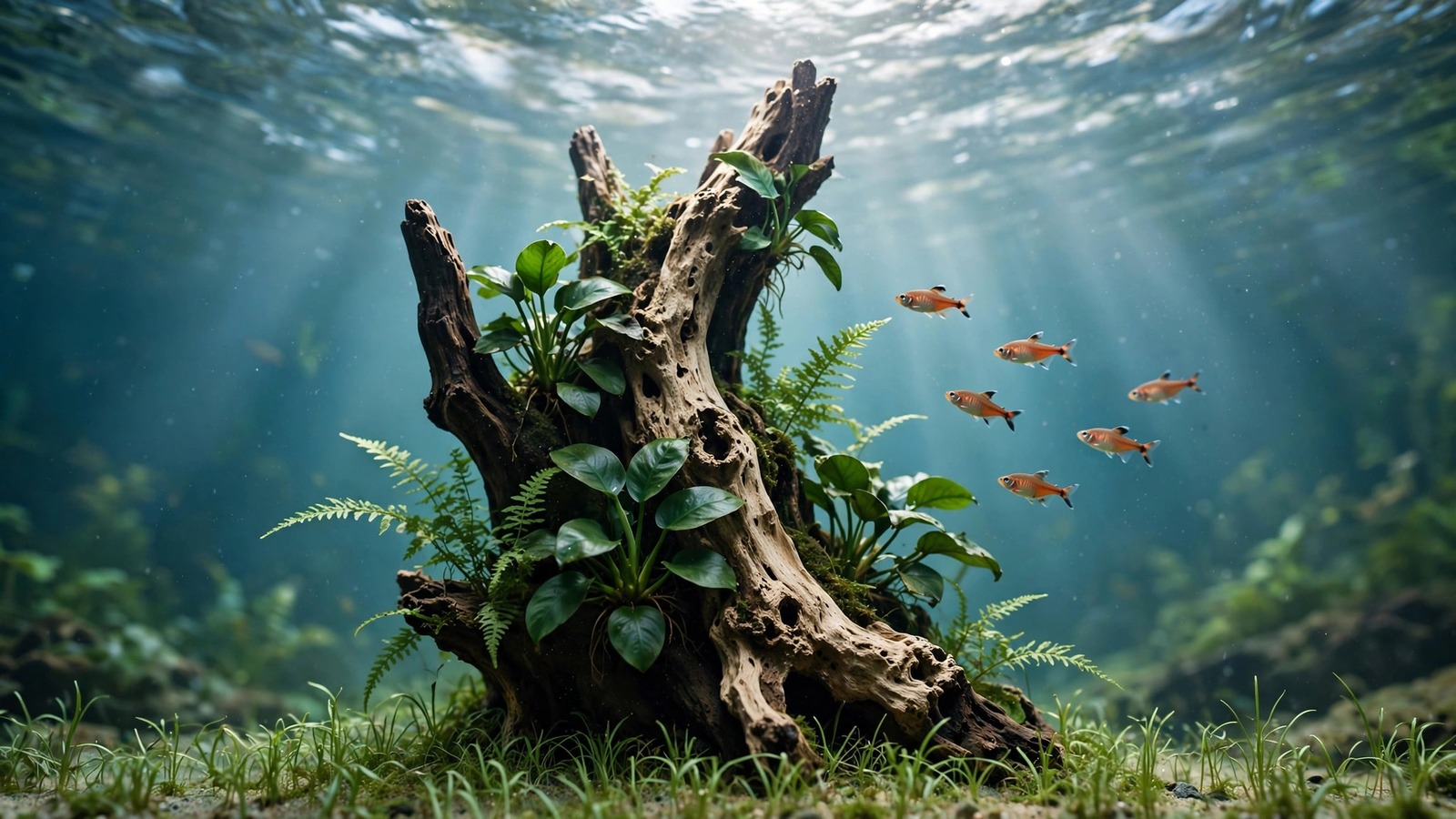
Six months after you scaped the tank, you pull the centerpiece out and your thumb sinks straight into it. The underside smells like a compost bin, the branch tips crumble like wet cardboard, and the "driftwood" you paid good money for has become drift-sludge. This is not bad luck — it is a predictable outcome of choosing the wrong wood and skipping the checks that take five minutes in the store.
Here is the good news: truly rotting driftwood is rare when you buy right. Wood that disappears underwater almost always fails for one of three fixable reasons — it was a softwood sold as "aquarium safe," it was shipped half-cured with wet rot already started, or it was a thin branchy piece subjected to years of bacterial attack at its weakest points. This guide shows you how to pick wood that stays solid for years, rank every common aquarium wood by rot resistance, test a piece in the store before you pay, and prepare it so it lasts as long as the tank does.
The short answer: Choose dense hardwoods — manzanita, mopani, and Malaysian driftwood — which last 5–10+ years submerged because their tight grain resists water intrusion. In the store, reject any piece that smells musty, dents under your fingernail, or has soft punky patches. Boil new wood 1–2 hours, then soak it 1–6 weeks with water changes every 1–2 days until it sinks on its own. Never buy softwoods or conifers (pine, cedar): their resins harm fish and they rot within months.
Why Driftwood Rots — Or Usually Does Not
The fungi and bacteria that digest wood need two things at once: oxygen and moisture levels in the 35–50% range. Fully submerged aquarium wood is typically waterlogged well beyond that range, with its cell spaces flooded and air exchange cut off — conditions that starve most rot fungi. That is why a dense hardwood can sit on a riverbed or in your tank for years without losing structural integrity.
Rot happens when the wood is not fully in that safe zone. Three situations let decay get a foothold:
- The wood is soft or half-cured. Porous softwoods and punky, half-rotted "driftwood" from a craft store never reach full waterlogging in their core. Air pockets stay trapped, fungi stay active, and the piece softens from the inside out.
- It sits in the splash zone. Wood half-submerged in a paludarium or sticking out above the waterline in a riparium experiences alternating wet and dry — the exact moisture cycling rot fungi love. Fully submerged pieces last far longer than partially submerged ones.
- Anaerobic pockets form. Wood buried deep in compacted substrate, especially with bark still on, can trap organic sludge and stagnant water around it. Decay here is slow but real — and the hydrogen sulfide smell will warn you.
Understanding this explains the whole selection strategy: pick dense hardwoods that waterlog completely, strip bark and soft material, and keep the piece fully submerged. Do that, and "rot" stops being a fear and becomes a non-issue.
Driftwood Types Ranked by Rot Resistance
Not all aquarium woods are built alike. Here is how the common options compare, with realistic lifespans based on how aquarists actually see them behave:
| Wood type | Hardness | Underwater lifespan | Tannins | Best for |
|---|---|---|---|---|
| Manzanita | Very hard | 5–10+ years | Very low | Long-term aquascapes, bonsai trees, low-maintenance tanks |
| Mopani | Very hard | 7–10+ years | Very high | Centerpieces, cichlid tanks, blackwater biotopes |
| Malaysian driftwood | Hard | 5–8 years | High | Branchy scapes, epiphyte mounting |
| Tigerwood | Hard | 5+ years | Low | Statement pieces with striking grain |
| Spider wood | Medium-soft | 2–4 years (thin branches) | Low–moderate | Jungle/root-tangle scapes, epiphyte hotels |
| Cholla wood | Soft | 6–18 months | Low | Shrimp grazing (it is meant to be eaten) |
| Grapevine | Soft | Months | High | Avoid for permanent aquariums |
| Pine, cedar, conifers | Soft | Never use | Toxic resins | Never — sap and resins harm livestock |
Manzanita edges out everything else for most hobbyists because it combines extreme durability with very low tannin output — you get the decade-long lifespan without the months of tea-colored water. Spider wood is the beloved exception to the durability rule: its thin branches soften faster, but its chaotic branching makes it the best epiphyte mount available, so many aquarists accept a 2–4 year branch life as the cost of the look.
How to Test a Piece in the Store (60 Seconds)
Online photos flatten everything that matters about wood. Whenever you can, buy in person and run these checks:
- Heft it. Dense wood feels heavy for its size. A chunk that feels suspiciously light for its bulk is either a porous softwood or incompletely dried — both rot faster. Manzanita and mopani have a reassuring heft; thin spider wood is light by nature, which is why its branches have a shorter life.
- Knock it. Tap with a knuckle. Dense hardwood gives a dull, solid thud; a hollow rattle suggests internal voids or drying cracks that will become rot channels underwater.
- Press it. Press your thumbnail into the surface, especially at branch tips and junctions. Healthy hardwood will not dent. If your nail sinks in, that spot is punky — already decayed wood that will only spread once submerged. Check branch junctions in particular; manzanita sometimes splits at forks as it dries.
- Smell it. Good aquarium wood smells woody and earthy, even when dampened. Reject anything that smells musty, sour, chemically, or petroleum-like. Craft-store pieces are sometimes treated with preservatives or pesticides — that smell is a deal-breaker.
- Check the bark. Bark rots fastest and harbors the most organisms. Sandblasted or bark-stripped pieces are aquarium-ready; bark-on pieces need the bark stripped with a brush or drawknife before prep. Loose, flaky bark should come off in your hand before you buy.
- Inspect the thin tips. On spider wood, examine thin branch ends for softness or crumbling — these are the first parts to fail. You can trim off suspect tips, but a piece that is already failing at the tips in the store will not improve underwater.
The Prep Protocol That Protects Wood
Proper preparation is the single biggest controllable factor in how long your driftwood lasts. It kills hitchhiking organisms, extracts the sugars that feed early biofilm and bacteria, and fully waterlogs the piece so no oxygen pockets remain for rot fungi. The full walkthrough lives in our driftwood preparation guide — here is the rot-focused summary:
- Scrub and strip. Stiff brush, hot water, no soap — ever. Remove all bark, dirt, and soft punky patches. A pressure washer on low clears deep crevices on knotted pieces.
- Boil 1–2 hours per round. Submerge the piece (or as much as fits) and maintain a rolling boil. Boiling sterilizes, accelerates tannin extraction, and jump-starts waterlogging. Repeat until the water runs mostly clear — typically 2–4 rounds, up to 6 for mopani. Boil gently around delicate spider-wood branches; a violent rolling boil can make them fragile.
- Soak weighted for 1–6 weeks. Submerge completely in a bucket or tub, weigh it down, and change the water every 1–2 days. Stagnant soak water goes anaerobic and smelly; fresh water keeps extraction efficient. Durations by wood: manzanita 1–2 weeks, spider wood 1–2 weeks, Malaysian 2–4 weeks, mopani 3–6 weeks.
- Run the sink test. The wood is waterlogged when it stays submerged unassisted in the bucket. Do not rush this — wood that sinks in the bucket but floats in a deeper tank is a classic disappointment.
- Sniff the final check. Before the piece goes into the tank, smell the wet wood closely. Woody and earthy means healthy. Musty, sulfurous, or foul means internal rot — cut that section out or reject the piece.
For the in-depth timelines, tannin expectations by wood type, and how to secure pieces that still float, see How to Prepare Driftwood for Your Aquarium.
Warning Signs a Piece Is Failing
Not every ugly phase is rot. New driftwood almost always grows a white, translucent biofilm in weeks 2–6 — a bacterial and fungal colonization of surface sugars. It looks alarming but is harmless, temporary, and even eaten enthusiastically by shrimp, nerite snails, and otocinclus. Read our white fungus guide before panicking.
True rot looks and smells different:
- Soft, yielding spots. Press the piece underwater during a water change. Healthy wood is rigid; rotting wood gives under your thumb and may crumble.
- Foul smell. Pull the piece out and sniff the suspicious area. Earthy is fine. Rotten, sulfurous, or sharply unpleasant means the section is decaying — cut it out with a saw.
- Structural crumbling. Branch tips that disintegrate into mush, or a trunk interior that is soft while the outside looks fine (crack it open to check).
- Black mushy patches under biofilm. Surface biofilm is white and sits on hard wood. If the wood underneath is black and soft, that section is gone.
If rot is localized, saw off the affected section — the rest of a dense hardwood piece is usually perfectly sound. If a whole softwood piece is going, compost it and replace it with a hardwood; the replacement will outlast three softwood pieces for less total money.
Driftwood That Lasts: What to Buy
If you want the shortest path to wood that will not rot, buy a named hardwood from a reputable aquarium supplier and prep it properly. Craft-store and unlabeled pieces are where most rot stories start.
Disclosure: as an Amazon Associate, AquaVerdia earns from qualifying purchases made through the links below, at no extra cost to you. We only recommend products that genuinely fit the article's topic.
Fluval Mopani Driftwood is the top pick for maximum lifespan. Mopani is one of the densest aquarium woods available — it sinks immediately, resists decay for years, and its two-tone grain makes a dramatic centerpiece. The trade-off is heavy initial tannin leaching, so boil and soak it well before scaping. Check the Fluval Mopani Driftwood on Amazon ★4.4.
Hamiledyi Natural Spider Wood Driftwood is the honest budget option. Spider wood's thin branches are its visual signature and its weak point — expect 2–4 years from branch tips while the thicker base lasts much longer. It is the best wood for jungle and root-tangle scapes and an outstanding epiphyte mount; just buy it knowing the lifespan trade-off. Check the Hamiledyi Spider Wood Driftwood on Amazon ★4.3.
For branchy elegance that outlives both, compare spider wood vs manzanita and mopani vs Malaysian driftwood before deciding — the right species for your scape style matters as much as the durability number.
Frequently Asked Questions
Can I use driftwood I found at the beach or lake?
It is risky without proper preparation. Beach wood may carry pollutants, salt, and microorganisms; river driftwood is better since nature has already weathered it. Either way, identify it as a hardwood (never conifers), strip all bark, boil it multiple times, quarantine-soak for a full month, and reject anything with chemical or petroleum smells. When in doubt, buy from an aquarium supplier.
Will driftwood lower my tank's pH permanently?
No. Tannins mildly soften water and lower pH while the wood is actively leaching, but the effect fades as the tannin reserve exhausts — weeks to a few months depending on the wood. Regular water changes keep the shift gentle. Manzanita has minimal effect; mopani has the strongest. Neither will hold pH down permanently on its own.
How do I stop driftwood from floating?
Boil it first — heat accelerates waterlogging more than anything else — then soak it weighted down with a rock for 1–6 weeks depending on the wood type. For stubborn pieces, drill and screw the base to a slate tile buried in the substrate, or glue the base to a heavy stone. Spider wood and grapevine are the most float-prone; mopani almost never floats.
Is the white slime on new driftwood dangerous?
No. White, translucent biofilm on new driftwood is a harmless bacterial and fungal colonization of surface sugars. It peaks in weeks 2–6 and fades on its own within 4–8 weeks. Shrimp, snails, and otocinclus eat it. Do not medicate or tear down the tank over it — just siphon it during water changes if it bothers you.
Can I put a piece of driftwood straight into the tank without boiling?
You can, but you are signing up for months of frustration: floating pieces, tea-colored water, and heavy biofilm. Boiling and soaking are the difference between a smooth setup and weeks of corrective water changes. At minimum, scrub and soak until the wood sinks on its own.
Does sealing driftwood with polyurethane stop rot?
No, and it can make things worse. Sealants fail underwater, trap moisture and decay underneath, and many are not aquarium-safe long-term. Dense hardwood, fully waterlogged, needs no sealant — that is the entire point of choosing rot-resistant wood.