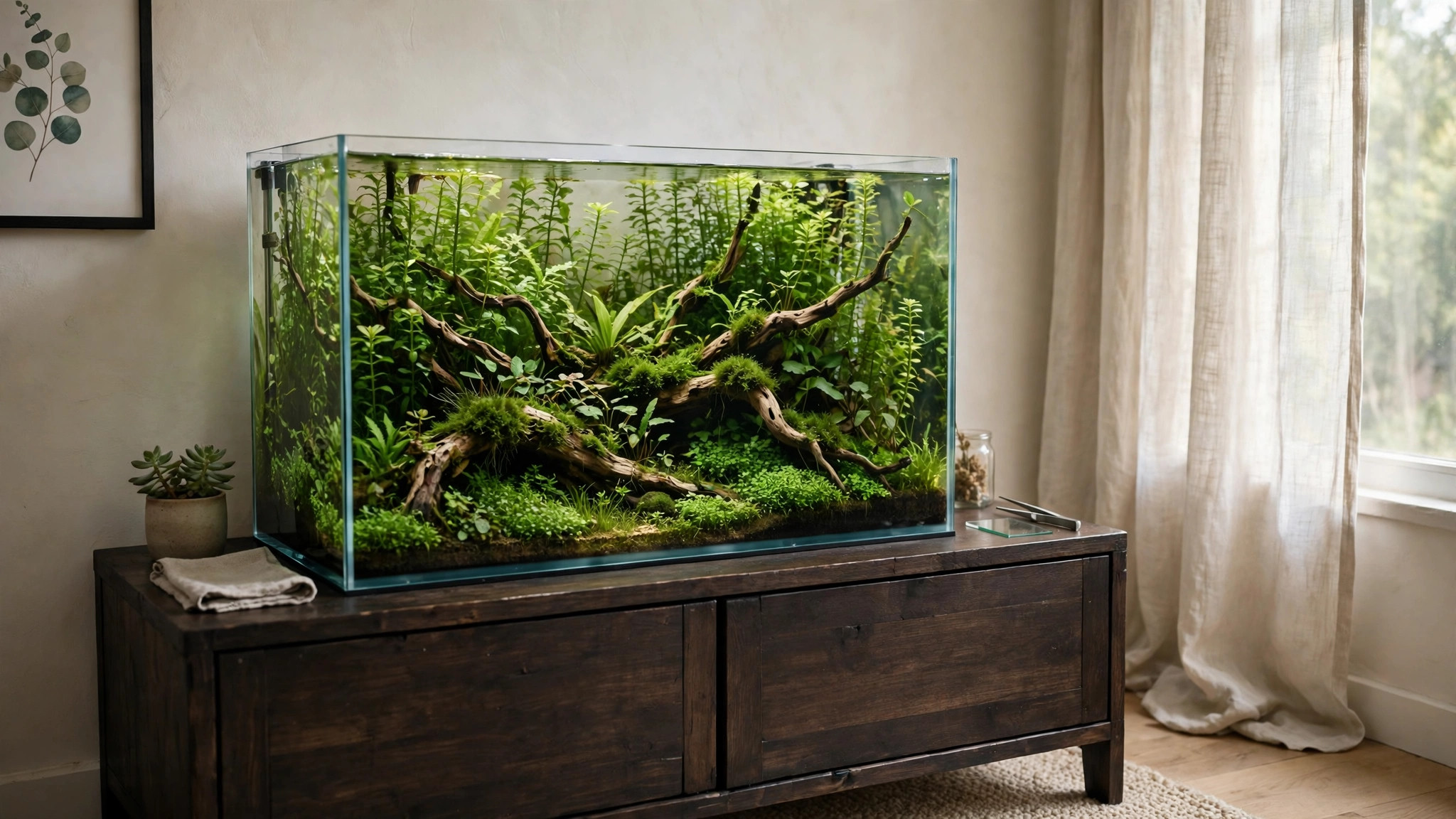
Most planted-tank failures don't start in the tank. They start three feet away — at the sunny window that bakes the glass every afternoon, the wobbly bookshelf the tank sits on, or the floor joist quietly carrying hundreds of pounds it was never meant to hold. Placement costs nothing to choose well and everything to choose wrong.
Before you pour a single gallon, check the four things that actually matter: light, temperature, floor strength, and access. Get these right and the tank mostly takes care of itself. Get one wrong and you'll fight it for years.
Short answer: The best spot for a planted tank is a low-traffic interior wall away from direct sunlight, radiators, and drafty doors, on a level stand built for the weight — a 20-gallon setup can top 200 pounds — with an outlet nearby and a tap within hose reach. Direct sunlight fuels algae and cooks the water; a full-spectrum LED on a timer grows plants better and keeps the glass clean.
Start with light: why the window is a trap
Every beginner has the same instinct: put the tank by the window so the plants get "free" light. It's also the most reliable way to grow green algae instead of green plants. A window delivers light you can't measure, dim, or schedule — afternoon sun spikes the water temperature, algae explodes, and your plants lose in the spot that was supposed to feed them.
Plants do far better on a light you control: a full-spectrum LED on a timer, running a consistent 6–8 hour photoperiod every day. A fixture like the NICREW ClassicLED Plus ★4.6 covers standard 24-to-30-inch tanks, and its inline controller makes the photoperiod set-and-forget.
Affiliate link — I earn a small commission at no extra cost to you.
Temperature: the invisible killer
Plants and tropical fish don't need a hot room; they need a stable one. The 72–78°F range most setups live in is easy to hold — until a radiator under the window, an AC vent, or a drafty entry door keeps yanking the water out of it. Just a few degrees of swing in a day is where stress starts: growth stalls, leaves melt, and fish get sick.
That's why the best wall is usually an interior one, in a room you already live in. Exterior walls run colder in winter and hotter in summer; basements are surprisingly good — dim, stable, often near a floor drain.
If the tank must sit near a heat source, a stick-on LCD thermometer on the glass will tell you more about what's actually happening than the heater dial ever will. Watch it for a week before planting; if the water holds steady through a hot afternoon and a cold night, the spot works.
Floor strength: the part everyone skips
Water alone weighs about 8.34 pounds per gallon, so a 20-gallon tank holds roughly 167 pounds of water before a single pebble. Add glass, substrate, rocks, and equipment and the "small" setup lands well over 200 pounds — big tanks push past 1,000. That weight concentrates into a few square feet, which is why what sits under the tank matters more than the tank itself.
| Tank size | Typical all-in weight (approx.) | Placement rule |
|---|---|---|
| 10 gallon | ~110 lb | Any sturdy, level surface — no glass tables |
| 20 gallon | ~200+ lb | Aquarium-rated stand or solid hardwood furniture |
| 40 breeder | ~450 lb | Dedicated stand; span multiple floor joists |
| 55 gallon | ~600+ lb | Stand against a load-bearing wall, joists perpendicular |
| 75 gallon and up | ~850+ lb | Ground floor or verified structure — check the structure first |
Regular furniture was never designed for this: particleboard shelving absorbs splashes, swells, and fails slowly — exactly the failure you don't notice until it's dramatic. Use a stand built for aquariums, and for anything over 20 gallons, spread the weight across several joists rather than the unsupported middle of a floor. If you're sizing up, run the numbers first with a detailed breakdown of how much a large aquarium weighs and what your floor needs to carry it before you fill anything.
Power access: outlets, surge, and drip loops
A planted tank is an electrical appliance that happens to hold water: filter, heater, light, and often a CO2 solenoid, each with a cord. Put the tank within easy reach of an outlet so cords run downhill and out of the way.
Give every cord a drip loop — a slack U below the outlet so water drips off the loop instead of into the socket — and run everything through a surge protector. Never run power and water hoses through the same tight gap behind the stand.
Access and level: think like the person doing water changes
You'll service this tank weekly for years, so place it for the worst day, not the best. Leave room to lift the lid fully, swing a siphon without hitting the wall, and wipe the front glass without moving furniture. Put the tank within hose reach of a tap and a sensible drain — hauling buckets across carpet is how floors get ruined and backs give out.
Check the stand with a spirit level before the tank goes on: a stand that's out of level puts uneven pressure on the tank's seams, a slow, silent route to a leak. Shim the stand itself, never the tank.
Frequently asked questions
Can a planted tank go in front of a window if I use blinds?
Blinds soften direct sun but don't fix it — you'll still get daily temperature swings and enough light leak to feed algae. A few feet from a bright window with only indirect light is fine; glass directly against the sun is not.
How level does the stand need to be?
Dead level. If a spirit level shows the stand off across its length, shim the legs. Silicone seams distribute even weight — they don't hold uneven loads.
Can I put a 55-gallon tank on the second floor?
Sometimes — against a load-bearing wall, spanning several joists. Verify the structure before you commit water to it.
Is an interior wall really better than an exterior wall?
Yes. Exterior walls run colder in winter and warmer in summer; an interior wall gives the most stable water with the least effort.