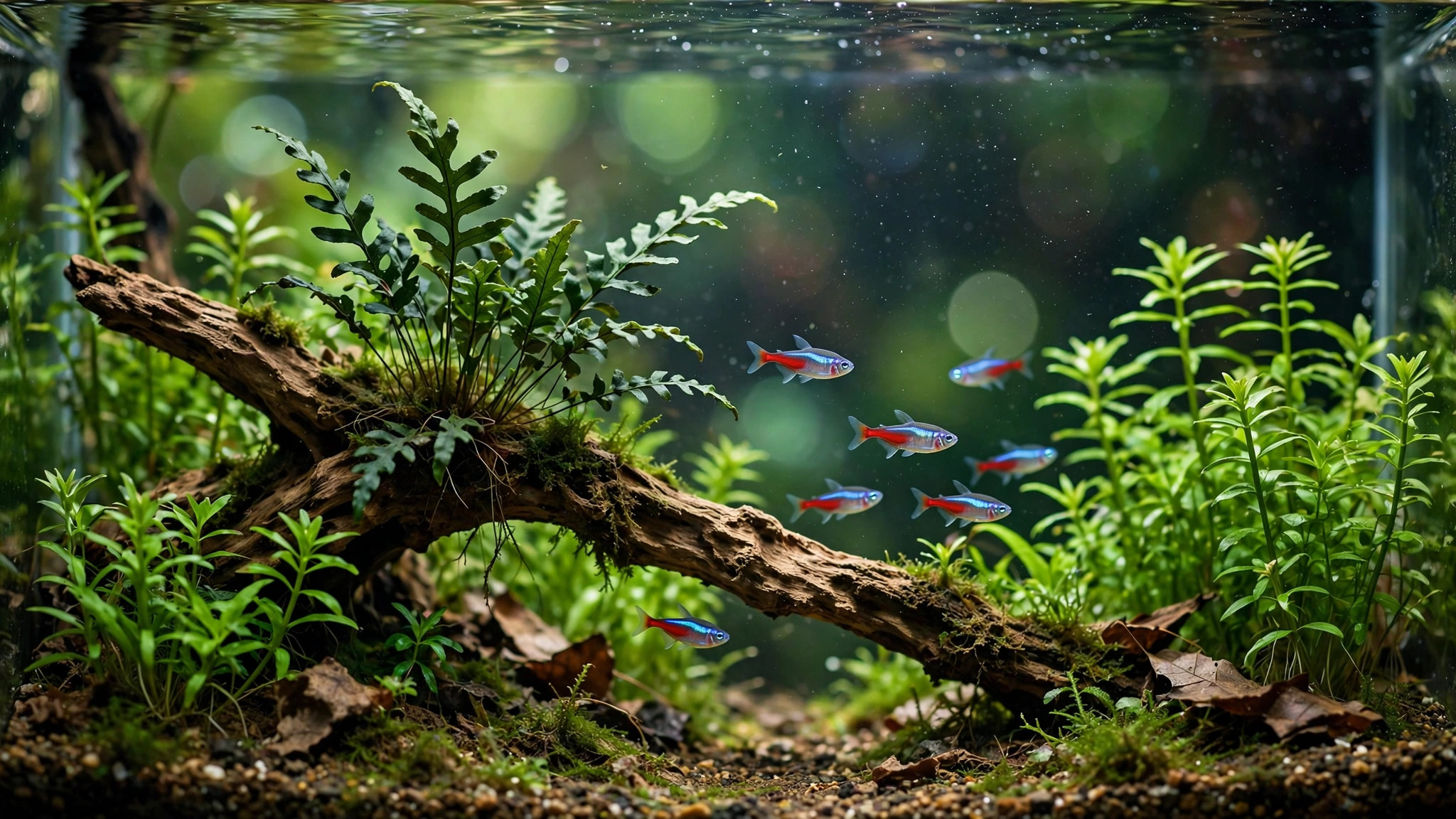
Seachem Prime and Seachem Safe dominate every water-change conversation in the planted-tank hobby. Hobbyists call Safe "dry Prime," but that nickname hides real differences — heavy metals, slime coat, dosing, and one storage rule that can quietly waste your money.
This guide settles Prime vs Safe for planted tanks: what they share, where they genuinely differ, exact dosing, and which one belongs next to your tank.
Short answer: Seachem Safe is the powdered, super-concentrated version of Prime's core formula — it removes chlorine and chloramine and detoxifies ammonia, nitrite, and nitrate. But it is not identical: no heavy-metal detoxification, no slime-coat support, no pre-mixing and storage, and tricky small-tank dosing. Choose Prime under ~75 gallons; choose Safe for large tanks and fish rooms.
What Prime and Safe Have in Common
Both are reducing agents doing two jobs in one step. First, they neutralize chlorine and break the chloramine molecule apart. Second — what separates them from plain sodium-thiosulfate dechlorinators — they bind the freed ammonia into a non-toxic form for roughly 24–48 hours. Both also detoxify nitrite and nitrate, which is why keepers reach for them during cycling and ammonia emergencies.
For planted tanks, three traits matter: both are non-acidic and will not shift pH; both are fully plant-safe; and detoxified ammonia is not locked away — Seachem's own product description notes it converts ammonia into a form "readily removed by the tank's biofilter," and plants absorb it normally once the temporary binding fades. Both smell faintly of sulfur. That is normal.
The Real Differences, Side by Side
| Feature | Seachem Prime | Seachem Safe |
|---|---|---|
| Form | Liquid concentrate | Dry powder |
| Heavy metals | Detoxified at typical tap concentrations | Not treated |
| Slime coat | Promotes natural slime coat production | No support |
| Pre-mix & store | Yes — has stabilizers | No — use immediately |
| Small-tank dosing | Easy — measured in mL | Tricky — fractions of a teaspoon |
| Best for | Tanks under ~75 gallons, shrimp, sensitive livestock | Large tanks, fish rooms, big water changes |
Tap water through older plumbing can carry trace copper and lead — Prime detoxifies them at typical concentrations, Safe does not. For shrimp keepers, that alone decides the product: Seachem Prime ★4.8.
Safe's advantage is pure concentration. Seachem's label directions for the 250 g and larger sizes are 5 g (1 tsp) per 1,625 L (450 gallons) for chlorine, per 1,250 L (300 gallons) for chloramine, and per 400 L (100 gallons) to detoxify 4 ppm ammonia — figures also quoted across long-running hobbyist dosing threads. At the chloramine rate, the 250 g jar treats roughly 60,000 gallons — against about 5,000 from a 500 mL bottle of Prime. For a fish room, that settles it. Seachem Safe ★4.7 is the smartest buy when you dose in bulk.
Affiliate disclosure: AquaVerdia participates in the Amazon Services LLC Associates Program. If you buy through the links above, we may earn a commission at no extra cost to you — it helps keep these guides free.
Dosing Math for Each
Prime: 5 mL (one capful) treats 50 gallons of new water. For smaller tanks, a 1 mL oral syringe beats the cap — a 5-gallon bucket needs only 0.5 mL. A double dose is acceptable for exceptionally high chloramine, and up to 5× normal dose may be used to detoxify nitrite in an emergency. Above 86°F (30°C) with low chlorine/ammonia, use a half dose.
Safe: 1 tsp (5 g) per 450 gallons for chlorine, per 300 gallons for chloramine, or per 100 gallons to detoxify 4 ppm ammonia. Do not overdose — excess Safe depletes dissolved oxygen; halve the dose above 86°F (30°C). The hard part is precision: a 10-gallon water change needs roughly 1/30 of a teaspoon, nearly impossible to eyeball — a milligram scale is practically mandatory for small tanks, which is the main reason Prime wins under ~75 gallons. Dose Prime into your water-change bucket the night before if you like — its stabilizers keep it working; Safe must always be mixed and used immediately.
Which One for Your Planted Tank
Choose Prime if your tank is under about 75 gallons, if you keep shrimp or invertebrates (cheap insurance against trace copper from plumbing), if you keep sensitive fish (a genuine safety net), or if you pre-mix water-change water in advance. Choose Safe for large tanks, multiple tanks, fish rooms, ponds, and high-volume quarantine systems — the concentration advantage is enormous. You can switch between the two freely with no transition — many experienced keepers run both: Prime for the display tanks, Safe for the fish room. The verdict for most planted-tank keepers: Prime, for the convenience, the heavy-metal safety net, and the forgiving dose. But if you dose in bulk, Safe treats an astonishing amount of water for the money — just weigh it, and never pre-mix it.
Two Mistakes That Hurt Fish
1. Overdosing Safe. The powder is so concentrated that an "eyeball teaspoon" can be 3–5× the correct dose — and Safe has a narrow overdose margin. Excess Safe strips dissolved oxygen, which is why Seachem's directions warn not to overdose. If you overshoot, add aeration immediately and perform a water change. Weigh every dose.
2. Pre-mixing Safe and storing it. Safe has no stabilizers, so a batch mixed days ahead degrades — mix it, use it, done.
FAQ
Is Seachem Safe just powdered Prime?
Essentially — the super-concentrated dry version of Prime's core formula, minus heavy-metal detoxification and slime-coat support, and without the stabilizers that let Prime sit in liquid form — hence the no-storage rule.
Can I switch from Prime to Safe without any transition?
Yes — just start dosing Safe per its label at your next water change.
What should I do if I overdose Safe?
Increase aeration immediately — drop in an airstone or raise your filter outflow — and perform a water change with correctly dosed water. Watch for gasping at the surface, and weigh doses from now on.
Do Prime or Safe remove nitrates from a planted tank?
Neither removes anything — they temporarily detoxify ammonia, nitrite, and nitrate (about 24–48 hours) while your biofilter and plants do the real work. Chronically high nitrates need more water changes or faster growers, not more conditioner.