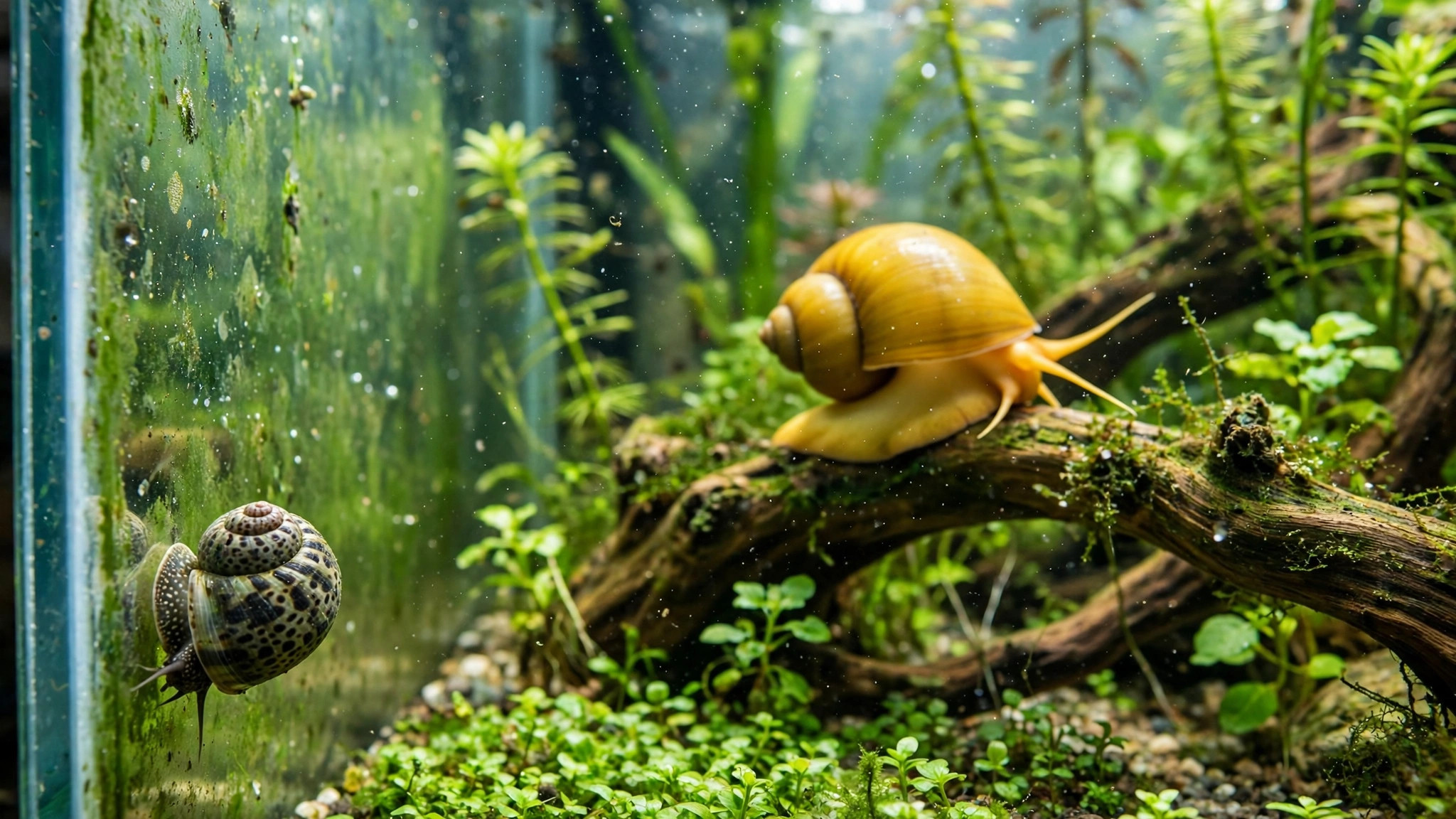
The nerite snail vs mystery snail debate splits planted-tank forums every month, yet most arguments skip the part that matters: the eggs. A nerite peppers your driftwood with sesame-white capsules that sit for months and never hatch. A mystery snail leaves a pink clutch above the waterline that can hatch dozens of babies in a few weeks. Pick wrong and your cleanup crew becomes a cleanup project.
Nerite snail vs mystery snail for planted tanks really comes down to the job you need done: maximum algae removal with zero breeding risk, or a big, colorful scavenger that also eats leftover food. Here is the side-by-side — algae cleaning, plant safety, eggs, feeding and care — so you choose the snail that fits your tank.
Direct answer: For maximum algae control with no plant damage and no breeding risk, get nerite snails — they clear diatoms, green film and green spot algae, ignore healthy plants, and their eggs cannot hatch in freshwater. For a large, colorful scavenger that also eats leftover food, get a mystery snail — but feed it, use a tight lid, and remove its pink egg clutches before they hatch.
Nerite vs Mystery Snail: Who Actually Cleans Algae Better?
If algae removal is the job, nerites win decisively. They scrape diatoms, green film algae and even green spot algae — the hard, crusty dots most cleaners ignore — off glass, hardscape and leaves. A few nerites visibly clear a filmed-over glass panel within days.
Mystery snails are opportunistic: they rasp soft algae and biofilm, but they are scavengers first, algae eaters second. One left to “live off algae” in a clean planted tank slowly starves — it needs real food several times a week, and many keepers find theirs ignores algae while waiting for its next meal.
Supplemental feeding matters more than most guides admit. A sinking, vegetable-based food like Hikari Algae Wafers ★4.5 covers a mystery snail's daily diet — and keeps a hungry snail off your soft-leaved plants. Half a wafer per snail every other day is plenty.
Will They Eat Your Plants?
Nerites are the gold standard here: they do not eat healthy live plants, full stop. They graze only algae and biofilm on leaf surfaces — and can even help slow growers like Anubias by cleaning algae off the leaves.
True mystery snails (Pomacea diffusa) are also plant-safe when fed properly, eating algae, detritus and decaying leaves — not living tissue. The risk appears only when one is chronically underfed: then it may rasp delicate plants, with fine-leaved stems and thin mosses the usual victims.
Check the ID before you buy: some shops mislabel other Pomacea species as mystery snails. True diffusa lays pink, raspberry-like clutches above the waterline; green, white or orange eggs mean a different apple snail — possibly a genuine plant eater. Compare the two in this mystery vs nerite egg guide or browse this plant-safe snail list.
Eggs and Population: The Real Deciding Factor
This is the section that matters most for long-term management. Nerites glue small, hard, sesame-white capsules to glass, rocks and driftwood. In freshwater they cannot hatch — nerite larvae need brackish or saltwater. The eggs are a cosmetic nuisance (scrape early; old ones leave marks), but there is zero population risk.
Mystery snails differ: with separate sexes, a fertilized female lays gelatinous pink clutches just above the waterline — on the lid or anything emerging from the water. Each hatches in roughly 1–4 weeks. Do not want babies? Remove clutches the moment you see them.
Feeding, Water, Lids and Everyday Care
Both build shells from calcium, so give them moderately hard water with pH at or above 7.0. Nerites are fussier: they want pH 7.0–8.2, and pitted shells in soft, acidic water are the first warning sign. Mystery snails tolerate a wider range.
A mystery snail is a heavy eater needing sinking foods several times a week, and it carries a noticeably heavier bioload — think twice in small tanks. A nerite is low-maintenance, grazing tank algae; in a spotless tank, offer a wafer or blanched vegetable slice occasionally. Note: copper-based medications kill both.
And the escape problem nobody warns about: nerites climb cords and tubing right out of the tank, so a tight-fitting, gap-free lid with tidy cable routing is non-negotiable. Mystery snails climb too but rarely commit to a full escape. Keep the waterline an inch below the rim.
Which Snail Should You Get?
Pick the nerite if algae is your main problem, your plants are delicate or expensive, you want zero breeding risk, or the tank is small.
Pick the mystery snail if you want a big, colorful, personality-filled pet that also scavenges leftovers — and you will feed it and remove egg clutches.
Pick both in a larger planted community tank with a tight lid — they occupy different niches and complement each other.
| Nerite snail | Mystery snail | |
|---|---|---|
| Best job | Algae removal | Scavenging + color |
| Eats healthy plants? | Never | Rarely (if starved) |
| Breeds in freshwater? | No | Yes — clutches hatch in 1–4 weeks |
| Escape risk | High | Low |
| Bioload | Low | Moderate–high |
| Feeding | Mostly self-sufficient | Needs regular feeding |
| Water | Harder, pH 7.0–8.2 | Wider tolerance |
Frequently Asked Questions
Can I keep nerite and mystery snails together?
Yes — they occupy different niches and are peaceful with community fish. Feed the mystery snail its own diet so it does not outcompete the nerites, and watch the bioload in smaller tanks.
How many nerite snails do I need per tank?
About one per 5 gallons handles a typical algae load; scale up for heavy algae. Do not overstock — extra nerites in an algae-free tank slowly starve.
My mystery snail has not moved in days. Is it dead?
Probably not — they rest for a day or two. Lift it out and sniff: a dead snail smells unmistakable. A tightly shut trapdoor usually means it is just sleeping.
Do snails replace water changes?
No. Snails convert algae into waste; they cut your scrubbing but never replace partial water changes and filter maintenance.