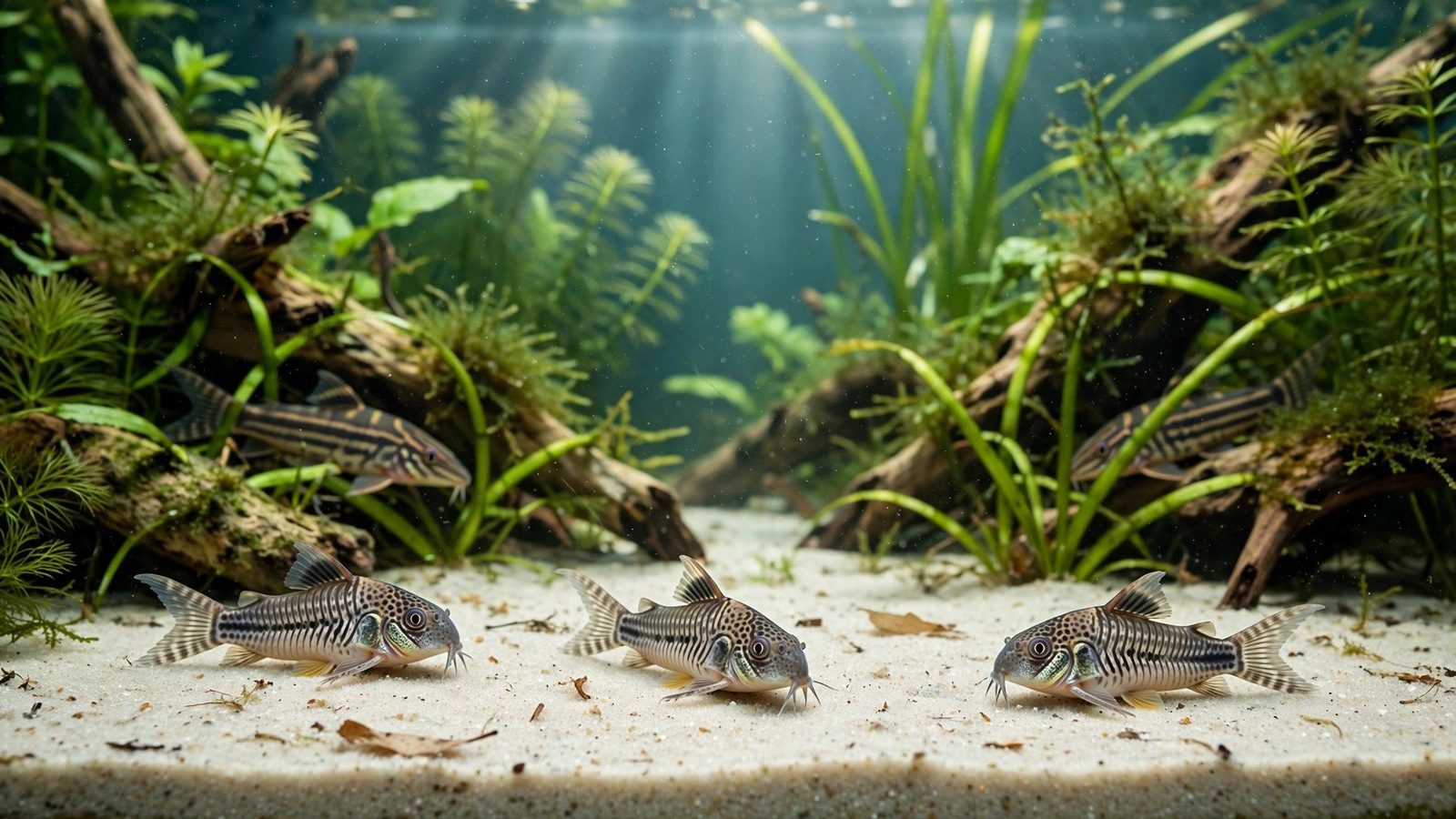
You bought a beautiful planted tank, added a cleanup crew — and never saw half of them again. That is the most common story in the kuhli loach vs corydoras debate: one puts on a daily show, the other treats your aquascape like a witness-protection program.
Both are peaceful and plant-safe. But they solve different problems — choose by what you actually want to watch, not by which one a forum calls "better."
Bottom line: Pick corydoras for visible daytime activity; pick kuhli loaches for nocturnal life in dense scapes. Keep either in groups of 6+ on soft sand — both share the same easy water parameters.
Meet the contenders
Corydoras (Corydoras spp.) are armored South American catfish from slow Amazon-basin waters. They spend their days rooting through the substrate in tight, social groups — sifting, darting to the surface for air, then gliding back down.
Kuhli loaches (Pangio kuhlii and relatives) are slender, eel-like fish from Southeast Asian streams. They burrow into soft substrate, wedge under driftwood, and generally vanish by day — emerging after lights-out to wriggle through plants. In a dense tank, a group of kuhlis can feel like a rumor.
The biggest difference: activity and visibility
Corydoras are diurnal: out in the open most of the day, shoaling along the front glass and poking through carpet plants. If your tank sits in a living room, corys give you something to watch every time you look.
Kuhli loaches are nocturnal. A group of three will hide relentlessly; six to ten get noticeably bolder, but you will still see them mainly at dawn, dusk, and after lights-out. Dimly lit, densely planted tanks make them far more visible — the plants give them security to roam. But they will never be daytime fish.
Ask yourself one question: do I want my bottom dwellers on display, or am I happy knowing they exist? Your honest answer picks your fish.
Substrate and plant safety
Both need fine sand, not sharp gravel. Corydoras sift substrate through their gills, and rough gravel wears down their barbels — the sensory "whiskers" around their mouths — inviting infection. Kuhlis have soft, scaleless skin and burrow directly in; coarse material scrapes them.
The planted-tank recipe works for both: nutrient-rich aquasoil for the plants, capped with 2–3 cm of fine silica or river sand in open foraging areas, 5–7 cm total depth. Neither species eats plants or digs up rooted ones. Fresh carpet plantings may need a few weeks to anchor before the bottom crew arrives.
Feeding and competition
Both are omnivorous scavengers, and both share the same dangerous myth: that they "clean the tank." They do not — they eat leftovers and detritus, not fish waste and not algae. Feed sinking pellets or wafers for bottom feeders daily — Hikari Algae Wafers ★4.8 are a staple sinking wafer both species take readily — plus frozen bloodworms or daphnia once or twice a week; kuhlis in particular go wild for them.
Where they differ is boldness. Corys feed aggressively and openly. Kuhlis feed mostly after dark and get outcompeted by faster fish. If you keep both, scatter food across the tank — and drop the kuhlis' share after lights-out.
Tank size and group numbers
Both species are shoalers, and group size is the single biggest welfare lever:
- Corydoras: 6+ of the same species in a 20-gallon (75-liter) tank. Larger species (bronze, sterbai) do better in 30+ gallons; pygmy corys can work in a well-planted 10-gallon.
- Kuhli loaches: 6+ (never 3 — small groups stay permanently hidden) in a 20-gallon or larger tank. More loaches means bolder loaches.
The classic beginner mistake is buying three of each "to try both." Two stressed half-groups hide, compete over food, and get sick. Pick one species and buy six to ten. Water-wise both are easy: pH 6.0–7.5, 22–28°C, with kuhlis preferring the warmer end (24–28°C) and soft, slightly acidic water.
Can you keep both together?
Yes — with space and planning. They are peaceful toward each other and share water parameters. The recipe that works: a 30-gallon or larger planted tank, full groups of each (6+ corys, 6+ kuhlis), soft sand everywhere, and food spread over a wide area so the night-shift kuhlis are not outmuscled.
Two cautions. First, avoid mixing kuhlis with pygmy corydoras — they are small and timid, and boisterous kuhli feeding sessions stress them. Second, in tanks under 30 gallons, one bottom-dwelling shoal is the better choice: two species compete for the same floor space and food.
Verdict: which should you pick?
| Corydoras | Kuhli loaches | |
|---|---|---|
| Visibility | Always out, daytime | Mostly nocturnal |
| Best for | Viewers who want daily activity | Night owls and jungle-style scapes |
| Group of 6 cost | Budget-friendly | Budget-friendly |
| Substrate | Fine sand (barbel safety) | Fine sand (skin safety) |
| Plant safety | Excellent | Excellent |
| Beginner ease | Very easy | Easy, if kept in groups of 6+ |
If you are choosing your first bottom dwellers for a planted tank, corydoras are the safer pick: you will actually see them, and they forgive beginner mistakes. Choose kuhli loaches when you specifically want nocturnal life — and commit to six or more, because three kuhlis is how tanks end up with invisible fish.
Frequently asked questions
Will corydoras or kuhli loaches eat my shrimp?
Adult cherry shrimp are generally safe with both, but neither is fully shrimplet-safe — both opportunistically eat newly hatched babies. With moss cover, enough survive to sustain the colony.
Do I need to feed them if they eat leftovers?
Yes — every day. Leftovers alone are never enough nutrition, and uneaten-food-only diets lead to thin, sick fish. Offer sinking wafers or pellets daily as their main diet.
Why are my kuhli loaches always hiding?
Almost always three things: the group is too small (fewer than six), the tank is too bright and open, or they are new. Add more kuhlis, dim the lighting with floating plants, and give them a few weeks.
Can corydoras live on gravel?
They can survive on smooth, rounded gravel, but fine sand is strongly better — gravel blocks natural sifting and risks barbel damage. With gravel and corys, add a sand foraging zone.