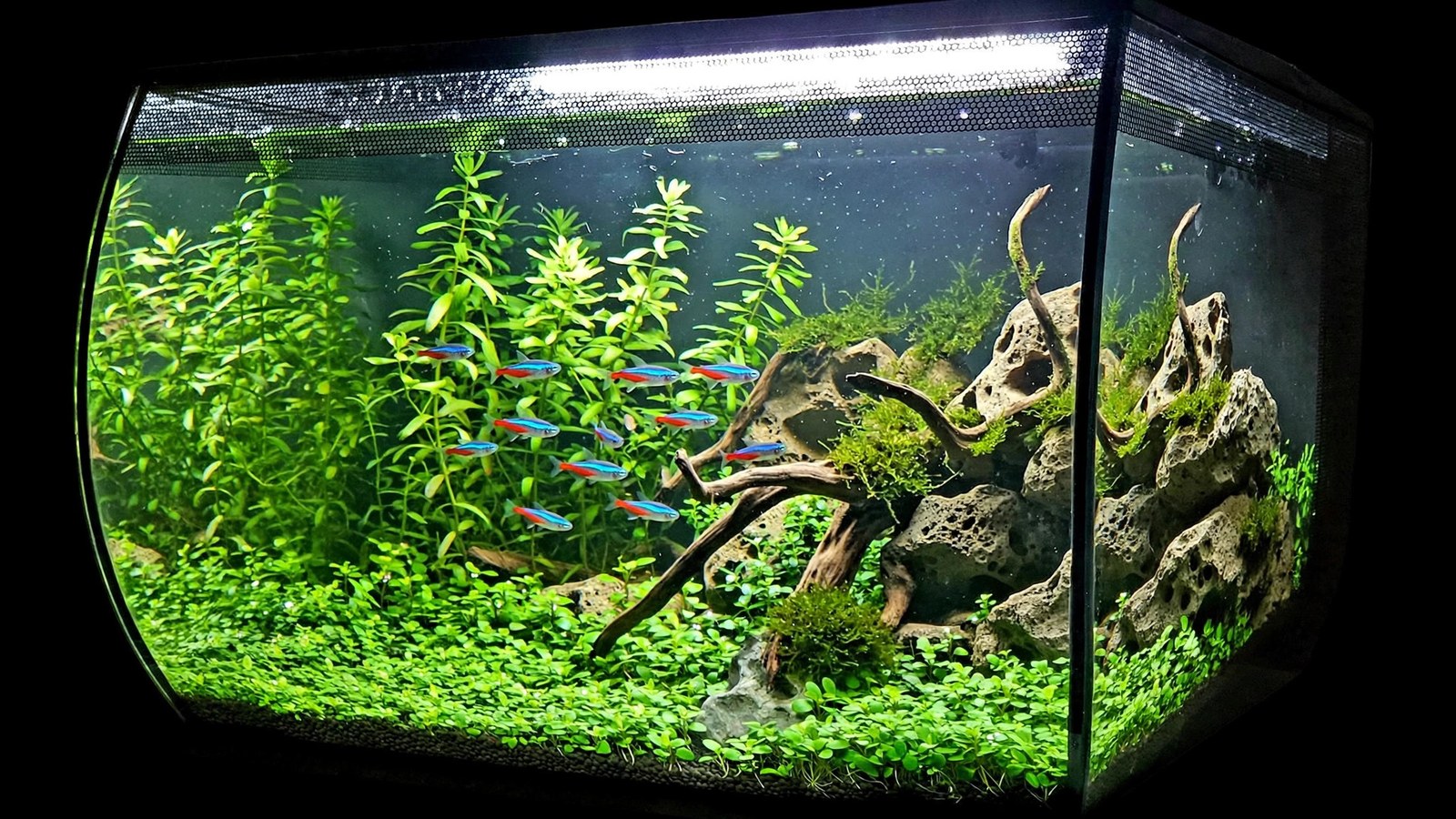
The Fluval Flex 15 sells more people on their first planted tank than almost any other all-in-one kit — curved glass, hidden filter, a light built with plants in mind. But the out-of-box setup hides planted-tank traps: the stock carbon works against your liquid fertilizer, the nozzles can blast a fresh carpet planting loose, and the LED is good, not great.
Set it up the planted-tank way instead of the fish-first way the manual suggests, and the Flex 15 becomes one of the easiest 15-gallon planted tanks to run. Here's the exact order: the tweaks, the planting plan, and a first-month routine that skips the usual algae phase.
Short answer: The Fluval Flex 15 works as a planted tank with three tweaks. Its 7,500K LED grows low- and medium-light plants like anubias, java fern, cryptocoryne, and swords, and the 132 GPH pump turns the 15 gallons over nearly 9 times per hour. Swap the stock carbon cartridge for extra biological media, use a planted substrate like Fluval Stratum, angle the dual outputs away from foreground plants, and run the light 6–8 hours daily while cycling. That gives you a stable, low-algae planted Flex 15.
What's in the Box — and What Matters for Plants
The classic Flex 15 (model 15008) is a complete freshwater kit: curved-front glass tank, lid with feed opening, 7,500K LED module, 132 GPH pump, and a hidden rear compartment pre-loaded with foam, carbon, and Biomax. The FLEXPad remote adjusts color blends and effects. Full specs are on the Fluval Flex 15 product listing. For plants, only three parts matter: the light, the pump, and the media. (Fluval has a Flex 2.0 revision with different specs; this guide covers the classic 15008.)
Three Decisions That Make or Break the Tank
1. Substrate: planted or inert? A nutrient-bearing substrate pays for itself. Fluval's own Plant and Shrimp Stratum ★4.7 is the natural fit: slightly acidic buffering, good root anchoring, months of root nutrition. One 8.8 lb bag covers a 15-gallon footprint at ~2 inches deep.
2. Filter media: ditch the carbon. Carbon removes organics and tannins — and some fertilizer trace elements. Pull the carbon insert and replace it with a second Biomax insert or extra foam.
3. A plant list matched to the stock light. Skip demanding red stems and HC Cuba — they'll melt under this light. Pick from the table below and you'll be growing, not rescuing.
Step-by-Step Setup
Quick note: some links here are Amazon affiliate links — buying through them earns a small commission at no extra cost to you.
- Rinse everything in plain water — never soap. Set the tank on a level, sturdy stand with the anti-slip pad.
- Lay substrate dry, sloping ~1.5 inches front to 3 inches back.
- Hardscape first. One strong focal piece plus a supporting stone; the curved front magnifies everything.
- Plant heavily on day one (60–70% density) — the best algae prevention there is. For heavy root feeders, push one Seachem Flourish Tab ★4.6 near each plant's roots — one per 4–6 inches of root zone, replaced every 3–4 months.
- Fill slowly over a plate so the slope and planting stay put.
- Start the filter; set the light to 6 hours. Angle one nozzle at the surface, the other along the back glass.
- Cycle 2–4 weeks until ammonia and nitrite read zero for days running. Plants in day one; fish wait — verify with a liquid test kit.
The Stock Light: What It Actually Grows
The 7,500K module (10.8 W, 2,450 lux) is low-to-medium light for this depth — enough for a lush tank with the right plants. Expect strong growth from anubias, java fern, java moss, cryptocoryne, vallisneria, bacopa, and amazon swords, all without CO2.
It won't reliably grow HC Cuba carpets or vivid red stems (they grow green and leggy). Algae in new Flex 15s is almost always a light-duration problem: start at 6 hours, add 30 minutes per week up to 8 as plants establish.
Plants That Thrive in a Flex 15
A proven planting plan for the stock light — buy tissue-culture cups where you can (pest- and algae-free).
| Plant | Placement | Light | Notes |
|---|---|---|---|
| Anubias nana 'Petite' | Foreground / hardscape | Low | Glue or tie to wood/stone — never bury the rhizome |
| Java moss | Hardscape | Low | Trim monthly or it smothers neighbors |
| Cryptocoryne wendtii | Midground | Low–med | Root tabs; may melt on arrival, then regrows |
| Java fern | Mid / background | Low | Attach to hardscape like anubias |
| Vallisneria | Background | Low–med | Runners fill the back fast — thin quarterly |
| Amazon sword | Background | Medium | Heavy root feeder; one Flourish Tab per plant |
Epiphytes on hardscape, root feeders in substrate, fast growers at the back — that's what makes a Flex 15 look intentional. See the Fluval Flex 15 aquascaping walkthrough for a clean hardscape-first layout.
The First 30 Days
Week one is patience: plants in, light at 6 hours, no fish. The brown diatom dusting around week two is normal — it burns out as silicates deplete. Don't reach for algaecide; reach for the light timer.
Start fertilizing when you see new growth (week two or three). A comprehensive liquid like Seachem Flourish ★4.7, dosed after each water change, feeds stems and epiphytes while root tabs feed substrate plants — that two-track approach is all a low-tech Flex 15 needs.
At week four, add the first fish — one species at a time, a week apart. Proven combos: 8–10 neon tetras or 6–8 chili rasboras, 6 pygmy corydoras, 10–15 cherry shrimp, 2–3 nerite snails — or a single betta with flow baffled. Targets: 74–78°F, pH 6.5–7.5, ammonia/nitrite zero, nitrate under 20 ppm.
FAQs
Can the Flex 15 grow carpeting plants?
Monte Carlo — small clumps, root tabs, patience. Hairgrass spreads slowly without CO2; HC Cuba needs CO2 and stronger light.
Do I need CO2 injection?
No — every plant above thrives without it. Consider CO2 only as a second-phase project alongside a light upgrade.
How do I reduce the pump's flow?
Aim both nozzles at the glass so current dissipates; a prefilter sponge over the intakes softens flow and keeps shrimplets out of the rear compartment.
Can I keep a betta in a planted Flex 15?
Yes — one of the better betta tanks at this size. Baffle the flow, and skip shrimp as tank mates (they become snacks); nerite snails are the safer cleanup crew.