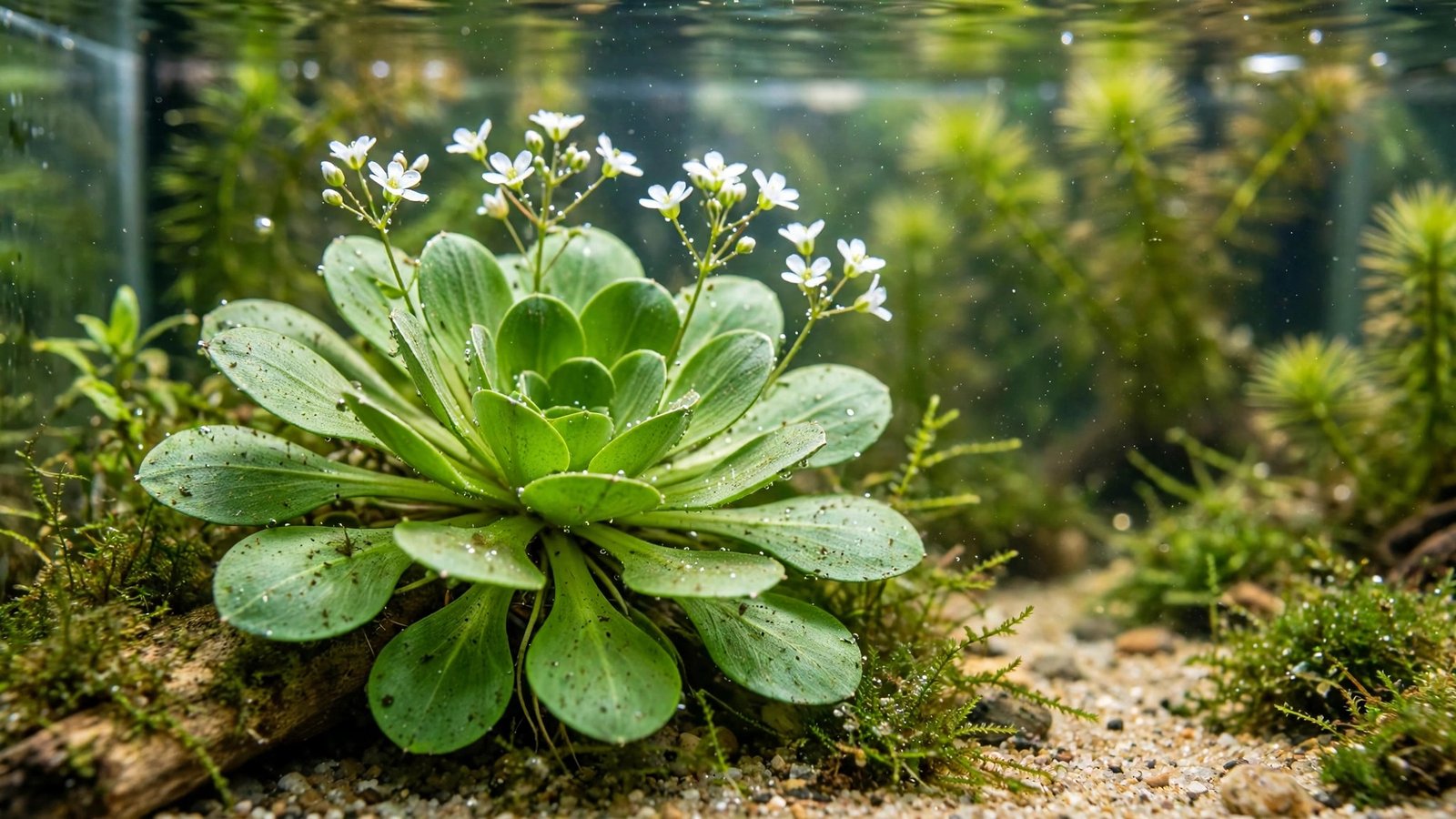
Every few years, one unassuming marsh plant sneaks out of the wetlands and into the tissue-culture catalogues, and the collectors who buy it early get to enjoy it before everyone else. Samolus parviflorus aquarium plant care is the topic almost nobody is writing about yet — odd, because the water pimpernel may be the easiest attractive midground plant you've never heard of. It behaves like a friendly weed in the tank: bright, fountain-shaped rosettes that fill midground gaps in weeks and flower if a shoot reaches the surface. By the end of this guide, you'll know which of its two forms to buy, how to plant a tissue-culture cup so nothing melts, and the five mistakes that make beginners give up on it.
What Samolus parviflorus actually looks like
Forget the dry Latin name for a second. In the wild, Samolus parviflorus is a marsh-edge perennial of the southeastern and central United States — stream banks, floodplain pools, tidal freshwater marshes — a plant that botanical floras classify as an obligate wetland species, meaning it insists on wet feet. Emersed, it grows upright stems 15–45 cm tall with glossy, spatula-shaped leaves and tiny white flowers under 6 mm wide on wiry stalks. That wetland ancestry is your first clue to why it thrives in aquariums: the submerged form is just one of its natural moods.
Underwater, the plant settles into a rosette habit. From a short central crown it pushes out arching, lance-shaped leaves 2–3 cm long in the classic green form, stacking into a fountain silhouette that reads beautifully between low carpets and taller background stems. A single rosette can reach 10–30 cm tall, which is why it belongs in the midground. The leaves have a soft, almost succulent gloss that catches light — quite different from the matte texture of most carpeting plants.
Then there is the second form: Samolus parviflorus 'Red' (sold in some catalogues as Lysimachia parvifolia). It grows shorter and tighter, with rounder, thicker leaves that flush bronze to deep red under strong light — but stay stubbornly green under medium light, which is the source of most "what went wrong?" messages about this plant.
Green form vs. red form
| Trait | Green form | Red form |
|---|---|---|
| Leaf colour | Bright, light green | Bronze to deep red in high light; green in low light |
| Leaf shape | Lanceolate, 2–3 cm | Rounder, thicker, slightly rippled |
| Height | 10–30 cm | 10–20 cm (4–8 inches) |
| Growth rate | Medium–fast | Slow–moderate |
| Minimum light | Low–medium | Medium–high |
| CO2 | Optional | Recommended (10+ ppm helps) |
| Best for | Beginners, low-tech tanks, fast fill | Colour accents, Dutch-style layouts |
Light, CO2, and nutrients: what each form demands
Here is the good news first: the green form is genuinely undemanding. It grows under low–medium light, needs no CO2 injection, and tolerates both soft and hard water — growers keep it happily from pH 5.5 to 7.5 and 10 to 30 °C. Give it roughly 30–60 µmol PAR at the substrate and a basic all-in-one liquid fertiliser, and it steadily pushes out new leaves and side shoots. Push light to 60–100 PAR with CO2 and it simply accelerates; the care routine barely changes. This is the form to buy if you want a plant that survives your learning curve.
The red form is where precision starts to matter. To pull bronze and crimson tones out of it, you need serious light — experienced growers report that reds deepen noticeably above roughly 150 µmol PAR with 7–8 hour photoperiods, and that longer lighting hours deepen colour further in a sun-tan effect (see the 2Hr Aquarist's growing guide for Samolus parviflorus Red). CO2 injection at 10+ ppm is strongly recommended: the plant survives without it, but growth thins and leaves revert to flat green. A fertiliser regime with chelated iron supports the reddest colouration, since iron-hungry red plants fade when micros run lean.
Substrate choice affects both forms. Nutrient-rich aquasoil gives the strongest root development and fastest establishment; with sand or plain gravel, bury a root tab under each planting site and refresh it every 6–8 weeks. This plant feeds from roots and leaves alike, so rich substrate plus a weekly all-in-one liquid keeps leaves full rather than thin and leggy.
Samolus rosettes are root feeders; tabs deliver nutrients directly to the crown: root tabs like Seachem Flourish Tabs.
Planting technique: how to handle the tissue-culture cup
Most hobbyists will meet Samolus parviflorus as a sealed tissue-culture cup — pest-free, snail-free, and sterile. That sterility is wonderful, but the contents are emersed-grown plantlets that must transition to submerged life, and your handling decides whether the first two weeks bring steady growth or a sad melt. The single most important step is the one people skip: split the cup into individual plantlets, aiming for 10–15 pieces from one standard cup.
- Rinse the gel off completely. Tip the cup out, rinse under room-temperature tap water, and gently tease the plantlets apart. Leftover nutrient gel rots in the substrate and fuels algae.
- Trim the roots lightly. Snip roots to about 1–2 cm — this encourages fresh submerged root growth, and short roots are far easier to anchor.
- Plant with tweezers, 2–3 cm apart. Push each plantlet down until the crown sits just at the substrate surface — not buried, not floating. Crowns buried deeper than 1 cm rot from the center out.
- Don't shade them. Give new plantlets clear overhead light — a TC plantlet under hardscape shadow will stall for weeks.
- Hold parameters steady for 2 weeks. Emersed leaves may look soft for a few days; new glossier, slightly narrower submerged leaves from the crown are your sign of success, usually by day 10–14.
If you buy potted stock instead, the process is simpler: remove the rockwool, split the pot into 3–4 portions, and plant the same way. Potted plants sit closer to submerged form, so transition melt is usually lighter — but they carry hitchhiker risk, which is why many hobbyists prefer the cup.
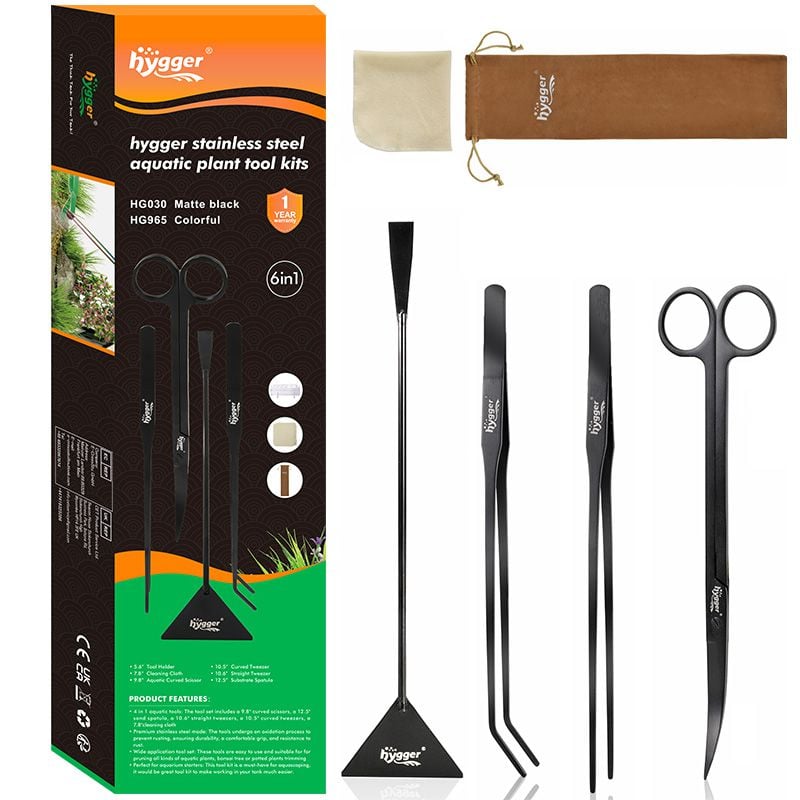
Fine tweezers place tiny TC plantlets without crushing stems: long aquascaping tweezers.
 ★4.6
hygger 6-in-1 Long Aquarium Aquascaping Tools Kit
Check Price on Amazon ★4.6Water parameters and tank conditions
Samolus parviflorus genuinely shrugs at water chemistry — the green form grows in soft, acidic blackwater and hard, alkaline tap water alike. Stability matters more than magic numbers: sudden swings during the first fortnight after planting cause more melt than any single "wrong" parameter.
| Parameter | Green form | Red form |
|---|---|---|
| Temperature | 10–30 °C (hardy) | 20–28 °C (72–82 °F) |
| pH | 5.5–7.5 | 6.0–7.5 |
| Hardness | Soft to hard | Soft to medium-hard |
| Light (PAR) | 30–60+ µmol | 100–150+ µmol for reds |
| Photoperiod | 6–8 hours | 7–8 hours |
| CO2 | Optional | Recommended, 10+ ppm |
| Water changes | 30% weekly | 30% weekly |
Propagation: side shoots, runners, and divisions
Propagation is where Samolus quietly pays you back. The green form produces side shoots from the base of mature rosettes — tiny daughter crowns that root into the substrate on their own. Once a shoot has 4–6 leaves (usually 3–4 weeks after it appears), pinch it free with tweezers and replant it wherever the scape needs filling. One healthy parent feeds you a new plantlet every 2–3 weeks, so a single cup becomes a whole midground border within two months.
The red form propagates the same way, just more slowly, and adds a stem-plant trick: when a mature plant develops visible internodes on a vertical stem, you can cut the top and replant it like a stem cutting — the base branches, and the cutting roots in 7–10 days under good light. Division works too: lift a mature clump, split it into 2–3 pieces with roots attached, and replant the same day.
Aquascaping uses: where the water pimpernel shines
Samolus earns its place as a midground fountain accent. The arching rosette habit gives you a soft, dome-shaped bush that contrasts with both flat carpets and vertical background stems. In a nature-style scape, use it the way you would Blyxa japonica — a fountain texture between a Lilaeopsis or Dwarf Sagittaria foreground and the background stems — but with brighter, glossier leaves that read as a highlight in the composition.
In Dutch-style layouts, the red form becomes a midground "street" plant, planted in a deliberate row that leads the eye toward the focal point. Its red is softer than Alternanthera's, which makes it easier to live with — and because it grows slowly, the street holds its shape between trims far longer than fast red stems. Pair it with Proserpinaca palustris 'Cuba' — another North American native with red potential — for a collectors' red-zone that sparks conversation.
Three more placements worth trying: nano tanks, where the red form's compact 10–20 cm size fits 20–40 litre scapes; biotope tanks, where the genuine North American origin adds authenticity to southeastern US stream or wetland themes; and transition zones in paludarium-style setups, where the plant grows half in and half out of the water.
Emersed growth, flowering, and paludarium use
Let a Samolus shoot reach the water's surface and something delightful happens: it keeps going. The stem pierces the surface, stiffens, and transitions to emersed growth — and then, if conditions are bright and humid, it flowers. The blooms are small, white, and clustered, like the wild plant's racemes, and they are genuinely pretty in a delicate way few aquarium plants offer. In the wild this species lives half-drowned in marshes, so surfacing is its natural life stage, not a stress response.
That makes it a strong candidate for paludariums and wabi-kusa: grow it with the root zone half-submerged and the crown in humid air above 70% humidity, and it forms an upright, bushy marginal plant that flowers for months. Terrarium growers report it is as easy emersed as submerged — you can keep a mother plant in a jar on a windowsill and harvest divisions for the tank. Note that emersed leaves grow green regardless of light, so the red form's underwater colouration won't carry over.
Common mistakes (and the easy fixes)
Mistake 1: planting the whole TC cup as one clump. Twenty plantlets jammed together rot in the middle from zero water flow. Split them — always.
Mistake 2: burying the crown. The rosette's growing point must sit at the substrate surface. If you push it 2 cm deep "to anchor it," the center melts within a week. Shallow tweezers work, patience, and a root tab nearby beat deep burial.
Mistake 3: expecting red-form colour in a low-tech tank. The red form survives without CO2 and under medium light — and survives as a green plant, which is exactly what disappoints people. Buy the green form for low-tech tanks and save the red form for your high-tech setup.
Mistake 4: moving it every week. Samolus hates being uprooted repeatedly during establishment — each move resets the root clock, and the red form in particular stalls when fussed over. Plant it, leave it for a month, then judge.
Mistake 5: trimming like a stem plant. The green form responds to crown-level division, not to being hacked mid-leaf: shearing a rosette leaves cut leaf stubs that invite algae. If a rosette gets too tall, split off side shoots and remove the mother crown. Position it once, as our dwarf sagittaria care guide explains.
Frequently Asked Questions
Why is my Samolus parviflorus 'Red' still green?
Almost always light and patience. The red form needs 100–150+ µmol PAR and several weeks to build red pigments — tissue-culture stock ships green and takes 3–4 weeks to colour up. CO2 injection and iron-rich fertilising help significantly. If your tank runs medium light without CO2, accept green growth or buy the green form instead.
Can it grow without CO2 injection?
Yes — the green form grows perfectly well in low-tech tanks and many growers consider it one of the easiest tissue-culture plants available. The red form also survives without CO2, but its leaves stay thinner and greener, so you lose the whole reason for buying it. For CO2-free colour, look at other species instead of fighting this one's nature.
How fast will one cup spread?
Expect visible new submerged leaves within 2–3 weeks of planting. The green form then produces a harvestable side shoot every 2–3 weeks per mature rosette, so a single cup of 10–15 plantlets can fill a 30 cm midground drift in roughly 6–8 weeks. The red form runs about half that pace — plan on 10–12 weeks for the same coverage.
Will it flower in my aquarium?
Yes, if you let it. When a shoot reaches the surface, it transitions to emersed growth and can produce clusters of tiny white flowers — the same blooms the wild plant makes in marshes. Leave one shoot untrimmed, or grow a spare in an open-top setup, and you will likely see flowers within a couple of months.
Is Samolus parviflorus safe for shrimp and snails?
Completely. It is non-toxic to shrimp, snails, and fish, and its broad leaves make good grazing surfaces for cherry shrimp and otocinclus. Tissue-culture cups are the safest buy for a shrimp tank since they arrive free of pests, snail eggs, and pesticide residues that sometimes hitchhike on potted nursery stock.
The bottom line
Samolus parviflorus is that rare thing: a tissue-culture plant as easy as the label implies — at least in its green form. Buy the green one for a fast, forgiving midground fountain in any tank. Buy the red one only if you can give it real light, CO2, and a month of patience. Either way, split the cup, plant the crown shallow, and leave it alone — the water pimpernel does its best work when you stop fussing over it.