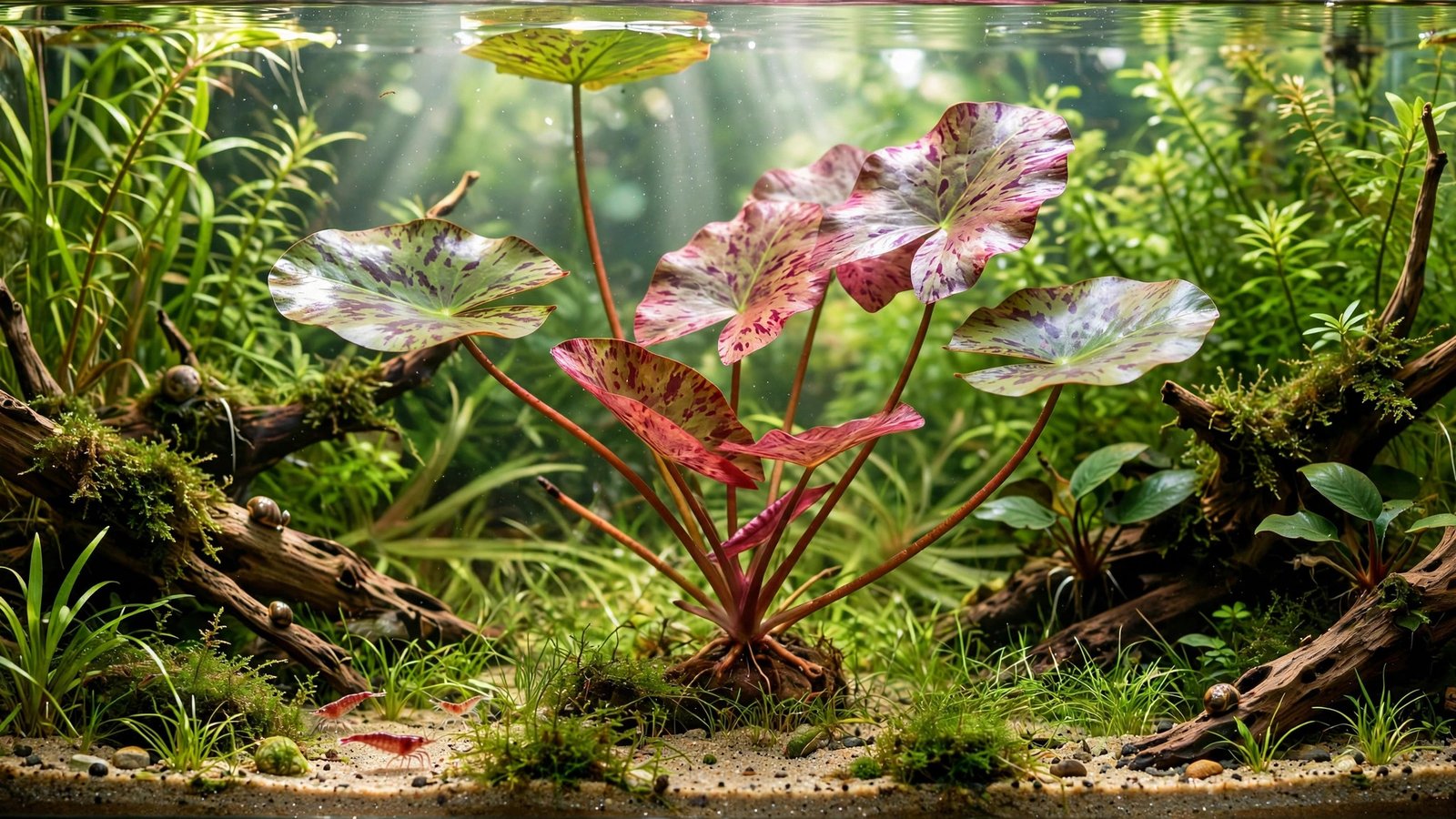
That bag of "tiger lotus" bulbs could grow into any one of three different plants — and only one is the true species in this guide. Nymphaea lotus care starts with the name: this is tiger lotus proper, the Nile-basin water lily with broad, purple-speckled leaves in green-to-red. Like other bulb aquarium plants, it ships dormant — and it is easier than it looks: medium–high light, a root tab, and a monthly prune grow a 25–30 cm centerpiece.
But first, the ID check the trade rarely gives you. True tiger lotus (Nymphaea lotus, sometimes "white tiger lotus") is the subject here. The deep red, burgundy-leaved bulb sold most often is a different species entirely — Nymphaea zenkeri, covered in our red tiger lotus care guide (Nymphaea zenkeri). And the small, star-flowered "lotus" in nano-tank kits is the dwarf aquarium lily (Nymphaea stellata) care guide. Check the species name on your bulb's label before planting.
The short answer: How do you care for Nymphaea lotus? Half-bury the bulb in nutrient-rich substrate at 22–28 °C, give it medium–high light (30–50 PAR at the substrate), feed one root tab every 6–8 weeks, and snip off any leaf that reaches the surface to keep growth submersed. A healthy bulb spreads 25–30 cm across with broad, arrow-marked leaves in green or red. If it dies back to the bare bulb, don't discard it — dormant N. lotus bulbs commonly rest 4–8 weeks before resprouting.
Nymphaea Lotus Care: Planting the Bulb Right
A tiger lotus arrives as a hard, dormant bulb — no leaves, no roots. This Nile and tropical African native is catalogued by Kew's Plants of the World Online as native to Egypt and tropical Africa, where it grows in sheltered, nutrient-rich shallows. Give it the same in your tank: aquasoil or sand over a fertilized base, with room to anchor.
Push the bulb in until half sits buried and press one root tab 5–8 cm away — fully buried bulbs rot more often than they sprout. If you spot a sprout point, face it up; if not, don't fuss. Leaves appear within 1–3 weeks in warm water. Renew the root tab every 6–8 weeks: like the other heavy feeders in our freshwater aquarium plants guide, it shows hunger as smaller, paler new leaves.
Which Lotus Did You Buy? The Three-Way ID
The trade has mixed these labels for decades, and the differences change how the plant behaves. Red tiger lotus (N. zenkeri) holds burgundy color in moderate light and stays compact; dwarf aquarium lily (N. stellata) is smaller with star-shaped flowers. True N. lotus is the variable one — arrowhead-spotted young leaves, rounder at maturity — and it runs toward the surface fastest in low light.
| Feature | Nymphaea lotus (this guide) | N. zenkeri (red tiger lotus) | N. stellata (dwarf aquarium lily) |
|---|---|---|---|
| Trade name | Tiger lotus / white tiger lotus | Red tiger lotus | Dwarf aquarium lily |
| Leaf color | Green to red, purple-spotted | Deep red to burgundy, unspotted | Olive green, often ruffled |
| Leaf spread | 25–30 cm | 20–25 cm | 15–20 cm |
| Surface-leaf habit | Aggressive in low light | Moderate | Frequent flower spikes |
| Dormancy | Common; don't discard the bulb | Occasional | Rare indoors |
Red and green variants sold as tiger lotus are both N. lotus — the red form is simply more common in the trade. Color alone doesn't prove the species; leaf size, spotting, and behavior together tell the story.
Light, Feeding, and Water Conditions
Light is the control dial. At 30–50 PAR at the substrate (a typical medium–high LED on a 45 cm deep tank), tiger lotus keeps its submersed form: short petioles, broad spotted leaves hugging the bulb. Drop below ~20 PAR and the same plant rockets long stalks to the surface, shading everything beneath. Want leaves instead of floating pads? Add light before you blame the bulb.
Feed from the roots, not the water column: one root tab within 5–8 cm of the bulb, renewed every 6–8 weeks, covers its appetite. Like the Amazon sword, another legendary root feeder, it shows hunger as smaller, paler new leaves. Keep water at 22–28 °C, pH 6.0–7.5, with gentle flow; strong current tears the broad leaves. CO2 is optional: injected tanks grow it noticeably faster, but it thrives without it in aquarium plants for fish tanks kept at community pace.
 ★4.6
NICREW ClassicLED Plus planted aquarium light
Check Price on Amazon ★4.6Pruning: Keeping the Lotus Underwater
Surface leaves are the plant's default ambition; your scissors are the counter-argument. Inspect the rosette weekly: any stalk outpacing the rest is heading up. Follow it down to the bulb and snip at the base — never tear. Removing a would-be floating leaf redirects energy into submersed leaves. Skip pruning for a month and a pad reaches the surface, shades the rosette, and the plant decides the water column is home — then you're fighting habit, not growth.
Trim outer leaves as they yellow inward — decay only feeds algae. A healthy rosette holds 6–12 active leaves; thin the oldest past 15. In a fed, well-lit tank, pruned leaves regrow within days — prune boldly, not timidly.
Dormancy and Daughter-Bulb Propagation
Every keeper meets this moment: leaves yellow and melt away, leaving a bare bulb in the substrate. It almost certainly isn't dead. Like Aponogeton crispus, another bulb plant that rests after heavy growth — N. lotus periodically pauses for 4–8 weeks. Leave the bulb in place, stop the root tabs, keep the water stable. Usually a pale green shoot appears within weeks.
Dormancy often ends with a bonus: the mother bulb splits into daughter bulbs. Lift the cluster gently during the rest, twist the daughters free once each has its own growing point, and replant them half-buried at least 15 cm apart. This is how one bulb becomes a tankful over a year — simply don't throw it away. Flowering is possible in open-top setups (the white nocturnal flowers are the "white lotus" of its trade name), but daughter bulbs are the reliable indoor method.
Frequently Asked Questions
Is tiger lotus the same as red tiger lotus?
No — different species. Tiger lotus is Nymphaea lotus, with green-to-red, purple-spotted leaves reaching a 25–30 cm spread. Red tiger lotus is Nymphaea zenkeri, with deep burgundy, unspotted leaves and a more compact habit. Check the species name before buying; N. zenkeri holds its red color in lower light.
My tiger lotus melted to a bare bulb. Is it dead?
Almost certainly not. N. lotus routinely drops all its leaves and rests as a dormant bulb for 4–8 weeks. Leave the bulb half-buried, pause the root tabs, and keep the water stable — a firm bulb will resprout, and often splits into daughter bulbs during the rest. Only discard a bulb gone soft and mushy throughout.
How do I stop it growing leaves across the surface?
Raise light to 30–50 PAR at the substrate and prune weekly: follow any fast-rising stalk to the bulb and cut it at the base. The plant redirects energy into submersed leaves. One floating pad shades the rosette and trains the plant upward, so remove surface candidates before they arrive.
Red or green variant — which is easier to keep?
Same species (N. lotus), identical care. The red variant is more common in the trade and keeps color best in medium–high light; the green form shows the purple spotting most vividly. Pick whichever suits your scape — neither is hardier.
A Centerpiece Worth the Name
True tiger lotus rewards two things: the identity on the label and the discipline of the scissors. Half-bury the bulb, feed the roots, keep light strong and surface leaves trimmed. When it vanishes for two months, smile — it's just resting.