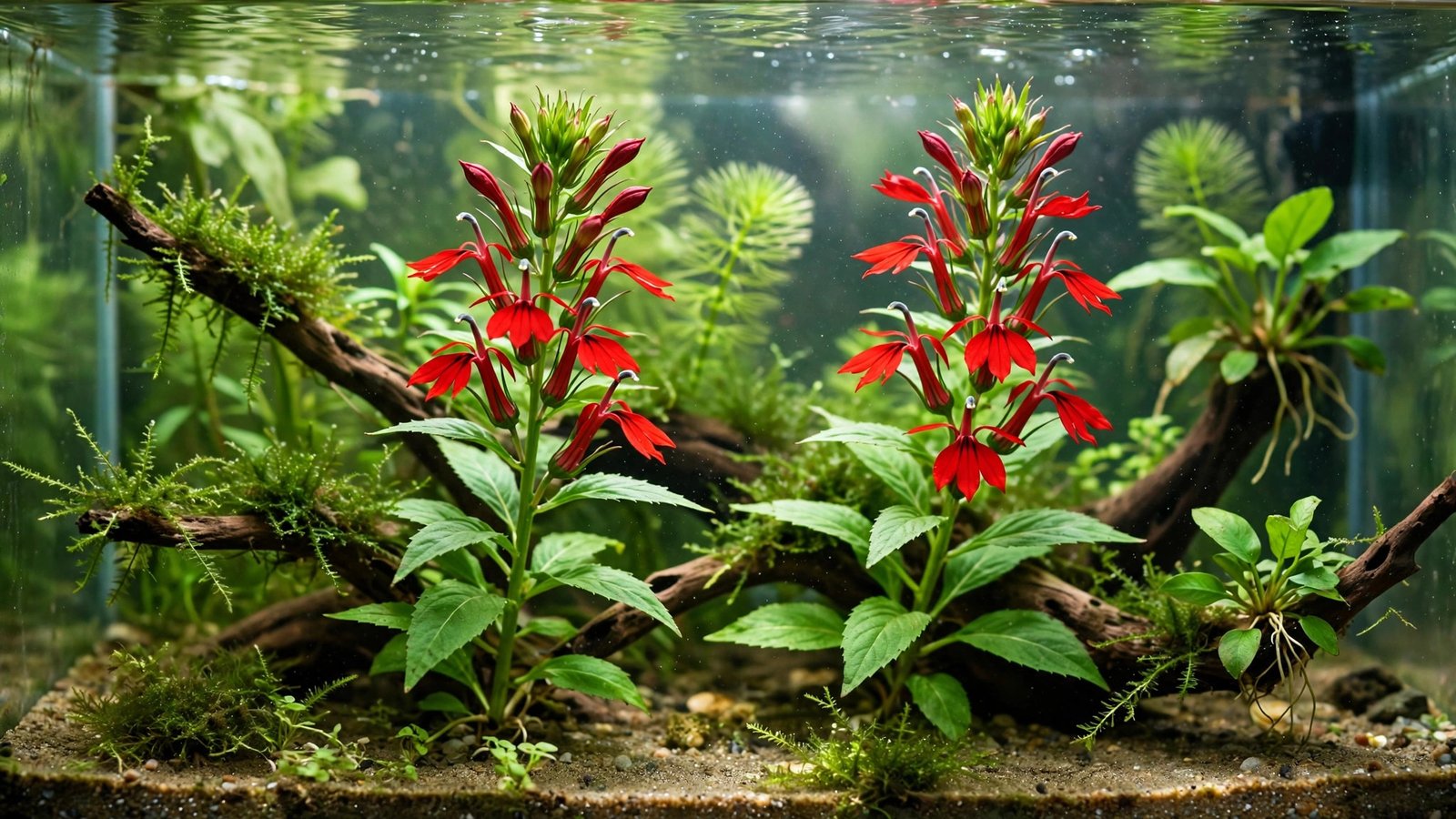
If you want a splash of warm color in your tank without investing in pressurized CO2, lobelia cardinalis aquarium care is worth learning inside and out. Known in the hobby as the cardinal plant, this North American native is one of the few foliage plants that can turn a genuinely attractive bronze-purple under good light alone — no CO2 injection required. It is not, however, a shortcut to a fire-engine-red aquascape, and any guide that promises that is setting you up for disappointment. This guide gives you the honest version: what cardinal plant does well in a low-tech setup, where its color limits really are, and how it compares to the CO2-hungry reds it is often sold next to.
What Is Lobelia Cardinalis?
Lobelia cardinalis is a stem plant in the bellflower family (Campanulaceae) that grows wild in the wetlands, stream banks, and marshy margins of eastern and central North America. In nature it is amphibious: emersed plants grow upright to several feet and produce the scarlet, hummingbird-pollinated flower spikes that gave the species its common name, the cardinal flower.
In aquariums, submersed lobelia cardinalis behaves quite differently. It grows more compact, with rounded to slightly elongated leaves arranged in opposite pairs along a fleshy stem, typically reaching 10–30 cm tall and 5–10 cm wide in the submerged form. Under strong light the upper leaf surfaces develop a bronze, copper, or purple-brown tone while the undersides stay purplish — a coloration that reads as genuinely "reddish" in a tank full of green. Under weak light the same plant turns plain light green and stretches upward, which is why beginners sometimes fail to recognize it in their own tanks.
One important clarification: this is not the dwarf "Lobelia cardinalis 'Mini'" cultivar you will also see in shops. The mini form stays much smaller and is typically used as a foreground or midground plant, while the standard form is a midground-to-background stem plant. Everything in this guide refers to the standard form unless stated otherwise.
The Honest Answer About Red Color
Let us set expectations before you buy the plant, because this is where most beginners go wrong. Lobelia cardinalis will not turn candy-apple red in a low-tech tank. No amount of iron dosing or wishful thinking changes that. What it does deliver is a rich bronze-purple under medium to high light, which is more color than nearly any other foliage plant can manage without CO2 — and that bronze looks superb when it is contrasted against bright green neighbors.
The reason is biology, not effort. In true high-tech reds such as Alternanthera reineckii care demands — intense light, injected CO2, and lean nitrate — the vivid reds come from pigments the plant produces under stressful, high-energy conditions. Lobelia cardinalis produces its purple-bronze tones as part of its ordinary submerged growth habit once light is adequate. It is a structural color shift, not a stress response, so it happens reliably and does not melt away the moment your dosing slips.
Practically speaking: under medium light you get olive-bronze tops, and under high light with a long photoperiod you get the deeper purple-brown that makes the plant famous in Dutch-style layouts. If you later add CO2, the color deepens further and growth accelerates — but the plant never depends on it. That is the real selling point, and it is the reason lobelia cardinalis keeps its place in low-tech aquascaping long after flashier reds have melted.
Light Requirements for Lobelia Cardinalis Aquarium Care
Light is the single biggest lever on this plant. Treat medium light as the entry point — roughly 0.5 watts per liter with fluorescent tubes, or 30–50 PAR at the substrate with LEDs. At low light levels lobelia cardinalis survives but grows leggy: long internodes, small pale-green leaves, and a straggly appearance that tempts people to throw it out.
Dialing in the right light
- Medium light (8–9 hour photoperiod): compact olive-green to bronze growth, slow and steady — ideal for low-tech tanks.
- High light (9–10 hour photoperiod): the deepest bronze-purple tones, tighter internodes, and faster side-shoot production.
- Consistency matters more than peak intensity: a steady medium light beats an erratic high one, especially for algae control.
Because it is a stem plant that grows toward the light, placement matters: put it in the midground or background where it gets unobstructed light, not tucked under a hardscape shaded by Anubias. In open-top tanks some hobbyists let stems grow emersed, where the leaves regain their dark green and purple undersides and the plant may even produce its signature scarlet flower spikes — a striking bonus.
Light drives the bronze-purple color: a quality light like the NICREW ClassicLED Plus.
 ★4.6
NICREW ClassicLED Plus planted aquarium light
Check Price on Amazon ★4.6CO2, Fertilizer, and Water Parameters
Here is the part low-tech keepers care about most: lobelia cardinalis genuinely grows without injected CO2. It benefits from liquid carbon supplements and from CO2 if you have it, but it will not stall or melt in its absence the way demanding reds do.
Water parameters
- Temperature: 18–26°C (64–79°F); avoids hot water above 28°C.
- pH: 6.0–7.5, adaptable to most tap water.
- GH/KH: soft to moderately hard water is fine; it is not fussy.
Fertilization
This plant feeds from both the water column and its roots. In a nutrient-rich substrate like aquasoil, a light weekly all-in-one liquid fertilizer is usually enough. In inert sand or gravel, root tabs placed near the base make a visible difference — the same approach used for other heavy root feeders such as Amazon sword care routines recommend. Iron supplementation helps deepen the purple underside coloration, but do not megadose iron expecting redder leaves; the effect is subtle and excess iron feeds algae faster than it colors leaves.
One nutrient worth watching is potassium. Lobelia cardinalis is one of the plants that shows potassium deficiency early, with pinholes appearing on older leaves. If you see that pattern, a potassium-focused adjustment to your dosing usually clears it up within a couple of weeks of new growth.
Honest low-tech red still needs basic nutrients: Seachem Flourish as the basic nutrient source.
Planting and Propagation
Cardinal plant arrives either as a potted nursery plant grown emersed or as tissue-culture cups. Either way, rinse off the rockwool or gel, separate the stems, and plant each stem individually about 2–3 cm apart, burying the bottom 2–3 cm in the substrate. Expect the emersed leaves to shed over the first week or two as submerged leaves grow in — this is normal transition behavior, not melting, and the plant is fine as long as the stems stay firm and the growing tips look healthy.
Propagation is straightforward stem-plant arithmetic. Once stems reach the surface, snip the top 10–15 cm and replant the cuttings; the rooted base will respond by pushing out side shoots from the leaf nodes. Because it is a naturally bushy grower, repeated topping produces a dense cluster that the Dutch aquascaping tradition uses in tidy rows called "plant streets" — one of the classic uses of this species. A single healthy stem can become a respectable bush within two months in a well-lit tank.
Trimming and Maintenance
Growth is slow to medium without CO2 — typically a few centimeters per month — so trimming is a monthly job rather than a weekly one. When stems get tall and shading becomes an issue, top them and replant the cuttings beside or in front of the parent group to thicken the stand. Remove any leaves that develop algae or begin to yellow; lobelia cardinalis does not shed old leaves as gracefully as some stem plants, and decaying foliage in a dense stand can trap detritus.
Replanting the tops while keeping the rooted bases is a judgment call. The bases will keep growing, but over several months they get woody at the bottom and produce smaller, leggier new shoots. Most aquascapers replant fresh tops every few months and compost the oldest bases — the same renewal cycle used for other upright stem plants like Bacopa caroliniana care routines follow.
Common Problems and How to Fix Them
| Symptom | Likely cause | Fix |
|---|---|---|
| Leggy stems, pale green leaves | Insufficient light | Increase intensity or photoperiod; move to an unshaded spot |
| Pinholes in older leaves | Potassium deficiency | Add potassium via all-in-one fertilizer |
| Lower leaves melting after planting | Emersed-to-submerged transition | Normal; keep stems planted, remove dead leaves |
| Stunted, twisted new growth | Calcium or CO2 limitation | Check GH; consider liquid carbon |
| Algae on leaves | Excess light vs. slow growth | Shorten photoperiod; add fast growers nearby |
The transition melt deserves emphasis because it panics beginners. Nursery plants are grown emersed (out of water) in humid conditions, and their air-adapted leaves cannot function underwater. Shedding them and growing new submerged foliage is the plant doing exactly what it should. Give it two to three weeks before judging it.
Lobelia Cardinalis vs. High-Tech Reds
To put the color question in perspective, here is how the cardinal plant stacks up against the classic CO2-dependent reds it competes with for a spot in your tank:
| Plant | CO2 needed? | Redness without CO2 | Difficulty |
|---|---|---|---|
| Lobelia cardinalis | No | Bronze-purple under good light | Easy–medium |
| Alternanthera reineckii | Strongly recommended | Stays green or melts | Medium–hard |
| Rotala and Ludwigia reds | Recommended for true red | Olive or pinkish at best | Medium |
This is the trade nobody should make blindly: Alternanthera reineckii gives you genuinely crimson foliage, but only if you commit to injected CO2, strong light, and disciplined fertilization — and it punishes lapses with melting. Lobelia cardinalis asks for far less and delivers a bronze-purple that, while not true red, is reliable. For a low-tech tank the choice is obvious; for a high-tech tank you can happily grow both, using the cardinal plant's bronze as a bridge tone between green midground plants and your true reds.
If you want to explore more beginner-friendly color options, our roundup of red aquarium plants for beginners covers the full low-tech palette, from this plant's bronze to hardier red-tinted species.
Aquascaping With Cardinal Plant
In a layout, lobelia cardinalis shines as a midground accent. Its upright, rounded-leaf form contrasts beautifully with fine-leaved stem plants like Cabomba caroliniana, and its bronze tone sits naturally between deep greens and true reds. The classic Dutch approach plants it in rows or blocks, trimmed to a uniform height so the purple undersides catch the light as a cohesive band.
Good tankmates include slow growers that will not outcompete it: pair it with Cryptocoryne species in the foreground-to-midground transition for a texture contrast, or place it behind an Anubias-covered hardscape element so its warm tones show against the dark wood or stone. Because it grows slowly without CO2, keep it away from aggressive fast growers that will shade it out within weeks.
Frequently Asked Questions
Does lobelia cardinalis really not need CO2?
Correct — it is one of the most CO2-tolerant stem plants in the hobby and grows perfectly well in low-tech setups. Injected CO2 will speed up growth and deepen the bronze-purple coloration, and liquid carbon supplements give a modest boost, but neither is required. This is the plant's defining advantage over true reds like Alternanthera reineckii, which stall or melt without supplemental carbon. If your tank runs without CO2, cardinal plant is one of the safest warm-colored choices you can make.
How red does it actually get?
Honestly: not truly red. Under high light it develops a rich bronze to purple-brown on the upper leaves with purple undersides, which reads as warm and colorful next to green plants but will never match the crimson of CO2-driven species. Under medium light expect olive-bronze; under low light it stays plain green and grows leggy. Buy it for reliable bronze-purple, not for red — and you will never be disappointed.
Why are my lobelia cardinalis leaves melting after planting?
Almost certainly the emersed-to-submerged transition. Shop plants are grown in humid air, and their air-adapted leaves die off underwater while new submerged leaves grow in. This takes one to three weeks. Keep the stems planted, trim away mushy leaves, and judge the plant by its growing tips: if they are firm and producing new foliage, everything is on track. True rotting — soft, foul-smelling stems — is a different problem, usually caused by planting damaged stems or burying them too deep.
How fast does cardinal plant grow?
Slow to medium. In a low-tech tank expect a few centimeters of growth per month; with CO2 and strong light it grows noticeably faster and bushes out with side shoots. This slow pace is actually an advantage for beginners: trimming is a monthly task rather than a weekly chore, and the plant rarely needs emergency maintenance. Plan your aquascape knowing it will fill in over two to three months rather than two to three weeks.
Can lobelia cardinalis grow emersed or flower in my tank?
Yes — it is amphibious by nature. In an open-top tank, stems that reach the surface will continue growing into the air, where the leaves regain their dark green color with purple undersides. Given enough time and light, emersed stems can produce the scarlet flower spikes the species is famous for in the wild, which are a genuine showpiece. You can also grow it in a paludarium or even a garden pond in warm climates, as the species' natural history confirms it thrives in wet margins.
Is lobelia cardinalis good for beginners?
Yes, with one caveat: beginners need medium light to get the attractive bronze form. In a dim tank it survives but looks underwhelming, which is the most common beginner complaint. Give it decent light, a modest fertilization routine, and patience through the transition period, and it is one of the most forgiving warm-colored plants available. For authoritative cultivation notes, Tropica's plant database and the USDA plant guide for Lobelia cardinalis both confirm its undemanding nature.
Final Thoughts
Lobelia cardinalis earns its reputation not by being the reddest plant in the hobby, but by being the most honest one for low-tech tanks: bronze-purple foliage under good light, no CO2 required, forgiving of beginner mistakes, and endlessly useful as a bridge tone in an aquascape. Set your expectations at bronze rather than crimson, give it the light it needs, and it will reward you with warm color that the CO2-hungry reds simply cannot deliver without expensive hardware. In a hobby full of plants that overpromise, the cardinal plant's quiet reliability is exactly what makes it special.