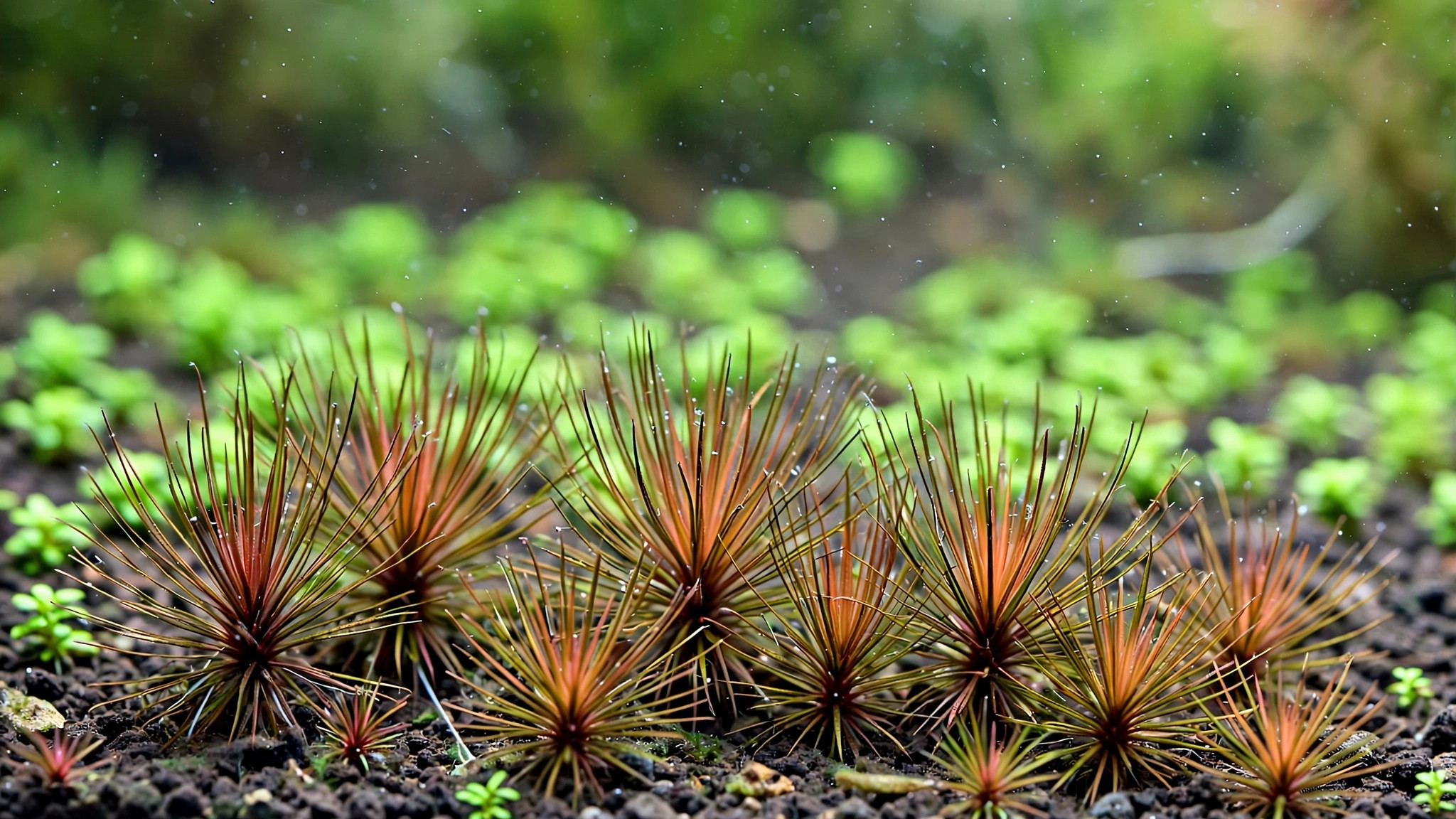
Most foreground plants forgive a mediocre tank. Eriocaulon quinquangulare does not. Hobbyists buy it for that red-flushed rosette, plant it in a shaded corner under a standard light, and watch the outer leaves soften, fray, and melt within weeks — then blame the plant. The plant was never the problem: it is a specialist that needs high light, strong carbon dioxide delivered right at the substrate, and soft, acidic water.
Below are those exact conditions, a planting method that survives the transition, and the feeding trick behind its red base.
Direct answer: Eriocaulon quinquangulare is a rare, slow-growing rosette from India that needs very bright unshaded light, carbon dioxide around 50 ppm directed to the substrate zone, soft acidic water below 3 dKH, and ammonia-rich aquasoil. Given those four things, it grows steadily at 2.5–3 inches tall, reddish at the base and fading to olive-orange at the tips.
What makes quinquangulare different
Eriocaulon quinquangulare is a recent arrival in the aquarium hobby, from India and the surrounding region. It is a compact rosette of thin, needle-like leaves, reddish at the base and fading to olive or orange toward the tips. Adult submerged plants stay short, around 2.5–3 inches tall — and that short stature is the root of most failures.
A foreground plant lives in the water layer closest to the substrate, where light is weakest and CO2 hardest to deliver. Treat it like a midground stem plant and it starves quietly. Its leaves are also delicate and easily crushed, so rough handling at planting can damage a plant that would otherwise settle in fine. Buy healthy stock, plant it once, and leave it alone.
Light, CO2, and substrate: the non-negotiable trio
Light. This plant needs very bright light and must not sit in the shade of taller plants or hardscape. Shade does not slow it gracefully — it causes melting and stunting. Keep it in open foreground and trim taller neighbours back from above it.
CO2. Quinquangulare is unusually CO2-hungry, doing markedly better at around 50 ppm than at the standard 30 ppm most planted tanks use. Distribution matters as much as the bubble count: aim filter outflow or a circulation pump low so CO2-rich water washes across the substrate, and check your drop checker at substrate level, not at the surface. Low CO2 shows up as softening outer leaves, fraying tips, a pale look, and — if you uproot a struggling plant — grey, mushy roots instead of bright white, firm ones.
Substrate. It grows very well in ammonia-rich aquasoils, which feed its root system directly. An ammonia-rich aquasoil such as ADA Aqua Soil Amazonia Ver 2 ★4.7 gives new plants exactly the root-zone nutrition this species responds to.
As an Amazon Associate, AquaVerdia earns from qualifying purchases made through links on this page, at no extra cost to you.
Water parameters that actually matter
Soft, slightly acidic water is the target: pH roughly 5.5–7.0, KH below 3 dKH, temperature 20–28 °C. The KH figure is the one to watch — this plant is sensitive to alkalinity, and hard, alkaline water is one of the quiet reasons it stalls in otherwise good-looking tanks. If your tap water is hard, remineralised RO water is the reliable route to the soft conditions it wants.
Stability matters as much as the numbers. Fluctuating parameters invite algae onto slow-growing older leaves, and this plant cannot outgrow algae the way a fast stem plant can. Keep up regular partial water changes, hold parameters steady, and resist moving the plant while it settles — frequent uprooting damages delicate roots and sets it back each time.
Planting and surviving the first month
Quinquangulare is often sold emersed or as tissue-culture cups, and the transition to submerged growth is the riskiest period. Emersed leaves will usually melt as underwater-adapted foliage grows in — this is normal, not failure. Remove melting leaves promptly, keep parameters stable, and allow three to four weeks for new submerged growth to establish.
Plant gently: spread the roots, set the crown just above the substrate surface (burying the crown invites rot), and space rosettes so each one gets unshaded light. Submerged forms ship poorly over longer distances, so emersed or tissue-culture stock often arrives in better shape. A healthy specimen at planting is half the battle.
Once the aquasoil matures and its ammonia charge fades, root feeding keeps the plant going. Push Seachem Flourish Tabs ★4.6 into the substrate near — never through — the crown every couple of months, and the roots will have a steady nitrogen source even as the soil ages.
Feeding for colour: the nitrate-limitation trick
Here is the technique behind the red base. Limiting nitrate in the water column pushes the reddish colour further from the base toward the leaf tips. The safe way to do this is to keep nitrogen available at the roots (rich aquasoil or root tabs) while keeping the water column lean — the plant stays fed underground while low water-column nitrate triggers the colour.
Do this gently. Growth slows under nitrate limitation, and pushing it too far risks a growth crash across the tank. Aim for slight limitation, not zero nitrogen, and watch new growth: if fresh leaves come in pale, stunted, or deformed, you have gone too far and should restore normal dosing. A light dose of a comprehensive liquid such as Seachem Flourish ★4.7 covers trace elements without flooding the water column with nitrogen.
Propagation and day-to-day maintenance
Propagation is by division: a mature rosette produces side shoots or can be divided at the crown, and the divisions are replanted the same gentle way as the parent. It is slow — this is not a plant you farm for profit — but a healthy colony thickens steadily over months, keeping the parent's colour if conditions stay the same.
Routine maintenance is mostly restraint. Pluck off old or melting leaves one by one so rot never gets a foothold, keep the foreground unshaded, and do not uproot the plant to "check" on it. Check the roots only if the plant is clearly failing — bright white and firm means it is fine; grey and mushy means CO2 or stability needs fixing first.
| Eriocaulon | Difficulty | Light / CO2 demand | Best for |
|---|---|---|---|
| quinquangulare | Advanced | Very high / ~50 ppm | High-tech foreground focal point |
| cinereum | Moderate–advanced | High / strong | Sea-urchin rosette texture |
| setaceum | Advanced | High / strong | Fine, hair-like foreground detail |
| vietnam | Moderate | Moderate–high / moderate | First Eriocaulon for a CO2 tank |
For deeper reading, the 2Hr Aquarist guide to growing Eriocaulon quinquangulare covers its CO2 demands in detail, and their nitrate-limitation explainer shows how to run the colour technique safely.
Frequently asked questions
Can Eriocaulon quinquangulare grow without CO2?
Realistically, no. It is one of the most CO2-demanding foreground plants, doing best around 50 ppm at substrate level. In a low-tech tank it typically softens, frays, and melts rather than adapting.
Why is my quinquangulare melting after planting?
Most often it is transition melt: emersed leaves dying back while submerged leaves grow in. Remove melting leaves, keep parameters stable, and give it three to four weeks. If new growth also melts, check CO2 delivery at substrate level and KH.
How do I make it redder?
Keep nitrogen fed at the roots through aquasoil or root tabs while keeping the water column lean — slight nitrate limitation extends the red base toward the tips. Do it gently; severe limitation stalls growth.
Can I grow it in gravel?
Plain inert gravel is a poor match. It wants ammonia-rich aquasoil; in gravel it would need heavy root-tab feeding plus soft, CO2-rich water to have any chance — aquasoil is the far more reliable route.