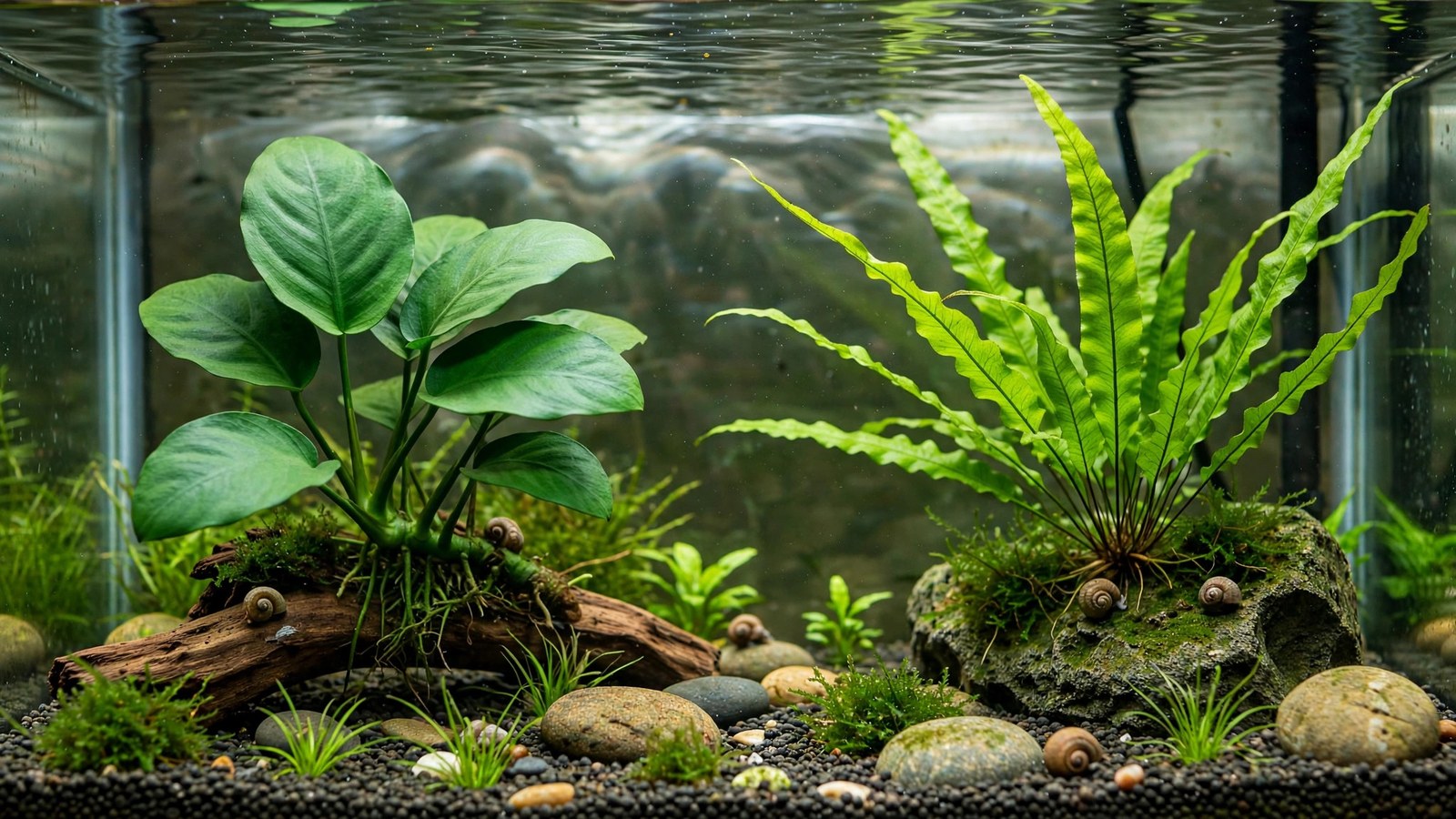
Shopping for plants means meeting the anubias vs java fern question fast: both are sold as un-killable beginner epiphytes, both attach to wood and rock, and both appear in every starter bundle. But they behave differently once they're in your tank — and the wrong pick for your lighting can mean months of algae scrubbing.
Both share the same care fundamentals — low light, no substrate planting, never bury the rhizome. For full how-tos, see anubias care in full and java fern care in full. What follows is purely the buying decision.
Anubias vs Java Fern at a Glance
| Decision dimension | Anubias (Anubias barteri var. nana) | Java fern (Microsorum pteropus) |
|---|---|---|
| Mature size | 5–15 cm; compact, bushy | 15–30+ cm; tall, flowing |
| Look | Broad, dark-green rounded leaves | Long, narrow, strap-like fronds |
| Growth rate | Very slow — 1 leaf per 2–4 weeks | Slow — noticeably faster |
| Light needs | Low; prefers shade | Low; tolerates brighter spots |
| Algae susceptibility | High — leaves persist for years | Moderate — faster leaf turnover |
| Price per pot | Lower; small plant | Higher; much bigger plant |
| Best tank role | Foreground / midground accent | Background fill on wood |
| Beginner forgiveness | Very forgiving; slow to show mistakes | Very forgiving; recovers faster |
Size and Look: Broad Leaves or Flowing Swords
This is the most visible difference, and it should drive most of your decision. Anubias nana stays compact — a full-grown plant is about the size of your palm, with thick, oval leaves that read as solid dark-green architecture. Planted on a foreground stone, it gives a tank structure within the first week.
Java fern is the opposite energy. Its fronds rise 15–30 cm and sway, softening rear corners and adding height for almost no effort. Cultivars like 'Windeløv' or 'Trident' suit smaller or more manicured tanks. Plan around the scale: one java fern pot can be triple the biomass of an anubias pot.
The rule of thumb: low, chunky plants draw the eye forward; tall, moving plants create depth behind. Most well-composed beginner tanks use both, but if you're buying only one, choose for the empty vertical band in your tank. For a low, detail-heavy foreground, Anubias nana 'Petite' stays even smaller than standard nana and suits nano tanks.
Growth Rate and Algae Susceptibility
Here's where anubias's reputation quietly catches up with it. Anubias grows very slowly — one new leaf every two to four weeks, sometimes slower — and each leaf then lives for years. That long leaf lifespan is the catch: algae needs little to colonize a leaf that never turns over. In a new tank with unstable nutrients, anubias in bright open water is an algae magnet.
Java fern also grows slowly, but observably faster — new fronds unroll within a month, and old leaves get replaced rather than sitting around forever. That's why beginners often find it "easier": problems cycle through faster.
The practical fix is placement, not avoidance. Put anubias in the shaded lee of wood and stone, away from direct light, and its algae risk drops dramatically. Give java fern the brighter, taller spots. Under high lighting, anubias survives only in shade — or consider Bucephalandra or the African water fern (Bolbitis), two rhizome epiphytes with similar temperaments.
Placement Strategy and Tank-Spot Roles
Both are epiphytes: tie or glue them to hardscape, never bury the rhizome. Anubias excels as a midground and foreground accent, nestled at the base of driftwood or cupped into stone crevices. Its compact rosette never outgrows its assigned space, making it the safest plant in a small tank.
Java fern belongs taller: tied to vertical wood, wedged into background gaps, filling rear corners where stem plants would demand trimming. It multiplies usefully too — plantlets grow on the underside of mature leaves, so one pot eventually becomes several. For the low foreground alongside anubias, java moss ties to the same hardscape and fills gaps the rosettes leave behind.
 ★4.6
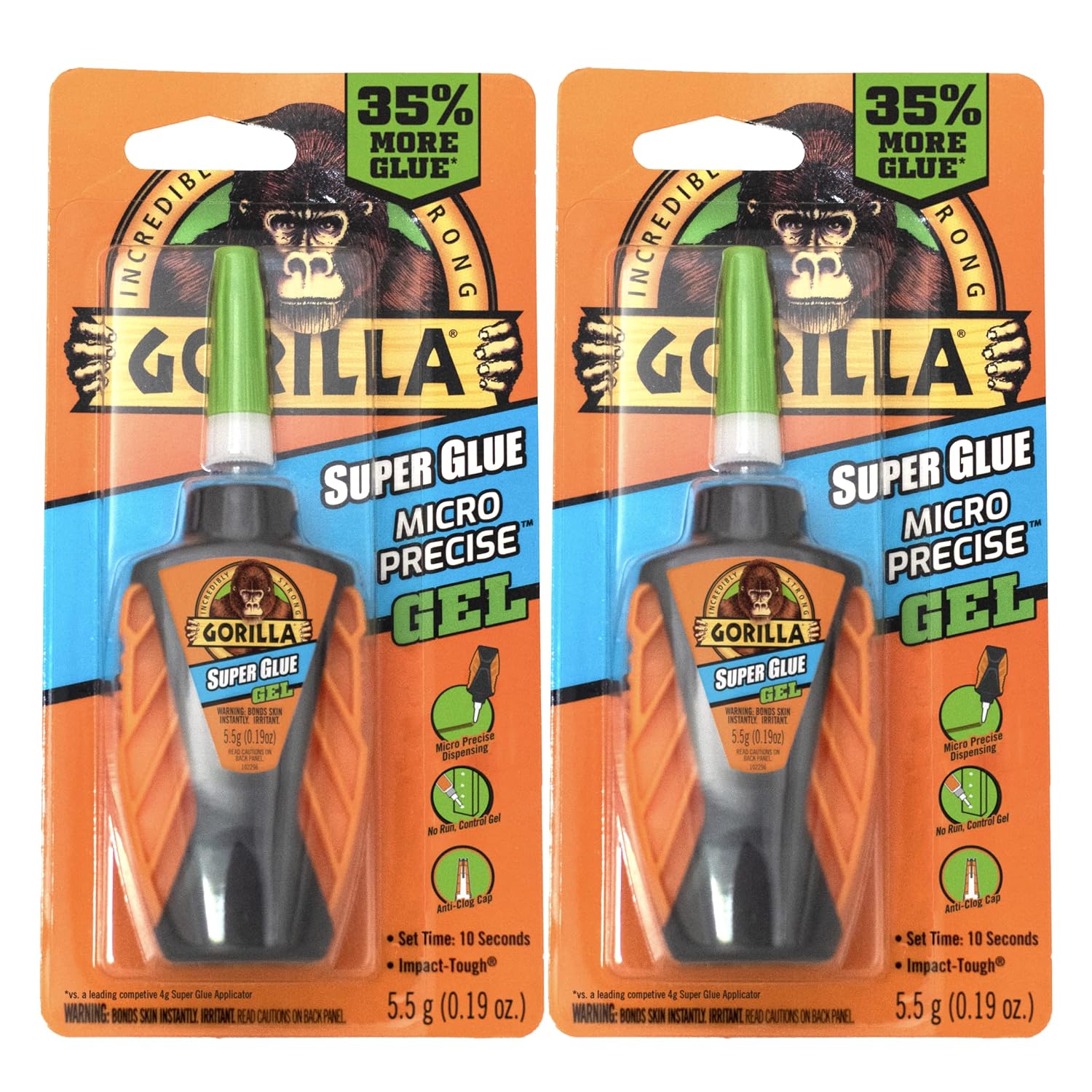
Gorilla Micro Precise Super Glue Gel
Check Price on Amazon ★4.6Price, Pots, and What You Actually Take Home
At retail, anubias nana pots typically run a little cheaper than java fern pots — but hold a much smaller plant. Price per unit of scape impact favors java fern: one pot can anchor a background corner, while anubias often needs two or three pots to carry a midground. For a starter 20-gallon, a realistic split is three anubias pots for the midground and two java fern pots for the background.
Check the Tropica Anubias barteri var. nana page and the Tropica Java fern page to compare pot contents and mature heights before ordering, since retailers sell multiple cultivars of both under loose names.
One small purchase pays for itself: a tube of cyanoacrylate super glue gel. It's the fastest way to attach either rhizome to wood or stone — one drop, press, done, tank-safe once cured.
So Which One Should You Buy First?
Stop choosing between them as rivals and start choosing by job. Buying your first plant for a new tank? Get one of each: anubias low and shaded, java fern tall and toward the light. Together they teach you the two placement principles behind every epiphyte you'll ever own.
If the budget allows only one: pick anubias for tanks under 40 liters, strong lighting, or rough fish like goldfish and cichlids. Pick java fern for mid-size or larger tanks, modest lighting, and visible progress in the first month. Either way, you're starting with the two most beginner-proof plants in the hobby — and that's exactly the right move.
Frequently Asked Questions
Can I keep anubias and java fern in the same tank?
Absolutely — they thrive in identical conditions (low light, no CO2, no substrate planting), which is why retailers bundle them. Put anubias in shaded foreground spots and java fern on taller background wood to cover the full tank height without competing.
Which one grows faster, anubias or java fern?
Java fern grows noticeably faster. Anubias produces roughly one leaf every two to four weeks, while java fern unfurls new fronds steadily and multiplies via plantlets on old leaves. Neither is fast by stem-plant standards, but java fern wins comfortably.
Why does my anubias have algae but my java fern doesn't?
Anubias leaves live for years and grow very slowly, so algae gets far more time to colonize each leaf — especially in bright light. Java fern's faster leaf turnover sheds problem leaves naturally. The fix is moving the anubias behind hardscape, where algae pressure is lower.
Is one better for a low-tech, no-CO2 tank?
Both are low-tech champions that need no CO2. Java fern shows more enthusiasm without it, while anubias continues at its unhurried pace. With no CO2 and modest light, pick by the size and look you want — either will do fine.
Do anubias and java fern cost about the same?
Anubias pots are usually cheaper, but java fern pots contain a much larger plant, so java fern gives more scape coverage per dollar. In a 20-gallon starter tank, expect to spend more on anubias overall — you'll likely buy two or three pots to fill a midground.
The Bottom Line
The anubias vs java fern question has a boring answer and a good one. The boring answer: both are nearly indestructible beginner epiphytes, so buy either. The good answer: buy them for different jobs — anubias for compact, shaded, low architecture; java fern for tall, flowing, fast-turnover background presence. Get that one placement decision right, and these two plants will carry your aquascape while you learn everything else.