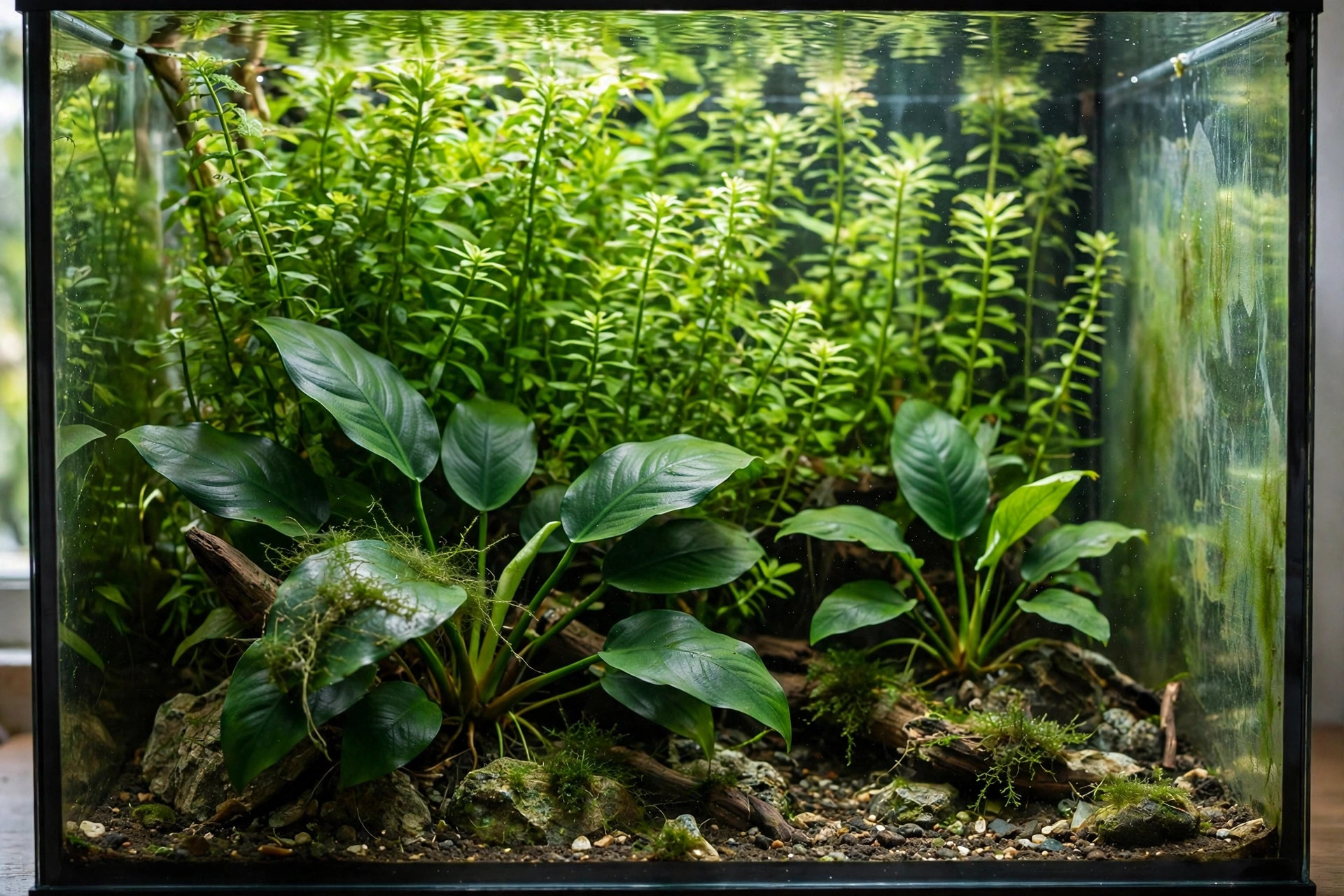
You dose on Sunday, as the bottle says. By Thursday the glass is hazy, hair algae waves from the driftwood, and the fertilizer bottle is in the dock.
Usually, it is not. Fertilizer gets blamed because it arrived last, not because it triggered the bloom. Algae needs a trigger — too much light for the carbon available, unstable CO2, or ammonia from decaying matter — and fertilizer only feeds growth once that trigger has fired.
Why the timing fools you
Algae spores are always present in a tank. They sit quietly until conditions suit them, then grow fast enough to notice within days. That lag is why fertilizer takes the blame: you change one visible thing, algae appears days later, and your brain links the two.
But consider what else changed around that dose. Many keepers start fertilizing when they also upgrade a light or add new plants, and new plants shed old leaves as they adapt. Those decaying leaves release ammonia — the nutrient form that genuinely triggers algae. Estimative Index tanks, dosed deliberately in excess and reset by a weekly water change, routinely run without algae when light and CO2 are balanced.
The real trigger: light, CO2, and ammonia
Think of light, CO2, and nutrients as a triangle, as Dennerle describes it: plants grow only as fast as the scarcest of the three allows. Raise light without raising carbon, and plants stall while algae — which needs far less carbon — carries on growing. That is the classic post-dosing bloom: fertilizer raised the growth ceiling, but CO2 stayed put.
Unstable CO2 is worse than low CO2, and ammonia is the other genuine trigger. Switch CO2 on one to two hours before the lights and keep the rate steady day to day. Ammonia rarely comes from the bottle — standard liquids use nitrate, not ammonia. It comes from overfeeding, a dead fish behind hardscape, an overdue filter, or melting leaves left to rot.
When fertilizer does play a part
Not every bottle gets a free pass. Some fertilizers use ammonium as a nitrogen source, and overdosed, those supply the very trigger other fertilizers avoid. If yours lists ammonium or urea, dose it exactly and never double up to “catch up.”
Plant mass matters too. A few slow-growing Anubias cannot absorb a full dose meant for a dense stem-plant scape, so nutrients sit in the water while algae uses them. Match the dose to the plants you actually have, not the tank size alone.
Diagnose before you change anything
Do not change light, CO2, and fertilizer all at once — you will never learn which one mattered. Work through this table in order.
| What you see | Likely trigger | Check first |
|---|---|---|
| Algae on slow leaves only | Too much light | Photoperiod over 8 hours, direct sunlight |
| Hair or staghorn algae after a CO2 change | Unstable CO2 | Drop checker colour all day |
| Green water after feeding changes or a death | Ammonia spike | Ammonia test, filter, decay |
| Pale new growth plus algae | Plants starved | Consistent dosing for 2 weeks |
| Algae only where flow is weak | Poor distribution | Dead spots behind hardscape |
The fix sequence that actually works
Work in this order, giving each step a week before judging it. First, set light to 6–8 hours on a timer and remove direct sunlight. Second, stabilise CO2 if you inject it: same on-time, same rate, lime-green all day. Third, clean: remove algae by hand, prune melted leaves, and vacuum detritus. Only then adjust fertilizer, upward if plants look hungry.
For most planted tanks, a single all-in-one liquid keeps this simple. As an Amazon Associate, I earn from qualifying purchases through the links here. A complete liquid such as NilocG Thrive All-in-One ★4.6 covers macros and micros in one dose.
Expect two to three weeks to settle. New growth is the signal: fresh leaves emerging clean matters more than old algae disappearing, because old algae often needs manual removal anyway.
How to dose without fear
Start at half the label dose for two weeks in a new or lightly planted tank, then step up only if new growth looks pale or stunted. Dose on the same days each week, and write it down — accidental double doses start most “fertilizer caused algae” stories.
In a low-tech tank with slow growers, a lean comprehensive liquid is often the better fit. A gentle liquid such as Seachem Flourish ★4.7 suits that setup: dose lightly and raise it only when growth shows it can use more.
Stop chasing zero nitrate or phosphate on a test kit: healthy tanks routinely carry measurable nitrate, and driving it to zero starves plants while algae carries on. Read the plants instead — deep green, steady new growth, and clean new leaves mean the dose is right. For background, see the Estimative Index explanation at PlantedBox and the light, CO2, and fertilization triangle at Dennerle.
Companion article: once you’ve confirmed fertilizer is the trigger, How to Dose Liquid Fertilizer Without Causing Algae covers the dosing method itself — schedules and amounts. This article covers diagnosis; that one covers method.
Frequently asked questions
Should I stop fertilizing until the algae is gone?
No. Stopping fertilizer weakens plants and hands algae a bigger advantage. Fix light and CO2, remove algae manually, and keep dosing at half strength if plant mass is low.
Does phosphate cause green spot algae?
Not on its own. Green spot algae is often linked to low phosphate, and many keepers clear it by raising phosphate, not cutting it.
Why did algae appear only after I switched fertilizers?
A new fertilizer may use a different nitrogen form, concentration, or schedule. Check whether it contains ammonium, whether you stacked it on the old dose, and whether light or CO2 changed at the same time.
How long after fixing light and CO2 should algae stop spreading?
Allow two to three weeks. Existing algae rarely dies back on its own, so manual removal matters. If new growth stays clean while old algae persists, the fix is working.