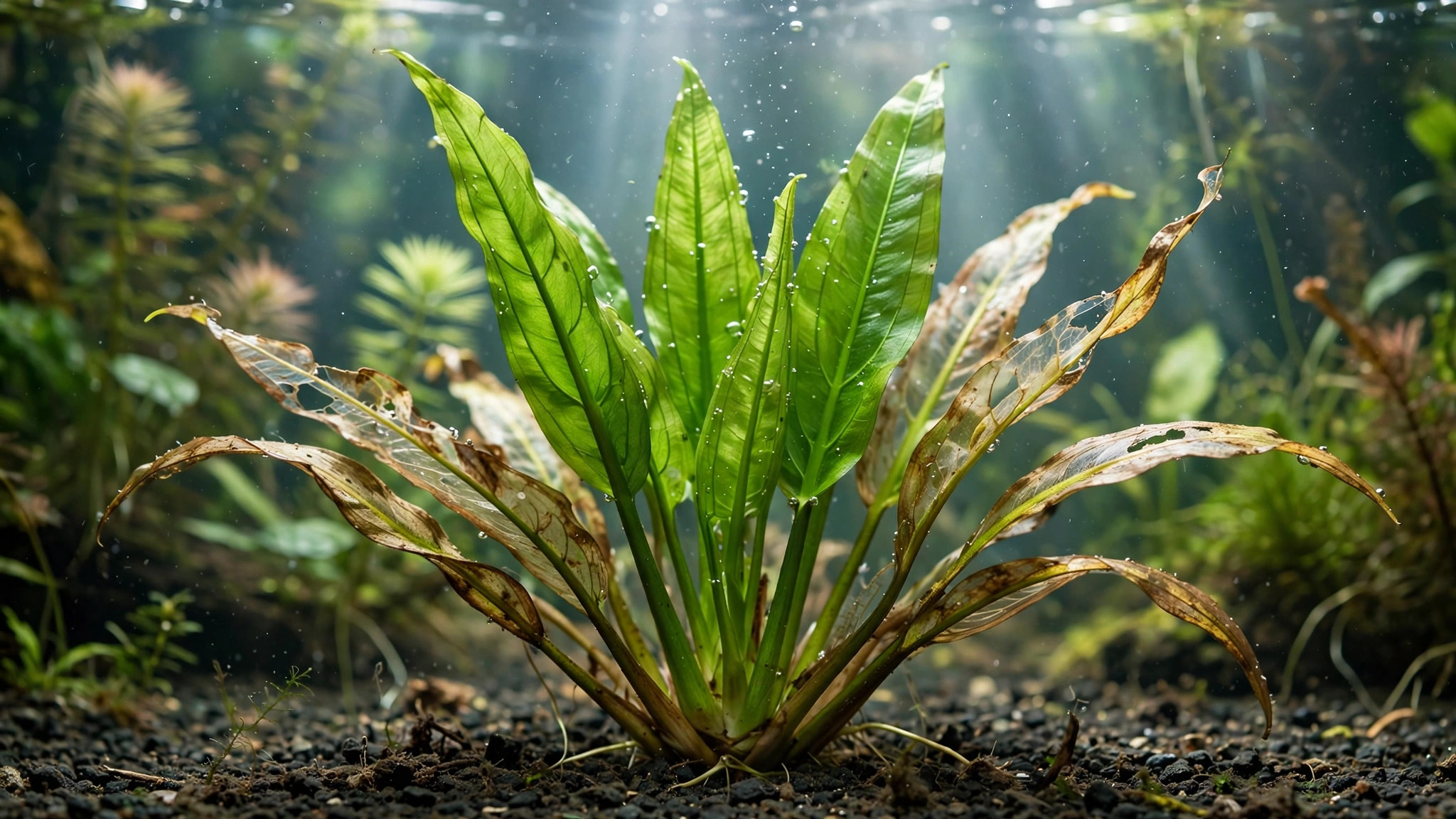
You planted an Amazon sword two weeks ago and it looked like the product photo. Now the outer leaves are going brown at the edges, a few look oddly see-through, and one collapsed into mush this morning. Your first instinct is to blame your water — but with swords, the most common culprit is the plant itself shedding the leaves it no longer needs. The trick is knowing which brown, transparent leaves are a normal goodbye and which are a cry for food.
First: Which Leaves Are Suffering?
Before you change anything, look at where the damage sits. This single observation separates the normal cases from the real problems, and it takes about ten seconds:
| Pattern | Likely meaning |
|---|---|
| Outer, oldest leaves browning; center leaves green and growing | Normal transition melt — the plant is fine |
| All leaves, including the newest center ones, pale or glassy | Nutrient starvation or low CO2/light |
| Leaves browning from the base upward; mushy crown | Crown buried or rotting — fix the planting depth |
| Holes and ragged edges alongside the browning | Potassium shortage (or hungry herbivores — check at night) |
| Brown slimy coating that rubs off with a finger | Diatom/brown algae on the leaf, not leaf damage — different problem |
If your sword matches the first row and you planted it within the last two months, skip straight to Cause 1 and relax a little. Everything else, read on.
Cause 1: Normal Emersed-to-Submerged Melt
Almost every Amazon sword you buy was grown emersed — roots wet, leaves in humid air at the nursery. Air-grown leaves are thicker and rounder, built for a world with abundant CO2 and no water pressure. Submerged leaves are thinner and longer, shaped for life underwater. The plant cannot remodel an old leaf; it discards it and grows a new one.
So the brown, transparent outer leaves on a new sword are usually the plant doing exactly what it's supposed to do: abandoning air-built leaves it can't use underwater. This "melt" typically starts within a week or two of planting and runs its course in 2–6 weeks. During that window, the crown should be pushing out fresh green leaves from the center even as the old ones collapse.
Diagnosis: the plant is new (under ~2 months in your tank); damage is on the outer, oldest leaves; new center growth looks healthy. Fix: almost nothing. Trim the worst leaves at the base so they don't rot in the tank, keep conditions stable, and don't move the plant. Relocating it mid-transition restarts the clock.
Cause 2: Hungry Roots — Swords Feed From Below
This is the big one for established swords. Echinodorus species are famously heavy root feeders: they pull most of their nutrition through a big root system, not from the water column. A sword in plain gravel or an old, depleted substrate with no root feeding slowly exhausts the nutrients stored in its rhizome — and the symptom of that slow starvation is exactly brown, glassy, collapsing leaves, often starting with the older foliage and eventually hitting new growth too.
The classic scenario: the plant thrived for months, then declined. Liquid fertilizer in the water didn't help — because liquid fertilizer mostly isn't where this plant eats. The fix is feeding the substrate: push root tabs into the gravel near the plant's crown, spaced in a rough ring a few inches out from the base, and replace them on the package's schedule (most last a couple of months). Within a few days to a week you should see fresh leaves pushing from the center; that's your confirmation the roots are eating again.
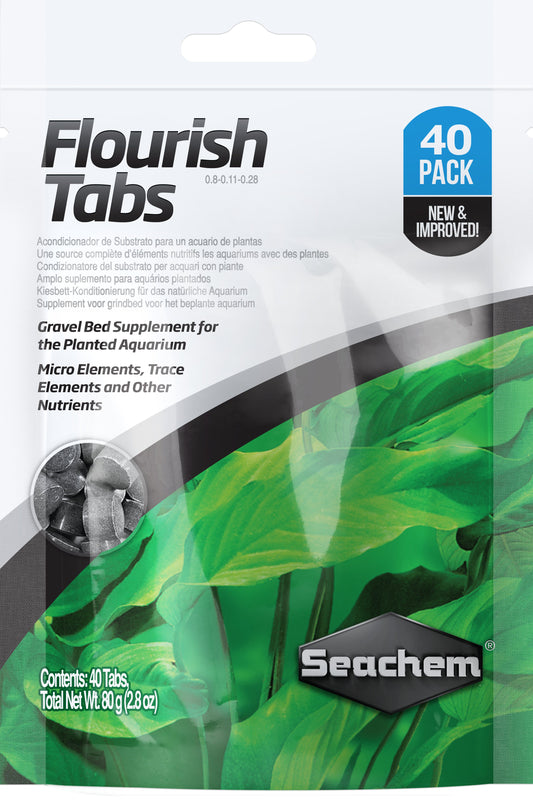
Seachem Flourish Tabs ★4.6 are the standard choice here — they're formulated for exactly this job, and the same product is what serious sword keepers reach for first. As an Amazon Associate I earn from qualifying purchases made through the link below, at no extra cost to you.
 ★4.6
Seachem Flourish Tabs
Check Price on Amazon ★4.6One more detail that matters: press each tab deep into the substrate — an inch or two down — rather than leaving it at the surface. Tabs sitting on top of the gravel dissolve straight into the water column, which feeds algae instead of roots and can spike nutrients. Deep placement keeps the nutrients where the sword's roots actually hunt.
Cause 3: A Buried Crown Rots From the Inside
The crown is the pale, whitish knot at the plant's base where all the leaf stems meet the roots. It must sit at or just above the substrate surface. Plant a sword too deep — easy to do, because a top-heavy new plant wants to tip over — and the buried crown stays damp and airless in compacted substrate, then rots. Leaves yellow and turn brown from the base upward, stems feel mushy where they meet the crown, and the whole plant can collapse in days.
Diagnosis: gently brush the gravel away from the plant's base. If you can't see the pale crown tissue, it's buried. Fix: pull the plant up until the crown is exposed and just the roots are in the substrate. If the crown is mushy and smells off, trim the soft tissue back to firm white material with clean scissors — mush doesn't recover, but firm tissue will regrow. This is one case where acting fast genuinely saves the plant.
Cause 4: Too-Little Light or Unstable CO2
Swords are undemanding about light by planted-tank standards — they grow fine in low to medium light, roughly 30–50 µmol/m²/s of PAR at the leaf level, which most stock aquarium LEDs provide. But two light/CO2 situations do cause transparent, glassy leaves:
- Very dim corners: a sword crammed behind hardscape in near-darkness can't photosynthesize enough to maintain its tissue. Leaves thin out and go pale-transparent. Move the plant or trim the shade.
- CO2 instability, not absence: swords don't need injected CO2 — plenty thrive in low-tech tanks. What hurts them is inconsistent carbon: a DIY or pressurized system that sputters on and off, or "liquid carbon" dosed erratically. Tissue grown under one CO2 regime collapses when the regime changes.
Diagnosis: transparency affects new leaves across the plant (not just old emersed ones), while the crown and roots look healthy and you're already feeding the roots. Fix: stabilize rather than maximize — pick a CO2 approach and keep it consistent, or run none at all. Many long-term sword tanks run zero injected CO2 with excellent results.
Cause 5: Water Chemistry Swings and Soft-Water Collapse
Big, sudden changes in water chemistry can push leaves past browning straight into translucent collapse: a huge water change with very different parameters, a pH crash in a low-KH tank, or moving the plant between tanks with very different hardness. In very soft, mineral-poor water, swords can also struggle to build sturdy tissue at all — the leaves emerge thin and glassy, a sign the plant can't get enough calcium and magnesium.
Diagnosis: the melt hit suddenly after a water change, a move, or a chemistry event — and it hit multiple plants, not just the sword. Fix: stop the swings first. Match temperature and roughly match parameters on water changes (change less water, more often, if your tap and tank differ a lot), and in very soft water consider a GH-remineralizing product used exactly per its instructions. Once the tank is stable, swords almost always regrow from the crown.
The 10-Minute Recovery Routine
When a sword's leaves are browning, do this in order — it covers every fixable cause above without guessing:
- Check the pattern (see the table above). Old leaves only on a new plant? Mostly just watch.
- Expose the crown. Brush substrate back until the pale base is visible. If it's mushy, trim to firm tissue.
- Feed the roots. Press root tabs deep into the substrate in a ring around the crown, per the package's spacing.
- Trim the worst leaves. Cut fully brown or mushy leaves at the base with clean scissors — a few at a time, not all at once.
- Stabilize the tank. No big rescapes, no parameter swings, consistent light schedule (8–10 hours daily).
- Wait and watch the center. Fresh green leaves from the crown within 1–3 weeks mean you're winning. Then keep trimming old damage as the new canopy fills in.
Mistakes That Make It Worse
- Stripping the plant bare. Removing every damaged leaf at once leaves the crown with no photosynthetic income while it's trying to regrow. Trim in stages.
- Uprooting and replanting to "check the roots." Every move restarts the transition clock and breaks the fine root hairs doing the actual feeding.
- Dosing more liquid fertilizer instead of feeding roots. Extra water-column fertilizer on a starving-root plant mostly feeds algae.
- Cranking the light to "help." More light on a nutrient-starved plant just grows algae on the dying leaves.
- Assuming it's dead too early. A sword with a firm crown and white roots is alive even if every leaf looks terrible. Give it 3–4 weeks of correct care before judging.
When the Sword Is Beyond Saving
Be honest with yourself at this point: if the crown is completely mushy with no firm white tissue left, the roots are brown-black and slimy rather than white and firm, and nothing has sprouted from the center after a month of correct feeding and stable conditions, the plant is done. Pull it — a rotting crown fouls the substrate.
The silver lining: established swords often send up daughter plantlets on runners before they fail, and a healthy mother plant produces them routinely. If yours threw a runner with a baby plant while it was declining, you already have its replacement. Plant the plantlet with its crown exposed, feed the roots from day one, and you'll skip most of this article's drama the second time around.
Frequently Asked Questions
Will brown, transparent Amazon sword leaves turn green again?
No — damaged leaf tissue doesn't heal. But that's fine: a sword with a healthy crown constantly grows new leaves from the center. Trim the ruined leaves gradually and judge the plant by its new growth, not its old damage.
How long after adding root tabs will I see new growth?
Usually within 1–3 weeks you'll notice fresh leaves unrolling from the center of the crown. The old damaged leaves won't improve — watch the new ones. If nothing appears after a month, recheck the crown depth and your water stability.
Should I remove all the melting leaves at once?
No. Cut only the leaves that are fully brown, transparent-mushy, or detached, and leave the rest — even ugly yellowed leaves still photosynthesize a little. Removing more than a third of the foliage at once slows recovery.
Do Amazon swords need CO2 injection to survive?
No. They're one of the best low-tech background plants and grow vigorously without injected CO2. What they punish is inconsistent CO2 — a sputtering system or erratic liquid-carbon dosing causes more melt than running no CO2 at all.
My new leaves are coming in pale and thin — is that normal?
Slightly pale new growth during the first month is normal transition behavior. If new leaves stay thin and glassy for weeks while the crown is fed and conditions are stable, check your water hardness — very soft, mineral-poor water can prevent sturdy leaf formation, and a GH supplement used per its instructions usually fixes it.
Can I plant an Amazon sword in plain gravel?
Yes — plain gravel works fine as a physical anchor as long as you feed the roots. Push root tabs deep into the gravel around the crown and replace them on schedule. The gravel itself doesn't need to be fancy; the root tabs do the nutritional work.