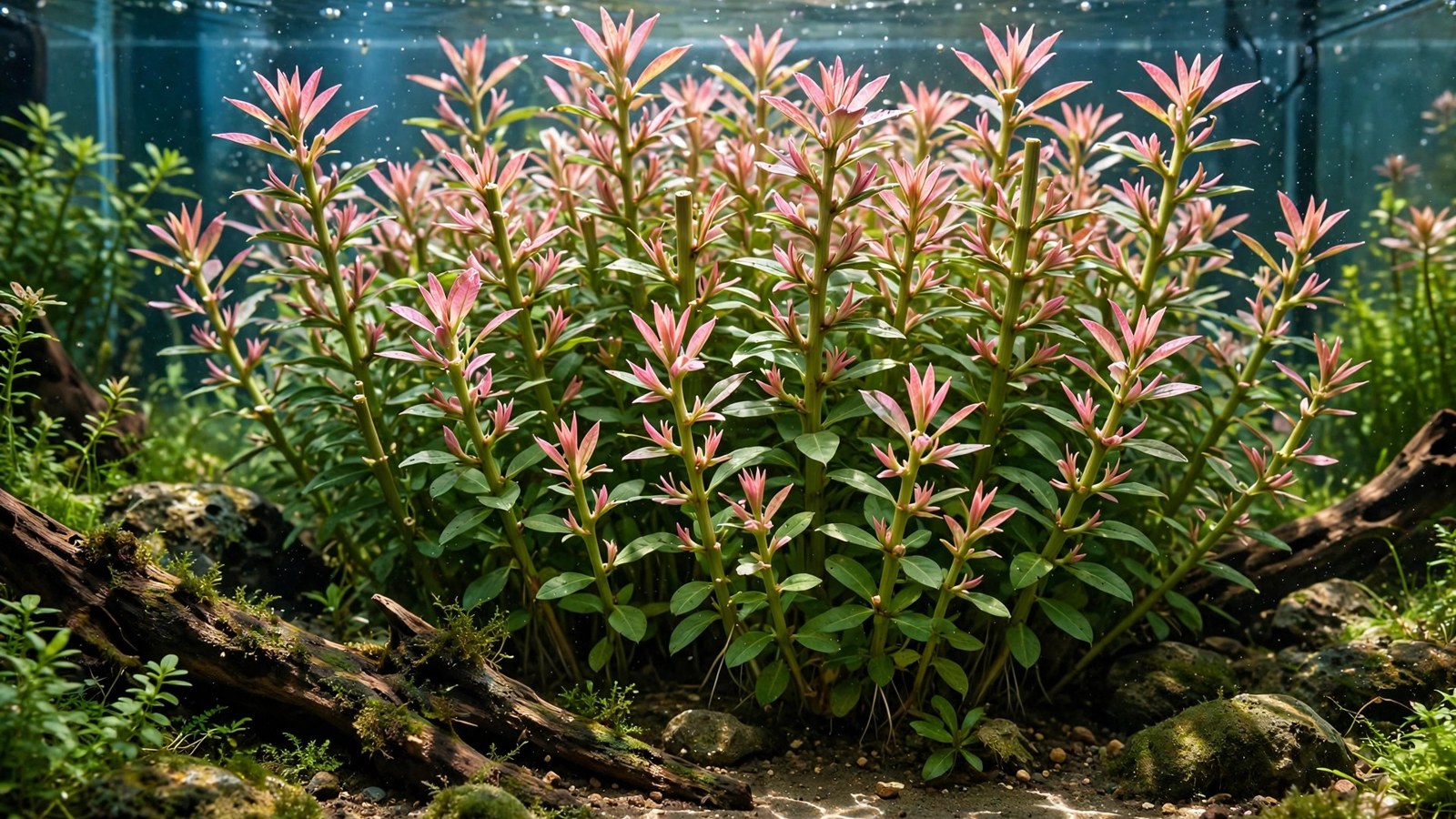
A single rotala stem, left alone, shoots straight for the surface, sheds its lower leaves in the shade of its own canopy, and ends up a bare stalk with a tuft on top. The fix is not more fertilizer. It is one deliberate cut, made in the right place, followed by replanting what you cut off.
This guide covers that cut for rotala: where to cut, how to replant the tops so stem count doubles, and how to fix light and spacing so the bush stays dense at the base.
Direct answer: To make rotala bushier, cut each stem just above a leaf node, then replant the healthy tops beside the stumps. The stump branches into two or more side shoots below the cut, and each replanted top roots as a new stem — so one trimming round can double your stem count. Expect visibly denser growth in 3–4 weeks if light reaches the lower stems.
Why rotala goes leggy in the first place
Rotala grows toward light and keeps its newest leaves at the tip. When a stand gets tall and crowded, the top leaves shade everything below them. The lower leaves yellow and drop, and the stem stretches — its internodes, the gaps between leaf pairs, lengthen as it reaches for brighter water. It looks like a failing plant, but it is usually just a stem plant behaving normally in shade.
Three causes cover almost every leggy rotala: light too dim for the depth of the stand, stems planted so tightly that no light or flow reaches the interior, and never trimming at all — an uncut stem has one growing tip, so it stays one stem no matter how tall it gets.
The cut that creates branches
Find a leaf node — where a pair of leaves joins the stem — at the height you want the bush to branch from. Cut cleanly just above that node, about a quarter of an inch above it, in a single snip. Do not pinch, tear, or saw: a crushed stem rots back instead of branching.
Leave 2–3 healthy nodes on the stump below your cut. Those nodes carry the dormant buds that become side shoots. Cut below the lowest healthy node and the stump has nothing left to sprout from; cut too high and you keep the leggy look you were trying to remove. Aim for a stump one-third to one-half of the final height, with leaves still on it. Within 1–2 weeks, one or usually two side shoots should push out just below the cut, so one stem becomes two or three. A clean cut with the hygger 6-in-1 aquascaping tools kit ★4.6 gives you both the curved scissors for reaching into a dense stand and the tweezers for the replanting step below.
As an Amazon Associate, AquaVerdia earns from qualifying purchases made through links on this page, at no extra cost to you.
Top and replant, step by step
Trimming alone shortens rotala; trimming plus replanting multiplies it. Work in this order, just before a water change so floating debris is easy to net out.
1. Pick your cut height. For a background stand, cut at roughly two-thirds of the height you ultimately want, so the stand ends up fuller rather than simply shorter.
2. Cut stem by stem, not in one sweep. Cutting across the whole bunch like a hedge gives uneven branching, because stems differ in node position. Snip each stem above its own node, and set the tops aside in tank water.
3. Strip the bottom leaves off each top. Remove the lowest one or two leaf pairs so a bare inch of stem goes into the substrate. Buried leaves rot and invite algae on the new planting.
4. Replant the tops between the stumps. Push each top about an inch deep with tweezers, spacing stems roughly an inch apart. Tops planted beside the stumps fill the gaps branching will take weeks to close, so the stand looks dense immediately.
5. Deal with bare bottoms honestly. If a stump is healthy and leafy, keep it — it will branch. If a stem is bare for most of its length, pull it and replant only the top: a bare stump rarely recovers.
6. Clean up and wait. Net out every floating cutting the same day. Fragments left drifting root wherever they land or decay and foul the water. Side shoots should show within 1–2 weeks, and the stand should look clearly denser by week 3–4.
Shaping a bush, not a hedge
A bushy rotala stand is not a flat-topped block. Cut the front stems shorter than the back ones so the group slopes upward toward the rear — that stepped profile lets light reach the lower leaves of every row. Stagger the cuts, too: trim the tallest third this week and the rest next week.
Spacing matters as much as cutting. If replanted tops touch each other, the interior stems shade out again within weeks. Roughly an inch between stems suits rotundifolia types; finer-leaved forms such as wallichii want a little more room. Thin ruthlessly at each trim: remove the weakest stems entirely. Twenty strong stems look bushier than forty starving ones.
Fixing legginess that is already there
For a stand already bare at the base, the top-and-replant reset above is the honest fix — no fertilizer regrows leaves on a bare lower stem. After the reset, address the cause: raise light or lengthen the photoperiod modestly, thin the stand, and make sure flow reaches the base. In low-tech tanks without injected carbon dioxide, the same result just takes longer — give each round a full month. Colour follows the same logic: the pink and red tips rotala is famous for need strong light at the tips, and a shaded stand stays green no matter what you dose. The 2Hr Aquarist rotala guide describes the same top-and-replant approach.
| Method | What happens | Best for |
|---|---|---|
| Top trim only | Stump branches below the cut; tops discarded | Quick tidy-up of a healthy stand |
| Top and replant | Stump branches and tops root as new stems | Doubling density, rescuing a leggy stand |
| Staggered trim | One-third of stems cut per week | Keeping a show tank looking full throughout |
| Full reset | Bare bottoms removed, only tops replanted | Stands bare for most of their height |
Mistakes that keep rotala leggy
Common errors: cutting below the last healthy node, leaving a leafless stump that cannot branch; trimming with dull household scissors, which crush the stem and invite rot; trimming everything at once into a flat hedge, which shades the interior; and skipping cleanup, so floating cuttings decay and feed algae. And do not judge the result after three days — branching takes 1–2 weeks to show and a full month to look like a bush. For the broader stem-plant technique, see our stem plant trimming guide and the Rotala rotundifolia care guide.
Frequently asked questions
How often should I trim rotala to keep it bushy?
Every 2–3 weeks in a growing tank, or whenever stems reach the surface. Injected-carbon-dioxide tanks may need weekly attention; low-tech tanks can go a month between trims.
Will the cut stumps really branch, or do they just die?
Healthy stumps with 2–3 nodes left below the cut almost always branch, usually into two side shoots. Leafless or mushy stumps are the exception — replace those with replanted tops.
Can I just replant the tops and throw the stumps away?
Yes, and for a badly leggy stand that is the better move. The tops are the healthiest growth and root quickly. Keep stumps only when they still carry healthy leaves and you want the extra branching.
Why is my rotala still leggy after trimming?
Usually light or spacing, not technique. If the base stays shaded by a crowded top, or stems are packed touching each other, new growth stretches again. Thin the stand and give it a full month before the next trim.