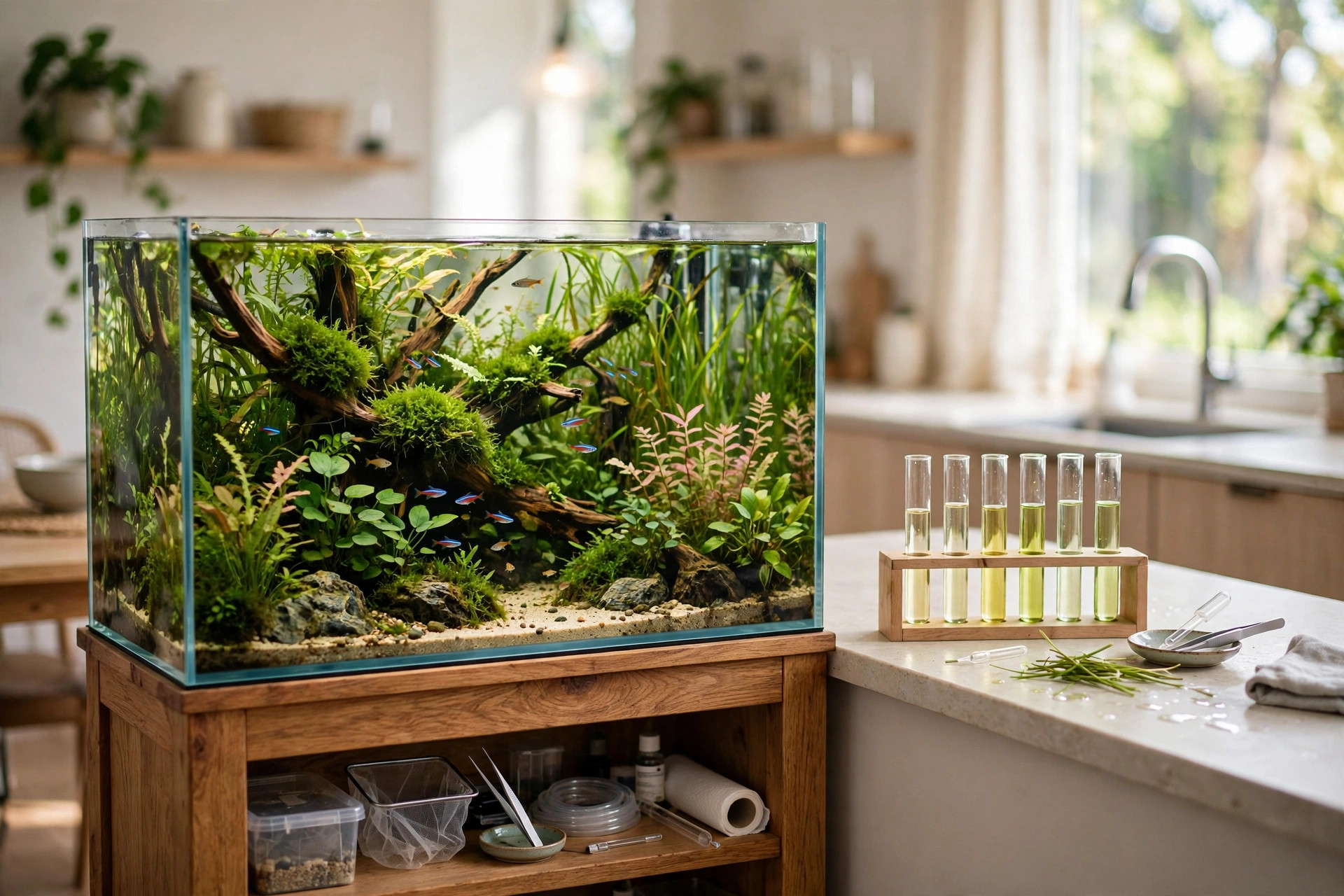
Your tap water arrives with a chemistry report card you never asked for — and your plants read every line of it. Two tanks filled from two different taps can grow completely differently with the same light, fertilizer, and plants, simply because one city's water is soft and acidic and the other's is hard, alkaline, and dosed with chloramine. Most "mystery" plant problems — melting stems, stunted tips, algae that won't quit — trace back to a parameter the keeper never measured.
The good news: you only need to understand about eight numbers, and most of them barely move once you know your tap. This guide explains each one in plain language — what it is, what range planted tanks like, and what to do when your tap sits outside it.
Short answer: For most planted tanks, aim for pH 6.5–7.5, GH 4–8 dGH, KH 3–8 dKH, zero ammonia and nitrite, nitrate under 20 ppm, and chlorine/chloramine fully removed before water touches the tank. Test your tap once with a liquid kit, compare it to these ranges, and fix only what is actually out of range — most tap water needs dechlorination and nothing else.
Chlorine and chloramine: remove these first
Every municipal supply disinfects its water, and the two disinfectants behave very differently in a fish tank. Chlorine is a gas dissolved in water: left standing in an open bucket for a day or two, much of it escapes on its own. Chloramine — chlorine bonded to ammonia — does not. It stays put for days, survives aeration, and is increasingly common because it lasts longer in pipes. If your water company uses chloramine and you only "age" your water, you are still pouring disinfectant into your tank.
The fix is simple: a liquid dechlorinator dosed into every bucket, or straight into the tank before the new water goes in. Check the label for the word "chloramine" specifically — a product that only neutralizes chlorine is not enough. Your supplier's annual quality report, usually on its website, will tell you which one your city uses. Dose for the volume of new water, and add it before the water hits the filter bacteria, not after.
pH: what the number actually means
pH measures how acidic or alkaline water is, from 0 to 14, with 7 neutral. The scale is logarithmic, so pH 6 is ten times more acidic than pH 7 — small-looking changes are bigger than they appear, which is one reason sudden pH shifts stress fish and melt sensitive plants.
Most common plants — Java fern, Anubias, Amazon sword, Vallisneria, Rotala — grow happily from about 6.5 to 7.5, and many tolerate a wider band. What they do not tolerate is a pH that bounces: a tank at a steady 7.8 will outperform a tank swinging between 6.8 and 7.6 with every water change. If your tap reads 7.8 and your tank reads 7.8, leave it alone. Chasing a textbook 7.0 with chemical adjusters creates exactly the instability plants hate. One exception: CO2 injection lowers pH while it runs, sometimes by a full point during the photoperiod. That daily swing is normal in a CO2 tank, because the KH buffer below keeps it within a safe band.
GH and KH: the hardness pair every keeper confuses
GH, general hardness, measures dissolved calcium and magnesium — minerals plants actually use. Calcium builds cell walls; magnesium sits at the center of the chlorophyll molecule. KH, carbonate hardness (alkalinity), measures dissolved carbonates — the buffer that resists pH change. Same word "hardness," two completely different jobs.
| Parameter | Planted-tank range | Too low looks like | Too high looks like |
|---|---|---|---|
| GH | 4–8 dGH | Holes in leaves, stunted tips, shrimp molting problems | White crust on glass, soft-water plants stall |
| KH | 3–8 dKH | pH crashes, unstable CO2 readings | pH locked high, CO2 less effective |
If your tap is very soft (GH under 3), remineralizing salts will raise GH without dragging pH around. If it is very hard (GH over 12), most hardy plants still cope, but soft-water specialists will struggle — mixing in reverse-osmosis water is the honest fix, not a bottle of "pH down." And if your KH is under 2, add buffer before you add CO2: a tank with no buffer and injected CO2 is a pH crash waiting for a quiet night.
Ammonia, nitrite, and nitrate: the nitrogen trio
Fish waste and decaying leaves produce ammonia, which beneficial bacteria convert to nitrite, then to nitrate. Ammonia and nitrite are toxic at any measurable level in an established tank — zero is the only acceptable reading. Nitrate is the relatively harmless end product, and planted tanks are unusual in that plants consume it as fertilizer: a heavily planted tank may read near zero nitrate even with fish in it.
Tap water itself sometimes carries nitrate — agricultural areas can deliver 10–40 ppm straight from the tap. That is not a crisis for plants, but it means your tank's nitrate baseline starts high: judge water changes against the tap reading, not against zero. Ammonia in tap water usually arrives disguised as chloramine: when a chloramine-neutralizing dechlorinator breaks the chlorine-ammonia bond, it frees a small amount of ammonia, which your filter bacteria then process. That is normal — and why you dose dechlorinator before the water reaches the filter.
How to test: the tap baseline and the weekly habit
You need two sets of numbers: a one-time tap baseline, and a light routine on the tank. For the baseline, run every test you own on a glass of plain tap water — pH, ammonia, nitrite, nitrate, GH, KH — and write the results down somewhere you will find them in six months. That sheet becomes the answer to half your future questions: compare the tank's numbers to the tap's, and the difference tells you what the tank itself is doing.
For routine testing, a liquid test kit beats paper strips on accuracy, especially for ammonia and nitrate, where strips are famously optimistic. The API Freshwater Master Test Kit ★4.8 covers pH, ammonia, nitrite, and nitrate in one box and lasts hundreds of tests, which is why it is the default recommendation in most planted-tank circles.
Affiliate link — I earn a small commission at no extra cost to you.
Test the tank weekly at first, then monthly once it is stable — and always test after anything changes: a new substrate, a new fertilizer routine, or a move to a new home. Because testing means water, wet hands, and test tubes around plugs and power strips, it is also worth brushing up on aquarium electrical safety at home — drip loops, GFCI outlets, and cord placement — before testing becomes a weekly habit. One damp power strip can undo a year of careful water chemistry in a second.
TDS, copper, and the readings most keepers can skip
TDS, total dissolved solids, is a single number for everything dissolved in the water, measured with a cheap pen meter. It is useful as a trend, not a diagnosis: if your tank's TDS climbs 100 ppm between water changes, something is accumulating — usually fertilizer salts or evaporation top-offs with hard tap water. But TDS cannot tell you which parameter moved, so it complements test kits rather than replacing them.
Copper deserves a mention because it is the one tap contaminant genuinely dangerous at low levels — lethal to shrimp and snails well below the level that bothers fish. Old copper plumbing, especially where water sits in pipes overnight, can leach copper. If you keep shrimp, run the tap for thirty seconds before collecting water-change water, and consider a copper test if shrimp die mysteriously while fish look fine.
Fixing common tap-water problems, without overcorrecting
When a baseline reading sits outside the ranges above, fix that one thing and re-test in a week. The classic mistakes are fixing three things at once (so you never learn which one worked) and fixing a number that was never a problem. A pH of 7.8 with healthy plants is not a problem. A KH of 2 with CO2 injection is.
| Tap problem | Fix that works | Fix to avoid |
|---|---|---|
| Chloramine present | Dechlorinator rated for chloramine, every water change | Aging water in a bucket (does not remove chloramine) |
| Very soft water (GH < 3) | Remineralizing salts, dosed to GH 4–6 | Crushed coral dumped in unmeasured |
| Very hard water (GH > 12) | Mix with reverse-osmosis water | Chemical "pH down" (swings, then rebounds) |
| Low KH (< 2) with CO2 | Raise KH to 3–4 before injecting CO2 | Ignoring it until a pH crash |
| High tap nitrate (20–40 ppm) | More plants, regular changes against the tap baseline | Chasing zero nitrate with chemicals |
| Copper from old pipes | Flush taps 30 seconds, test if shrimp die | Assuming the filter removes it |
Frequently asked questions
Do I need to test my tap water, or just the tank?
Both, but the tap baseline matters more than most keepers realize. Tank readings alone cannot tell you whether a problem came from the tap or from the tank; a one-time tap test gives you the reference point that makes every later tank reading interpretable.
Can I use tap water straight into a planted tank?
Yes, once it is dechlorinated — and for chloramine-treated supplies, only with a dechlorinator rated for chloramine. Most tap water needs nothing else; fix additional parameters only when a test shows they are actually out of range.
Is high pH bad for aquarium plants?
Not by itself. Most common plants grow fine up to about pH 8 as long as the pH is stable and GH and KH are in range. A steady 7.8 beats a swinging 7.0 every time, so do not dose adjusters to chase a textbook number.
How often should I test my aquarium water?
Weekly while a tank is new or anything is changing, monthly once it is stable, and immediately after a move, a new water source, or an unexplained plant or livestock problem. Update the tap baseline card once a year, or whenever your water company reports a treatment change.