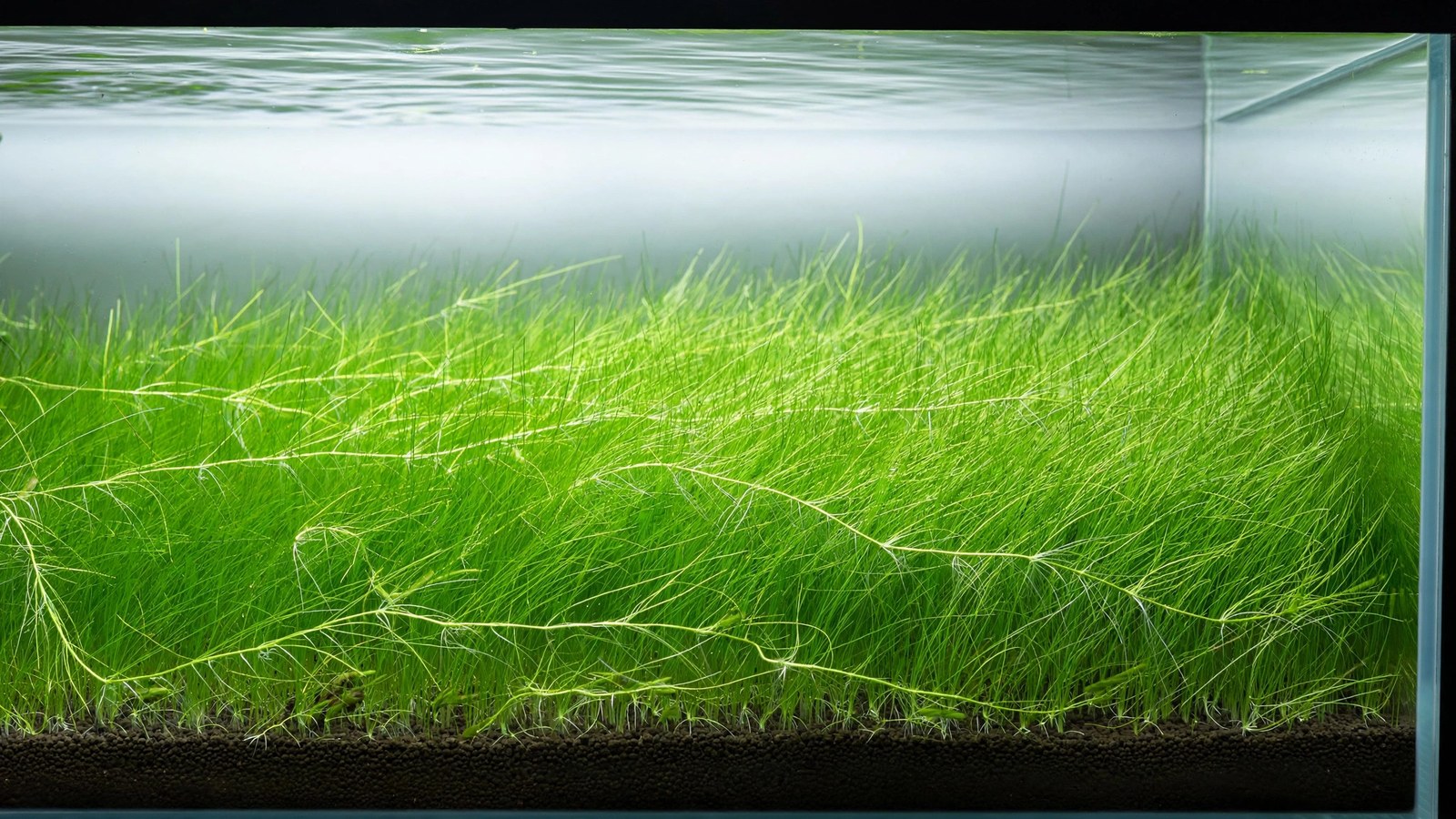
You bought six pots of dwarf hairgrass, shoved each one into the substrate as a single proud clump, and three months later the gaps between them are still bare gravel. Meanwhile a friend planted two pots into forty tiny pinches and had a full lawn in six weeks. The painful lesson every carpet grower learns eventually: dwarf hairgrass fills a tank fastest when you divide it most aggressively. The plant spreads through underground runners that colonize open substrate, and runners only grow outward from a growing point — so five growing points means five fronts of expansion, while forty means forty. This guide shows you exactly how to exploit that fact, plus the trimming, light, CO2, and root-feeding thresholds that turn a struggling patch into a dense carpet.
The short answer: To make dwarf hairgrass spread faster, split each pot into pinches of 3–5 blades and plant them on a 1-inch (2.5 cm) grid with roots buried about half an inch deep. Trim the tops short at planting, keep light strong (8–10 hours daily), aim for 20–30 ppm CO2, and feed the roots with tabs in a fine nutrient-rich substrate 2–3 inches deep. Expect new runner shoots in 1–2 weeks and a closed carpet in 6–10 weeks under those conditions.
Why Dwarf Hairgrass Stalls (and Tall Growth Is a Warning Sign)
Before fixing the spread, it helps to understand what dwarf hairgrass is actually doing under the substrate. It doesn't spread like a lawn from seed. Each tuft sends out horizontal underground stems — runners, technically stolons — and new plantlets sprout at intervals along them. More plantlets mean more runners, and runners radiating from many points fill gaps exponentially faster than runners radiating from a few.
That single fact explains most stalled carpets. The three stall patterns aquarists see over and over:
- It grows taller but won't carpet. This is the plant telling you light at substrate level is too weak. Tall, stretched, pale blades are a low-light response, not a growth phase to celebrate. Light reaching the substrate is what decides carpet versus stretch.
- Runners fail to connect. Usually a combination of weak light, poor substrate, and plugs planted too far apart (or in a few dense lumps). Dense clumps compete with themselves; sparse grids invite colonization.
- It melts right after planting and you assume it's dead. Tissue-culture and nursery stock is grown emersed (above water). The original blades almost always melt back as the plant converts to submersed form. This is normal, and the melt itself isn't the problem — digging the plant up every week to "check the roots" is. As the team at Ariumology puts it, you shouldn't uproot the plant unless no new shoots appear after a full month.
The 1-Inch Grid: Planting So Runners Fill the Gaps
This is the highest-leverage technique in the entire guide. It costs nothing, takes fifteen minutes, and routinely halves the time to a full carpet.
- Divide aggressively. Pull the purchased mat apart into small pinches of just 3–5 blades each. Yes, this feels wrong the first time. Yes, it is the correct move.
- Trim the roots to about half an inch. Long roots curl and fold under themselves; short roots point down and anchor instantly.
- Plant on a rough 1-inch grid. Push each pinch about half an inch deep into the substrate with planting tweezers, roots down, blades above the surface. Space plugs roughly one inch (2.5 cm) apart across the entire foreground.
- Firm and test. Gently wave water over the planted area with your hand. Any plug that lifts was planted too shallow — replant it deeper before livestock go in. A plug that floats free reads as "melt" to beginners but is really just uprooting, and it costs you a week of growth every time.
Why this works: forty pinches give you forty runner origins. Each one radiates stolons in every direction, and the gaps between pinches get attacked from all sides. A few dense clumps, by contrast, have their interior blades shading and starving each other while only the outer ring produces runners.
The Deep-Trim Trick That Forces Horizontal Growth
The moment your plugs are in, do the thing that feels like vandalism: take clean, sharp aquascaping scissors and cut every plug down to roughly one inch tall, removing all the clippings from the tank.
Two things happen when you do this. First, you strip off the tall emersed-grown blades that were about to melt anyway — they would have shaded the substrate, decayed, and fueled algae while contributing nothing. Second, the plant redirects its energy budget from maintaining doomed leaves into new submersed growth and, crucially, into runner production at the base.
This isn't a one-time trick. Once the carpet is established, trim it every 2–3 weeks, cutting about one-third of the blade length. Each trim pushes the plant to spread sideways instead of climbing, which is how you keep a lawn dense instead of letting it become a shaggy meadow. Always remove the cuttings — loose clippings left on the carpet decay, release ammonia, and give algae a foothold exactly where your new shoots are trying to emerge. A thorough walkthrough of the technique is in our guide to trimming carpeting plants.
Light: The Carpet-or-Stretch Decision
Light is the throttle for everything else in this guide. Without enough of it at the substrate, strong CO2 and heavy fertilizer only feed algae. With enough of it, even a low-tech tank can carry a slow but real carpet.
- Photoperiod: 8–10 hours daily. Shorter stalls growth; much longer hands the tank to algae.
- Intensity: medium-high to high at substrate level. What matters is what reaches the bottom, so a carpet shaded under driftwood or dense stem plants will fail in spots even under a strong fixture. Rearrange hardscape so light falls evenly, and clear overhanging stems away from the foreground.
- Spectrum: full-spectrum planted-tank lighting supports compact growth and green color; dim yellow light grows leggy blades.
If your current fixture leaves the foreground dim, a lighting upgrade does more for carpeting speed than any fertilizer ever will. A high-output full-spectrum fixture like the NICREW ClassicLED Plus ★4.5 is a common choice for planted tanks because it delivers serious PAR at the substrate without jumping to a full high-tech rig — and the difference in runner density once the foreground is properly lit is obvious within two weeks. Keep the 8–10 hour window consistent; a timer beats memory every time. For the full no-gas path, see how to grow aquarium plants without CO2.
CO2: The Single Biggest Spread Accelerator
You can carpet dwarf hairgrass without CO2 — plenty of low-tech aquarists have — but nothing else you do changes the timeline as dramatically. Injected CO2 at 20–30 ppm typically takes a carpet from "maybe by month four" to "closed in six to ten weeks," and the blades stay short, tight, and bright green instead of tall and sparse.
What to aim for:
- 20–30 ppm dissolved CO2, verified with a drop checker showing a steady lime-green through the photoperiod. Turn the gas on an hour before lights and off an hour before lights-out.
- Good distribution. CO2 dissolved in the water column still needs to reach the foreground. Position the diffuser where filter flow carries micro-bubbles across the carpet, and eliminate dead spots behind hardscape where new runners are trying to push.
- Stability over peak numbers. Fluctuating CO2 is worse than consistently moderate CO2 — swings trigger algae on the slow-growing hairgrass blades while barely helping the plant.
No CO2 setup? You still get a carpet — it just runs slower, often three to six months instead of six to ten weeks. In that case, maximize the other levers: the brightest light the tank can take without algae, the 1-inch grid, diligent trimming, and patience. If CO2 is on your roadmap, our guide to acclimating plants to CO2 covers the ramp-up without melting your stock.
Feeding the Roots: Substrate and Root Tabs
Dwarf hairgrass is a root feeder. Its fine roots pull the majority of their nutrition from the substrate, which is why the ground it sits in matters more than anything you dose into the water column.
- Use a fine, nutrient-rich substrate — aquasoil or a fine planted substrate — 2–3 inches (5–8 cm) deep. Runners travel easily through fine material; coarse gravel fights them. Inert sand works if you feed it, but bare gravel starves the carpet.
- Top up with root tabs. Even rich aquasoil depletes over 6–12 months, and a hungry foreground is one of the quiet causes of stalled carpets in mature tanks. Press root tabs into the substrate under the carpet every 4–6 weeks. Seachem Flourish Tabs ★4.6 are a widely used choice: push a tab into the substrate every 4–6 inches in a grid pattern around the carpet and they'll feed the runners directly at the root zone. A light liquid fertilizer 2–3 times weekly rounds out micronutrients for the water column, but the tabs do the heavy lifting for a root feeder like hairgrass.
- Keep the substrate uncompacted. If patches of carpet thin out after months of good growth, gently loosen the top centimeter — compacted substrate chokes the fine roots and blocks new runner tips.
Disclosure: the product links above are Amazon affiliate links. They cost you nothing extra and help support the site's free guides. I only recommend products I believe are genuinely useful for the topic — root tabs and strong lighting are two of the biggest real levers for a faster hairgrass carpet.
The Dry-Start Shortcut
If you haven't flooded the tank yet, the dry-start method is the single fastest way to a guaranteed carpet — dwarf hairgrass is one of the best species for it. Spread the pinches into moist substrate, cover the tank with plastic wrap to hold humidity, and mist daily. Over 4–8 weeks the plant builds a deep, anchored root system and spreads across the surface with unlimited atmospheric CO2. When the carpet is dense enough, flood the tank slowly. The established roots hold the lawn in place far more reliably than planting into a flooded tank, and you skip the entire floating-plug and initial-melt anxiety.
Realistic Timeline: What to Expect Week by Week
| Timeframe | High-tech (CO2 + strong light) | Low-tech (no CO2) |
|---|---|---|
| Week 1–2 | Emersed blades melt back; tiny new shoots appear from runners | Slower melt and adjustment; plugs anchor but little visible change |
| Week 3–4 | Runner tips visible between plugs; do the first real trim | First new submersed blades; some runner activity at edges |
| Week 6–8 | Gaps closing; carpet looks 70–90% connected | Noticeable fill-in; trim taller blades to encourage spread |
| Week 8–10 | Full closed lawn; shift to maintenance trimming every 2–3 weeks | Still filling; keep trimming and feeding roots |
| Month 3–6 | Thick, even carpet; divide and replant overgrown sections as needed | Full carpet achieved with patience and consistent care |
The single most common beginner error is judging the plant in week two. Melt is not death. Unless a full month passes with zero new shoots emerging, leave the plugs alone — every uprooting resets the runner clock. For a deeper look at growth rates across conditions, see how to make aquarium plants grow faster.
Frequently Asked Questions
How long does dwarf hairgrass take to form a full carpet?
With CO2 injection, strong light, and the 1-inch grid planting method, expect a closed carpet in 6–10 weeks. Without CO2, the same technique works but the timeline stretches to 3–6 months. Both timelines assume you don't repeatedly uproot the plugs to check on them.
Can dwarf hairgrass carpet without CO2?
Yes, but it will be slower and the blades tend to grow taller and thinner rather than short and dense. Maximize light (without inviting algae), use a nutrient-rich fine substrate with root tabs, plant on a tight grid, and trim regularly to force horizontal spread. The dry-start method also helps low-tech setups enormously.
Why is my dwarf hairgrass growing tall instead of spreading?
Tall, stretched growth is a low-light response — the plant reaches for light instead of sending runners sideways. Increase light intensity at the substrate, lengthen the photoperiod to 8–10 hours, clear shading from hardscape and neighboring plants, and trim the tall blades to redirect energy into runners.
Should I trim dwarf hairgrass right after planting?
Yes. Cut the plugs down to about one inch tall immediately after planting. The trimmed blades were mostly emersed-grown and would melt anyway; removing them lets the plant invest energy in new submersed growth and runner production instead of maintaining dying leaves.
Why is my dwarf hairgrass turning brown or melting after planting?
Nursery stock is grown emersed (out of water), so the original blades melt as the plant converts to submersed form. This is normal and not a reason to panic. New growth emerges from the runners and crown within 1–2 weeks. Only worry if a full month passes with no new shoots appearing.
How far apart should I plant dwarf hairgrass plugs?
About 1 inch (2.5 cm) apart, pushed roughly half an inch deep with tweezers. Wider spacing leaves gaps that take months to close; planting whole pots as single clumps is the slowest option of all because runners only originate from the outer edge of each clump.