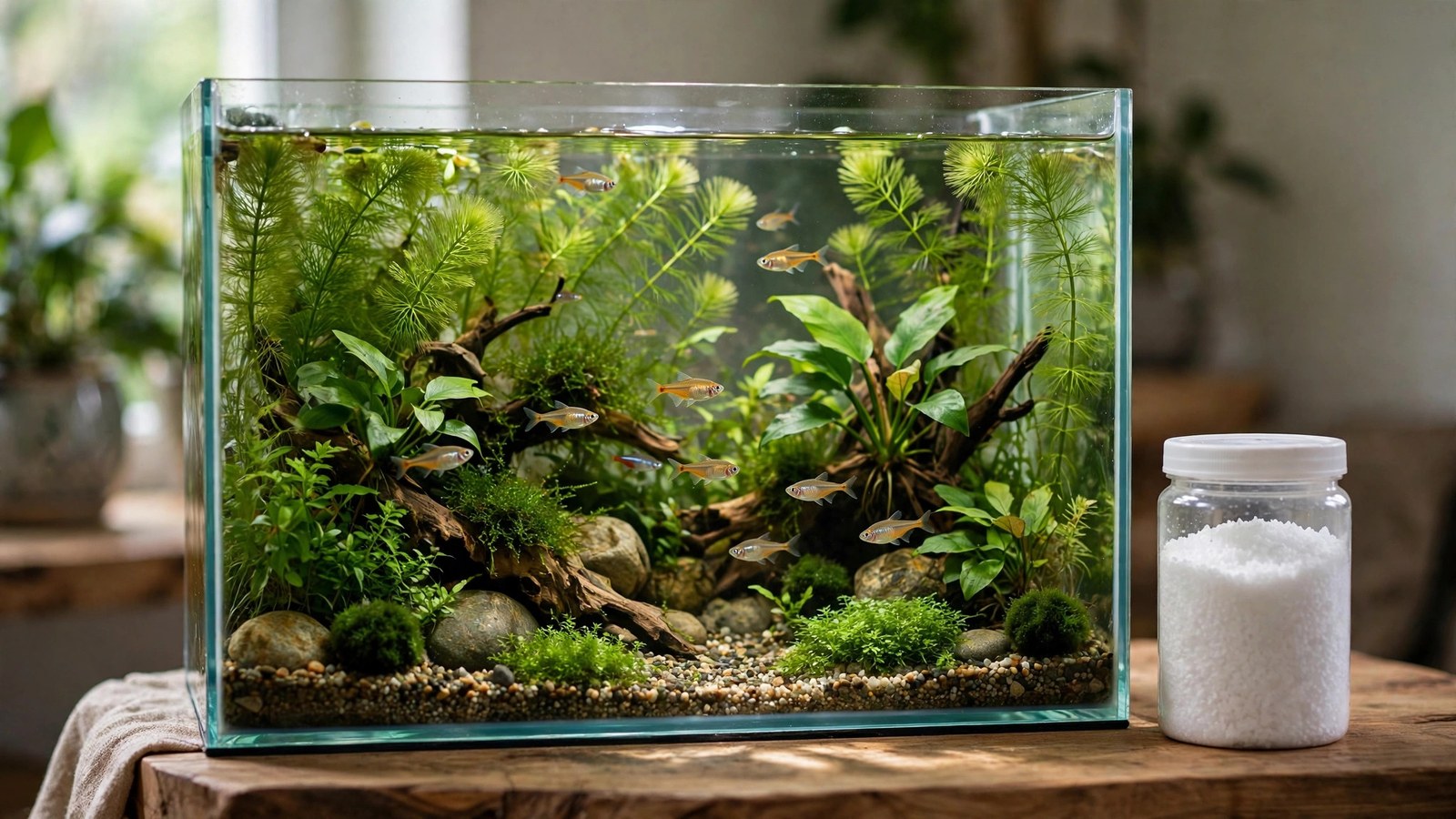
Your fish are scratching against the driftwood, white spots are dusting their fins, and every forum thread screams the same old remedy: salt. But when your tank is a living aquascape — Vallisneria curling toward the surface, crypts finally rooted after months of sulking — one careless handful of salt can do more damage than the disease you are trying to treat. So can you use aquarium salt with live plants? Yes — but only at the right dose, for the right duration, and ideally never inside the planted display tank itself.
Fish-health note: this article is general aquarium husbandry information, not veterinary advice. If your fish show signs of disease, have them assessed by an aquatic veterinarian or another qualified fish-health professional.
Why Salt Heals Fish but Hurts Plants
Aquarium salt acts on fish through osmosis. When the surrounding water gets saltier, water is drawn out of cells with thin, exposed membranes, while the fish's slime coat and regulated internal chemistry let it tolerate the change. Low doses also ease osmotic stress on fish with damaged skin by bringing the water closer to the saltiness of their blood. That combination is why hobbyists have used salt for decades as a general-purpose, low-cost husbandry aid.
Plants suffer the same force with no defense. Dissolve enough salt to harm parasites — roughly 1 tablespoon per gallon, about 4.5 parts per thousand — and water is pulled out of leaf cells instead of in. Membranes rupture, and the plant goes translucent, then brown, then to mush. Anyone who has watched a Vallisneria bed collapse overnight after a heavy salt dose knows how fast "melting" happens.
The deciding factors are concentration and duration. A five-minute dip barely registers for hardy species, but the ten-to-fourteen-day treatment windows fish diseases demand turn mild stress into total tissue loss. Fish medicine needs time — and time is what kills plants.
Which Plants Survive Salt — and Which Don't
Not all plants react equally. Thick-leaved, slow growers like Anubias and Java fern shrug off salt levels that dissolve delicate stem plants, which take the hit first. Research on Vallisneria shows survival dropping past roughly 5 parts per thousand (about 1 tablespoon per gallon) — right at the boundary of a standard therapeutic fish dose.
| Plant | Salt tolerance | What happens at 1–2 tsp per gallon for 7–14 days |
|---|---|---|
| Java fern (Microsorum pterotoides) | High | Usually fine; older leaves may spot |
| Anubias species | High | Minimal damage; growth pauses |
| Java moss (Taxiphyllum barbieri) | Moderate–high | Tip browning; recovers quickly after removal |
| Hygrophila polysperma | Moderate | Some yellowing; rebounds fast |
| Bacopa monnieri | Moderate | Lower leaves may drop |
| Limnophila sessiliflora | Moderate | OK short-term; long soaks thin lower foliage |
| Amazon sword (Echinodorus) | Moderate | Outer leaves melt; crown usually survives |
| Rotala rotundifolia | Low–moderate | Stunted tips and leaf drop within a week |
| Cryptocoryne species | Low | Prone to "crypt melt"; roots often regrow |
| Vallisneria species | Very low | Goes translucent and disintegrates within 2–5 days |
| Hornwort (Ceratophyllum demersum) | Very low | Needle shedding begins almost immediately |
| Elodea / anacharis | Very low | Rapid melting; first to show damage |
One caveat: gradual changes hurt less than sudden ones — ramping the dose over 24 hours causes far less melting than dumping it all at once.
Invasive-species responsibility note: Hygrophila polysperma is a federally listed noxious weed in the United States. Never release it — or any aquarium plant — into local waterways, and check your local regulations before buying or planting it.
Salt Treatment Approaches Compared
Four basic approaches sit on a sliding scale from plant-safe to plant-lethal:
| Method | Typical dosage | Duration | Common hobby use | Plant safety |
|---|---|---|---|---|
| Salt dip (fish in, fish out) | 1 tbsp per gallon, separate bucket | 5–15 minutes daily for 3–5 days | Commonly used for short external treatments; plants never touch salt | Excellent — plants never touch salt |
| Hospital tank dosing | Start at 1 tbsp per 3 gallons; increase to 1 tbsp per 2 gallons if needed (up to 10 days, per common hobby practice) | 4–14 days | The standard hobby approach when fish need salt — display plants stay untouched | Excellent — display plants untouched |
| Display tank tonic dose | 1 tsp per gallon (one-time addition) | 7–14 days | Mild osmoregulatory support and slime-coat stimulation, per common hobby practice | Fair — hardy plants tolerate it; Vallisneria may still decline over two weeks |
| Display tank therapeutic dose | 1 tbsp per gallon or more | 10–21 days | The dose range hobbyists report using for serious external issues; expect major plant melting | Poor — expect major melting; only for tanks you are willing to replant |
| No-salt alternatives | Varies (see below) | Varies | Plant-friendly options hobbyists reach for when the display tank can't be avoided | Excellent |
The pattern is unmistakable: methods that keep salt out of the planted tank let you use full hobby-level doses with zero risk to your aquascape. Display-tank dosing is a gamble you will usually lose.
Aquarium Salt With Live Plants: The Safe Protocol
When fish in a planted tank need salt, most hobbyists follow the same general routine below — not as a prescription, but as the standard practice that keeps salt away from plants. The dose ranges are those commonly reported in hobby sources; always observe your fish closely and stay conservative.
1. Move the fish to a hospital tank. A bare 10-gallon with a cycled sponge filter and heater — no substrate, no plants. Keep the affected fish there for the duration, not in the scaped tank.
2. Dose low and ramp up slowly. The range most commonly reported in hobby sources runs from about 1 tablespoon per 3 gallons up to about 1 tablespoon per 2 gallons. Dissolve the salt fully in a cup of tank water first (undissolved crystals can burn fish skin), and never raise the concentration by more than roughly half in a single day.
3. Observe on a schedule. Check twice daily. Hobbyists commonly keep fish at these doses for roughly 4–14 days while watching behavior closely. Gasping or listlessness after a dose increase means an immediate 50% water change.
4. Return fish home gently. After treatment, do not dump hospital-tank water into your display. Net the fish out and acclimate them back into the display like a new purchase — the plants and bacteria there never got salt, and you want to keep it that way. Meanwhile, your display tank sat unsalted the whole time. This is the right moment to get back on your regular water change routine, since stable water quality prevents the stress that invited the disease in the first place.
Getting Salt Out After Treatment
Salt does not evaporate, plants do not consume it, and filters do not break it down. It leaves one way: water changes. If salt went into the planted display, you need a deliberate removal plan.
The math is simple dilution: each 50% water change removes half the salt, so three of them cut a full therapeutic dose to roughly 1/8 — about 0.5 parts per thousand, which even sensitive plants handle fine. A practical schedule:
- Days 1–3: 30–40% daily, knocking the concentration down fast while plants are most vulnerable.
- Days 4–7: 30% every other day. By week's end, a therapeutic dose is typically down to trace levels.
- Confirm with a TDS meter: when the reading matches your pre-treatment baseline, the salt is gone.
Match temperature and dechlorinate every change, and vacuum lightly — a recovering tank does not need its substrate disturbed too. Melted plants usually push new growth from roots or crowns within one to three weeks, and steady nutrition matters more than any additive. One exception: in the fragile first 90 days of a new aquascape, salt damage stacks on transplant shock, so be especially conservative.
No-Salt Alternatives When Plants Matter Most
Sometimes treating in the display tank can't be avoided — catching every fish in a large school may be impractical, or a fish may be too weak to survive netting. Plant-friendly alternatives are worth knowing about for those cases.
Heat instead of salt: gradually raising the display temperature to around 86°F (30°C) for up to two weeks — increasing 1–2 degrees per day, with extra surface agitation since warm water holds less oxygen — is a commonly reported hobby practice for display tanks where salt is off the table. Most plants, including Vallisneria and crypts, generally tolerate two weeks of heat far better than two weeks of therapeutic salt.
Methylene blue: another option hobbyists use in display tanks, since it generally does not melt leaves. It stains silicone and decor blue — use it in the display only if you can accept the staining.
Epsom salt is not aquarium salt. Epsom salt is magnesium sulfate — chemically a different compound from aquarium salt (sodium chloride), and the two are not interchangeable.
Skip the tonic-dose habit. Adding "a little salt just because" is an old goldfish-book recommendation with no benefit for freshwater fish and a slow, cumulative cost to plants. Salt's real uses — parasite control, nitrite-toxicity blocking, osmoregulatory support — are targeted treatments, never permanent additives. Spend the effort on keeping leaves algae-free instead of salting the water.
Frequently Asked Questions
Will one teaspoon of salt per gallon kill my plants?
Almost certainly not in the short term. One teaspoon per gallon is roughly 1.5 parts per thousand salinity, which most plants tolerate for a week or two. Damage becomes likely only at sustained therapeutic doses (1 tablespoon per gallon, about 4.5 ppt) or after many weeks of low-level exposure. Vallisneria and hornwort are exceptions — they can decline even at tonic doses, so the hospital-tank approach is still safer.
Which aquarium plants handle salt best?
Java fern, Anubias, and Java moss are the toughest — their thick tissues let them ride out salt levels that melt delicate species. Bacopa, Hygrophila, and Amazon swords sit in the middle and usually recover fully once salt is removed. Vallisneria, hornwort, and Elodea are the most salt-sensitive and show damage first. When in doubt, assume sensitivity and treat fish in a separate tank.
Can I use Epsom salt instead of aquarium salt for sick fish?
No — they are different compounds with different uses. Epsom salt is magnesium sulfate; aquarium salt is sodium chloride. They are not interchangeable, and swapping one for the other won't do the job the other is meant for. Keep both on hand, but never substitute one for the other.
How do I remove salt from a planted tank after treatment?
Water changes are the only method, since salt does not evaporate or get filtered out. A practical schedule: 30–40% daily for three days, then 30% every other day for a week. Three 50% changes reduce a full therapeutic dose to roughly one-eighth. Use a TDS meter to confirm the water has returned to its pre-treatment baseline.
Is salt at plant-safe doses actually effective against fish disease?
Barely, by most hobbyists' accounts. The tonic dose most plants tolerate (1 teaspoon per gallon) is generally described as mild osmoregulatory support, while the dose ranges typically used for treatment start around 1 tablespoon per 2–3 gallons — right where sensitive plants begin suffering. This mismatch is why the hospital tank is the standard recommendation: a full hobby dose on the fish, zero dose on the plants.
Can I salt-dip new plants to kill snails and algae before adding them?
You can, but bleach dips are more reliable for the same job. A 5-minute dip at 1 tablespoon per gallon kills many snail eggs and some algae — but it can also melt delicate plants like Vallisneria on contact. Always test the dip on a spare trimming first, and never dip plants you cannot afford to lose.
The Bottom Line
Salt remains one of the most widely used tools in the hobby — cheap, well documented, and backed by sources ranging from the University of Florida's aquaculture extension to peer-reviewed research on plant salinity tolerance. The mistake is not using salt; it is using it in the wrong tank. Keep a bare hospital tank ready, dose the fish there, and your aquascape never pays for their recovery.