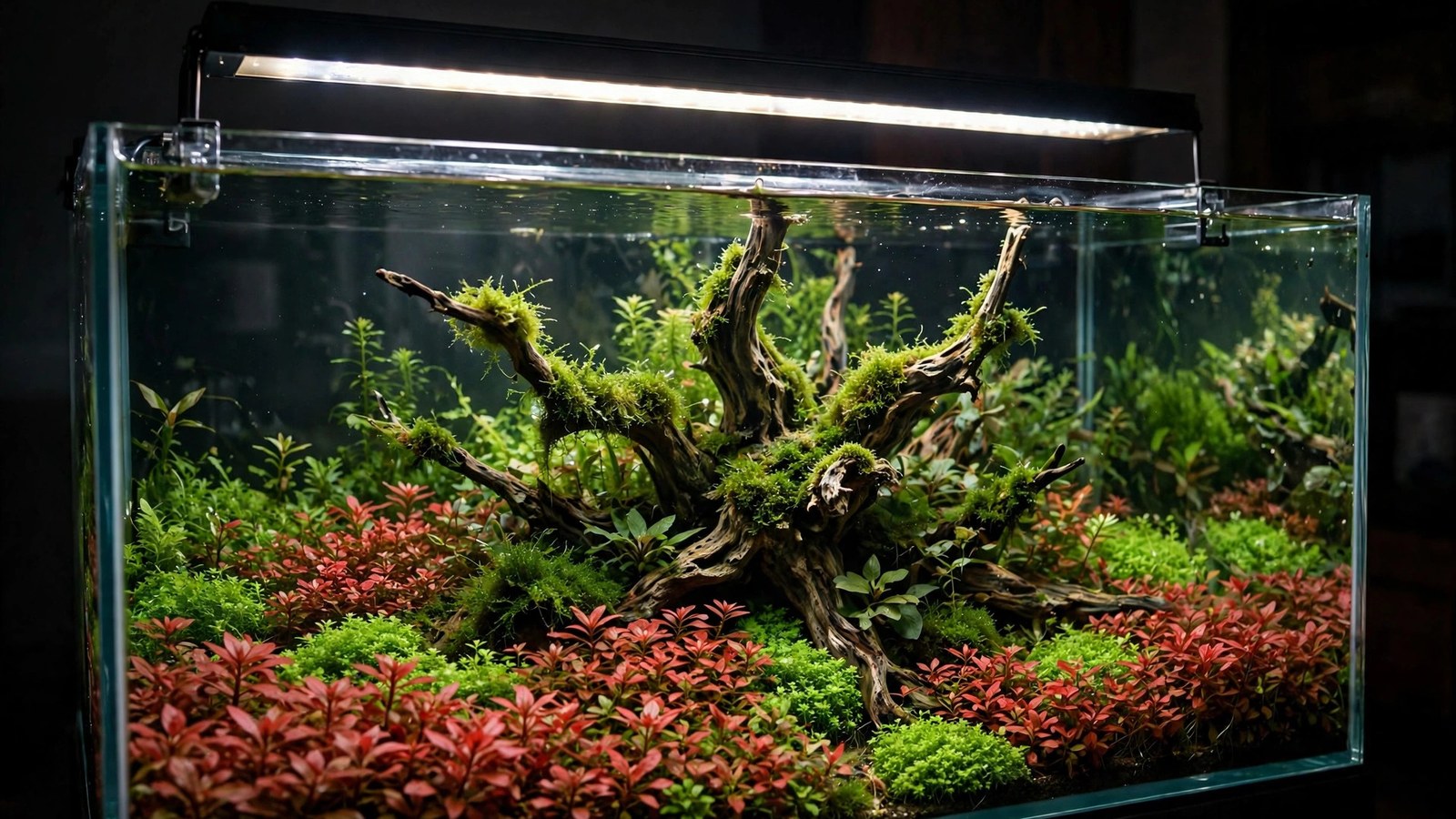
Ask ten aquascapers which light belongs over a planted tank and you will hear two names more than any others: the Fluval Plant 3.0 and the Chihiros WRGB 2. They cost roughly the same in most size classes, they both dim from an app, and both will grow plants. So picking wrong here is not about wasting money on junk — it is about spending real money on strengths you will never use. Buy the Chihiros for red stems and run it at full blast without CO2, and you bought an algae machine. Buy the Fluval for a high-tech red-plant tank, and you will always wonder why your Alternanthera looks salmon-pink instead of crimson.
Short answer: The Chihiros WRGB 2 is worth the money if you keep (or plan to keep) demanding red stems and carpets with CO2 injection — its RGB-heavy spectrum renders reds and contrast the Fluval Plant 3.0 cannot match. The Fluval Plant 3.0 is worth the money if you want the smoothest app experience, full IP67 waterproofing, and a 3-year warranty, especially for low- to medium-light tanks. Match the light to your plants, not to the brand name.
Spectrum and color: where the money actually goes
This is the comparison's real battlefield. Both fixtures are "full spectrum," but they arrive there by opposite routes, and the difference shows up the moment red plants enter your tank.
The Chihiros WRGB 2 is built around RGB LEDs with a dedicated white channel — the "WRGB" in the name. That RGB-dominant mix pumps out deep reds and blues that make Alternanthera reineckii glow crimson, Rotala turn orange at the tips, and fish colors pop against green foliage. Reviewers and competition aquascapers consistently point to this as the WRGB II's defining trait: The 2Hr Aquarist's 2026 LED guide ranks the Chihiros WRGB II among the RGB specialists that lead "for outright performance and visual quality," while noting the Fluval 3.0 stays useful "within their colour limits" for programmable convenience.
The Fluval Plant 3.0 takes the other path: 336 LEDs on the 46W model (168 and 252 on the smaller sizes) across 6 independently controllable color channels, biased toward a crisp white output with red, blue, green, and pink channels to tint. It is the more flexible generalist. Greens look clean and natural, low- and mid-light plants grow steadily, and the 6-channel control lets you tune a pleasing look. But white-dominant arrays cannot fake the deep-red punch of dedicated RGB emitters — several forum keepers who switched from a Fluval 3.0 to a WRGB II report the reds were the first and biggest visible change, along with stronger contrast across the whole scape.
The practical takeaway: if your plant list is Anubias, Java fern, crypts, and swords — all green, all forgiving — the spectrum gap barely matters and either light grows them beautifully. If your dream tank is a Dutch-style forest of red stems or a high-contrast Iwagumi with red accents, the Chihiros earns its price on day one.
Apps and daily control
Both lights are Bluetooth-only out of the box and both offer sunrise/sunset ramps, per-channel dimming, and timers — no external controller or hub required. The difference is polish.
The Fluval Plant 3.0 runs on the FluvalSmart app, which is widely regarded as the most refined lighting app in the mainstream aquarium trade: full 24/7 programmable cycle, preset modes, weather effects, and six-channel sliders. It is the light you buy your non-hobbyist partner can operate. One known quirk: the 3.0's clock could reset after a power outage, forcing you to re-sync the schedule — an annoyance reviewers note the newer Plant 4.0 fixes alongside higher PAR output and an improved app.
The Chihiros WRGB II runs on the My Chihiros app over Bluetooth, with color-channel and temperature adjustment, sunrise/sunset, and preset effects. It is capable and gets the job done, but keepers describe it as functional rather than delightful — and the English documentation is thinner than Fluval's. (If you want Wi-Fi control on the Pro editions, Chihiros sells a separate Wi-Fi hub; Bluetooth control is built in.)
For a set-and-forget schedule — lights on at 8, ramp to full by 10, dim at dusk — both apps work. If app friction matters to you, or you have ever rage-quit a pairing screen, give the Fluval the edge.
Build, mounts and waterproofing
The Fluval Plant 3.0 is IP67 fully waterproof — it survives submersion, splashes, and condensation without drama. In a hobby where lights sit centimeters above open water and humidity is constant, that rating is not marketing fluff; it is the single most reassuring spec on the sheet.
The Chihiros WRGB II line is splash-resistant rather than waterproof (the Pro lists IP43), which is fine for normal use — keepers run them for years — but it means you should think twice about mounting one directly over an open-top tank in a humid fish room, and you definitely should not expect it to survive a drop into the tank. The WRGB II's party trick is physical design instead: a slim aluminum profile, wide light spread from its diffuser, and adjustable brackets covering 30–120 cm tank widths, plus optional hanging kits and shades for a cleaner look.
Mounting-wise both rest on the rim with extendable brackets and both offer hanging kits. The Chihiros's wider spread covers front-to-back depth better on wide tanks; the Fluval's extendable brackets are sturdier and simpler for standard rimmed tanks.
Warranty and support
Fluval backs the Plant 3.0 with a 3-year warranty and has one of the best-established dealer and support networks in the aquarium trade in North America and Europe. If a driver fails in year two, you deal with a known company and a known process.
Chihiros lists a 2-year warranty, but the practical experience depends heavily on where you buy. Chihiros is a Chinese manufacturer sold through regional distributors and specialty shops; warranty claims route through your seller. Buy from an established aquascaping retailer with a real returns policy rather than the cheapest gray-market listing — Green Aqua's Chihiros buying guide is a solid reference for which editions suit which tanks. The money you save on a bargain listing evaporates fast if the unit arrives dead.
Match the light to your tank, not the other way around
Here is where honest buying advice beats spec sheets. Run through these three questions:
1. Do you inject CO2? If yes, you can actually use the WRGB II's full output on demanding stems and carpets — this is the light's home turf. If no, both lights must be dimmed well below maximum, and the cheaper choice (or a discounted 3.0) usually wins, because you are paying for PAR you will never safely use.
2. What grows in the tank? Red stems, Ludwigia, Alternanthera, red tiger lotus — the Chihiros's RGB spectrum earns its keep. Green-only low-tech (Anubias, ferns, crypts, mosses) — the Fluval's app and waterproofing are the more relevant strengths, and either light grows them.
3. How deep is the tank? On standard 45–60 cm deep tanks both work. On deep tanks (60 cm+), the WRGB II's higher-output editions (Anniversary or Pro) hold intensity at depth better — one reason the Pro exists.
| Your setup | Better pick | Why |
|---|---|---|
| High-tech, CO2, red stems | Chihiros WRGB 2 | RGB spectrum renders reds and contrast Fluval cannot match |
| Low-tech, green plants, first planted tank | Fluval Plant 3.0 | Polished app, IP67 waterproofing, 3-year warranty |
| Deep tank (60 cm+), demanding carpet | WRGB II Pro / Anniversary | Higher output holds PAR at depth |
| You want one light for years across rescapes | Fluval Plant 3.0 | Support network and warranty favor the long game |
The verdict: which is worth your money
Neither light is a bad buy — they are simply priced for different priorities, and "worth the money" depends on which priority is yours.
Buy the Chihiros WRGB 2 if color is the point of your tank. Its RGB array is the single biggest visible upgrade you can make to red plants and overall scape contrast, the My Chihiros app covers every control a hobbyist needs, and the Anniversary and Pro editions give you a clear upgrade path as tanks get deeper. Check current pricing here: Chihiros WRGB II on Amazon ★5.0.
Buy the Fluval Plant 3.0 if you value the ownership experience: the best lighting app in its class, full waterproofing, and a 3-year warranty from a manufacturer your local shop can actually reach. It grows everything the average planted tank holds, and discounted 3.0 units are a genuine bargain now that the 4.0 exists. Check current pricing here: Fluval Plant 3.0 on Amazon ★4.6.
Affiliate disclosure: AquaVerdia is reader-supported. If you buy through the Amazon links above, we may earn a commission at no extra cost to you — it helps fund independent, ad-free guides like this one.
Still deciding? Our guide to the best aquarium lights for planted tanks compares both fixtures against budget and high-end alternatives by tank size.
Frequently asked questions
Is the Chihiros WRGB 2 better than the Fluval Plant 3.0?
For red plants and color contrast, yes — its RGB-dominant spectrum renders reds the Fluval's white-heavy array cannot match. For app polish, waterproofing (IP67), and warranty (3 years), the Fluval 3.0 is the better pick. Choose by your plant list, not by brand loyalty.
Can I use the Chihiros WRGB 2 without CO2?
Yes, but dim it. The WRGB II is powerful enough to grow algae on a low-tech tank at full output. Start around 50–60% intensity with a 6–8 hour photoperiod and increase only as plants demand it and your maintenance routine keeps up.
Should I buy the Fluval Plant 3.0 or the newer 4.0?
The 4.0 offers higher PAR, better color rendering, an improved app, and fixes the 3.0's clock-reset-after-power-outage quirk. If the price difference is small, buy the 4.0; if the 3.0 is meaningfully discounted, it remains an excellent light.
Does the Chihiros WRGB 2 work without the app?
You need the My Chihiros app (Bluetooth) to unlock its scheduling, dimming, and color control — there is no onboard display. Basic operation without the app is limited, so factor in a smartphone you are willing to pair with it.
What size Chihiros WRGB 2 do I need?
Match the model number to your tank length in centimeters — a WRGB II 60 suits 60–80 cm tanks, and the adjustable brackets give some flexibility. For tanks deeper than 60 cm, consider the higher-output Anniversary or Pro editions to hold intensity at the substrate.