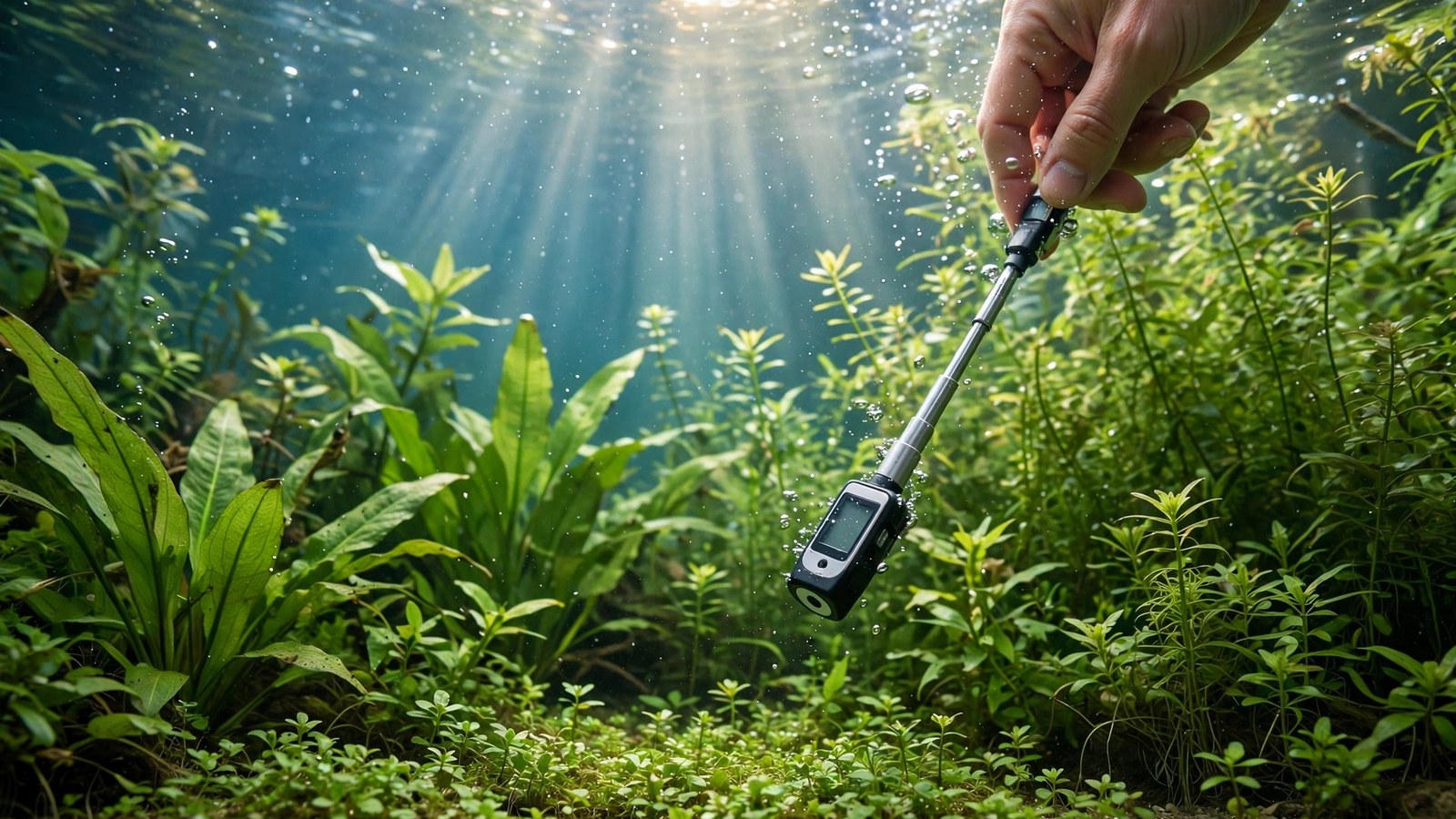
A familiar story plays out in planted-tank forums every week: someone upgrades to a powerful LED, runs it at full blast because brighter must be better, and watches their plants melt while hair algae moves in like it owns the place. The light was not defective. It was delivering nearly twice the PAR the tank needed, and nobody measured it. If you are shopping for the best PAR meter for aquarium plants under 100 dollars, you are trying to replace that guesswork with a number — and you are right to, because light is the one input you cannot judge by eye.
Short answer: The best PAR meter for aquarium plants under 100 dollars is the DANOPLUS DP-355 quantum PAR meter — a true 400-700 nm sensor that reads PPFD underwater, stores readings, and is the only budget meter in this price band with genuine hobbyist traction. It was in stock on Amazon at the time of writing. If you would rather spend nothing, the Photone phone app gets you within roughly 5% of a real meter for relative comparisons when used exactly per its instructions.
Why Guessing Light Levels Costs You Plants
Every number printed on a light box is designed to sell you the light, not to grow your plants. Watts measure electricity, not photons — a 30 W LED and a 30 W fluorescent deliver wildly different usable light. Lumens and lux measure brightness as human eyes see it, heavily weighted toward green-yellow light that plants use least efficiently. Kelvin ratings describe color appearance, not intensity at all.
PAR — photosynthetically active radiation, the 400-700 nm band that drives photosynthesis — is the only metric that measures what plants actually receive. When a light is too strong for the CO2 and nutrients available, you do not get faster growth; you get algae, because algae exploit the surplus energy that your plants cannot use. When it is too weak, stems stretch tall and leggy with bare gaps between leaf nodes, and carpets creep instead of spreading. Both failure modes look like "something is wrong with my tank" when the real problem is a number nobody measured.
A meter ends the argument in one afternoon. Map the substrate in a grid and you will often find the center reads double the corners — which explains exactly why the middle of the tank thrives and the corners melt. You will also catch the quiet PAR thieves: a dirty glass lid, tannin-stained water, or aging LEDs can cut delivered light far below what the fixture "should" produce.
What a Budget PAR Meter Must Get Right
Not everything labeled "PAR meter" on a marketplace deserves the name. A lux meter with a PAR sticker on it is still a lux meter. Before spending anything, check these five things:
| Requirement | Why it matters | What to check |
|---|---|---|
| True 400-700 nm quantum sensor | Lux sensors weight light for human eyes and misread LED spectra badly | Listing specifies a PAR/PPFD sensor, not just "light meter" |
| Submersible sensor | Air readings run higher and mislead; the number that counts is at the substrate, underwater | Sensor rated for underwater use, ideally on a wand or pole |
| PPFD plus DLI readouts | DLI (daily light integral) combines intensity with photoperiod — 60 PAR for 6 hours is not 60 PAR for 10 hours | Menu or specs mention DLI |
| Reading memory | You will take a dozen readings per tank; writing each down by hand gets old fast | Stores at least several dozen values |
| Independent testing | Budget sensors drift; a meter someone has checked against a reference is worth more than an untested one | Hobbyist comparisons (forums, YouTube testers) against Apogee or similar |
One more honest note: even good budget sensors can drift over time. If precision ever matters to you — say, before buying an expensive light based on a reading — compare your meter against a known reference occasionally. For the everyday jobs (is this corner too dark, did raising the light fix the algae, has my LED faded after three years), a budget meter is plenty.
The Best PAR Meter Under 100 Dollars: DANOPLUS DP-355
The DANOPLUS DP-355 is the budget pick that clears every bar above while staying under the hundred-dollar ceiling. It is a full-spectrum quantum PAR meter — a genuine 400-700 nm sensor reporting PPFD — rather than a lux meter wearing a costume. The sensor records up to 100 measured values with a real-time display of recent readings, so a full tank grid takes minutes without a notebook. A tripod socket on the back lets you position it at repeatable heights, which is exactly how you build a comparable before-and-after record when you raise a fixture or change a dimmer setting. It was in stock and available on Amazon at the time of writing, with Prime fulfillment mentioned on the listing.
Affiliate disclosure: the link below is an Amazon affiliate link. As an Amazon Associate I earn from qualifying purchases, at no extra cost to you — it is how this site funds its guides.
Check the DANOPLUS DP-355 PAR meter on Amazon ★5.0 — the standout budget quantum sensor for planted tanks under the hundred-dollar mark.
Honest limitations, because no budget meter is perfect: it will not tell you anything about spectrum — two lights reading 60 PAR can grow red plants very differently — and it does not track photoperiod, so pair it with a consistent timer (see our aquarium light timer guide). Treat its absolute numbers as accurate-to-useful rather than laboratory-grade, and it will pay for itself the first time it stops you from buying a light you did not need.
The Free Alternative: The Photone App
If your budget for this is zero, the Photone app is the option hobbyists keep coming back to — with a clear-eyed caveat. It is not a PAR meter. It uses your phone's ambient light sensor, which measures lux, and converts with an approximate factor. For absolute numbers ("do I have 50 or 80 PAR?") that conversion is not trustworthy, because the factor shifts with spectrum.
Where it earns its place is relative comparisons: is this corner dimmer than that one, is the new light actually brighter than the old one, did cleaning the lid change anything? One hobbyist on Reef2Reef tested the app against a real meter and found it within about 5% when used exactly per the app's instructions — fiddlier than a meter, but genuinely useful for calibrating your sense of a tank's light zones.
What Sits Above the Budget (and Whether You Need It)
Two names come up constantly once you outgrow the budget tier, and both are worth understanding so you can decide you do not need them yet.
The VBR-Aqua is the community's favorite step-up: multiple reef and planted-tank keepers on Reef2Reef use it as their daily meter, and one detailed comparison against an Apogee SQ-500 found the VBR reading about 3.5% low in air and essentially spot-on underwater — 117 versus 117.5 — with only about a 1% gap under heavy-violet LED settings. That is remarkable agreement for the money. One caveat from the same threads: a newer revision reportedly needs a 1.1x correction multiplier to match the Apogee, so check which version you are buying. It costs more than this guide's budget ceiling, which is the only reason it is not the pick here.
The Apogee MQ-510 is the professional gold standard — the meter reviewers and serious aquascapers measure against. It is also several times the budget ceiling, which is why our standing advice in the PAR meter guide is to borrow one from a fish club or rent one for a setup weekend rather than buying. For most hobbyists with one or two tanks, a single borrowed afternoon of measurements delivers nearly all the value at none of the cost.
How to Use Your Readings: Setting Light Height and Intensity
Owning the meter is step one; this is the part that actually fixes tanks. Work through it once per tank and write the numbers down — "75 PAR at substrate, light 10 inches above water, 80% power" is a reproducible record; "75 PAR" alone is trivia.
1. Map before you plant. With the tank filled and the light at its planned height, take substrate-level readings in a grid: center, four mid-points, four corners. This is your baseline. If the center-to-corner ratio is worse than about 2:1, raise the fixture — height evens out spread faster than anything else.
2. Aim for your path's target. Measured at the substrate: 30-50 PAR is the low-tech sweet spot — enough for lush growth of easy plants, low enough to stay within ambient CO2 supply. For high-tech, start at 60-90 and increase only once the tank is stable with CO2 running. Above roughly 80 PAR without injected CO2, you are growing algae, not plants. These ranges line up with the 2Hr Aquarist lighting guide, which recommends starting even high-tech tanks modestly and tuning upward.
3. Change one thing, remeasure. Raised the light two inches? Dimmed to 70%? Cleaned the lid? Take the grid again. This is where a budget meter with reading memory earns its keep: you are building a cause-and-effect record of your specific tank instead of relying on someone else's fixture review.
4. Recheck yearly. LEDs fade — quality diodes lose output gradually over years, cheap ones faster. A tank that thrived for three years and slowly declines with no other changes is often just a dimmer light than it used to be. One measurement session settles the "is my light dying?" question instantly.
| Option | What you get | Best for |
|---|---|---|
| DANOPLUS DP-355 | True quantum sensor, underwater readings, 100-reading memory, tripod socket | Buying your own meter on a budget |
| Photone app | Free lux-based estimate; good for relative comparisons | Zero budget, finding dim zones |
| Borrowed Apogee | Reference-grade accuracy for one afternoon | One-time setup or pre-purchase verification |
Frequently Asked Questions
Can I use a lux meter instead of a PAR meter for aquarium plants?
Only loosely. Lux meters weight light for human vision, which overvalues the green-yellow light plants use least efficiently, so they misread LED aquarium spectra badly. They are fine for relative comparisons between similar lights but unreliable for absolute PAR targets. A true PAR meter, even a budget one, measures the 400-700 nm band plants actually use.
Are cheap PAR meters accurate enough for a planted tank?
For hobbyist decisions, yes. The use cases that matter — finding dim corners, checking whether a light upgrade is needed, detecting LED fade — need repeatability more than laboratory precision. Hobbyist testing of budget meters like the VBR-Aqua against an Apogee found agreement within a few percent, which is far better than the guessing it replaces. Skip only the meters that are secretly lux meters.
Do I need a PAR meter for a low-tech tank?
Strictly, no — plenty of beautiful low-tech tanks were built without one. But the most common low-tech failure is a light that is quietly too strong for the available CO2, which grows algae instead of plants. A single measurement session, even with a borrowed meter, tells you whether you are in the 30-50 PAR sweet spot or unknowingly running high light on a low-tech setup.
How do I measure PAR underwater without damaging the meter?
Use a meter with a submersible sensor — that is a core requirement in this guide, not a nice-to-have. Lower the sensor to substrate level and hold it steady for a few seconds per reading. For phone apps, use a waterproof phone pouch; keep in mind the phone is bulkier and harder to position precisely than a sensor on a wand. Never submerge a non-waterproof sensor.
What PAR should I target at the substrate for carpeting plants?
For dwarf hairgrass, aim for 60-80+ PAR at the substrate where the carpet grows, with pressurized CO2. Below about 50 PAR it survives but carpets slowly and sparsely. Demanding carpets like HC Cuba want the upper end of that range or more. Whatever the target, reach it by adjusting height and dimmer first, and confirm with the meter rather than assuming.
How often should I replace or recalibrate a budget PAR meter?
There is no fixed schedule. Budget sensors can drift, so compare yours against a known reference — a club loaner, a friend's meter, or published PAR data for your fixture — once a year or before any big purchase decision based on its numbers. If it suddenly disagrees wildly with a reference, trust the reference and replace the budget unit.