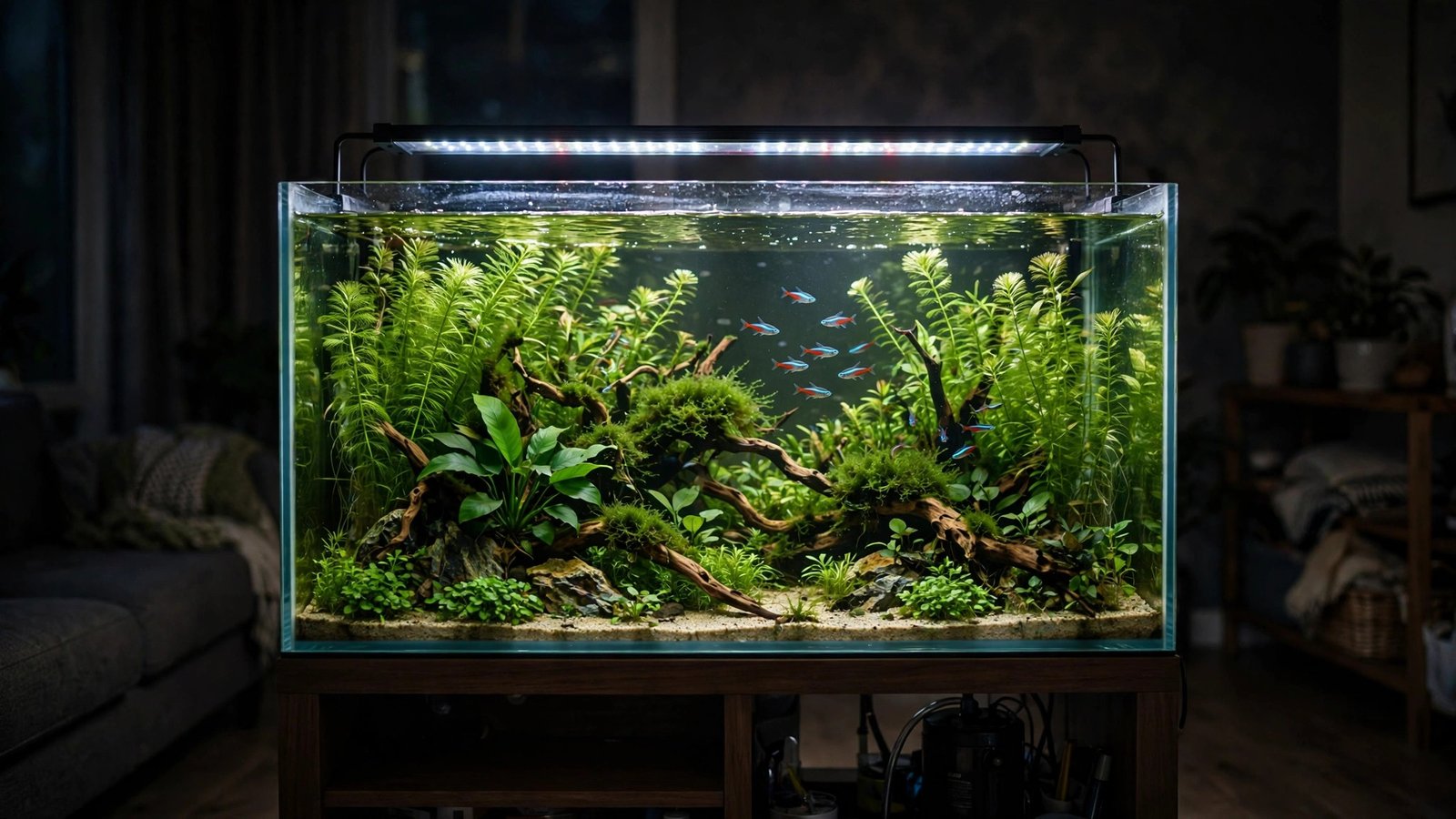
The first LED light you buy for a planted tank usually makes one of two expensive mistakes: it is either so weak your plants melt within a month, or it is so strong your tank turns into an algae farm before the plants root. hygger and NICREW own the budget end of the market precisely because they promise a middle path — but they are middle paths in very different ways. One sells you automation and set-and-forget lighting cycles; the other sells you raw output per dollar and a higher color-rendering spectrum. Pick the wrong one for your tank size and plant list, and you'll learn the difference the hard way.
Why This Comparison Matters for Beginners
Lighting is the engine of a planted tank. Too little and plants starve; too much and algae outcompetes them. Beginner forums are full of people who bought a bright light, ran it 12 hours a day, and spent three months fighting green water — the light was fine, the dose was the problem. hygger and NICREW both sit in the $30–$60 range for standard sizes, which is why the same question keeps coming up: which one actually grows plants without growing a crisis?
The honest answer is that both can. The difference is in how they behave in your hands: hygger tries to make lighting foolproof through automation, while NICREW hands you more manual control and more raw output. Your choice should follow from which failure mode you're more likely to commit — fiddling too much, or never getting the schedule right.
hygger Auto On Off: The Set-and-Forget Option
hygger's standout feature is its 24/7 lighting cycle, and it's genuinely well executed for the price. Switch the light into 24/7 mode and it runs a full simulated day on its own: an orange-tinted sunrise around 6 a.m., full white daylight through the afternoon, blue moonlight in the evening, then off overnight. You never touch a timer. For a beginner who just wants the tank lit consistently without learning light scheduling, this is the closest thing to plug-and-play in the budget category.
The fixture itself is a slim full-spectrum bar with 7 color modes, an adjustable brightness control, and extendable mounting brackets that fit most rimmed or rimless tanks in the listed size range. Newer models carry an IP68 waterproof rating and some ship with a built-in LCD monitor showing the current mode and timer settings. Color rendition sits around 85 CRI — good enough to make greens and fish colors look natural, though reds won't pop the way they do under a higher-CRI light.
Output-wise, hygger's standard models are moderate. Reviewers consistently report that plants thrive — java fern, anubias, crypts, vallisneria territory — but that demanding carpets (Monte Carlo, HC Cuba) and high-light red species are out of reach. That's not a flaw; it's the honest ceiling of an ~18-watt fixture, and for a first tank it's exactly the right ceiling, because it won't nuke a tank that's still finding its balance.
Tradeoffs worth knowing: hygger packs more features than NICREW at the same price, and some users report the occasional fixture that stops working after months of use — more electronics means more failure points. The DIY custom mode also uses a 15-minute color ramp rather than instant changes, which is harmless but surprises people expecting remote-control-style response.
NICREW ClassicLED Plus: The Output-Per-Dollar Option
NICREW takes the opposite design philosophy: fewer modes, more muscle. The ClassicLED Plus is a full-spectrum bar (white, blue, red, and green LEDs) with an in-line controller that handles on/off, brightness adjustment, and a built-in timer. There's no app, no 24/7 auto cycle, and no LCD — you set brightness and schedule once and it just runs.
What you get in return is more light for the money and better color rendering at roughly 90 CRI. In practice that means reds look redder and greens look more natural than under hygger's 85 CRI, and the higher output gives you more headroom: fast-growing stems and some carpeting attempts become realistic with good CO2 and nutrients. Third-party PAR comparisons put the NICREW SkyLED Plus at about 95 µmol/m²/s at 12 inches of depth — solid mid-range territory — and the ClassicLED Plus is marketed in the same "most plant types" bracket.
The tradeoff is control. The in-line controller is less elegant than hygger's 24/7 cycle, and the base models step through brightness levels rather than offering a true gradual sunrise/sunset (the ClassicLED Plus does advertise timed ramp-up). If you want that automatic day cycle, you either accept a hard on/off or add it yourself later. NICREW also offers the widest size range in the budget class (12–60 inches), so it's easier to size correctly for an odd-sized tank.
Head-to-Head: hygger vs NICREW
Here's how the two brands' flagship beginner fixtures compare on the factors that actually affect a planted tank:
| Factor | hygger Auto On Off | NICREW ClassicLED Plus |
|---|---|---|
| Standout feature | 24/7 auto sunrise-daylight-moonlight cycle | Adjustable brightness + ~90 CRI spectrum |
| Light output (18–24 in model) | Moderate — low-to-medium light plants | Moderate-plus — handles tougher stems |
| Timer | Built-in auto on/off, no programming | Built-in timer via in-line controller |
| Color rendition | ~85 CRI | ~90 CRI |
| Controls | Buttons / LCD on some models, DIY mode | In-line controller (no remote) |
| Waterproofing | IP68 on newer models | Splash-resistant |
| Size range | 12–55 in (varies by model) | 12–60 in |
| Warranty | 1 year typical | 1 year typical |
| Best for | Hands-off beginners, low-tech tanks | Budget growers wanting more intensity |
Notice what's not in the table: watts-per-gallon. LED wattage doesn't compare across brands the way it did with fluorescents — two 18-watt bars can deliver very different PAR because of LED efficiency and optics. Judge these lights by spectrum, CRI, and the plant list they'll support, not the number on the box.
The Beginner Verdict: Which Should You Buy?
Buy hygger if you want the tank lit correctly from day one with minimum input. The 24/7 mode is the single best anti-algae feature a budget light can have, because inconsistent schedules cause more beginner algae than weak lights do. It's the right pick for a first 10- or 20-gallon low-tech tank with easy plants.
Buy NICREW if you already have a plant list in mind that includes red ludwigia, rotala stems, or a carpeting attempt — the extra output and ~90 CRI give you more runway before you need to upgrade. It's also the better pick if you want one light that will still make sense after your second tank.
Skip both and spend more if your goal is a high-tech CO2 tank with dense carpets and red plants from day one. Neither fixture is designed for that; a Finnex Planted+ 24/7 or Fluval Plant 3.0 belongs in that conversation, and buying twice costs more than buying once.
Our Product Picks
Disclosure: links below are affiliate links. As an Amazon Associate I earn from qualifying purchases — it costs you nothing and keeps these guides free. I only recommend products that fit the article's advice, and prices change, so check the live listing before buying.
For a standard 20-gallon (24-inch) beginner planted tank, the hygger Auto On Off LED Aquarium Light (18–24 in) ★4.4 is the set-and-forget pick: full-spectrum output, built-in 24/7 sunrise-to-moonlight cycle, and extendable brackets that fit most 24-inch tanks. If you want more intensity and better color rendition for tougher plants, step up to the NICREW ClassicLED Plus LED Aquarium Light (18–24 in) ★4.6 with its adjustable in-line controller and ~90 CRI spectrum. Running a 29- or 40-gallon breeder? Size up to the NICREW ClassicLED Plus (24–30 in) ★4.5 instead — a too-short fixture leaves dark corners where algae moves in.
Sizing Guide: Match the Fixture to Your Tank
Beginners get this backwards more than anything else. Light intensity drops fast with distance and spread, so a bar that doesn't span the tank gives you a bright stripe and dim edges — and dim edges are where plants melt and algae colonizes.
| Tank | Length | Best fixture size |
|---|---|---|
| 10 gallon (standard) | 20 in | 18–24 in |
| 20 gallon long | 30 in | 24–30 in |
| 29 / 40 gallon breeder | 30–36 in | 24–30 in or 30–36 in |
| 55 gallon | 48 in | 48–55 in |
Mount the light centered and, if the fixture is at the short end of its range, accept that the last inch on each side will be softer — that's fine for hardscape or low-light plants, not for your carpeting attempt.
Frequently Asked Questions
Is hygger or NICREW brighter?
NICREW's ClassicLED Plus generally delivers more usable light for plants at a comparable size, with better color rendition (~90 CRI vs hygger's ~85). hygger counters with automation — its 24/7 cycle — rather than raw output. For easy plants the difference in brightness barely matters; for demanding stems and carpets, NICREW's edge is real.
Can I grow carpeting plants with these lights?
With the standard 18–24 inch models and no CO2 injection, treat carpeting as unlikely for demanding species like Monte Carlo or HC Cuba. NICREW gives you a better shot than hygger thanks to higher output, but reliable carpets at this budget need strong light plus CO2 plus lean dosing — three things these fixtures are designed to stay just under.
Do I need a separate timer with a hygger light?
No. The Auto On Off line's whole point is that the 24/7 mode handles the schedule internally — sunrise, daylight, moonlight, off — with no external timer or app. NICREW's ClassicLED Plus includes a timer in its in-line controller, so neither light needs a separate plug timer.
How many hours a day should a beginner run the light?
Start at 6–8 hours of full intensity. More hours grows algae faster than it grows plants in a new tank. Once plants are established and filling in — usually 6–8 weeks — you can extend to 8–10 hours if everything is clean.
Will these lights grow red plants?
They'll keep easy "red" plants like ludwigia repens alive and colored under NICREW's higher-CRI spectrum; under hygger they'll grow but stay greener. Truly red aquascapes need high-intensity light with strong 660 nm red output plus CO2 and nitrate limitation — a level above both budget fixtures.
Should I buy two budget lights instead of one expensive one?
Sometimes yes — two hygger or NICREW bars side by side on a wide tank can beat one premium fixture for spread, at similar cost. But you lose the refined controls (app, ramping) of a premium light, and mismatched aging between two cheap fixtures can give you uneven light a year later. For a first tank, one correctly sized fixture beats two mismatched ones.
The Bottom Line
For most beginners setting up their first planted tank, hygger's Auto On Off is the safer buy: the 24/7 cycle removes the single biggest beginner error (inconsistent lighting) and its output ceiling is a feature, not a bug, for low-tech tanks. NICREW's ClassicLED Plus is the smarter buy if you want more light per dollar, richer colors, and room to grow into demanding plants without buying a second light next year. Either way, match the fixture to your tank length and start at 6–8 hours a day — get those two things right and both lights will grow a great beginner tank.