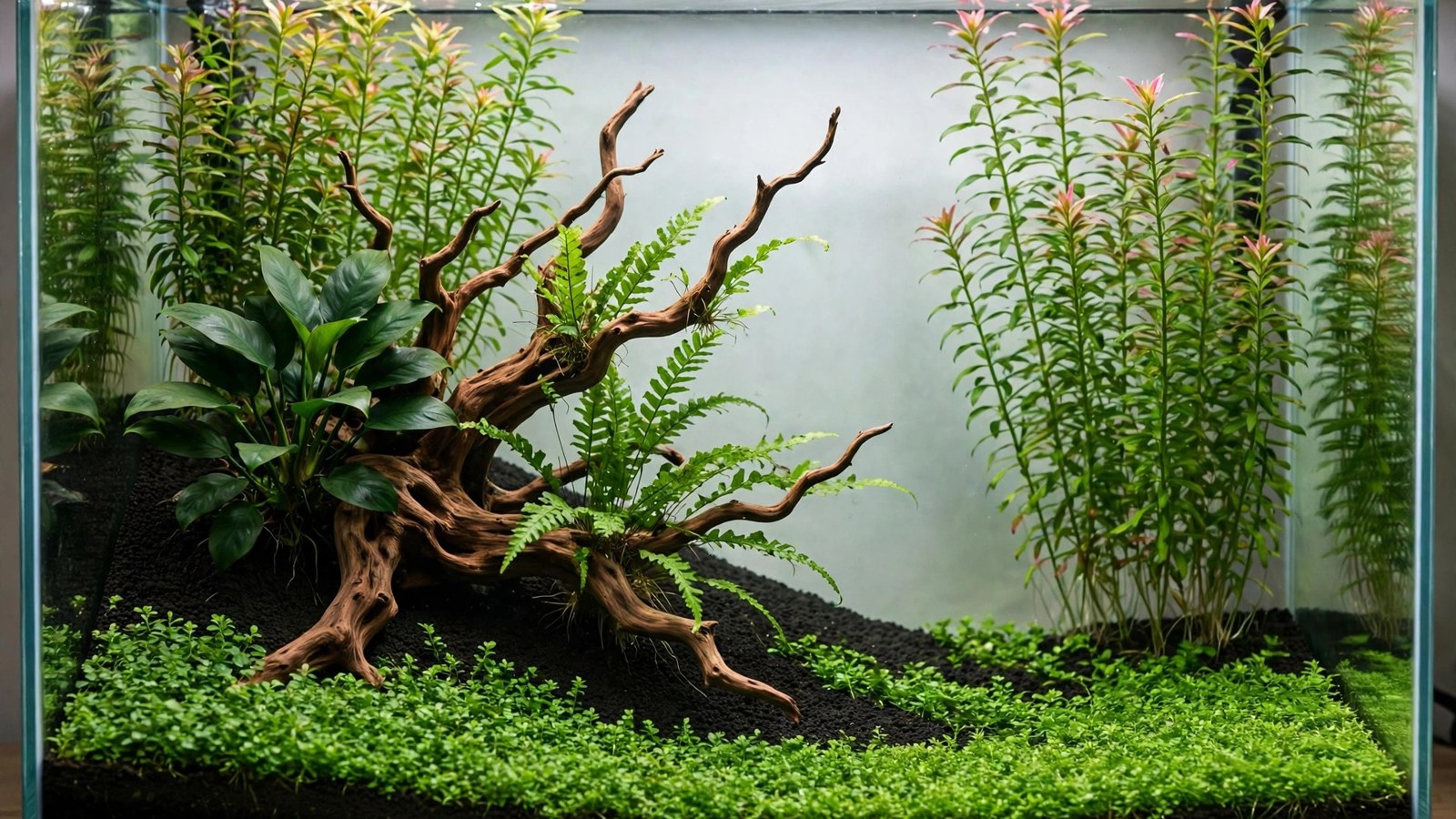
Most 10-gallon scapes fail before a single plant goes in — not for lack of talent, but because the tank gets treated like a shrunken 40-gallon. One oversized plant swallows a third of the view, and a centered rock turns the tank into a display shelf.
Direct answer: To scape a 10-gallon planted tank, place one focal point at a rule-of-thirds intersection, slope the substrate from about 1 inch at the front to 3 inches at the back, plant in three zones — carpet in front, mid-height plants around the hardscape, tall stems at the back — and use just 6 to 8 species so the tank reads as one scene.
Start with the footprint, not the plant list
A standard 10-gallon is 20 inches long, 10 inches deep, and 12 inches tall. That 10-inch depth shapes everything: with roughly three hand-widths from front glass to back glass, a plant that grows 8 inches wide dominates a zone by itself.
| Layout | How it reads | Best for |
|---|---|---|
| Triangle | Tall one side, open sand the other | First scapes |
| Island | One mound, open water both sides | Showpiece wood or stone |
| Concave valley | Tall both sides, low middle | Center focus |
For a first scape, pick the triangle. It is forgiving: if your focal wood leans a little too far left, the slope still carries the eye, and the open side gives fish swimming room.
Place one focal point using the rule of thirds
Divide the front glass into thirds, both ways, and you get four intersections. Put your main hardscape piece — one striking branch of spiderwood or one tall stone — at one of the two upper intersections, never dead center. A centered focal point splits the tank into two equal halves and the eye stops moving; an off-center one creates a long side and a short side, and the eye travels between them.
Dry-fit the hardscape outside the tank first, on that taped footprint, and photograph it from the front and from a slight angle. Then add two or three smaller stones or branches pointing toward the main piece. Every secondary piece should support the focal point, not compete with it.
Plant in three zones — and cap the species count
The classic beginner mistake is planting twelve species, one pot each. Twelve single plants read as a garden center, not a landscape. Pick 6 to 8 species and plant each one in a drift of at least three stems or rosettes, so the eye reads masses of texture.
Work zone by zone. The foreground gets one low plant only: Monte Carlo or dwarf hairgrass under moderate light, Cryptocoryne parva under low light. The midground belongs to plants attached to hardscape — Anubias nana and Java fern on wood and stone. The background takes tall stems: Rotala rotundifolia on the tall side, Vallisneria spiralis in the back corners.
Glue is the cleanest way to fix epiphytes to hardscape while the tank is still dry. A dab of Seachem Flourish Glue ★4.3 holds Anubias and Java fern rhizomes to wood in seconds and cures underwater. Never bury a rhizome — buried rhizomes rot, and a rotting Anubias in a 10-gallon fouls the water fast.
As an Amazon Associate, I earn from qualifying purchases made through links on this page.
Build it in this order: substrate, hardscape, plants, water
First, lay the substrate with the slope built in: about 1 inch at the front rising to about 3 inches at the back. Second, set the hardscape into the slope, pushing each base at least an inch into the substrate so it cannot topple when you fill.
Third, plant from back to front — background stems, then midground clusters, then the carpet last — so you never reach across freshly planted foreground. Long tweezers make this far easier in a 10-gallon, where fingers displace substrate with every move: the hygger 6-in-1 Aquascaping Tools Kit ★4.6 covers planting, trimming, and substrate smoothing in one set.
Fill slowly, pouring over a plate laid on the substrate so the stream does not carve a crater in your slope. Fill to about three-quarters, replant anything that floated free, then finish filling.
The first 4 weeks: light, trimming, and patience
New scapes do not need long light — they need steady light. Start at 6 to 7 hours a day on a timer, and only extend toward 8 hours once plants show new growth and algae stays absent for a full week. Algae in week two almost always means too much light for too few established plants: shorten the photoperiod by an hour first and watch for three days.
A light that fits the tank and dims on a timer removes most of this guesswork. The NICREW ClassicLED Plus (18-24 in) ★4.6 spans a standard 10-gallon, and its built-in timer and dimming let you start low and ramp up as the scape fills in.
Do a weekly water change of about a third of the tank for the first month, and trim only stems that reach the surface — topping a Rotala stem and replanting the cutting thickens the background fast. If a zone still looks empty, add more of a species you already have rather than a new one.
Compare this build with our 10-gallon aquascape ideas and the beginner first-layout guide.
Frequently Asked Questions
How many plants do I need for a 10-gallon scape?
Plan on 6 to 8 species, each planted in a drift.
Can I scape a 10-gallon tank without CO2?
Yes, if you choose plants that suit it: Anubias, Java fern, Cryptocoryne, and Vallisneria all grow well without injected CO2 under moderate light.
Where should the focal point go in a 10-gallon tank?
At a rule-of-thirds intersection — roughly one-third or two-thirds along the tank length, in the upper half of the front view.
How deep should substrate be in a 10-gallon aquascape?
Slope it from about 1 inch at the front to about 3 inches at the back. The shallow front keeps the carpet visible.