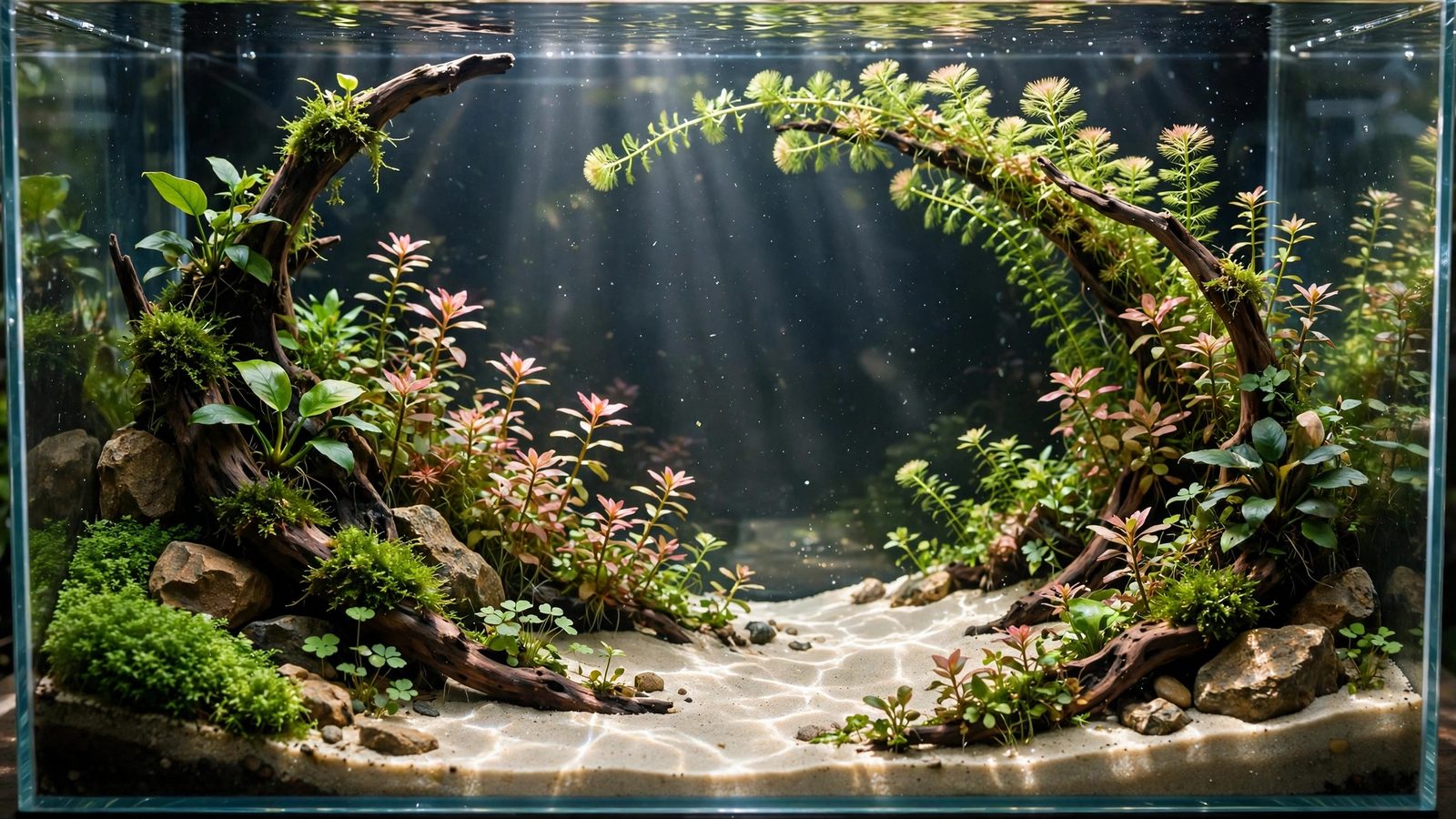
Most aquascapes are built on straight lines: triangles, diagonals, mountainsides marching from one corner to another. The crescent composition aquascape breaks that habit. Instead of stacking hardscape and plants along a straight slope, you sweep them in a wide, curving arc — like a crescent moon — across the tank, leaving the open interior of the curve as a calm pool of negative space. This guide covers the geometry, the build, and the planting strategy that makes the crescent work.
What Makes a Crescent Composition Aquascape?
A crescent aquascape is defined by three things: a curved mass of hardscape and plants shaped like the letter C, a clear interior space inside the curve that stays visually open, and endpoints that taper or dive out of sight at the tank walls. Unlike the triangle layout, which climbs from low to high in a straight diagonal, the crescent trades vertical drama for horizontal flow. Unlike the island style, the crescent has a direction — the curve itself is the story.
The arc can be gentle (barely more than a bow) or deep (the endpoints nearly meeting), but the sweet spot for most tanks is a curve whose deepest point sits at roughly one-third of the tank's width away from the back glass. Too shallow and it reads as a wobbly straight line; too deep and the interior pocket feels cramped.
Why the Curve Works Visually
Human eyes are drawn along curves. In a straight diagonal scape, the viewer's gaze arrives at the tall end and stops. In a crescent, the eye enters at one tapered tip, travels along the planted arc, and releases into the open interior, where it loops back to the start. That closed loop is why crescent scapes feel complete and restful even with less plant mass than a triangle or Dutch-style tank. You're building a circuit, not a slope.
This is also why the crescent pairs so naturally with negative space: the empty interior is the second half of the composition. A pale sand interior against a darker planted arc gives enormous contrast — and contrast is what the eye photographs first.
Arc Geometry: Radius, Sweep, and Placement
You don't need a protractor, but you do need intention. Before adding a single stone, sketch the arc from above on a piece of paper cut to your tank's footprint. Three decisions matter:
- Sweep (how far the arc reaches): the two tips of the crescent should aim at the left and right side panels, roughly one-quarter to one-third of the way back from the front glass. Tips that die against the back glass flatten the curve from the front view; tips that start at the front glass choke the foreground.
- Depth (how deep the belly of the curve goes): in a standard 60 cm tank, the deepest point of the arc usually lands 12–18 cm in front of the back glass, rising to 8–12 cm of substrate height at its peak. In a 90 cm tank you can push the belly to 20–25 cm depth for a more dramatic pocket.
- Direction (which way the arc opens): the open interior should face the viewer and slightly off-center — aim the belly's deepest point at the golden-ratio point rather than dead center. A centered crescent looks symmetrical and static; an offset one feels discovered, like a natural cove.
The 3-Point Mapping Trick
Once you're happy with the paper sketch, transfer three points to the empty tank: left tip, deepest point of the belly, right tip. Lay your primary hardscape stones along the dots before any substrate goes in. If the three points don't read as a smooth curve from the front glass, adjust now — correcting the arc after soil and plants are in is ten times the work.
| Tank length | Suggested arc depth (front-to-back) | Tip positions | Belly soil height |
|---|---|---|---|
| 45 cm (nano) | 6–9 cm | Side panels, near front third | 5–7 cm |
| 60 cm (standard) | 12–18 cm | Side panels, front third | 8–12 cm |
| 90 cm | 18–25 cm | Side panels, front third | 12–16 cm |
| 120 cm+ | 25–35 cm | Side panels, front third | 15–20 cm |
Building the Crescent: Substrate and Hardscape
A crescent stands or falls on its skeleton. Plant tissue is forgiving; a misplaced arc line shows forever. Build in this order: substrate contour, hardscape spine, then plants.
Step 1 — Contour the Substrate Into the Arc
The soil itself should form a crescent-shaped bank before any stone touches it. Pour your aquasoil in a rough arc following your three points, mounding the belly highest and feathering the tips down to bare bottom glass at the ends. A bank that stays tall at the tips looks like a horseshoe — the classic beginner error. The front face of the bank (facing the interior pocket) should be the steeper side, because that's the face the viewer reads; the back face can fall away gently toward the rear glass.
Tip: lay a thin layer of sand over the interior pocket floor before hardscape goes in. It protects the pocket from stray soil during the build and marks the "keep this open" zone so you don't creep plants into it later.
Step 2 — Lay the Hardscape Spine
Stones or wood ride the crest of the soil arc like vertebrae. Work from the belly outward: place your largest feature stone or wood piece at the deepest point of the curve, tilted slightly so its best face addresses the interior pocket. Then graduate downward in size toward the tips, burying the final pieces so the arc dissolves into the substrate rather than ending abruptly. A crescent with visible, evenly spaced stones looks like a fence. Aim for rhythm instead of regularity: clusters of two or three, small gaps, one standout.
Driftwood suits the crescent particularly well because wood already grows in curves. A single long branch laid along the crest, with smaller branches angled into the interior, can carry the entire arc in a softwood-dominant scape.
Step 3 — Lock the Arc Before Flooding
Before the first drop of water, do the "squint test": stand three meters back, squint, and check that the hardscape reads as one continuous curve. Photograph it too — the camera flattens depth and exposes gaps your stereo vision forgives. Fix breaks now with bridging stones or a small soil mound, because once the tank is flooded and planted, the arc is load-bearing.
A reliable pick here is Fluval Plant and Shrimp Stratum.
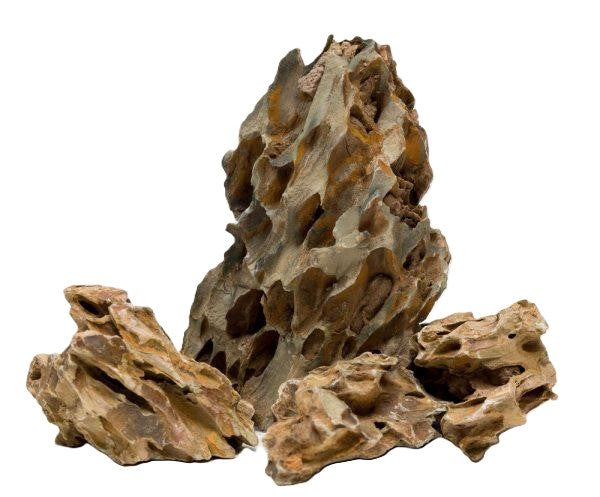
A reliable pick here is dragon stone.
 ★4.5
Unocho Dragon Stone Aquarium Rocks
Check Price on Amazon ★4.5Planting the Arc: Tiers Along the Curve
Planting follows the same arc logic as the hardscape. Think of the crescent as a curved hillside with three planting tiers, each sweeping along the curve:
- The outer slope (front, facing the pocket): low carpet and short foreground plants only, so the interior stays open and the arc reads as a bank, not a wall. Staurogyne repens, Eleocharis acicularis 'Mini', and Marsilea hirsuta are ideal — they creep and knit rather than climb.
- The crest (the top ridge): the main event. Medium-height stems and bushes in repeating clusters along the ridge, with your tallest cluster at or near the belly's deepest point. Rotala rotundifolia and Ludwigia super red mini hold a crest beautifully. Repeat the same species at both tips in smaller doses — echoes at the ends make the curve feel intentional.
- The inner slope (back, falling to the rear glass): tall background stems that soften the arc's back edge. Vallisneria nana, Hygrophila corymbosa, or a wall of Rotala species close the crescent's back so light doesn't leak through and flatten the curve.
Check the difficulty ratings on Tropica's plant database before committing to species — a crest planted with advanced high-light stems in a low-tech tank will bald within two months, and a thinning crest is what unravels a crescent first.
The Interior Pocket: What Goes Inside
Almost nothing. That's the point. A clean sand interior with one small accent at most: a single pebble, a tuft of Eleocharis, or a patch of fine gravel that reads as a path. The pocket's job is to be the calm eye of the layout. The moment you plant a bush in it, the crescent becomes two separate scapes. Defend the pocket during every trim — stems leaning inward from the crest get cut in the first three months.
Variants: Double Crescent, Mirror, and Vertical
Once the single crescent feels natural, three advanced variants open up:
- The double crescent: a second, smaller arc nested inside the pocket of the first, curving the same direction. Demands a 90 cm tank minimum and ruthless restraint — the inner arc must stay half the height of the outer or the pocket fills and the effect collapses.
- The mirrored crescent: two arcs curving in opposite directions, forming an S seen from above. Best in 120 cm tanks and up, with each crescent's focal accent offset from the other so the composition zigzags rather than repeats.
- The vertical crescent: in taller-than-wide tanks, the arc sweeps upward along the back glass instead of across the floor, with epiphytes (anubias, bucephalandra, mosses) doing the planting work. The crescent translated into a column.
Flow, Fish, and Lighting for Crescent Scapes
A crescent has one engineering quirk: the interior pocket is a natural dead spot for water flow. The arc's belly blocks circulation from behind, so detritus settles in the pocket and algae finds it first. Counter it by aiming the filter outflow along the curve — a lily pipe at one tip, blowing parallel to the arc, turns the crescent into a gentle circular current that sweeps the pocket clean.
Fish should reinforce the curve. Schooling fish that swim the circuit — ember tetras, green neon tetras, chili rasboras — are the classic choice: a school circling the arc makes the layout look alive in exactly the pattern you designed.
Lighting-wise, the crescent rewards a spotlight treatment. A single pendant hung over the belly's deepest point creates a bright center with gently fading tips — the light itself traces the composition. Raise the fixture slightly higher than usual: the crest's plants sit on a raised bank, so a light set for a flat tank will overdrive the ridge and under-serve the pocket.
5 Mistakes That Ruin a Crescent
- The horseshoe: tips that stay as tall as the belly. Taper the arc's ends or the curve reads as a wall with a notch in it.
- The broken spine: gaps between hardscape clusters where the arc line disappears. Squint-test and photograph before flooding.
- The planted pocket: one bush in the interior splits the composition in two. The pocket is sacred ground.
- Mirror-image tips: perfectly symmetrical tips make the scape look manufactured. Offset one tip slightly higher or longer — asymmetry is the crescent's native language, as the rule of thirds reminds us.
- Ignoring the back edge: a crescent seen from behind in a room-divider tank is just a lump. If the tank is viewed from both sides, plant the inner slope as a second, gentler crescent rather than leaving bare soil.
Compare these pitfalls with the concave (valley) layout and the island style — knowing how the curved compositions differ keeps you from drifting into one while building another.
Long-Term Maintenance: Keeping the Arc Sharp
Crescents age gracefully if you trim for the curve. Stem plants on the crest grow upward and inward, and after six to eight weeks an untrimmed crest balloons into a hedge that swallows the arc line. The rhythm: trim the crest's top weekly, replant trimmings into thinning spots along the arc, and re-sand the pocket monthly — the banks shed soil into the interior over time, and a pocket with a creeping soil tide loses its contrast.
Expect one "arc audit" re-scape session around month four: a half-hour of replanting along the existing skeleton, not a teardown. The aquascape trimming and maintenance guide covers the weekly routines that support this schedule.
Frequently Asked Questions
Is the crescent composition good for beginners?
Yes — it's one of the most forgiving compositions for a first serious layout. The three-point mapping trick makes the geometry almost foolproof, the planting tiers are simple (low in front, tall on the crest, tall behind), and the open pocket hides more mistakes than it reveals. The one beginner trap is the interior pocket: resist the urge to fill it.
What tank size works best for a crescent aquascape?
A 60 cm (roughly 20-gallon long) tank is the sweet spot — long enough for the arc to sweep gracefully, small enough to keep the curve readable from a normal viewing distance. Nano tanks under 45 cm can work, but the arc gets cramped and the pocket nearly vanishes. In tanks 90 cm and up, the crescent shines brightest and supports the double-crescent variant. Very tall tanks suit the vertical crescent variant instead.
Crescent vs. triangle composition — which should I choose?
Choose the triangle when you want vertical drama and a bold focal peak; choose the crescent when you want flow and calm. The triangle climbs from low to high in a straight diagonal and anchors the eye at one tall point, while the crescent sweeps the eye along a curve and releases it into open space. Triangle layouts feel ambitious; crescent layouts feel meditative.
How much substrate does a crescent layout need?
More than a flat tank, less than a mountain scape. The banked belly is the main consumer — budget roughly 1.5 times the substrate you'd use for a flat layout of the same tank. For a 60 cm tank, that's about 9–12 liters of aquasoil depending on how dramatic you want the belly. Economize by building the bank's core from lava rock in mesh bags, capped with 4–5 cm of aquasoil for real planting depth.
Can I combine a crescent with a carpet?
Absolutely — a carpet actually strengthens the crescent by unifying the outer slope and the interior pocket in one texture. Grow the same carpet species from the pocket floor up the front face of the bank, and the arc reads as a green wave cresting over sand. Just keep the carpet trimmed low on the pocket floor so it doesn't creep up and swallow the crest's base. Dwarf hairgrass and Marsilea hirsuta are the two most forgiving choices for this effect.
How do I stop the arc from flattening as plants grow?
Three habits: trim the crest weekly so no single cluster outgrows its neighbors, replant trimmings back into the arc rather than elsewhere, and do a monthly arc audit — photograph the tank, squint at the curve, and replant any gap with a fast-growing stem as a placeholder. Most arcs flatten because the belly's tallest cluster shades the tips; if your tips are thinning, trim the belly harder. The curve is a discipline, not a one-time build.
Bring It Around
The crescent composition asks one thing of you: respect the curve. Map it, build the skeleton into it, plant along it, and trim to it — and leave the pocket alone. Sketch your three points tonight; the curve will take it from there.