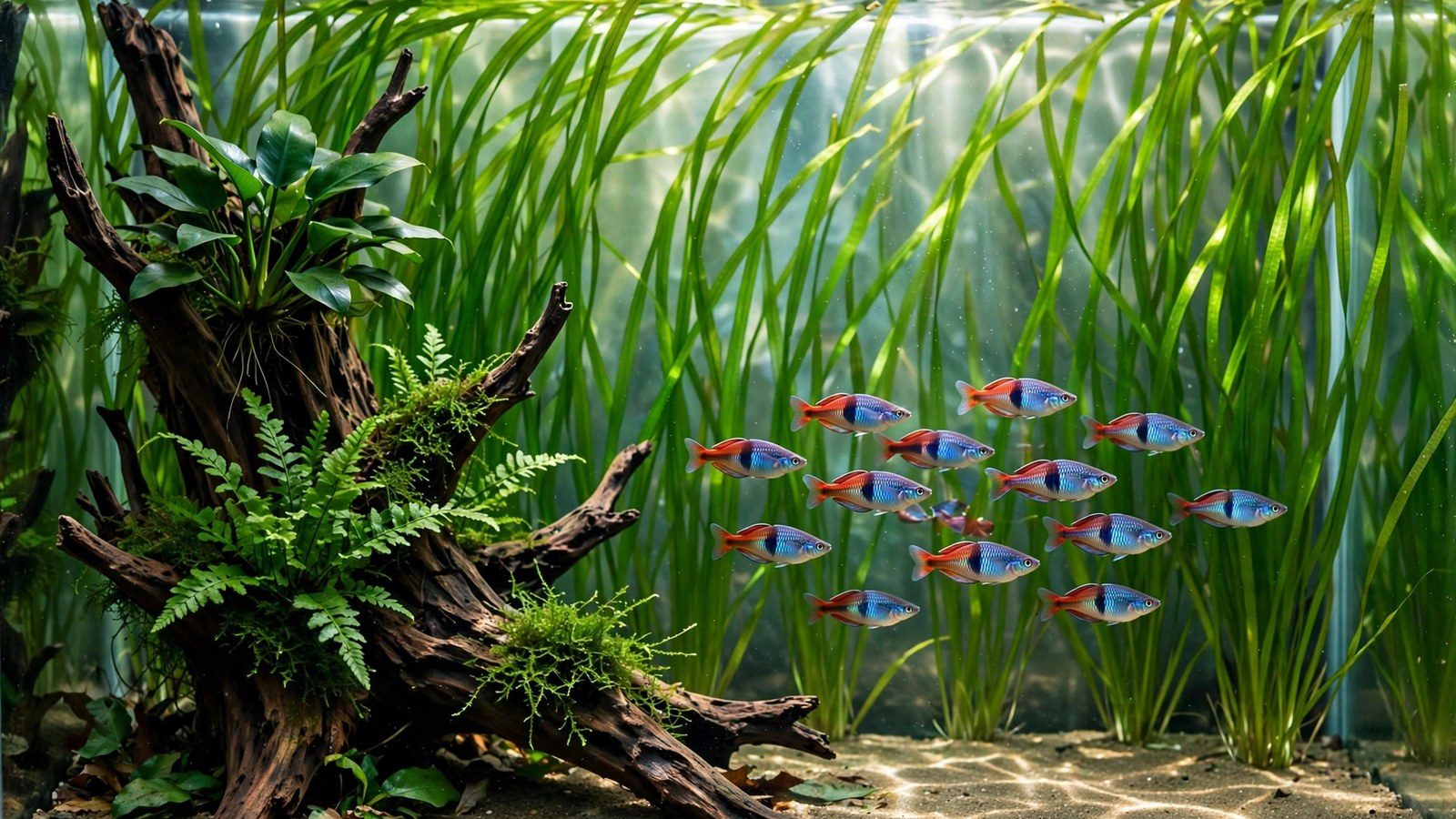
The fastest way to ruin a rainbowfish tank is to plant it like an aquascaping contest entry — stem walls edge to edge — and then wonder why your school of boesemanis sulks in a corner, colors washed out. Rainbowfish are open-water athletes: they need a clear swimming lane more than scenery. The best aquarium plants for rainbowfish tanks survive hard, alkaline water, stay rooted under a boisterous school, and frame that open lane so the fish color up and display.
The short answer: Hard-water-tolerant plants with dense edges and an open middle: vallisneria and ludwigia along the back, anubias and java fern glued to wood, java moss and hornwort as spawning cover, floating plants for dappled shade. Skip delicate carpets — active rainbows uproot them.
Best background plants for rainbowfish tanks
Vallisneria is the single best background plant for a rainbowfish tank. Tall ribbons along the back glass make blue-bodied rainbows look electric, it genuinely prefers hard alkaline water, and it spreads through runners on its own — a dozen crowns becomes a wall within two months. Vallisneria spiralis and V. americana both thrive under moderate light.
Ludwigia repens adds the color contrast rainbows deserve: red-tinged tops against blue and silver schooling fish. It grows in hard water without CO₂ and forgives beginners — trim stems at the surface and replant the tops, and one purchase fills a background fast.
Amazon sword (Echinodorus bleheri) is the anchor: one broad rosette fills a back corner and gives the school a landmark to circle. Swords are heavy root feeders — push a root tab near the crown every couple of months. A bundle like this Amazon Sword 3-plant bundle ★4.4 anchors both back corners of a 55-gallon from one order.
Disclosure: the plant links in this guide are Amazon affiliate links — they cost you nothing extra and help keep AquaVerdia's guides free.
Best epiphytes for wood and rock
Anubias is rainbowfish-proof: thick leaves that nibbling fish ignore, a rhizome that glues to driftwood in seconds, and almost zero demands — low-moderate light, no substrate feeding or CO₂. Never bury the rhizome; a dab of aquarium-safe super glue gel is the entire planting procedure. A potted option like SubstrateSource Anubias ★4.5 arrives with roots that grip hardscape fast.
Java fern (Microsorum pterotpus, now Leptochilus pterotpus) earns its spot the same way: tough leaves, epiphyte habit, growth slow enough to shrug off algae pressure. Tie it to the same driftwood as your anubias. Black spots on older leaves are usually baby plantlets forming — each one is a free plant once it grows roots and a few leaves.
Fine-leaved plants for spawning and fry shelter
Rainbowfish spawn at dawn, scattering tiny adhesive eggs into fine-leaved vegetation — which is why java moss belongs in every rainbowfish tank. Tie generous clumps to wood along the back and it becomes the tank's nursery and infusoria farm. Moss grows from dim corners to bright light and shrugs off hard water.
Hornwort (Ceratophyllum demersum) and guppy grass (Najas guadalupensis) are the fastest water-quality insurance you can buy: float a few stems in a back corner and they strip nitrate all week while their feathery whorls shelter fry. Both grow fast in hard water and are nearly impossible to kill. One honest caveat: hornwort sheds needles in water above 28°C, so net out the litter — and know that adults eat their own eggs and fry, so move the moss clump or the fry to a rearing tank if you want babies.
Floating plants for dappled shade
Wild rainbows come from dappled waters, and they color up noticeably under broken surface shade. Amazon frogbit and water lettuce cast soft shadows through broad rosettes, trail roots that fry hide in, and drink excess nutrients aggressively. Thin the mat weekly so it never covers more than half the surface, and keep a clear feeding ring in the open lane. Skip common duckweed — once it is in a tank it is in forever; frogbit lifts out in handfuls when you thin it.
How to plant the tank: dense edges, open middle
Pack the back third and both sides, and leave the front-center third as open water. Vallisneria along the back glass, swords in the back corners, epiphyte-covered wood framing the sides, moss in the wood, floaters overhead — and a clear runway down the middle where the school runs.
| Plant | Light | CO₂ | Growth | Role in a rainbowfish tank |
|---|---|---|---|---|
| Vallisneria | Moderate | No | Fast | Back wall; loves hard water |
| Ludwigia repens | Mod–high | No | Fast | Red contrast vs blue fish |
| Amazon sword | Moderate | No | Medium | Corner anchor; needs root tabs |
| Anubias | Low–mod | No | Slow | Tough epiphyte for wood |
| Java fern | Low–mod | No | Slow | Tough epiphyte; free plantlets |
| Java moss | Low–high | No | Medium | Spawning bed, fry shelter |
| Hornwort | Low–high | No | Very fast | Nitrate sponge; floater |
| Guppy grass | Low–mod | No | Fast | Fry cover; indestructible |
| Frogbit / water lettuce | Moderate | No | Fast | Dappled shade; calms school |
| Cryptocoryne | Low–mod | No | Slow | Tough midground filler |
Frequently asked questions
Can rainbowfish live with any aquarium plant?
Nearly. Skip delicate foreground carpets, which active schools uproot by accident, and soft-water-only species, which sulk in hard alkaline water. Everything on this list handles both.
Do rainbowfish eat aquarium plants?
Generally no — they may mouth soft new growth, but they do not graze like goldfish. Tough-leaved anubias, java fern, and crypts are ignored completely.
How densely should I plant a rainbowfish tank?
Heavily at the edges, open in the middle: back third and sides fully planted, with a clear swimming lane across the front-center. Heavy planting also absorbs the nitrate a well-fed school produces, keeping colors high.
Do I need CO₂ for a rainbowfish planted tank?
No. Every plant here grows well without injected CO₂ under moderate light. CO₂ speeds growth if you already run it, but this is a deliberately low-tech list — a rainbowfish tank should be about the fish.