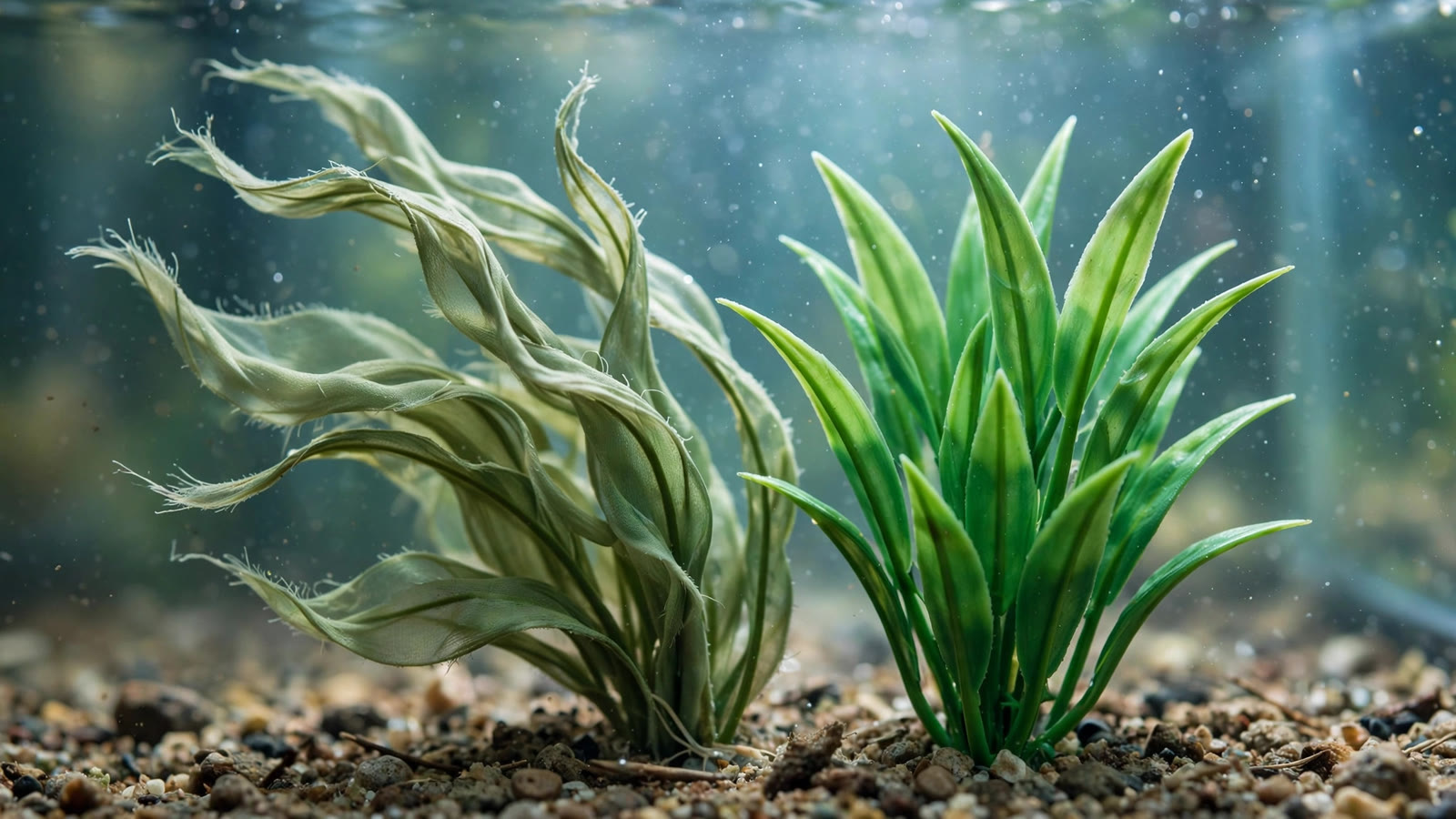
Walk into any fish shop and you'll see two aisles of fake greenery competing for your money: soft fabric-looking bunches labeled "silk" and rigid molded ones labeled "plastic." The silk vs plastic aquarium plants debate sounds like a minor shopping choice, but the wrong pick can shred your betta's fins or waste money on plants that fade within months. This guide compares them honestly — what each material is, how it behaves underwater, when artificial plants are genuinely the smart choice, and where live plants still win outright.
What silk and plastic aquarium plants actually are
Despite the names, neither is exactly what it says. Understanding the materials explains nearly every difference that follows.
Silk aquarium plants
True silk aquarium plants are made from synthetic fabric — usually polyester — cut into leaf shapes and attached to a weighted plastic base. The fabric has weight and flex, so leaves sway when the filter outflow pushes past them, much like a real stem plant. Because they're cut rather than molded, they have no rigid seams or flash lines. The trade-off: constant submersion, bright light, and grazing algae-eaters wear fabric down over time.
Plastic aquarium plants
Plastic aquarium plants are molded from polyethylene or similar rigid polymers, often printed with leaf veins and color gradients. Each piece comes out of a mold and holds one fixed pose forever — it doesn't sway or drape, it just stands. That rigidity is the selling point: a plastic plant looks the same on day 400 as on day one. The downside is molded edges that are thin and hard, sometimes sharp where the mold halves met.
Head-to-head comparison
| Factor | Silk plants | Plastic plants |
|---|---|---|
| Realism | Best-in-class for artificials; fabric leaves sway in current and drape like live foliage | Noticeably artificial up close; rigid leaves hold one pose, and molding seams catch the light |
| Safety for fish | Soft edges are gentle on long fins; best choice for bettas, fancy goldfish, and scaleless species | Hard, thin edges can tear flowing fins; test every piece by running it across your palm first |
| Durability | Fabric fades and frays in bright light; plan to replace every 9–12 months | Lasts years; colors and shape barely change, though algae film can dull the look |
| Price | Usually pricier than plastic, and the replacement cycle makes them costlier long-term | Cheapest way to fill a tank with greenery; one purchase lasts a long time |
| Maintenance | Pull out and rinse regularly; fabric holds algae more tenaciously, so use a soft brush | Wipe or soak off algae easily thanks to the smooth, non-porous surface |
Realism: how each looks underwater
In a brightly lit showroom tub, both look convincing. The difference appears once they're submerged and the filter kicks on. Silk leaves bend, ripple, and settle back the way live plants do, which fools the eye even at a glance. Plastic plants never move, and your brain notices: molded leaves reflect light off flat surfaces, and any molding flash — the thin ridge where the mold halves joined — becomes a small white line under aquarium lighting. Neither matches real foliage — a live easy aquarium plant that thrives without CO2 will always look, well, alive. But silk earns its price when realism is the goal.
Safety: edges, fins, and what's hidden inside
Safety is where silk wins most clearly, and it's the one factor where the stakes are real. Long-finned bettas, fancy goldfish, and scaleless species like loaches drag their bodies and fins across everything in the tank. Molded plastic leaves have edges thin enough to act like paper on skin — a common story is fins arriving intact and ending up tattered a week after a new plastic plant goes in. Silk can't do that: the fabric is soft and cut rather than molded, with no hard seams to catch a fin ray.
There's a second, quieter safety issue that has nothing to do with silk versus plastic: the internal construction. Craft-store silk plants — the kind sold for home décor — are built around wire stems that rust underwater, and they're colored with dyes never meant to be submerged. Rusting wire and leaching dye can poison a tank, and the same applies to craft-store plastic. Buy only plants made specifically for aquariums: legitimate aquarium lines like Marina's aquarium-made silk plant collection are built from non-toxic, tank-safe materials that won't affect your water chemistry. Retire anything the moment its coating cracks.
Durability and long-term cost
Plastic's great strength is longevity. A decent molded plant will still be standing, bright, and intact after two or three years of continuous submersion. It doesn't fade much, it can't fray, and algae-eating fish can't chew it into confetti. Decorate once, and never think about it again — that's plastic's pitch.
Silk is the opposite trade: beautiful now, temporary later. Bright aquarium lighting bleaches fabric dyes fastest, and grazers like plecos rasp the fabric as they clean it, until leaves develop worn patches, frayed edges, or tears. Expect about a year of good appearance, sometimes less under strong light. Since silk usually costs more to begin with, a fully silk tank becomes a recurring expense — do the math before you commit.
When artificial plants are genuinely the right choice
Live plants lose badly in some tanks. Here are the situations where artificial plants — silk or plastic — are honestly the better tool:
- Digger and shredder tanks. African mbuna rearrange substrate for a living and shred most live plants on contact. Setting up an African cichlid tank with artificial plants gives the fish cover and a scape that survives the week.
- Hospital and quarantine tanks. A treatment tank must be easy to tear down, disinfect, and reset between patients. Artificial plants give a stressed fish a hiding place without absorbing medication. Plastic wins here because it survives repeated sterilization.
- No-light or no-fuss setups. A goldfish tank on a desk with no plant light, or a bedroom betta tank with no maintenance routine — artificial plants deliver shelter where live plants would simply melt.
- Placeholder decor. Many keepers use artificial plants as temporary cover while a tank cycles or while sourcing the live plants they actually want — a few fast-growing plants for new tanks go in later; the silk filler comes out.
- Fish that eat everything green. Large goldfish and some herbivorous cichlids treat live plants as salad. If you want plants that can survive with goldfish and your goldfish says otherwise, silk gives you the look without the ongoing buffet.
These are real use cases, not consolation prizes. A quarantine tank with a soft silk plant is a better, more humane setup than a bare glass box — full stop.
The honest catch: what artificial plants can't do
Here's the fact that no packaging will tell you: artificial plants are furniture, not life. Live plants are part of your tank's chemistry. They absorb nitrates and phosphates as they grow — free ongoing filtration that slows algae and stabilizes water — and they release oxygen. Their surfaces host beneficial bacteria and microfauna that feed shrimp and fry. Silk and plastic do none of this. They provide cover, but nothing for water quality.
That doesn't make artificial plants a mistake. It means you should size your expectations — and your water-change schedule — around what they are. A tank of live low-light plants for beginners forgives a missed water change in a way a plastic-plant tank never will. Choosing artificials for convenience means accepting more manual maintenance, not less.
Cleaning and caring for artificial plants
Both materials collect algae — in a lit, nutrient-rich tank, everything does. The routine: pull the plant, rinse it in old tank water, and work stubborn patches off with a soft toothbrush. Never use soap, bleach, or household cleaners; residues leach back into the tank. A brief soak in plain dechlorinated water loosens biofilm before brushing.
Inspect fabric plants monthly: hold each leaf to the light and look for thinning spots, fraying edges, and fading color. A silk plant shedding fibers or exposing its internal structure is done — pull it before a curious fish tries to eat the loose threads. Give plastic plants a palm test on the same schedule: if any edge feels sharp enough to catch skin, file it smooth or retire the plant.
How to shop smart
- Match the material to the fish. Delicate fins or scaleless bodies? Silk. Hardy fish and a tight budget? Plastic is fine.
- Only buy aquarium-made. Craft-store plants aren't aquarium-safe — wire stems rust, dyes leach. Stick to established aquarium brands.
- Do the palm test in the store. Run every plastic plant across your palm. If it scratches you, it will hurt your fish.
- Check the base. A wide, heavy, tank-safe weighted base matters — floating decor is a daily annoyance, and loose bases shift and trap fish.
- Budget the replacement cycle. Silk looks better but needs yearly replacement. Decide up front: beauty or permanence.
Frequently Asked Questions
Are silk plants really safer than plastic for bettas?
Yes. Bettas have long, delicate fins that tear on hard edges, and molded plastic leaves have thin seams that act like sandpaper on fin tissue. Silk leaves are soft fabric with no rigid edges, so a betta can rest draped across them without damage — a point betta plant safety guides repeat consistently. For a betta tank, silk is the clear pick, or consider gentle live options like anubias.
Can I use silk flowers from a craft store in my aquarium?
No — one of the most common and most dangerous shortcuts in the hobby. Craft-store silk plants are built around wire stems that rust when submerged, and they're dyed with colorants never designed for continuous water contact. Rust and leaching dyes can poison fish and crash a tank. Aquarium-made silk plants use tank-safe construction and fade-resistant dyes — the craft-store versions are never aquarium-safe.
Do artificial plants help with water quality at all?
Not meaningfully. Live plants absorb nitrates and phosphates as they grow and release oxygen — genuine, ongoing filtration. Artificial plants contribute none of that; they're inert decor. Their surfaces still grow algae like every other surface in the tank. Treat artificial plants as shelter and scenery only, and keep your water-change schedule honest to match.
How do I clean algae off artificial plants?
Remove the plant and rinse it in old tank water siphoned out during a water change — never soap, bleach, or household cleaners, whose residues leach back into the tank. Soak briefly in dechlorinated water to loosen biofilm, then scrub gently with a soft toothbrush, being gentle around fraying fabric edges.
If I want live plants instead, where should I start?
Start with species that ask almost nothing of you: anubias and java fern that attach to wood, or hardy stems that need no injected CO2. Read our guide to easy aquarium plants that thrive without CO2, and check the breakdown of tissue-culture versus potted plants before you buy. Many keepers run a hybrid tank — live plants where they'll thrive, a silk accent where they won't.
The honest verdict
There is no universal winner in the silk vs plastic aquarium plants debate — there's only the right plant for your tank and your fish. Silk is the premium pick: it moves, it photographs well, and it's the only artificial option I'd trust with a betta's fins, at the cost of yearly replacement. Plastic is the workhorse: nearly indestructible, cheapest to buy, and adequate where fish are hardy and looks are secondary.
And whenever your tank can support them, give live plants their due. A thriving planted tank filters itself in ways no decor can imitate — even a few live plants that grow in plain gravel quietly remove nitrates every day. But when live plants aren't practical — the cichlid diggers, the quarantine tub, the lightless desk tank — artificial plants are a legitimate, humane choice. Buy aquarium-made, match the material to the fish, and clean them like you mean it.
Tissue-culture plants are the exception — they’re grown in sterile gel and adapt with minimal melting, which is part of what you’re paying for. Plants bought submersed from another hobbyist’s tank also transition with little melt, since they’re already in the right form.
Which Plants Melt Most (and Least)
Heavy melters (expect significant leaf loss)
- Cryptocorynes — infamous for “crypt melt,” sometimes dropping every leaf after any disturbance. They almost always recover from the roots within weeks.
- Stem plants grown emersed — rotala, ludwigia, and hygrophila often shed lower emersed leaves while the growing tips transition.
- Amazon swords — emersed-grown swords typically lose their broad oval aerial leaves and replace them with longer submersed ribbon leaves.
Light melters
- Anubias, java fern, bucephalandra — slow-growing rhizome plants transition gradually; occasional old-leaf melt but rarely dramatic.
- Vallisneria — usually transitions well, though it dislikes the move itself and may sulk for a week.
- Floating plants — minimal melt since their leaves were already at the air-water interface.
The Acclimation Protocol
Step 1: Quarantine or dip first
Before acclimating to your tank’s conditions, make sure you’re not acclimating pests along with the plant. Run new arrivals through our quarantine and dip protocol — it adds days upfront but prevents months of regret.
Step 2: Float to temperature-match (30 minutes)
Float the bag or container in your tank for 20–30 minutes to equalize temperature. Plants are less temperature-sensitive than fish, but a 10°F shock on top of transplant stress is an avoidable insult.
Step 3: Trim before planting
Remove any leaves that are already damaged, yellowing, or heavily algae-covered — they won’t recover and they’ll rot in your tank, feeding algae. For stem plants, trim off the bottom inch and any emersed leaves that look unlikely to adapt; the plant wastes energy maintaining leaves it’s going to shed anyway. Keep the healthy growing tips — that’s where recovery starts.
Step 4: Plant correctly the first time
Follow our planting guide — right depth, crown exposed on rosettes, rhizomes unburied on epiphytes. Every uprooting and replanting restarts the acclimation clock, so get placement right on the first attempt. Decide where each plant goes before it goes in the water.
Step 5: Run a gentle first week
For the first 7 days after planting:
- Moderate light — run your normal photoperiod but consider dropping intensity 20–30% if your light is dimmable. Blast-level light on a melting plant grows algae on the dying leaves, not recovery.
- Stable CO2 — if you inject CO2, keep it consistent. Fluctuating CO2 during acclimation is a melt accelerator. If you’re low-tech, this doesn’t apply — see growing without CO2.
- Half-strength fertilizer — new plants with damaged leaves can’t use full dosing, and the excess feeds algae. Ramp to full strength over 2–3 weeks per our fertilizer schedule.
- No disturbance — don’t move, trim, or “check on” new plants for at least two weeks. Every touch resets root establishment. This is especially critical for crypts.
Step 6: Remove melt, keep the base
As emersed leaves melt, remove the mushy material promptly — decaying leaves release ammonia and grow fungus that can spread to healthy tissue. But never discard the plant while the crown, rhizome, or roots are firm and alive. A crypt that’s lost every leaf but has firm roots is a plant that’s about to recover, not a dead plant. Give it 3–4 weeks before judging.
Telling Normal Melt From Real Problems
Normal transition melt:
- Affects oldest/emersed leaves first, newest growth last
- New submersed leaves emerge even as old ones dissolve
- Roots and crown stay firm and white/green
- Timeline: 1–4 weeks, then obvious new growth
Concerning melt (see our full melting diagnosis guide):
- New growth also melts or emerges deformed
- Rhizome or crown turns mushy and brown — this is rot, not transition
- Entire plant dissolves within days with no new growth after 4+ weeks
- Melting spreads to established plants that weren’t recently moved
Buying Tips to Minimize Melt
- Buy submersed-grown when available — hobbyist-grown cuttings transition with almost no melt.
- Choose tissue culture for sensitive species — crypts and delicate stems establish far more reliably from sterile cups.
- Avoid plants already melting in the store tank — some melt is normal, but a plant that’s mostly mush at purchase has less energy for recovery.
- Transport carefully — keep plants damp and out of direct sun/heat. A plant that dries out or cooks in a hot car melts far worse than one transported properly.
The First-Month Timeline: What to Expect Week by Week
Knowing what’s normal when removes most acclimation anxiety. Here’s the typical timeline for a healthy plant adapting to a new tank:
Week 1: The quiet week
Almost nothing visible happens. The plant is growing roots you can’t see and assessing its new environment. Some species (vallisneria, stem plants) may start shedding their lowest leaves. This is normal. Resist the urge to “help” — no moving, no extra fertilizer, no light changes. The most common beginner mistake is intervening during a week when the correct action is nothing.
Week 2: Melt peaks
This is when emersed leaves give up in earnest. Crypts may drop everything; swords shed their broad aerial leaves; stem plants lose lower foliage. It looks catastrophic and it’s usually fine. Keep removing mushy material, keep conditions stable, and watch the crown and growing tips — if those are firm and green, recovery is already underway.
Week 3: The turn
New submersed-adapted leaves emerge — smaller, thinner, often a slightly different shade of green than the emersed foliage. Stem plant tips start growing visibly; crypts push tiny curled leaves from the crown; swords unfurl narrow ribbon leaves. This is the moment most beginners exhale for the first time.
Week 4+: Established
New growth outpaces melt, and the plant is functionally yours. You can resume full-strength fertilizer, normal trimming, and stop treating it as fragile. Some slow growers (anubias, bucephalandra) take 6–8 weeks to show obvious progress — that’s their normal speed, not a problem.
Acclimating Different Plant Formats
Tissue-culture cups
Sterile, pest-free, and already adapted to high-humidity (not emersed) growth — tissue cultures melt the least of any format. Rinse the agar gel off gently (leftover gel rots and feeds fungus), split the portion into small plantlets, and plant per our planting guide. They establish slowly for the first two weeks, then accelerate. No dip needed, minimal acclimation stress — this is the premium experience you’re paying for.
Potted plants
Remove the pot and strip away the rockwool completely — leftover rockwool traps debris and rots. Tease the root mass apart gently; if it’s a dense mat, splitting it into 2–3 smaller portions actually establishes faster than planting one big clump (more growing points, better water flow around roots). Potted plants are usually emersed-grown, so expect the standard 2–4 week melt cycle.
Bare-root / bunched stems
Typically sold as weighted bunches. Remove any bands, foam, or weights, strip the lower leaves, and plant stems individually or in small groups. Bunched stems from the store are often already transitioning — check for new submersed growth at the tips, which tells you the plant is mid-adaptation and will settle quickly.
Hobbyist cuttings
Already submersed-grown and the fastest to establish — often showing new growth within days. The main acclimation factor is water-parameter difference between the two tanks. Float to temperature-match, plant promptly, and they’ll usually take off with minimal melt. This is why experienced hobbyists prefer trading cuttings over buying potted plants.
Frequently Asked Questions
Should I use a “plant starter” or transplant fertilizer?
Products marketed for transplant shock are mostly B-vitamins and mild hormones. They don’t hurt, but there’s no strong evidence they help aquarium plants specifically. Stable conditions and patience outperform any bottle. Save the money for more plants.
My new plant melted completely — bare crown, no leaves. Is it dead?
Probably not, if the crown or rhizome is firm. Crypts and swords routinely lose 100% of their leaves and regrow from the base within a month. The test is firmness: firm and pale/green means alive; mushy and brown/black means rot. Give firm-but-leafless plants a full 4 weeks before declaring them dead.
Can I speed up acclimation with extra light or CO2?
No — and trying usually backfires. A melting plant can’t use extra light; the excess just grows algae on its dying leaves. Keep light moderate and CO2 stable (not boosted) during acclimation. Growth speed comes from the plant’s own adaptation timeline, which you can’t rush, only avoid delaying.
Should new plants go straight into my main display tank?
After quarantine/dipping, yes — there’s no benefit to a separate “growing-in” tank for most plants. They acclimate to your water fastest in the tank they’ll live in. The exception is very delicate species going into a tank with boisterous fish; give those a few weeks in a calm corner or breeder box first.
The Patience Rule
The single most important acclimation skill is restraint: plant it right, set gentle conditions, remove decay, and then leave it alone for a month. The hobbyists with the best plant growth aren’t doing something clever in week one — they’re simply not interfering in weeks two through four while the plants do what they’ve evolved to do. Melt looks like failure and feels like failure, but in most cases it’s the visible part of a plant successfully becoming yours.