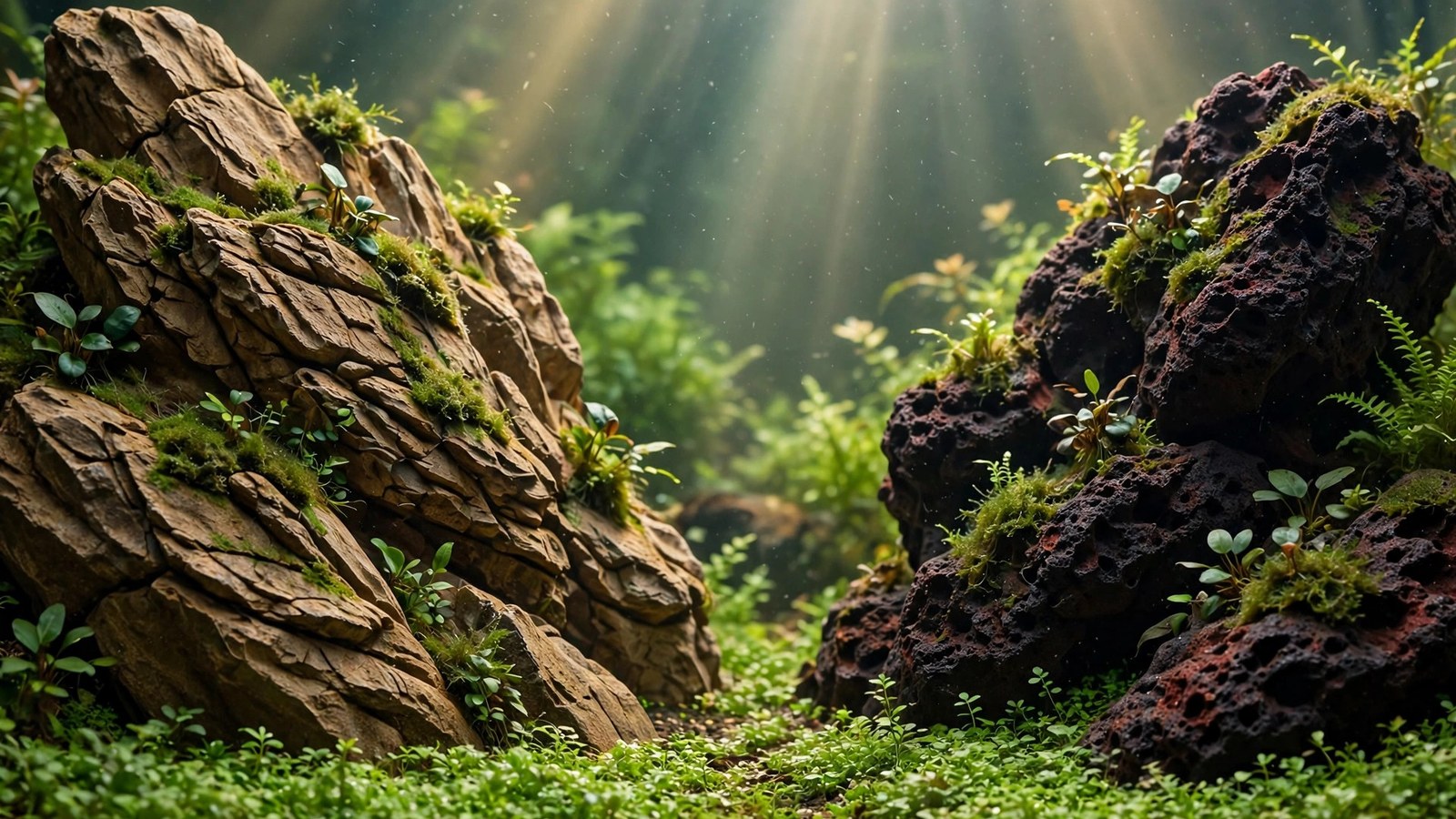
Two bags of rock sit on the shop floor. One is dark, rough, and absurdly light for its size. The other is earthy brown, folded and pitted like dragon scales, and costs noticeably more per pound. Both say "aquarium safe." Pick wrong and the scape never looks right, the water goes muddy for a week, or the stonework makes you nervous.
Two common hardscape stones, bought for opposite reasons: one a functional workhorse that happens to look dramatic, the other a character stone that happens to be chemically boring.
Dragon Stone (Ohko): The Character Rock
Dragon stone is a clay-mineral sedimentary rock — hardened, water-eroded clay — The surface is folded, grooved, and pocked with holes in warm browns and olives; against green plants and a dark background, it photographs like a mountain range — the default Nature-style feature stone.
Its clay origin makes it unusually workable: brittle compared to granite, so a hammer and chisel break pieces down into the shapes your layout needs. Fragile ridges snap if handled carelessly, and deep crevices trap clay dust that turns tank water muddy for days if you skip prep. Buy 30–50% more than you need; every piece is unique. The Unocho Dragon Stone 5 lb bag ★4.5 comes in 2–4 inch pieces suited to nano and mid-size layouts.
Disclosure: AquaVerdia participates in the Amazon Associates program. Buying through the links on this page may earn us a commission at no extra cost to you — it keeps these guides free.
Lava Rock: The Porous Workhorse
Lava rock is volcanic basalt — cooled, gas-pocketed magma. Dark charcoal to rust-red, rough as sandpaper, riddled with pores. A piece the size of a grapefruit feels like it should weigh twice what it does, because so much of its volume is empty space.
That empty space is the whole story. No common hardscape offers more surface area per dollar for beneficial bacteria — lava rock doubles as filter media, shrimp cover, and moss real estate. Anubias, Java fern, and mosses grip its texture eagerly — and it's the budget pick for hidden structure.
The trade-off is the edges: some pieces have genuinely sharp ridges, so keep the worst offenders away from corydoras, loaches, and long-finned fish. The LANDEN red lava rocks 16 lb bag ★4.5 covers visible accents plus hidden structure in tanks under 40 gallons.
Head-to-Head Comparison
The two stones solve opposite problems. Dragon stone provides detail: folded ridges and shadowed pockets. Lava rock provides mass and drama — dark, rugged, brooding — but individual pieces look plainer up close. Chemistry won't decide anything: both are inert and pH-neutral, unlike Seiryu stone and limestone, which can leach carbonates.
| Feature | Lava Rock | Dragon Stone |
|---|---|---|
| Appearance | Dark charcoal to rust-red, rough, porous | Earthy brown/olive, layered, scale-like grooves |
| Weight | Light for its size | Moderate — heavier per piece |
| Water chemistry | Inert, pH-neutral | Inert, pH-neutral |
| Porosity | Very high — top-tier bacterial surface | Moderate |
| Workability | Hard to reshape; watch sharp edges | Brittle — chips easily with hammer and chisel |
| Price tier | Budget | Mid-range |
| Best role | Hidden structure, moss walls, shrimp cover | Feature stone, centerpieces, photo layouts |
One design rule: pick one dominant stone per layout. A roughly 70/30 split reads intentional; 50/50 reads like indecision, because warm, detailed brown clashes with dark, coarse black. The classic hierarchy — dragon stone as the star, lava rock invisibly underneath — is what guides like Aquarium Lesson's comparison also recommend.
Still, run the vinegar fizz test on any new bag, because mislabeled rock happens. A few drops of white vinegar on the stone: fizzing means carbonate content, which raises pH and hardness over time. Real dragon stone and real lava rock stay silent.
Cleaning and Prep: Where Dragon Stone Punishes Laziness
Lava rock is easy: rinse to flush pore dust, scrub off loose debris, soak 24 hours, done. Don't boil it — trapped air pockets in porous rock can crack violently when heated.
Dragon stone demands more. Its crevices hold packed clay dust a casual rinse won't touch, and that dust turns tank water muddy brown for days. Scrub every piece with a stiff brush under running water, work into each crevice, then soak 24–48 hours, changing the water a few times. Tedious and non-negotiable.
Which Should You Buy?
Choose dragon stone if the rock is the visual star — Nature-style mountains, minimalist layouts, tanks you'll photograph. Choose lava rock for maximum function per dollar — shrimp tanks, moss walls, filter duty, tall builds, dark rockscapes. It's also the safer default on a tight budget.
Can't decide? Buy both, but give each a job: dragon stone fronts the layout, lava rock builds the invisible architecture. See also our best rocks for aquascaping and lava rock guide.
Frequently Asked Questions
Does dragon stone raise pH or water hardness?
No. It's inert and pH-neutral — no leaching, no effect on pH, GH, or KH, which is why it's a staple of soft-water planted tanks. Test new batches with the vinegar fizz test anyway.
Is lava rock safe for all aquarium fish?
Chemically safe for all freshwater fish, but sharp ridges can injure bottom-dwellers with delicate barbels — corydoras, loaches — or snag long-finned fish. Inspect each piece by hand and keep the sharpest ones out of the tank.
Can I mix lava rock and dragon stone in the same tank?
Yes, but commit to a hierarchy: roughly 70% of one stone, 30% of the other. A 50/50 mix usually looks undecided because their colors clash. The classic arrangement: dragon stone visible up front, lava rock as hidden filler.
Do I need to boil new hardscape rocks before adding them?
Don't boil porous rocks like lava rock — trapped air can crack them. For both stones, a thorough rinse and scrub plus a 24–48 hour soak is safer and sufficient.