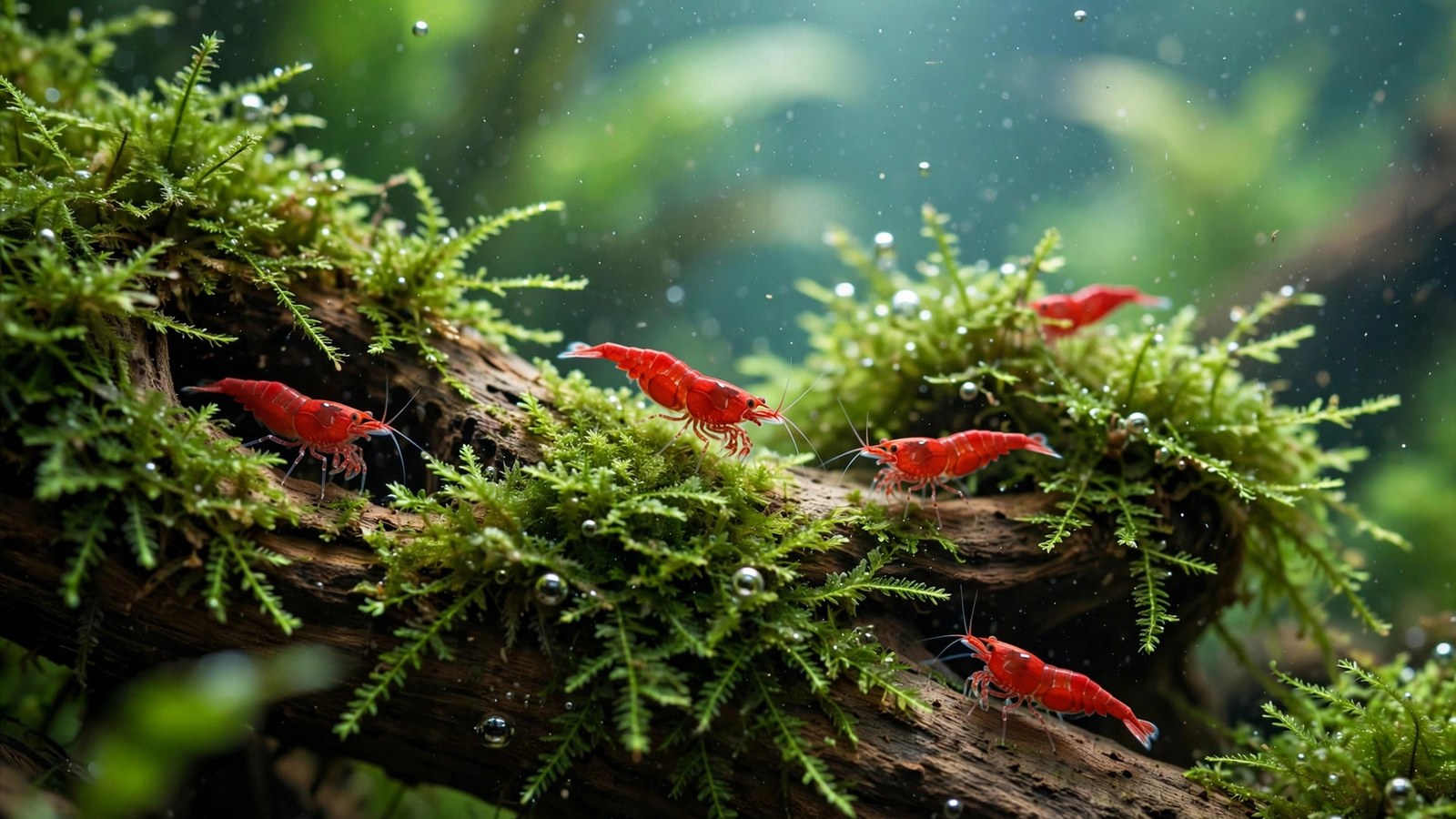
You paid for bright red shrimp that would add living color to your planted tank. Instead, all you see is an empty tank with expensive plants in it. The shrimp are somewhere — wedged behind the filter intake, buried in the moss, under the driftwood — and they come out at 11 p.m. like it's their job. The good news: cherry shrimp hiding is almost never a sign they're dying. The bad news: it almost always means something in your tank is telling them to stay put. This guide decodes the seven reasons cherry shrimp hide, shows you how to diagnose yours in ten minutes, and tells you exactly what to change so they come out in the open.
The 7 Reasons Cherry Shrimp Hide
Start here: read each cause, look for the "how to tell" test, and score your own tank. Most hiding shrimp have two or three of these overlapping — fix the easiest first.
1. New-tank stress (the most common reason)
A cherry shrimp that just arrived — whether shipped to you or bagged from the store — is dealing with a completely different water chemistry, temperature, and environment than the one it left. Even with careful drip acclimation, shrimp routinely hide for days to two or three weeks before they feel safe enough to graze openly. This is normal adaptation, not a disease. Juveniles hide the most; bolder adult females usually emerge first. If your shrimp are new and the tank is cycled and planted, the correct action is almost always: nothing. Give them a regular light schedule, stable parameters, and time.
2. Molting (the regular, harmless reason)
Cherry shrimp shed their exoskeleton roughly every 3–5 weeks (young shrimp molt more often; breeding females molt before each new clutch of eggs). Right before a molt, a shrimp turns slightly milky or opaque, eats less, and retreats into cover. After shedding, the new shell takes 24–72 hours to fully harden — during that window the shrimp is soft, defenseless, and will not come out for anything. You can confirm a molt happened: look for the discarded transparent shell (it looks like a ghost shrimp), often eaten by tank mates within a day. If you find molts but no bodies, your hiding shrimp are doing fine.
3. Predator pressure from tank mates
This is the reason that explains the most persistent hiding — and the one keepers deny longest. Cherry shrimp are near the bottom of the food chain, and they know it. Anything that has ever darted at, nipped, or stalked them becomes a reason to stay hidden permanently. The usual suspects:
- Bettas, gouramis, cichlids — will actively hunt shrimp. Expect zero visible shrimp in the daytime.
- "Peaceful" community fish — tetras, guppies, rasboras, platies. Adults usually survive, but every shrimplet is food, and the constant harassment keeps adults hiding. Otocinclus are the one genuinely safe fish; even pygmy corydoras mouth shrimplets.
- Bigger invertebrates — ghost shrimp can prey on cherry shrimp; large amanos occasionally bully them off food.
How to tell: do a night count. If you see five times more shrimp after lights-out than during the day, predators are training them to be nocturnal. The fix is structural, not behavioral: dense moss, driftwood crevices, and rock caves give shrimp predator-proof zones — or keep the tank shrimp-only, which is why serious breeders almost always do.
4. Water quality problems (the urgent reason)
Cherry shrimp are tougher than caridina shrimp, but they are still invertebrates — ammonia and nitrite are lethal at levels fish shrug off, and sudden parameter swings stress them into hiding long before anything dies. Hiding caused by water problems looks different: shrimp become lethargic, lose color, stop grazing, and stay motionless in corners rather than darting into cover. Warning signs that water is the culprit:
- Ammonia or nitrite above 0 ppm (uncycled tank, a recent crash, or a dead shrimp decomposing somewhere)
- Nitrate over 40 ppm from skipped water changes
- Recent large water change with mismatched temperature or chemistry — shrimp react badly to sudden TDS swings
- Copper: plant fertilizers with chelated copper, copper-based fish meds, or tap water from copper pipes
- Chlorine/chloramine from an unconditioned top-off
If hiding started suddenly after a water change or medication, suspect water first. The solution is measurement, not guessing — a liquid test kit tells you in five minutes whether ammonia, nitrite, nitrate, and pH are in range. You can check your tank's ammonia, nitrite, nitrate, and pH in one sitting with the API Freshwater Master Test Kit ★4.8, the liquid kit most planted-tank keepers use. Test, then do a modest 15–20% water change with temperature-matched, dechlorinated water. Big corrective swings stress shrimp worse than the problem you're fixing.
5. Too much light, no shade
Bright light is great for carpet plants; it's terrible for shy shrimp. In the wild, Neocaridina live in shaded, vegetated shallows. A high-output LED blazing eight hours a day over an open scape with no floating plants and no shade makes shrimp feel exposed every second the lights are on. Many keepers notice shrimp "magically appear" within minutes of lights-out — that's not nocturnal behavior, that's photophobia. Fixes: add floating plants (frogbit, red root floaters, salvinia) to dapple the light, dim the light to 60–70% intensity, and shorten the photoperiod to 6–7 hours. You'll often see a visible behavior change within days.
6. Not enough cover (the paradox)
Here's the paradox that confuses everyone: shrimp with plenty of hiding places hide less. A shrimp that knows escape is three centimeters away will graze in the open for hours. A shrimp in a sparse tank — no moss, bare hardscape, thinly planted — stays hidden all day because every moment in the open feels like a risk. The single highest-ROI upgrade for visible shrimp is a fist-sized clump of dense moss: java moss, Christmas moss, or Taiwan moss tied to driftwood. Moss is food (biofilm grows on every strand), a nursery for shrimplets, a molt-day safehouse, and a predator-proof bunker all at once. Attach moss to wood or rock with aquascape-safe super glue gel ★4.3 (a tiny dab, fully cured before it goes back in the tank) or cotton thread, and you'll have hiding-proof shrimp real estate within a month as it fills in.
7. They're hunting for food in the dark
Shrimp are grazers — they want to be constantly picking at biofilm and algae across every surface. In a new, sterile planted tank with polished leaves and zero biofilm, there's nothing to graze on, so they conserve energy in hiding instead. In an older tank, they may simply have eaten the easy algae and retreated. A consistent, small feeding routine trains shrimp to expect food in the open: a pea-sized algae wafer every other day, dropped in the same spot, turns feeding time into shrimp-counting time within two weeks. Good quality algae wafers ★4.8 or a shrimp-specific pellet formula gives them the vegetable matter and calcium they need between biofilm meals. Feed only what disappears in 2–3 hours; uneaten food rots and becomes cause #4.
The 10-Minute Diagnostic Checklist
Work through this in order. Most hiding problems reveal themselves by step 4.
- How long have they been in the tank? Under three weeks → probably just new. Leave them alone.
- Any fish in the tank? Anything bigger than an otocinclus that swims fast is a suspect. Watch for ten minutes during feeding.
- Night count: many more shrimp after lights-out → predator-trained behavior. Near-zero at night too → water or health.
- Test water now: ammonia, nitrite, nitrate, pH. If ammonia or nitrite reads anything above zero, that's your answer — fix it today.
- Find molts: empty shells on the substrate → recent molting. Leave the shrimp be; they'll emerge.
- Look for bodies: opaque pink-white corpses mean deaths are happening (check water, temperature, and look for a buried decomposing shrimp).
- Assess cover: can every shrimp reach dense moss or a cave within a few centimeters of wherever it grazes? If not, add moss.
- Check the light: is there any shaded area in the tank? No floating plants and blinding LED → dim it and add floaters.
How to Bring Them Out of Hiding
Once you've diagnosed the cause, here's the fix in priority order — cheapest and most effective first:
- Add moss, then more moss. One fist-sized clump of java or Christmas moss per 10 gallons of tank, tied to wood or rock. This single change fixes more hiding than everything else combined.
- Create shade. Floating plants covering 20–30% of the surface, or a dimmer light setting. Shrimp will start venturing out within days.
- Stabilize water. Weekly 10–20% water changes with temperature-matched, dechlorinated water; keep parameters boring and constant.
- Remove or re-home predators. If the night count shows predator-trained behavior, either move the hunters or accept a mostly-nocturnal colony.
- Feed on a schedule. A small wafer in the same spot every other day teaches shrimp that the open is where food appears.
- Wait. New shrimp need 2–3 weeks. Molting shrimp need 1–3 days. Berried females need the whole egg-carrying period (~3–4 weeks). Patience is a treatment.
Affiliate disclosure: as an Amazon Associate, AquaVerdia earns from qualifying purchases made through the product links in this article, at no extra cost to you. We only recommend products that fit the problem the article solves.
When Hiding Means Danger
Normal hiding is active hiding: shrimp dart into moss when startled, molt out of sight, or keep to the shadows in daytime. Abnormal hiding is lethargic hiding: shrimp sitting motionless in corners, on the glass, or at the surface; shrimp that don't react when gently nudged; shrimp losing their red color and turning pale or pinkish. The table below separates the two:
| What you see | Likely cause | Do this now |
|---|---|---|
| Hiding for a few days after adding | New-tank stress | Nothing — wait 1–3 weeks |
| Disappeared 2–3 days, milky shell found | Molting | Nothing — they reappear when the shell hardens |
| Visible at night, gone by day | Predator pressure | Add moss/cover; reconsider tank mates |
| Motionless in corners, color fading | Ammonia/nitrite spike | Test immediately, 15–20% water change, find the source |
| Sudden hiding after water change | Parameter swing or chlorine | Test; condition water; smaller, more frequent changes going forward |
| Pink-white bodies on substrate | Deaths — water, copper, or failed molts | Remove bodies, test everything, check for copper sources |
One dead shrimp is a data point; three in a week is an emergency. Remove bodies immediately — a decomposing shrimp spikes ammonia and turns one death into several.
Frequently Asked Questions
How long will new cherry shrimp hide?
Typically 3–14 days, occasionally up to three weeks. Juveniles hide longer than adults. If water parameters are stable, the tank is cycled, and there are no predators, hiding in the first two weeks is just acclimation — the shrimp are mapping their new territory and establishing safe routes. Shrimp that are still invisible after a month in a predator-free, planted tank need a water test.
Are cherry shrimp nocturnal?
No. Cherry shrimp are active day and night; they simply feel safer under low light. In a mature planted tank with dense moss and no predators, a colony grazes openly all day. If yours only come out after lights-out, the tank is telling them daytime is dangerous — usually because of fish, bright light, or too little cover.
Do cherry shrimp hide when molting?
Yes — hiding is a molting shrimp's survival strategy. The pre-molt phase (reduced activity, milky color) lasts a day or two, then the shrimp disappears for 1–3 days while its new shell hardens. Finding empty transparent shells on the substrate confirms this is happening. Leave molting shrimp alone; the soft shell tears easily.
Why does my berried female hide all the time?
A berried (egg-carrying) female is protecting ~20–40 eggs for 3–4 weeks. She fans them constantly and avoids open water because she's slower and more visible to predators. This is one of the most normal forms of hiding — she'll re-emerge shortly after the eggs hatch, and you'll see shrimplets within days of her reappearing.
How do I know how many shrimp I actually have?
You probably don't — cherry shrimp are expert hiders, and a colony of 50 in a planted tank can look like a colony of 10 in daylight. Do a night census 30 minutes after lights-out with a dim light. Colonies that are breeding will double or triple in a few months; rising night counts mean the "hiding problem" was actually a thriving colony all along.
Does java moss really make shrimp less shy?
Yes — it's the closest thing to a proven fix. Dense moss gives shrimp grazing surfaces loaded with biofilm, escape routes from anything that startles them, and protected molt sites. Shrimp with moss within reach spend most of their time in the open because shelter is always nearby. Sparse tanks produce invisible shrimp; mossy tanks produce visible ones.
The Patient Keeper's Ending
Almost every cherry shrimp keeper has stood in front of an apparently empty planted tank and wondered if the shrimp were all dead. In most cases, the shrimp are fine — they're just responding honestly to the conditions they find. Give them stable water, real cover, dimmer light, no predators, and a regular feeding spot, and the "invisible shrimp" problem solves itself. The keeper who panics and rearranges the tank every week resets the clock; the keeper who fixes the actual cause and waits gets rewarded with a red grazing colony out in the open. Your shrimp aren't hiding from you. They're hiding because something told them to — find out what, fix it once, and they'll come out on their own.