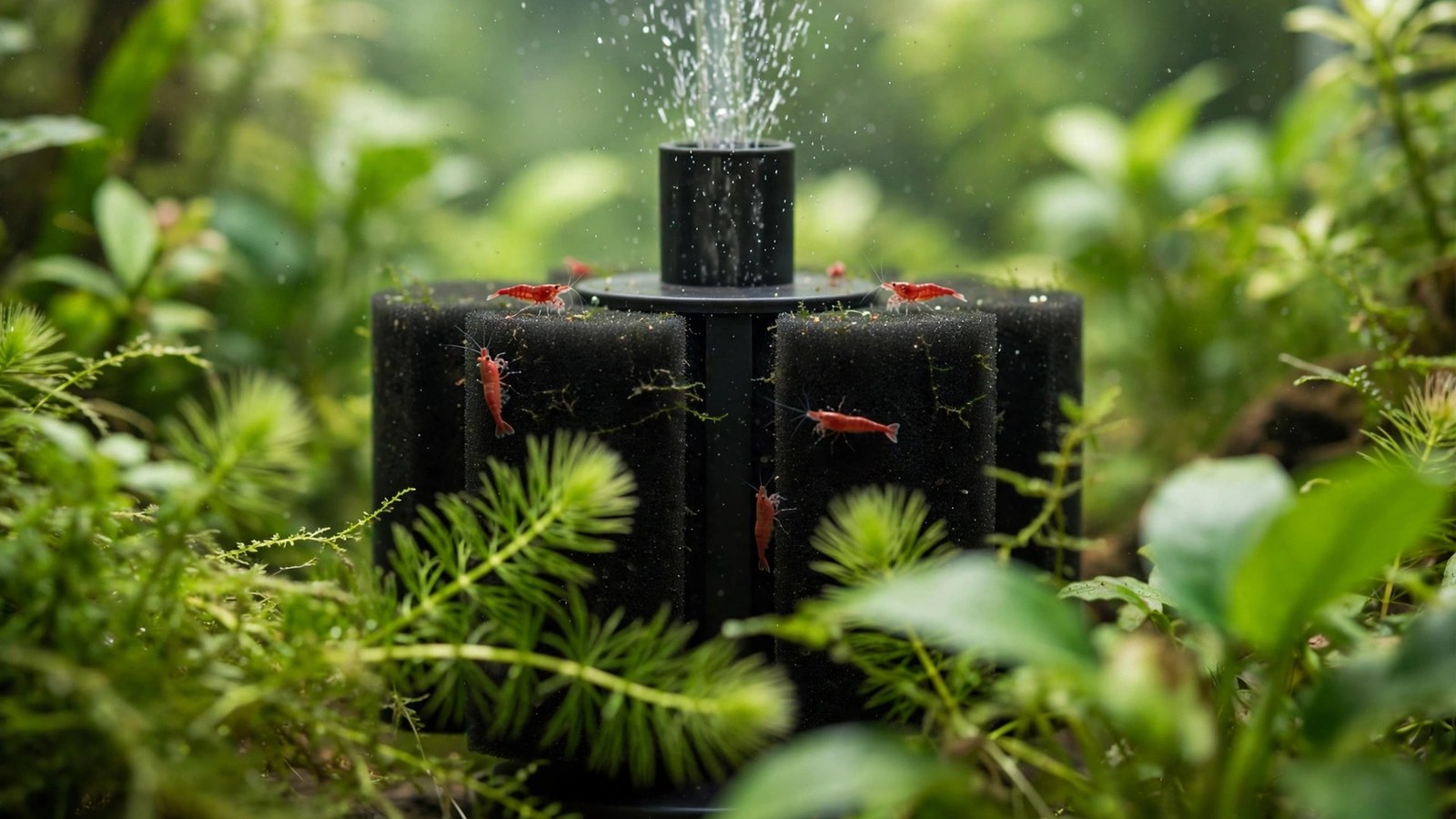
Every shrimp keeper has a version of the same story: the colony was thriving, the water was crystal clear, and then one morning the filter intake had vacuumed up a whole generation of week-old shrimplets. Power filters are workhorses for community tanks, but in a planted shrimp tank they are a liability with a plug. That is why breeders who run hundreds of tanks — the people whose rent depends on shrimp surviving — use the cheapest-looking filter in the hobby.
The short answer: the best sponge filter for a planted shrimp tank is a dual-sponge air-driven unit sized to your tank — it is shrimplet-safe by design, costs little, and doubles as a grazing surface for the colony. Pair it with a diaphragm air pump rated at or slightly above your tank's gallonage (not a piezoelectric nano pump, which cannot push enough air), add a check valve, and clean one sponge at a time in old tank water so the colony's biofilm never resets.
Why shrimp keepers choose sponge filters
Walk through a serious shrimp breeder's fish room and you will see row after row of tanks with the same unglamorous black cylinder in the corner. It is not nostalgia — it is math. A colony's most fragile asset is its newborns: shrimplets hatch at about 2 millimeters, small enough to be pulled into any intake that is not foam-covered. A sponge filter has no intake, no impeller, and no gap small enough to trap a shrimplet. Newborns can graze directly on the sponge without a parent in sight.
Then there is the second job the sponge does quietly: food production. Shrimp are grazers, and the largest share of their diet in a mature tank is the biofilm and microorganisms living on surfaces. A coarse-foam sponge is one of the largest surface areas in the tank, constantly bathed in oxygenated water. A well-established sponge filter is effectively a pasture — berried females and fresh hatchlings spend most of their time working it.
For planted tanks specifically, there is one more advantage: gentle circulation. Sponge filters move water without creating the current that uproots floaters or pins stems flat. The bubble stream provides surface agitation that keeps oxygen up and the dreaded oily biofilm down, without the waterfall effect of a hang-on-back filter that off-gasses CO2 in injected tanks. They are not the filter for a high-flow display scape — but a shrimp tank is not a high-flow display scape.
What actually matters when choosing one
Sponge filters look identical, but the details decide whether yours runs for years or clogs in a month. Here is what to evaluate:
Single vs double sponge. A single-sponge unit is fine for a 5-gallon desk tank with a small colony. For anything 10 gallons or up, dual-sponge is the default — twice the surface area for beneficial bacteria, and the critical maintenance trick: you can squeeze one sponge clean while the other holds the cycle intact.
Foam density. Fine foam (around 60 pores per inch) traps more debris and gives bacteria more surface, but clogs faster. Coarse foam flows better and cleans less often. For shrimp tanks, medium-to-fine is the sweet spot — shrimplets benefit from the finer grazing surface, and the maintenance rhythm stays manageable.
Size rating. Buy the next size up from your tank, then throttle airflow down if needed. An oversized sponge running gently is quieter, clogs slower, and holds more bacteria than a correctly-sized one running flat out. It is the cheapest insurance in the hobby.
Build details that matter: a weighted or suction-cup base that does not float away mid-week, an adjustable outlet tube so you can set the depth, and — on the better dual-sponge designs — a small media chamber under the sponges that holds ceramic rings for extra biological capacity.
The best sponge filters for planted shrimp tanks
Disclosure: the links below are Amazon affiliate links. If you buy through one, I earn a small commission at no extra cost to you — it helps keep AquaVerdia's guides free and ad-light.
After comparing the models that show up most consistently in breeder tanks and buyer reviews, these are the picks worth your money:
Best overall: hygger Double Sponge Filter (15–55 gallons). This is the unit that appears in more shrimp-tank setups than any other — two large sponges on a central lift tube, extendable outlet, suction cups that actually hold, and a media chamber with ceramic balls under the sponges for extra biological capacity. It is rated for 15 to 55 gallons, which makes it the natural fit for the standard 10–20 gallon shrimp colony tanks most keepers run. The fine foam gives shrimplets a rich grazing surface, and the two-sponge design means you alternate cleanings without ever resetting the cycle. You can check the hygger double sponge filter on Amazon ★4.5 — it needs an air pump and airline, which are not included.
Best for nanos and breeding racks: AQUANEAT Double Bio Sponge Filter 4-pack. If you run a 5–10 gallon shrimp cube or a rack of breeding tanks, a four-pack of small double-sponge units is the economical route — one filter per tank with spares to seed new setups. Breeders use seeded sponges like starter cultures: a sponge from an established tank jump-starts the cycle of a new one. Gentle flow, soft foam, shrimplet-safe by construction.
Best budget single-sponge: ALEGI-style single foam filters. For a 5-gallon cherry tank with a modest colony, a simple single-sponge unit does the whole job. Nothing fancy — just size the pump correctly and rinse the sponge on schedule. Shrimp keepers on forums consistently report these run for years on a cheap pump with zero colony losses.
The air pump: half the equation most guides skip
A sponge filter is only as good as the air driving it. The pump does two jobs at once: it draws water through the foam (filtration) and it agitates the surface (oxygen). An underpowered pump does neither well.
The sizing rule: choose a pump rated at or slightly above your tank's gallonage, then assume real-world losses. A 20-gallon-rated pump on a 20-gallon tank with a 4-foot airline, a check valve, and a splitter is already marginal. Oversizing slightly and throttling back with a gang valve gives you headroom and quieter operation.
Piezoelectric pumps cannot run sponge filters. This is worth stating plainly because nano air pumps like the NICREW Nano Silent and hygger's mini piezo models are marketed as whisper-quiet — and they are, because they move almost no air. They do not generate enough pressure to draw water through sponge media. They are designed for air stones only. If a sponge filter is in the tank, you need a diaphragm pump.
Best all-around: Tetra Whisper Air Pump (20–40 gallon rating). The Whisper line has been the default budget pump for decades because it does exactly what the name promises at this price tier: reliable airflow with modest noise. For a single sponge filter in a 10–20 gallon shrimp tank it is the sensible, widely-available choice. You can check the Tetra Whisper air pump on Amazon ★4.5. Pair it with a check valve so a power outage cannot siphon tank water into the pump.
Quietest step up: Eheim's air pumps. When reviewers test air pumps under real load rather than in a silent room, Eheim's diaphragm pumps consistently come out as the quietest plug-in option — the brand's reputation is built on motors that stay quiet for years instead of developing the diaphragm rattle that budget pumps get. If the tank sits in a bedroom or a quiet living room, the premium is worth it.
Best value adjustable: hygger's adjustable air pumps. The knob on the front is more useful than it sounds — being able to dial airflow down means you can buy one pump for the colony tank and re-tune it as the tank matures, instead of buying a second weaker unit. The multi-outlet versions can run several sponge filters across a breeding rack from one pump.
Setup in fifteen minutes
A sponge filter install is genuinely simple, but three small details separate a good one from a mediocre one:
- Soak the sponge first. Fresh foam is hydrophobic and buoyant. Soak it in dechlorinated water until it is saturated and sinks willingly — forcing a dry sponge underwater is how filters end up floating sideways at 2 a.m.
- Position the check valve above the water line. The valve goes in the airline between pump and filter, oriented so air flows toward the tank. In a power outage it stops tank water from back-siphoning into the pump. This is not optional equipment.
- Set the outlet near the surface but not splashing. The lift tube's job is to push water upward; you want the bubbles to ripple the surface, not churn it. On CO2-injected shrimp tanks (Caridina setups with active soil), keep agitation gentle to protect your CO2 levels.
If you run a gang valve to split one pump across multiple filters, bleed off the unused outlets rather than capping everything — a diaphragm pump with nowhere to breathe works harder and louder.
Keeping it quiet
Here is the uncomfortable truth about noisy sponge setups: the filter itself is silent. Every hum, buzz, and rattle comes from the air pump — and almost all of it is vibration transfer, not the motor. Before buying a quieter pump, try these, because they fix the vast majority of noise complaints:
- Isolate the pump. Set it on a foam pad, a folded towel, or a silicone mat — anything that breaks the contact with the shelf or stand. A quiet pump on a glass shelf measures dramatically louder than the same pump on foam.
- Do not let it touch the cabinet walls. Reposition so only the rubber feet touch anything. A pump resting against a stand panel turns the whole stand into a speaker.
- Cap or bleed unused outlets. On a dual-outlet pump, one open port hisses louder than the motor — adjust it closed with the valve.
- Hang it if nothing else works. Suspending the pump from a hook inside the stand cabinet removes vibration transfer entirely. It is the oldest trick in the fish-room playbook.
What actually bubbles in the tank is inaudible at normal room noise. Once the pump is isolated, a sponge-filtered shrimp tank is among the quietest setups in the hobby — one reason they dominate bedrooms and offices.
Cleaning without crashing your cycle
A sponge filter's biofilm is your tank's biological filter. The entire maintenance philosophy is: never clean the whole thing at once.
- Rinse in old tank water during a water change. Squeeze each sponge a few times in the bucket of removed tank water. Chlorinated tap water kills the nitrifying bacteria you spent weeks growing — this is the single most important rule of sponge filter ownership.
- Alternate sides on dual-sponge units. Clean one sponge this month, the other next month. The untouched side reseeds the cleaned one within days.
- Rinse every 2–4 weeks, not weekly. A sponge that never gets touched eventually clogs and flow drops; one that gets scrubbed constantly never builds a mature colony. Every few weeks is the rhythm most breeders use.
- Watch the flow, not the calendar. When the bubble stream weakens or the water in the lift tube moves sluggishly, the sponge is clogged — rinse it regardless of the schedule.
Replace sponges only when the foam physically degrades — tearing, crumbling, or permanently compressed — which takes years with decent foam, not months.
Frequently asked questions
Can one sponge filter handle a 20-gallon shrimp tank?
Yes — a dual-sponge unit rated for 20 gallons or above handles a 20-gallon colony easily, since shrimp have a tiny bioload relative to fish. The constraint is almost always the air pump's power, not the sponge. Size the pump generously and the filter keeps up.
Will a sponge filter work with CO2 injection?
Yes, and it is gentler on CO2 than a hang-on-back filter — the surface agitation is modest if you keep the outlet subtle. For high-tech displays with strong flow requirements, many keepers run a canister for circulation plus a sponge filter as the biological and shrimp-safe backup. Our sponge filter vs HOB comparison covers the tradeoffs.
How do I seed a new sponge filter quickly?
The fastest method is to run it alongside an established filter for two to three weeks, or to squeeze a mature sponge into the new tank's water near the new filter. The squeezed detritus is full of nitrifying bacteria that colonize the fresh foam within days rather than weeks.
Do sponge filters remove algae or tannins?
They help with the mechanical side — suspended debris and the surface biofilm that feeds certain algae — but they do not remove dissolved tannins or dissolved organics the way activated carbon or Purigen does. For tannin-stained water, add a small bag of chemical media alongside the sponge, or use our guide on planted tank water clarity.
Can I run a sponge filter without an air pump, using a powerhead?
You can drive a sponge with a small powerhead fitted over the lift tube, and some keepers do this for stronger flow. But you lose the shrimplet-safe advantage if the powerhead intake is exposed, and the setup becomes noisier and more expensive. For shrimp tanks, air-driven is the standard for a reason.
Why is my sponge filter floating?
Trapped air in fresh foam. Soak the sponge fully in dechlorinated water until it saturates and sinks on its own, then install it. Weighing the base down or using the suction cups until it is waterlogged also works — it stops floating within a day once saturated.