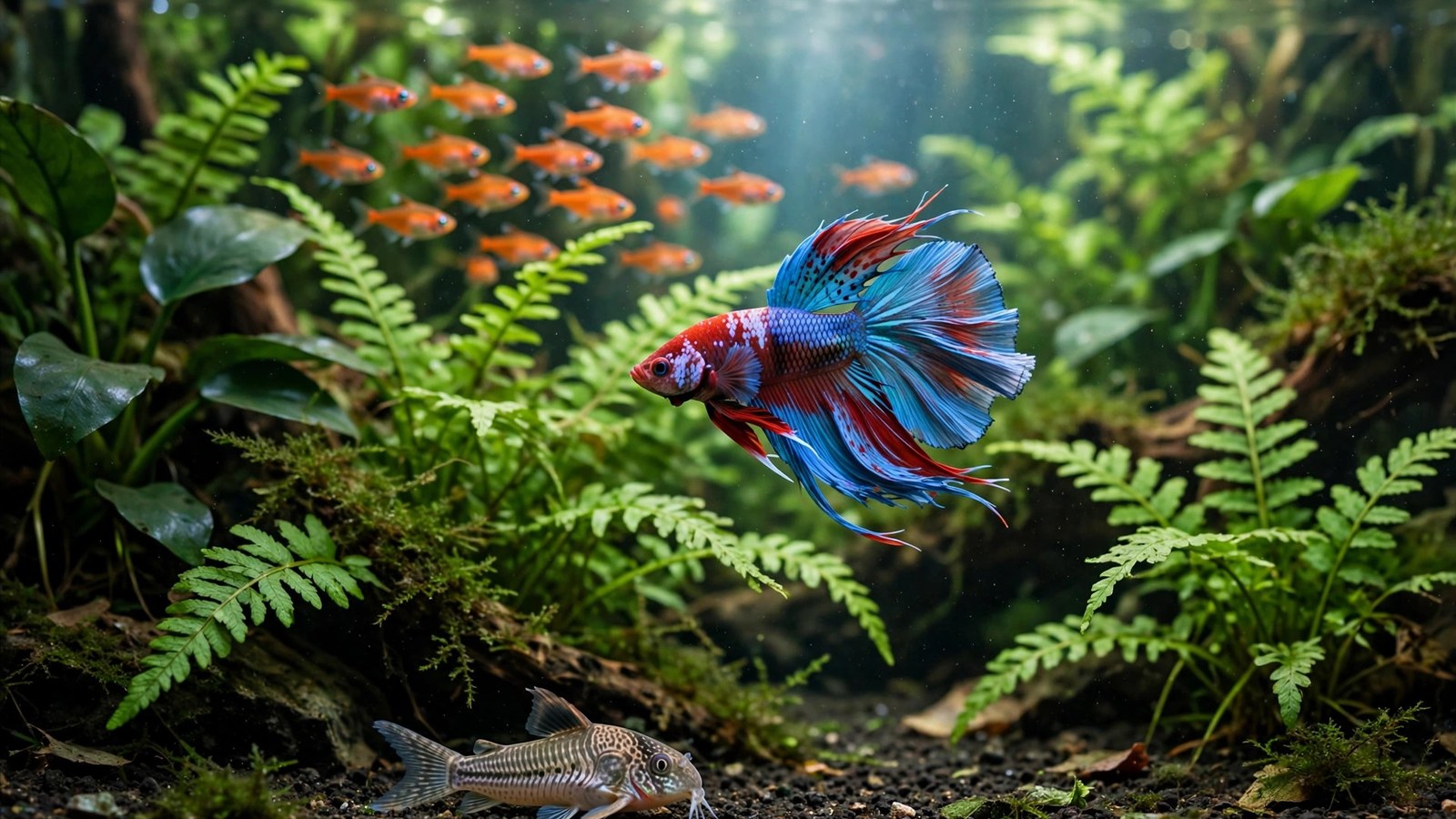
The fastest way to turn a peaceful planted tank into a casualty ward is to guess which fish get along with a betta. Most compatibility charts say yes to everything and warn you about nothing — including your betta’s personality, which matters more. This guide covers the proven tank mates, the species to avoid, and the setup rules that keep the peace.
The 4 Ground Rules of a Betta Community
A betta community is decided by the setup, not the species list.
1. Size before stocking. Ten gallons minimum for a betta plus a cleanup crew; schooling fish want 20+. Cramped quarters mean constant contact, and contact triggers chasing.
2. Plant for broken sightlines. A betta that can’t see the whole tank can’t claim all of it. Dense stems, driftwood, and floating cover split the aquarium into zones, and tannin-rich botanicals help too — a product like Seachem Catappa Leaves ★4.8 stains the water slightly amber and gives shy tank mates cover while adding the antibacterial tannins bettas evolved with.
3. Give the betta a home base. Bettas rest near the surface, so a suction-cup perch like the Zoo Med Betta Bed Leaf Hammock ★4.4 gives him a resting spot he’ll defend instead of patrolling the entire tank.
4. Always have a backup tank. Some bettas simply won’t share, and you can’t know until you try. Keep a small cycled tank ready for the betta or a bullied tank mate before you add anything.
The Safest Tank Mates, Ranked
A note on links: product links in this guide are Amazon affiliate links. If you buy through them, AquaVerdia earns a small commission at no extra cost to you — and we only link products that fit a planted betta setup.
These species have the best track record with male bettas. An independent compatibility database rates these same species among the most consistently successful pairings.
Nerite snails — the no-brainer. Bettas almost universally ignore them, they’re superb algae cleaners, and they can’t reproduce in freshwater. One per 5 gallons.
Pygmy corydoras (Corydoras pygmaeus) — best bottom crew. Small and peaceful, sifting the substrate far below the betta’s patrol zone. Groups of six or more on smooth substrate — coarse gravel wears their barbels.
Ember tetras and chili rasboras — best midwater school. Tiny, calm, and fast enough to dodge a curious betta. They suit the low-light planted tanks bettas love. School of six minimum.
Harlequin rasboras — the hardier option. Larger and sturdier than embers — a good pick if your parameters aren’t razor-stable yet.
Kuhli loaches — the night shift. Eel-shaped bottom dwellers active after lights-out, so they rarely meet the betta. Groups of five or more.
Amano shrimp — excellent, with an asterisk. Superb algae controllers, but a gamble: some bettas ignore a colony for years, others clear it in a week. Dense moss and wood hides give the best odds. If you’re fertilizing plants around shrimp, use a formula made for it — a shrimp-safe all-in-one like ThriveS ★4.7 feeds plants without copper levels that stress invertebrates.
| Species | Min. group | Min. tank | Zone | Notes |
|---|---|---|---|---|
| Nerite snail | 1 | 5 gal | Everywhere | Ignored by bettas; won’t breed in freshwater |
| Pygmy corydoras | 6 | 15 gal | Bottom | Needs smooth substrate |
| Ember tetra | 6 | 10 gal | Midwater | Tiny and calm |
| Harlequin rasbora | 6 | 15 gal | Midwater | Hardy beginner pick |
| Kuhli loach | 5 | 15 gal | Bottom | Nocturnal; provide hides |
| Amano shrimp | 3 | 10 gal | Everywhere | Gamble — temperament-dependent |
Species to Avoid
These fail often enough they’re not worth the experiment. Fin-nippers (tiger barbs, serpae tetras, black skirts) shred betta fins. Gouramis are fellow labyrinth fish that read as rivals. Male guppies and other long-finned, bright fish can trigger the rival-male response. Crayfish and cichlids can injure a betta outright — and never house two male bettas together.
How to Introduce Tank Mates
Quarantine every newcomer for two weeks — non-negotiable; a sick tetra can wipe a community. Add tank mates first and let them settle, then rearrange a few plants to reset territories, dim the lights, feed the tank, and add the betta last. He arrives as the newcomer.
Watch closely for two weeks. Curious following is normal; persistent chasing or cornering is not. If it doesn’t calm down within days, separate them — that’s what the backup tank is for.
Feeding a Mixed Community
The practical headache of a betta community isn’t aggression — it’s dinner. Bettas hoover up everyone’s food. Feed the schooling fish and bottom crew first (sinking pellets or wafers for corys and loaches), then feed the betta his portion at the surface while the others are busy. Feed twice daily rather than once, and fast the tank one day a week. If the betta balloons while the corys look thin, you’re feeding in the wrong order.
When to Pull the Plug
Separate immediately if you see nipped fins, a tank mate hiding permanently, relentless patrolling of one fish, or clamped fins. A community that worked for months can still turn — bettas sometimes “decide” later, especially after a rescape. Move the aggressor or the victim the same day; don’t wait for injuries.
Frequently Asked Questions
Can a betta live with guppies?
Usually not with males — their bright colors and flowing tails can trigger the rival-male response, and guppies nip fins themselves. Female guppies are calmer, but it stays unpredictable. Tetras and rasboras are safer.
What is the minimum tank size for betta tank mates?
Ten gallons minimum for a betta plus a cleanup crew like snails. A multi-species community with schooling fish needs 20 gallons or more — space is the biggest factor in keeping aggression down.
Will my betta eat my shrimp?
It depends on the individual. Some ignore cherry and amano shrimp completely; others hunt them within days. Large amano shrimp in a heavily planted tank have the best odds. Expect to lose a few.
Should I add the betta or the tank mates first?
The tank mates, always. A betta added to an established community arrives as the newcomer and is far less likely to claim the whole tank. Rearrange some plants before adding him.