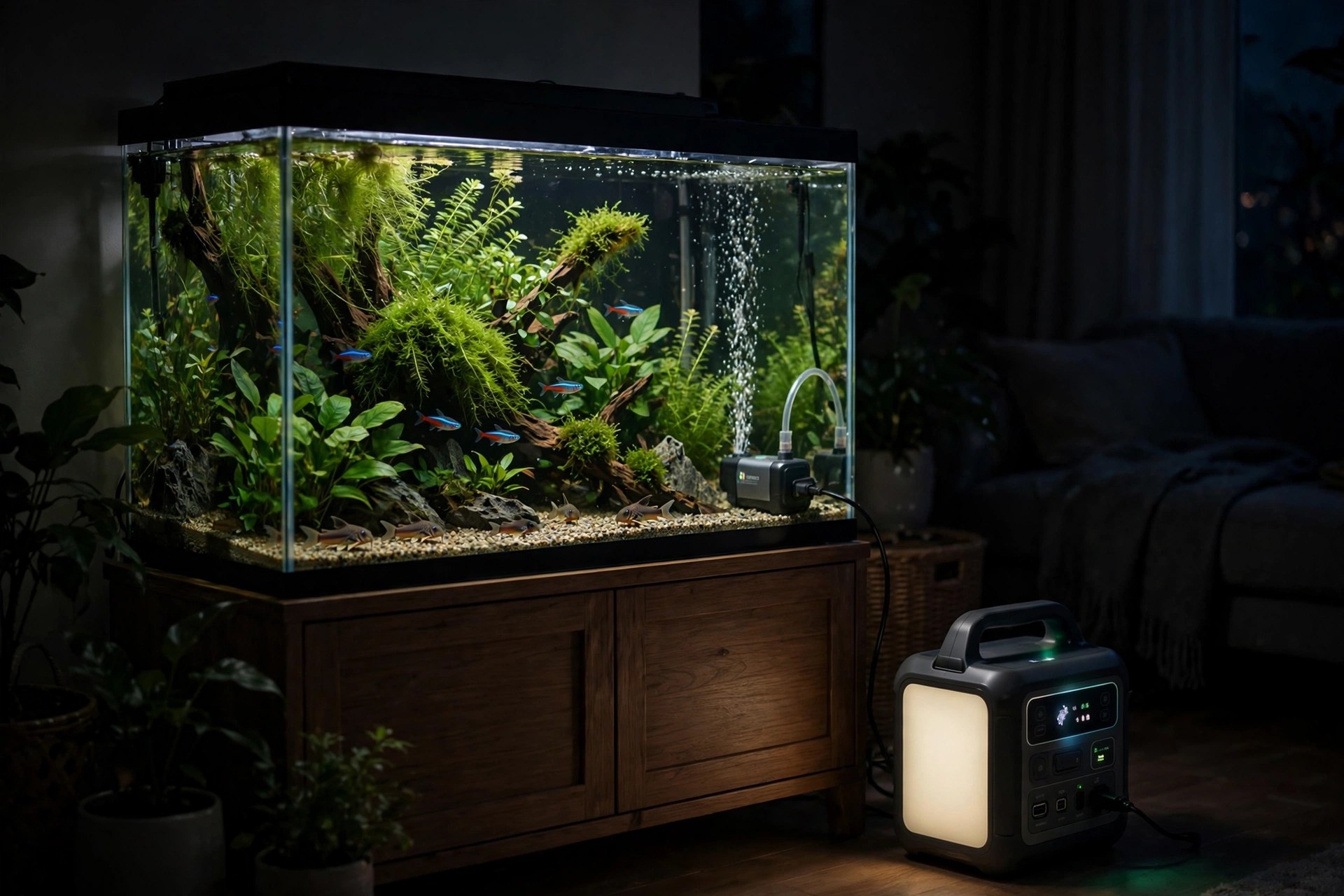
The power goes out at 2 a.m., and your planted tank starts a countdown you cannot see. The filter stops, the air stone goes quiet, and the water that was full of oxygen begins to run down its reserves. Fish and plants can ride out a short outage easily — a healthy tank holds enough oxygen for several hours — but once the outage stretches past half a day, or the weather turns hot or cold, the tank needs help. The difference between a tank that survives a blackout and one that does not is almost never luck. It is a backup plan that was set up before the lights went out.
This guide builds that plan in three tiers: the battery air pump that keeps oxygen flowing automatically, the uninterruptible power supply or portable power station that keeps filters and lights alive, and the simple watt-hour math that tells you how long each tier will actually last. You do not need all three tiers on day one. Start with the first, add the second when your tank — or your local grid — justifies it, and test the whole setup twice a year, not during a storm.
Short answer: Put a battery backup air pump on every tank first — it switches on automatically when mains power fails and keeps oxygen flowing for hours on ordinary batteries. Then, if outages in your area last longer than a few hours, add a UPS or portable power station sized to your filter and lights using the watt-hour math below: add up the watts of what you want to keep running, multiply by the hours you want it to run, and buy a station with at least that many watt-hours, plus a margin. Heaters and CO2 are the last priorities, not the first — oxygen and filtration keep fish alive, and lights keep plants from stalling.
What actually fails first when the power goes out
Five things stop when the power stops, and they do not matter equally. Understanding the order they become dangerous is what lets you spend backup money in the right place.
Oxygen fails first. Fish and bacteria consume oxygen continuously, and plants switch from producing oxygen in light to consuming it in darkness. A heavily stocked tank on a warm night can reach stressful oxygen levels in four to six hours; a lightly stocked planted tank may hold out for a day or more, because plants and surface area help. Warm water holds less oxygen than cool water, so a summer outage is more dangerous than a winter one at the same stocking level.
Filtration fails second, but more slowly. When a filter stops, its bacteria do not die instantly — they begin to starve of oxygen over hours, and a filter that sits stagnant for a day or more can develop low-oxygen pockets that release unpleasant compounds when it restarts. That is why the restart matters as much as the outage: run the filter briefly into a bucket, or let it flush, before it dumps stagnant water back into the tank.
Temperature drifts third, at the speed of the room. A large tank changes temperature slowly — a 50-gallon tank may move only a few degrees in a day in a mild house — while a small nano tank can swing fast. Heaters matter most for tropical fish in a cold snap, and least in a mild outage. Lights fail last in importance: plants can sit in darkness for days without permanent damage, though a long dark stretch stalls growth and can trigger algae when the lights return at full blast. CO2 injection should simply be off — with no light, plants are not using it, and injected CO2 with no photosynthesis can push pH down while nobody is watching.
Tier 1: the battery air pump that switches itself on
The cheapest and most effective backup in the hobby is a battery air pump with automatic switch-on. It plugs into the wall like a normal pump, and the moment mains power fails, it starts running on its own batteries. You do not have to be home, awake, or even aware there is an outage. That automatic part is the whole point: most outages that kill fish happen overnight, when nobody is there to notice the filter has stopped.
Set it up permanently, not in a drawer. Connect the airline and air stone to the tank, leave the pump plugged in, and keep fresh batteries in it — replace them on a schedule, not when you remember after a storm warning. Put the air stone where it disturbs the surface: breaking the surface is what exchanges gases, and a stone buried under decor or under a thick plant mat does less good than one in open water. For tanks above the pump's rated size, run two pumps or accept that aeration will be partial — partial is still far better than none.
For routine backup, the Penn-Plax Silent Air B11 battery backup air pump ★4.6 is the standard example of this tier: it plugs into the wall, switches on automatically when power fails, and runs on two D batteries, with tubing and an air stone in the box. It is rated for tanks up to about 29 gallons, so larger tanks want one per tank section, or a second pump, rather than one pump stretched across a big aquarium.
Affiliate link — I earn a small commission at no extra cost to you.
Tier 2: a UPS or portable power station for filters and lights
Once aeration is automatic, the next tier keeps the tank actually running: filter and lights on a UPS (uninterruptible power supply) or a portable power station. A small computer UPS will run a low-wattage filter for an hour or two and is a good fit for a single small tank. A portable power station — the lunchbox-sized lithium battery with AC outlets — runs longer, can be recharged from a car or solar panel, and is the better choice for a big tank, multiple tanks, or outages that last half a day.
Plug only the essentials into the backup: filter first, light second, and nothing else unless the math says you can afford it. Heaters are the trap here. A 200-watt heater will drain a mid-size power station in an hour or two, and a tank that loses heating slowly is in far less danger than a tank that loses oxygen quickly. If the room is cold enough that temperature is genuinely the risk, insulate the tank with blankets or towels first — insulation is free runtime — and save the battery for the filter.
For lights, do not run the full photoperiod on backup. Run a shortened, dimmer schedule — a few hours at reduced brightness — to keep plants ticking over without burning the battery. Plants tolerate a short day far better than fish tolerate no oxygen, and a light at half brightness for four hours uses roughly half the energy of a full-brightness eight-hour day. When mains power returns, bring the light back gradually over a day or two rather than snapping straight back to full brightness, which is when algae tends to seize the opening.
Sizing your backup: the watt-hour math
Backup sizing is one multiplication, and it is worth doing with the actual labels on your own equipment rather than a generic chart. Find the watts on each device — printed on the filter, the light, or the power brick — add up what you want to keep running, and multiply by the hours you want it to run. That gives you the watt-hours your station must hold. Buy at least 25 percent more than the answer, because stations rarely deliver their full rated capacity, and a battery that is two years old holds less than a new one.
| What you run | Typical watts | 4 hours needs | 8 hours needs |
|---|---|---|---|
| Air pump alone | 2–4 W | ~16 Wh | ~32 Wh |
| Canister filter | 10–25 W | ~100 Wh | ~200 Wh |
| LED plant light | 20–40 W | ~160 Wh | ~320 Wh |
| Filter + light together | 30–65 W | ~260 Wh | ~520 Wh |
| Heater (for comparison) | 100–300 W | ~1,200 Wh | ~2,400 Wh |
Worked example: a canister filter at 15 watts plus an LED at 30 watts is 45 watts. For six hours, that is 270 watt-hours; with the margin, look for a station rated around 350 watt-hours or more. If the number shocks you, that is the math doing its job — it is better to learn it in the shop than at hour three of a blackout. And remember that the battery air pump from Tier 1 is not part of this math at all: it runs on its own batteries, so the tank keeps breathing even if the station runs dry.
When the power comes back: the restart checklist
The outage ending is not the end of the risk. Restarting carelessly causes a surprising share of post-outage losses, so work through a short checklist before everything goes back to normal. First, check the fish: gasping at the surface after power returns can mean oxygen is still low, so keep the air pump running until the filter has been going for an hour. Second, flush a filter that sat still for a day or more before it dumps stagnant water into the tank. Third, check temperature before switching the heater back to its normal setting — a tank that drifted cool should be warmed gradually, not snapped back. Fourth, switch CO2 back on only with the lights, and at the usual rate, not higher to "make up" for lost time.
Power coming back is also when leaks happen: pumps restart out of sync, siphons break and re-form, and a canister that lost prime can push water where it was never meant to go. If your tank sits on wood floors, or above a finished room, it is worth reading up on leak-proofing a room for a big fish tank before you finalize where your backup gear lives — a drip tray under the stand and a water alarm beside the filter cost little and catch exactly the kind of slow leak a post-outage restart produces.
Finally, test the water the next day. An outage that stopped filtration for a day can leave a small ammonia bump as bacteria recover, and a water change plus a fasted day for the fish is the gentle fix. Do not overfeed to "make up" for the outage, and do not dose a shelf of remedies at once — one water change, one re-test, and patience will tell you whether the tank actually needs anything else.
What not to back up, and the habits that matter more
Not everything deserves battery power. Heaters on a small station, CO2 injection during darkness, UV sterilizers, and decorative pumps are all energy spent on things the tank can live without for a day. Every watt spent on a non-essential is a watt stolen from the filter, so be ruthless about what plugs into the backup, and label the backup outlets so a housemate does not plug a phone charger into the tank's lifeline during an outage.
The habits around the gear matter as much as the gear. Keep spare D batteries with the pump, not in a kitchen drawer. Keep the power station charged — a station stored empty for six months may not charge when you need it, so top it up every few months. Keep a printed card on the stand: what plugs into the backup, how long it should last, and the restart checklist above. An outage at 2 a.m. is no time to be reconstructing a plan from memory.
Frequently asked questions
How long can a planted tank survive without power?
It depends on stocking, temperature, and tank size, but a lightly stocked planted tank can often ride out 12–24 hours, while a heavily stocked tank in warm water may struggle after four to six hours. Oxygen is the limiting factor, which is why an automatic battery air pump extends survival more than any other single purchase.
Should I run my filter or my air pump on backup first?
The air pump, if you must choose one. Aeration keeps fish breathing directly, while a filter's bacteria survive hours of stillness and recover once flow returns. Ideally run both — the pump on its own batteries and the filter on a UPS or power station — but never sacrifice aeration to keep a filter running.
Can a portable power station run an aquarium heater?
Technically yes, practically rarely for long. A 200-watt heater drains a mid-size station in an hour or two, while the same station runs a filter and light for most of a day. Insulate the tank and protect oxygen and filtration first; reserve the heater for genuinely cold rooms and large stations.
Do I need to turn off CO2 during a power outage?
Yes. With no light, plants are not photosynthesizing, so injected CO2 accumulates and can push pH down while the tank is already stressed. Switch CO2 off when the power fails and back on with the lights when it returns, at the normal rate.