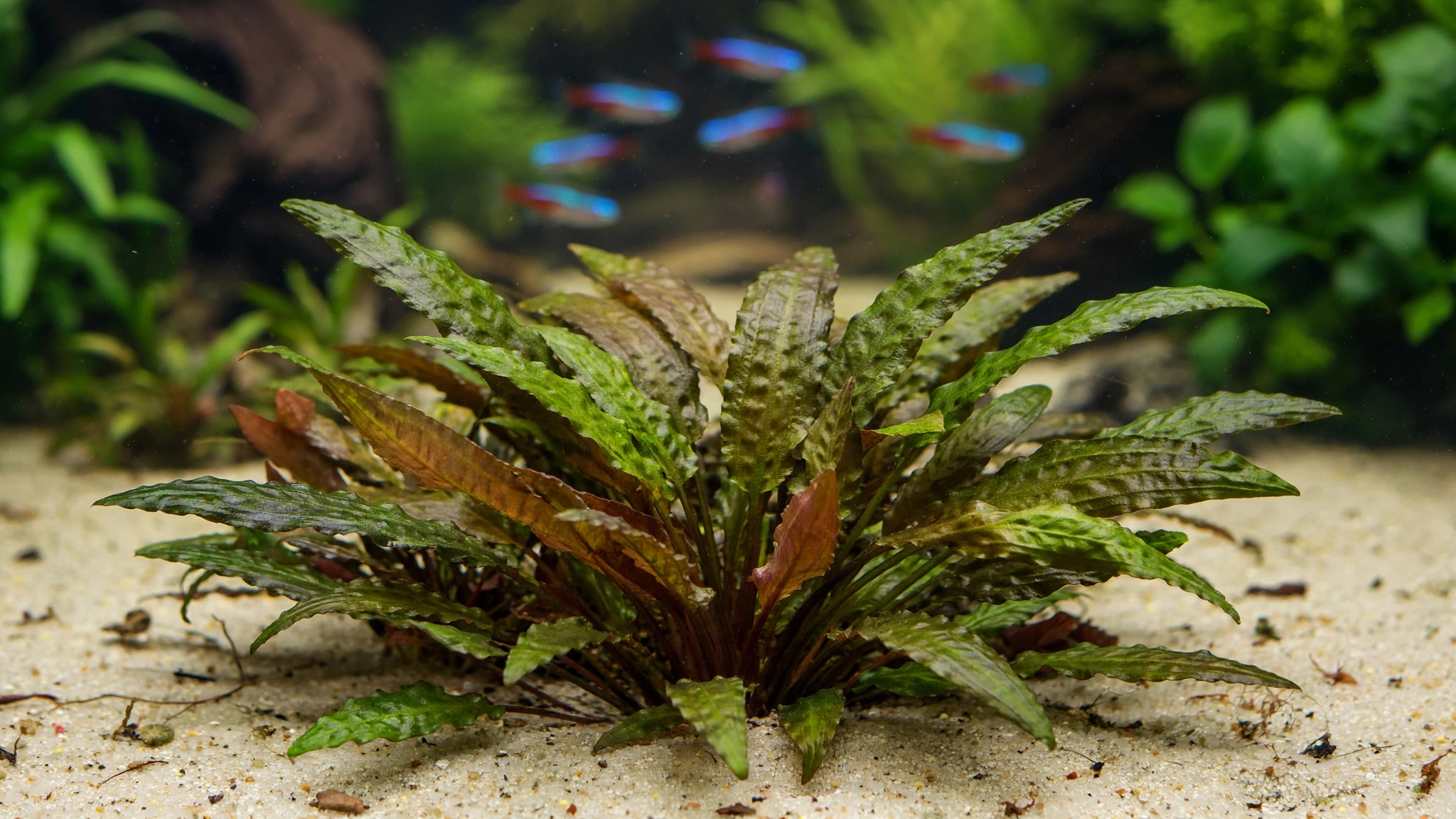
Ask about Cryptocoryne anywhere and you will hear the same warning: crypts are heavy root feeders, so you must push root tabs into the substrate or they will starve. It sounds authoritative, and it sells a lot of tabs. Yet plenty of low-tech tanks grow healthy wendtii in plain sand with no tabs at all — because the label is only half the story.
This guide separates the half that matters from the half that does not: when crypts grow fine in low light without root tabs, when tabs earn their place, and how to feed crypts through the water column instead.
Direct answer: Yes, most crypts can grow in low light without root tabs. In an established, normally stocked tank, fish waste, mulm, and regular liquid fertilizer supply enough nutrients for slow-growing species such as Cryptocoryne wendtii. Root tabs help in new, lightly stocked, or heavily planted tanks — but they are an accelerator, not a requirement.
Why crypts got the "heavy root feeder" label
Crypts grow an extensive root system, and that is what earned them the label. A mature wendtii clump can fill a surprising volume of substrate with roots, so it seems obvious that it must feed mainly from below. What the label leaves out is that crypts also absorb nutrients through their leaves. Every rooted plant takes up nutrients by both routes; the split shifts with species and substrate, but it is never all one way.
In a low-tech tank, growth itself limits demand. Without injected carbon dioxide and with low light, a crypt grows slowly, so its nutrient need is small. Fish food, fish waste, and mulm in the substrate steadily add nitrogen, phosphorus, and trace elements — a slow drip that is often enough for a slow plant. The Glass Box Diaries test of the heavy-root-feeder idea reaches the same conclusion from low-tech tanks on inert sand: swords and crypts grew well without tabs or aquasoil, because the tank as a whole supplied nutrients, not just the substrate.
When crypts grow fine without root tabs
Three conditions together make tabs unnecessary for most common crypts. The tank is established — running for a few months, with a stable bacterial colony and some mulm in the substrate. It is normally stocked, so fish contribute waste every day. And you dose the water column, even lightly. If all three hold, Cryptocoryne wendtii, C. undulata, and C. lutea will grow steadily in low light with no tabs. They will not grow fast, but new leaves will arrive green, full-sized, and regularly.
Aquasoil tanks get the same pass while the soil is still charged — active substrates release nutrients for roughly the first year, and tabs during that window are redundant. The honest check is always the newest leaves: if new growth is green and normal-sized, the plant is fed. Our Cryptocoryne care guide covers the melt-and-recovery side in more detail.
When root tabs actually earn their place
Tabs stop being optional in four situations: a brand-new tank with inert sand, few fish, and several hungry plants; a heavily planted tank where many root feeders compete for the same substrate; an older aquasoil tank whose nutrients are spent, typically after a year or more; and a plant showing real deficiency after settling — new leaves coming in small and pale, or growth stalled for weeks despite stable light and water.
Placement matters more than brand. Push one tab an inch or two into the substrate a couple of inches from the crown — never directly on top of it — and repeat roughly every two to three months, not weekly. Tabs dissolve slowly, and stacking them is how tanks get ammonia spikes and algae blooms. If you do add them, Seachem Flourish Tabs ★4.6 are the standard choice for crypts because they sit in the root zone and release gradually.
As an Amazon Associate, AquaVerdia earns from qualifying purchases made through links on this page, at no extra cost to you.
How to feed crypts without root tabs
The no-tab routine is simple: dose the water column lightly and consistently. A comprehensive liquid fertilizer once a week after the water change, at half the bottle dose to start, covers the micronutrients crypts need most. Increase only if new growth stays pale after a month; in a low-light tank without injected carbon dioxide, plants cannot use a heavy dose, and the excess feeds algae instead. Keep the photoperiod at 6–8 hours on a timer, and keep the crown — where leaves meet roots — just above the substrate line. A buried crown rots, and rot is often misread as a feeding problem.
Then leave the plant alone. Crypts hate being moved: every relocation disturbs the roots and can trigger melt, where leaves dissolve within days. Melt after moving is not proof the plant needed tabs; it is transplant shock, and new leaves usually follow within a few weeks. The Cryptocoryne wendtii care guide is the best species starting point for a low-light tank. For the water-column routine, Seachem Flourish ★4.7 is a widely used comprehensive liquid that suits lean, weekly dosing.
| Situation | Without root tabs | With root tabs |
|---|---|---|
| Established, stocked, low light | Enough with weekly liquid dosing | Faster, fuller growth; not required |
| New tank, inert sand, few fish | Slow start; pale new growth likely | Recommended until the tank matures |
| Aquasoil under a year old | Soil still feeds the roots | Redundant until the soil is spent |
| Old aquasoil, stalled growth | Decline continues | Restores root-zone nutrients |
| Demanding species (parva, balansae) | Survives but stays very slow | Helps, alongside stronger light |
Mistakes that look like a tab deficiency
Most "my crypts need tabs" diagnoses are something else in disguise. Moving the plant is the biggest: melt follows relocation, and growers blame the substrate when the cause was disturbance. Burying the crown is second — the plant rots from the centre outward no matter how well fed it is. Third is impatience: crypts can sit apparently unchanged for a month after planting while they build roots. Fourth is light misread as food: a crypt in deep shade grows slowly even with perfect nutrition, and no tab fixes a light problem. Check light, crown depth, and stability before you buy anything — and for the broader picture, see our guide to whether low-light plants need fertilizer.
Frequently asked questions
Can crypts grow in plain gravel with no fertilizer at all?
In a stocked, established tank, often yes for a while — fish waste and mulm supply nutrients. In a new or lightly stocked tank, plain gravel with no dosing will eventually show in small, pale new leaves, and a light liquid fertilizer is the simplest fix.
Do root tabs cause algae?
Properly buried tabs rarely do, because their nutrients stay in the substrate. Tabs left exposed, overdosed, or stacked too close together can leach into the water and feed algae — which is why placement and the two-to-three-month interval matter.
Which crypts are least likely to need root tabs?
Cryptocoryne wendtii, C. undulata, and C. lutea are the most forgiving in low light with water-column feeding alone. More demanding species such as C. parva and C. balansae grow noticeably better with root-zone nutrition and stronger light.
How long should I wait before adding tabs to a struggling crypt?
Wait until the plant has settled — about four to six weeks after planting — and judge only new growth. If new leaves are still small or pale after that window, and light and water are stable, tabs are a reasonable next step rather than a first resort.