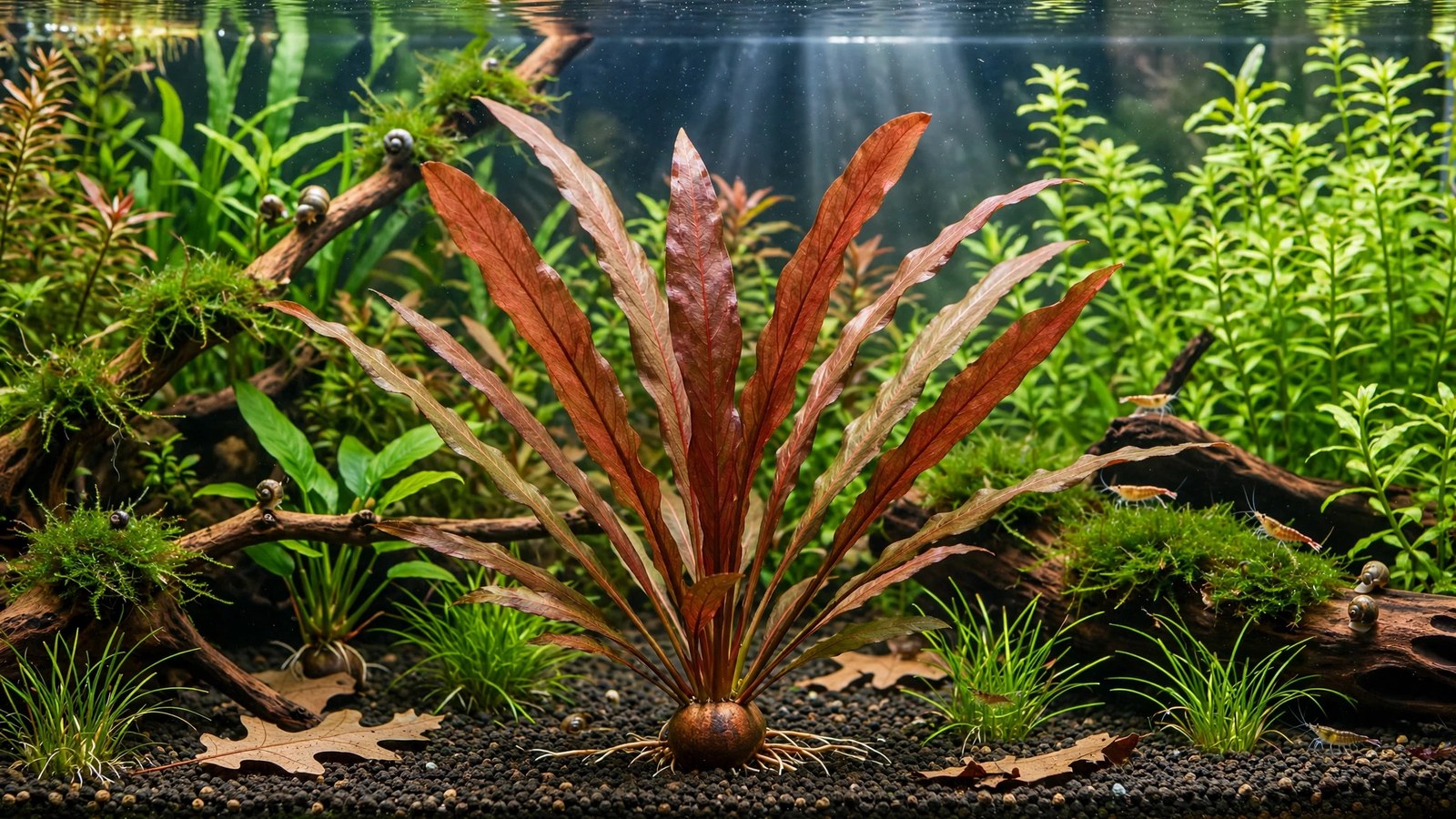
Most red plants in this hobby demand CO2 injection, punishing light, and a maintenance schedule you keep like a part-time job. Barclaya longifolia ignores all of that. This slow bulb plant unfurls 20- to 40-centimeter ribbon leaves — olive-green brushed with copper and wine-red — from a single fist-sized bulb, and once settled, it stays gorgeous for years. By the end of this guide you'll know how to plant the bulb without rotting it, how to prune so it never smothers your tank, and the one rookie mistake that kills more Barclaya than any nutrient deficiency.
Why Collectors Are Chasing This Bulb
You won't find Barclaya longifolia in every fish shop, and that scarcity is half its appeal. In the wild it clings to slow, shaded streambeds across Southeast Asia, and that backstory explains its temperament: a patient plant built for low, filtered light. The upper leaf surface runs olive to bronze-green; underneath you'll see the deep reddish-bronze undersides that earn it the "red bulb plant" nickname. Under strong light the whole plant warms toward burgundy.
Its closest lookalike is red tiger lotus, but the two behave very differently. Tiger lotus sends lily pads to the surface; Barclaya keeps a tighter rosette whose blades stay submerged, swaying like seagrass. A lotus is a surface plant wearing a midground disguise — Barclaya is a true underwater specimen that stays where you put it.
One non-negotiable to accept before you buy: this plant is slow. A new bulb typically spends 2–4 weeks doing nothing visible while it roots. Then leaves emerge at roughly one every 10–14 days, and a mature specimen carries 15–25 at once.
Water Parameters That Actually Matter
Barclaya is forgiving within a broad envelope, but it sulks — stalling and shedding outer leaves — when a few specific boundaries are crossed:
| Parameter | Target range | Notes |
|---|---|---|
| Temperature | 22–28 °C (72–82 °F) | Best color and growth at 24–26 °C |
| pH | 5.5–7.5 | Soft, slightly acidic is ideal |
| GH | 3–12 dGH | Avoid very hard water (stunted leaves) |
| Light | 40–80 PAR at substrate | More light = redder leaves, more algae risk |
| Photoperiod | 7–9 hours | Longer invites algae on the broad blades |
| CO2 | Optional; 20–30 ppm helps | Biggest single color payoff |
The parameter hobbyists get wrong most often is temperature. Above 28 °C the leaves thin out and algae colonizes the broad blades; below 20 °C the plant essentially goes dormant — not dying, just waiting, sometimes for months. Hold 24–26 °C and most problems never appear.
On CO2: Barclaya survives and looks decent without it, which is why low-tech keepers love it. But CO2 is the single largest lever on color. With injection at 20–30 ppm, new leaves emerge bronze-red and hold the tint for months; without it, they emerge olive and redden only under the highest safe light. If you're choosing between a CO2 system and a stronger light to chase red coloration, choose CO2 every time — more light without CO2 just buys you algae.
Planting the Bulb: The Critical First Step
How you plant the bulb on day one determines whether you get a five-year centerpiece or a five-week funeral. Barclaya bulbs arrive looking like a small, dark onion — firm, with stubby roots and a crown where leaves emerge. The exact process:
- Inspect before it touches water. It should be firm all over, like an onion, with no soft spots and no sour smell. A partially soft bulb may still survive if at least half is firm — trim dead roots, but never cut into the bulb body.
- Give it deep, fine substrate. Provide 8–10 cm (3–4 in) of nutrient-rich substrate — aquasoil, or inert sand with root tabs — directly under the planting spot. Coarse gravel is a poor choice; roots struggle to penetrate it.
- Set the bulb with the top third exposed. Press the bottom two-thirds in, crown up, top third above the substrate line. This is the anti-rot rule: a fully buried bulb sits in an oxygen-poor zone where rot bacteria thrive.
- Don't move it for at least 6 weeks. The bulb spends its first month pushing roots before a single leaf appears — tugging it up to check resets that clock.
Placement deserves real thought because this plant doesn't relocate gracefully. Barclaya belongs in the background or as an off-center midground focal in tanks 45 cm (18 in) tall or taller — anything shorter and the leaves fold at the surface and shade everything below. A 60–75 liter (15–20 gallon) tank is the practical minimum; in a 200-liter (50-gallon) tank, three bulbs spaced 20 cm apart make a proper stand.
Feeding a Heavy Root Feeder
Barclaya's leaves feed almost entirely through the bulb's root system, which flips the usual fertilization logic. Water-column dosing is largely ignored by this plant. The program that actually works:
- Root tabs: press one comprehensive tab (Seachem Flourish Tabs, Aquarium Co-Op Easy Root Tabs, or equivalent) into the substrate 8–10 cm from the bulb's crown every 8–12 weeks. Bulbs exhaust tabs silently — the first symptom is new leaves emerging narrower (3 cm instead of 4–5 cm), not the dramatic yellowing other plants show.
- Water-column dosing: optional and light. If you run an all-in-one liquid, dose at half the label rate; Barclaya benefits only marginally, mostly in micronutrients.
- Iron: the one supplement worth targeting if you chase the red. Chelated iron (Fe DTPA) at 0.05–0.1 ppm, 2–3 times weekly, deepens reds — but only alongside adequate light and CO2.
Fresh aquasoil is the best possible start: ADA Amazonia or Tropica Aquarium Soil gives 6–12 months of built-in nutrition, so you can delay the first tabs until month 4 or 5. On exhausted aquasoil or inert sand, start tabs from day one.
Pruning and Leaf Management
You don't prune Barclaya to shape it; you prune it so it survives in your tank. Left alone, 25+ leaves stack, shade each other, and collect algae on the lower blades. The routine takes ten minutes every two to three weeks:
- Remove outer, declining leaves first. The oldest leaves sit at the outside of the rosette. When one yellows or collects persistent algae, trace it to the crown and cut it there — not mid-leaf, which leaves a stub that rots.
- Cut at the crown, never into the bulb. Use long aquascaping scissors and sever the stalk 1–2 cm above the crown.
- Keep 12–18 healthy leaves. Enough canopy for the bronze look, enough circulation to keep detritus moving. Above 20, inner blades decline from self-shading.
- Don't trim for height. A cut leaf dies back to the crown — you can't shorten a Barclaya leaf like a stem plant. Remove the tallest outer leaves entirely instead.
Because growth is slow, many weeks you'll remove just one or two leaves. Compare that to a dwarf aquarium lily, which can demand surface-pad management twice a week once established.
Common Problems and How to Fix Them
Bulb rot. The crown goes soft instead of firm — usually from planting too deep or detritus packed around the crown. If only part is soft, trim the mushy tissue with sterilized scissors and replant shallower; the firm remainder often recovers. A fully soft, sour-smelling bulb is done.
No new growth after 6+ weeks. Verify the bulb is still firm — a firm bulb is a living bulb, and some take 6–8 weeks to wake. If firm and idle, the usual culprits are temperatures below 22 °C or exhausted substrate. Warm it, tab it, and wait another month before declaring it dead.
Melting leaves after introduction. Normal while the bulb adapts — it sheds leaves grown in the supplier's conditions. Remove melted leaves promptly (they rot fast and spike ammonia) and judge the plant only on leaves that emerge in your tank.
Algae on the blades. Wide, slow-growing leaves are algae magnets under too much light. Drop the photoperiod to 7 hours, confirm CO2 reaches plant height with a drop checker, and remove the worst-affected outer leaves. Resist cranking the light for more red — CO2 is the color lever, not light.
Propagation: Slow but Satisfying
Barclaya multiplies in two ways: daughter bulbs and seeds.
Daughter bulbs are the practical route. A healthy, well-fed bulb 2–3 years old often sends up small offsets beside the mother. Let them reach 3–4 cm across with 5–6 of their own leaves before separating with a sharp, sterile blade — separating too early kills the offset. Plant mother and daughter 20+ cm apart with separate tab zones.
Seeds are the collector's route. With CO2 and strong light, Barclaya can flower underwater — a genuine event — and the blooms form seed pods that release seeds into the substrate. If you spot a flower stalk, leave it alone — snipping it is why home tanks never get seedlings.
For context on pace: banana plants throw splittable runners monthly, and Aponogeton crispus bulbs divide within a year. Barclaya is the tortoise of the family — one reason specimens command premium prices.
Dormancy: What It Looks Like and What to Do
After a heat spike, a big move, or sometimes no reason at all, Barclaya may shed every leaf over 2–3 weeks until only the bulb remains. Your instinct will scream that it's dead. It is almost certainly dormant — and this is where beginners lose the plant by throwing the bulb away.
The rule: if the bulb is firm, it's alive. Leave it in place, keep tabs on schedule, maintain normal water changes, and wait 4–10 weeks. The first new leaf emerges small and pale; normal growth resumes within a month. Don't "help" by uprooting it for weekly inspections. Crinum calamistratum sulks for months after disturbance in much the same way — the bulb-plant temperament is a family trait.
Tank Mates and Aquascaping Roles
Barclaya plays a specific role: the midground-to-background anchor that ties a scape together. Its ribbon leaves bridge the scale between foreground carpets and tall background stems, and its bronze-red tones ease the eye from green Lagenandra beds toward vivid red stems. Two designs work especially well: the solitary statement — one bulb off-center with open water around it, reading as a deliberate focal point — and the valley grove, three bulbs in a loose triangle spaced 20–25 cm apart in tanks 120 cm and up, each with its own tab zone.
On fauna: Barclaya suits nearly everything that doesn't eat plants. Amano shrimp, nerite snails, and otocinclus are the ideal cleanup crew for its algae-prone blades. Plecos and large cichlids that rearrange substrate can dislodge the bulb — anchor it with a ring of small stones for the first two months. Keep goldfish and silver dollars far away; they shred the leaves.
For authoritative species data, see the Tropica plant database entry for Barclaya longifolia; the Flowgrow aquatic plant database compiles hobbyist growth reports that match the timelines in this guide.
Frequently Asked Questions
How fast does Barclaya longifolia grow?
Slowly — roughly one new leaf every 10–14 days in good conditions, so a new bulb needs 3–4 months before it looks like a proper specimen. Growth speed is driven mainly by root-zone nutrition and CO2; a bulb on fresh aquasoil with CO2 grows noticeably faster than one on inert sand without it. Don't judge the plant in its first 6 weeks, when it may show no visible growth.
Can Barclaya longifolia grow without CO2?
Yes — it's one of the few genuinely red-toned plants that tolerates no CO2. Without it the leaves stay more olive-bronze than wine-red, and growth slows to about one leaf every 3–4 weeks. For the deep burgundy color, CO2 at 20–30 ppm makes a bigger difference than any other single change, including light upgrades.
Why is my Barclaya bulb rotting?
Almost always because it's buried too deep. The bulb needs its top third exposed; fully buried bulbs sit in oxygen-poor substrate where rot bacteria thrive. If only part is soft, trim the mushy tissue with sterilized scissors and replant shallower — the firm remainder usually recovers. A fully soft, sour-smelling bulb is finished.
Does Barclaya longifolia go dormant?
Yes — after stress like a heat spike, a move, or sometimes no obvious reason, it can shed every leaf over 2–3 weeks and sit as a bare bulb for 4–10 weeks. As long as the bulb stays firm, it's alive and will regrow; only discard one that's soft and mushy throughout. Keep tabs on schedule during dormancy and don't dig it up to check.
How tall does Barclaya longifolia get?
Leaves typically reach 30–40 cm (12–16 inches), with exceptional specimens hitting 50 cm in deep tanks with rich substrate. That's why it needs a tank at least 45 cm tall — in shallower tanks the leaves fold at the surface and shade everything beneath them.
Can I split a Barclaya bulb to propagate it?
Not by cutting — slicing a Barclaya bulb kills it. Wait for natural daughter bulbs, which form beside the mother on mature specimens (usually 2–3 years old), and separate them only once they're 3–4 cm across with 5–6 leaves. Or let it flower underwater: the self-pollinating blooms produce seeds that germinate in the substrate 4–6 weeks later.
Is Barclaya Longifolia Right for Your Tank?
If you keep a tank at least 45 cm tall, can leave a bulb alone for six weeks without fiddling, and value a centerpiece that deepens over years rather than weeks, Barclaya longifolia is one of the most rewarding plants you'll ever grow. Plant the bulb shallow, feed the roots, and give it the one thing hobbyists struggle to give: time.