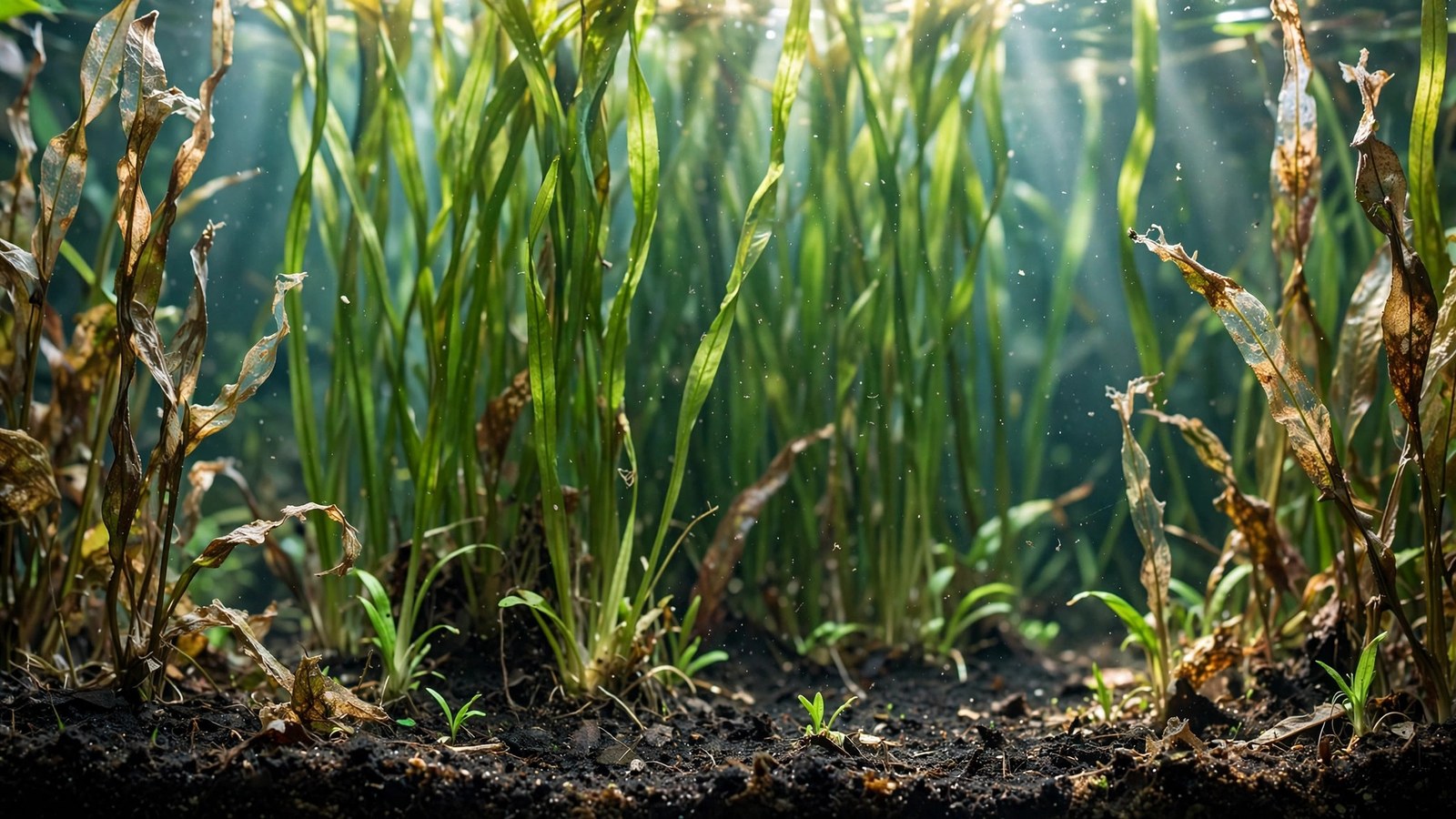
You planted a healthy row of vallisneria on Sunday. By Friday, the leaves are turning translucent, the outer ones are sloughing off like wet tissue paper, and the whole bunch looks like it's dissolving. Before you pull it all out and bin it — stop. In most cases, melting vallisneria is not a dead plant. It is a plant doing exactly what stressed vallisneria does: shedding its old leaves while it quietly rebuilds underground. What you do in the next two weeks decides whether you get a lush background curtain or an empty corner.
Cause 1: Liquid carbon is melting your vals
If you are dosing Flourish Excel, EasyCarbo, or any other glutaraldehyde-based "liquid CO2" product, stop reading and stop dosing. This is the number-one cause of vallisneria melt, and it is well documented. Aquarium forums are full of identical reports: healthy vals planted on Monday, translucent and collapsing within a week of daily liquid-carbon dosing — and recovering within a couple of weeks once the dosing stopped.
The chemistry explains the pattern. Vallisneria is an obligate underwater plant that absorbs nutrients and gases directly through its leaves instead of through stomata like most emersed plants. Glutaraldehyde diffuses straight through the same route — and at dosing concentrations it is a biocide, not a gentle carbon source. The damage tends to be worse in soft water; hobbyists report that vals sometimes survive liquid carbon in very hard water but collapse in soft water under the same dose. Seachem once tested Excel against vallisneria and reported it could not reproduce the die-off, but it never published the test conditions, so the safe working assumption stays the same: do not dose liquid carbon anywhere near vallisneria, at any dose.
This matters more than the brand name. EasyCarbo (polycycloglutaral) and Excel (polycycloglutaracetal) are chemically different, and the severity varies between products and tanks — some hobbyists have dosed around vals for months without a wipeout. But "some got away with it" is not a strategy. The melt pattern is distinctive: leaves turn transparent from the tips inward, go limp, and disintegrate within days of starting a dosing routine. If that matches what you're seeing, liquid carbon is your prime suspect.
Cause 2: Transplant shock from emersed-grown stock
Most vallisneria sold in stores is grown emersed — out of water, in humid greenhouses — because it grows far faster that way. When those plants go under your waterline, they have to rebuild their leaf structure for submerged life: different light levels, dissolved CO2 a fraction of atmospheric levels, different everything. Shedding old leaves is how they do it.
Experienced keepers routinely lose up to 75% of the plant's mass during this transition, and it can take 3–4 weeks or more for acclimatization to finish. The dead giveaway is the pattern: the old leaves melt while tiny new shoots push up from the crown at the same time. That is not a dying plant — that is a plant changing clothes. What you must not do is panic and keep replanting, moving it around, or "trying again" with fresh bunches. Every replant resets the clock. Plant once, then let it be.
Trimming helps here. Cutting away the worst of the melted leaves redirects the plant's energy away from tissue it has already abandoned and toward the new growth at the base. Snip melted leaves close to the crown with sharp scissors rather than yanking them — vallisneria leaves tear, and tearing wounds the crown.
Cause 3: The crown is buried too deep
The crown is the pale, firm base where the leaves meet the roots. It must breathe. Vallisneria planted with the crown buried under the substrate rots from the base upward, and the rot looks exactly like melt — leaves detach with a gentle tug and the base smells off.
The fix is planting depth, not products. Push only the roots into the substrate, fanned out, and let the crown sit just above the surface of the sand or soil. About 2–3 cm of root depth is plenty; vals anchor quickly and send runners that lock the plant in within a week or two. If your vals were planted by pushing the whole base down with tweezers until nothing showed, lift them gently and reposition — one careful adjustment now beats watching them rot for a month.
Cause 4: Not enough light reaching the leaves
Vallisneria is not a high-light plant, but it has a floor. Under roughly 30 PAR, or when shaded by floating plants, tall hardscape, or its own overcrowded older leaves, vals brown from the leaf tips downward and melt halfway along the blade. One UKAPS keeper noted his vals melted whenever floating plants shaded them, and the lower portion stayed alive until light returned.
If your melt is happening weeks after planting, only on the shaded side or the lower leaves, and your tank is packed with frogbit or duckweed, thin the floaters first. Vals will often sort themselves out once light reaches them again — they're fast growers when the basics are right.
Cause 5: Root damage at planting
Rough handling and root trimming are a quieter cause of melt. Vallisneria can recover from root trimming — always with a sharp knife or scissors, never by tearing — but heavily trimmed roots mean the plant has nothing to feed itself with while it grows submerged leaves, so the old growth melts faster. Most nurseries ship vals with generous root systems; plant them as they arrive and trim only dead, black, or slimy roots.
How to tell which cause you have
Match your symptoms to this table before changing anything — fixing the wrong cause wastes the plant's recovery window.
| What you see | Likely cause | Check |
|---|---|---|
| Leaves turn transparent from tips inward, days after starting a new bottle of liquid carbon | Liquid carbon toxicity | Are you dosing Excel/EasyCarbo or any "liquid CO2"? |
| Old leaves melt, new tiny shoots appear at the crown within 1–2 weeks | Transplant shock (normal) | Was the stock store-bought and emersed-grown? |
| Leaves detach with a gentle pull, base looks dark and smells off | Buried or rotting crown | Is the crown under the substrate? |
| Melt only on shaded leaves or lower blades, starting weeks after planting | Too little light | Are floaters or tall hardscape shading the vals? |
| Whole bunch melts within days of planting, roots looked trimmed or mangled | Root damage | How were the roots handled at planting? |
The recovery plan: what to do this week
Follow this sequence — order matters, because each step protects the next:
- Stop liquid carbon today. Not "half dose," not "every other day" — zero, anywhere near vallisneria. If algae control is the reason you dose, deal with the algae another way while your vals recover.
- Check planting depth. Gently brush substrate away from the base of each plant. If the crown is buried, lift and reseat it with the crown exposed. Do this once, carefully.
- Trim the dead tissue. Cut melted, transparent, or mushy leaves close to the crown with sharp scissors. Leave any leaf that is still firm and green, even if it's only half intact — it is still photosynthesizing and feeding the recovery.
- Do not uproot and replant. Every replant resets the acclimatization clock. The one exception is a rotted crown (see below).
- Feed the roots, lightly. Vals are heavy root feeders. Press one root tab 5–7 cm from each crown, not directly under it — see the feeding section below.
- Wait 2–4 weeks. New shoots from the crown are the only scoreboard that matters. The timeline below tells you what to expect.
| Week | What to expect | What to do |
|---|---|---|
| 1 | More old leaves melt; the worst of it happens now | Trim mush, don't panic |
| 2–3 | Tiny bright-green shoots emerge from the crown | Leave them alone; keep trimming dead outer leaves |
| 4–6 | New leaves reach 10–20 cm; first runners may appear | Let runners establish before separating |
| 8+ | Runners form a dense stand | Thin and replant runners where you want them |
Feeding recovering vals: root tabs first
Vallisneria feeds mostly through its roots, so the single most useful product for a recovering stand is a good root tab — not a liquid fertilizer, and definitely not liquid carbon. Push one tab 5–7 cm from each crown (not directly underneath, which can burn the roots), about 5 cm deep in the substrate. Replace tabs every 3–4 months.
A gentle all-in-one liquid fertilizer at half the label dose supports the new leaves without overloading a tank that currently has less plant mass absorbing nutrients. Full-dose liquid ferts into a tank of melting plants mostly feed algae — dose for the plants you have now, not the jungle you're aiming for.
As an Amazon Associate I earn from qualifying purchases. The two products that genuinely fit this job are Seachem Flourish Tabs ★4.6, the root tabs I reach for around recovering vals, and Seachem Flourish ★4.7 liquid for a light, comprehensive supplement at half dose. Note this is the standard Flourish — not Flourish Excel, which is the glutaraldehyde product that melts vallisneria.
When to give up on a plant
Sometimes the crown is gone and no patience will fix it. Give up on an individual plant only when:
- The crown is soft, brown, and mushy to a gentle squeeze — healthy crowns are firm and pale.
- No new growth appears after 6 full weeks of correct conditions (no liquid carbon, exposed crown, adequate light).
- The plant smells of rot at the base even after dead tissue is trimmed away.
If the crown is firm but the leaves are all gone, leave it. Vals have come back from bare crowns more often than most keepers expect.
Frequently asked questions
Will melted vallisneria grow back?
Usually, yes — if the crown is firm and healthy. Old melted leaves won't recover, but a living crown will push new shoots within 2–4 weeks once the cause (usually liquid carbon or a buried crown) is fixed. Only a soft, rotted crown is truly dead.
Should I remove the melted leaves or leave them?
Remove them. Melted leaves rot, foul the water, and feed algae, while the plant wastes energy on tissue it has already abandoned. Trim close to the crown with sharp scissors, but keep any leaf that is still firm and green.
Can I use Flourish Excel with vallisneria?
No — this is the single most common cause of vallisneria melt. Glutaraldehyde-based liquid carbon products (Excel, EasyCarbo, and equivalents) damage vals' leaves, especially in soft water. Use standard liquid fertilizers or root tabs instead, and never dose liquid carbon near vallisneria.
How long until I see new growth?
Typically 2–4 weeks after planting, once the cause of the melt is addressed. Emersed-grown stock takes the longest; runners usually start appearing around week 4–8 once the mother plant is established.
Is vallisneria a heavy root feeder?
Yes. Vals do best with nutrients at the roots, which is why one root tab per crown (replaced every 3–4 months) outperforms liquid dosing alone for this species. Press tabs 5–7 cm from the crown, not directly under it.
Why did my vals melt but my other plants are fine?
Vallisneria is unusually sensitive to glutaraldehyde because it absorbs directly through its leaves, so liquid carbon hits it harder than plants with a protective cuticle. It is also more likely to be sold emersed-grown than many other species, making transplant shock more dramatic. If only your vals are melting, liquid carbon is the first thing to suspect.