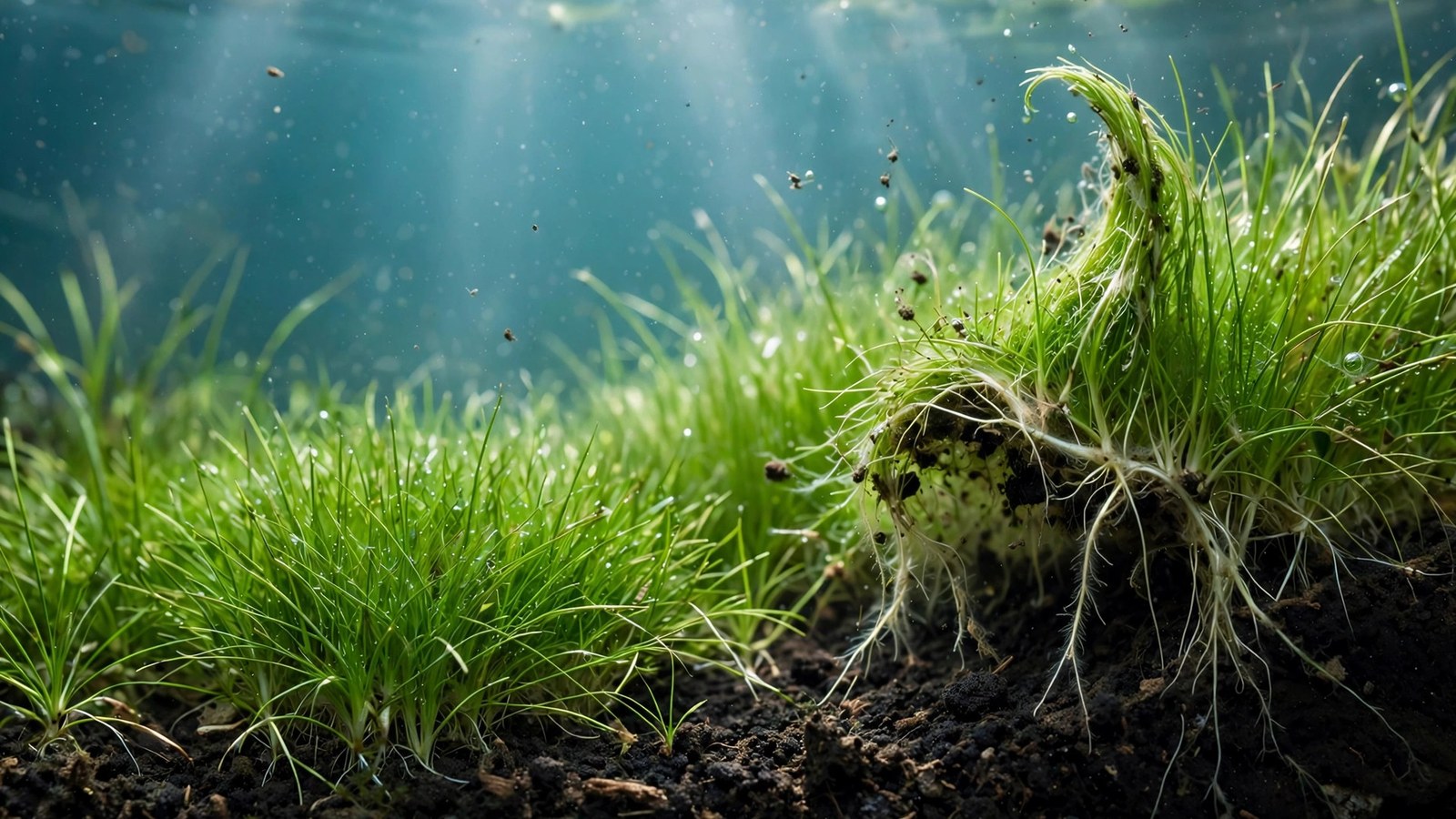
You check the tank in the morning and a green raft is drifting at the surface — your carpet, uprooted in one piece. Weeks of patient work, peeling itself off the substrate overnight.
Carpeting plants almost never lift off for mysterious reasons. It is always a short list of mechanical causes: planting depth, root strength, and disturbance. Match your symptoms below and fix it in one sitting.
Short answer: Carpeting plants lift off because their shallow roots lose their grip. The culprits are usually plugs planted too shallowly, emersed-grown bases melting under water, weak roots in depleted or coarse substrate, trapped gas bubbles prying the mat up, or digging fish and strong flow working the edges loose. Replant each plug 1.5–2 cm deep at a slight angle, anchor loose mats temporarily with small stones, and wait 3–4 weeks for runners to lock in before trimming.
Why Carpets Lift: Buoyancy vs. Grip
Carpeters root with fine, shallow hair roots, and until those knit into the substrate, buoyancy plus water movement works to float them. A carpet can look fine for three weeks and then peel up in a sheet. The fix is always the same: plant deeper, and keep it undisturbed until runners lock it down.
Cause 1: Planted Too Shallow
The single most common cause. A tuft tucked half a centimeter in looks planted but pops loose at the first strong current or vacuum pass. Never plant a carpet clump as one thick wad — the outer plugs float while the buried middle rots. Split clumps into plugs under 1 cm wide, push each in at a 45° angle with long tweezers until only ~1 cm of leaf shows, in a grid 2–3 cm apart. Fingers can't do this precisely — Liveek 4-in-1 aquascaping tools kit ★4.7 has the long straight tweezers that make deep, angled planting easy.
Affiliate disclosure: product links in this article are Amazon affiliate links. If you buy through them, AquaVerdia earns a small commission at no extra cost to you.
Cause 2: Melted Emersed Growth and Hungry Roots
Most carpet plants arrive grown emersed. Once submerged they shed old leaves; if the melt hits the base sitting in the substrate, the planted portion dissolves and the healthy crown floats free. Brown or translucent stems at the base with green growth on top is the tell. Trim off the dead base and replant the healthy crown deeper. In mature tanks, aquasoil nutrients run down after 6–12 months and roots stay shallow — Seachem Flourish Tabs ★4.6 pressed under the carpet every 3–4 months (about one tab per 10–15 cm) feed the dense root mats that keep a carpet pinned down.
Cause 3: Digging Fish and Strong Flow
Sometimes the livestock undid everything. Cichlids, goldfish, loaches, and large corydoras colonies dig along the foreground and pry up the mat's edges night after night. A filter outlet pointed along the substrate erodes soil around the edges until plugs work loose. Aim outlets slightly upward or fit a spray bar, pin the mat's edges with smooth stones for the first month, and keep dedicated diggers behind a shallow stone border.
Cause 4: Trapped Gas Bubbles Under the Mat
A thick carpet photosynthesizes so hard that oxygen gets trapped underneath, and anaerobic pockets can release their own gases — the pocket lifts the mat like a balloon from below. You'll see the carpet doming in the center with bubbles under the leaves, usually in the afternoon when pearling peaks. Press the mat flat with a spatula or tweezers to vent the bubbles, then trim: a mat kept under 3–4 cm thick traps far less gas. If the pocket keeps returning in the same spot, that substrate is compacted — stir it gently at the next water change.
Diagnose by Symptom
| What you see | Likely cause | First fix |
|---|---|---|
| Plugs floating after planting or water changes | Planted too shallow, clumps not split | Split clumps; replant 1.5–2 cm deep at 45° |
| Base brown/translucent, top still green | Emersed-growth melt at the base | Trim the dead base; replant the healthy crown |
| Mat edges curling up at the foreground | Fish digging or flow eroding edges | Redirect flow; stone-border the edges |
| Carpet doming in the center with trapped bubbles | Gas pocket under the mat | Vent gently; trim mat under 3–4 cm thick |
| Whole mat lifts in a sheet, pale thin roots | Depleted or coarse substrate | Root tabs under the mat; finer aquasoil on rescape |
| Sections come up right after trimming | Trimmed before runners anchored | Wait for visible lateral runners before first trim |
Re-Anchor and Prevent It for Good
Gather every floating piece. Trim off melted or algae-covered portions, replant the healthy crowns with the deep 45° plug method, and lay small stones on stubborn sections until the carpet resists a gentle tug. For the first month, hold the siphon an inch above the carpet, point outlets away from the foreground, and feed the roots. With solid light at the substrate, fed roots, and four undisturbed weeks, the carpet becomes one rooted sheet that survives trims, water changes, and curious fish.
Frequently Asked Questions
Can I glue my carpet mat down with aquarium plant glue?
It's a patch, not a solution. Aquarium-safe cyanoacrylate can tack a mat's edges to rock or wood, but it doesn't replace roots. Replant the soil areas properly.
How long does a replanted carpet take to anchor?
About 3–4 weeks in a well-lit tank with CO2, roughly double that in low-tech setups. Look for lateral runners visibly spreading between plugs.
Should I throw away floating pieces or replant them?
Replant anything with a healthy green crown — a floating Monte Carlo stem is a free plug. Discard only material that is mushy, black, or fully algae-smothered.
Would a dry start have prevented this?
Mostly yes — growing the carpet emersed before flooding gives it weeks to root without disturbance. But flood too aggressively and the mat can still peel up.