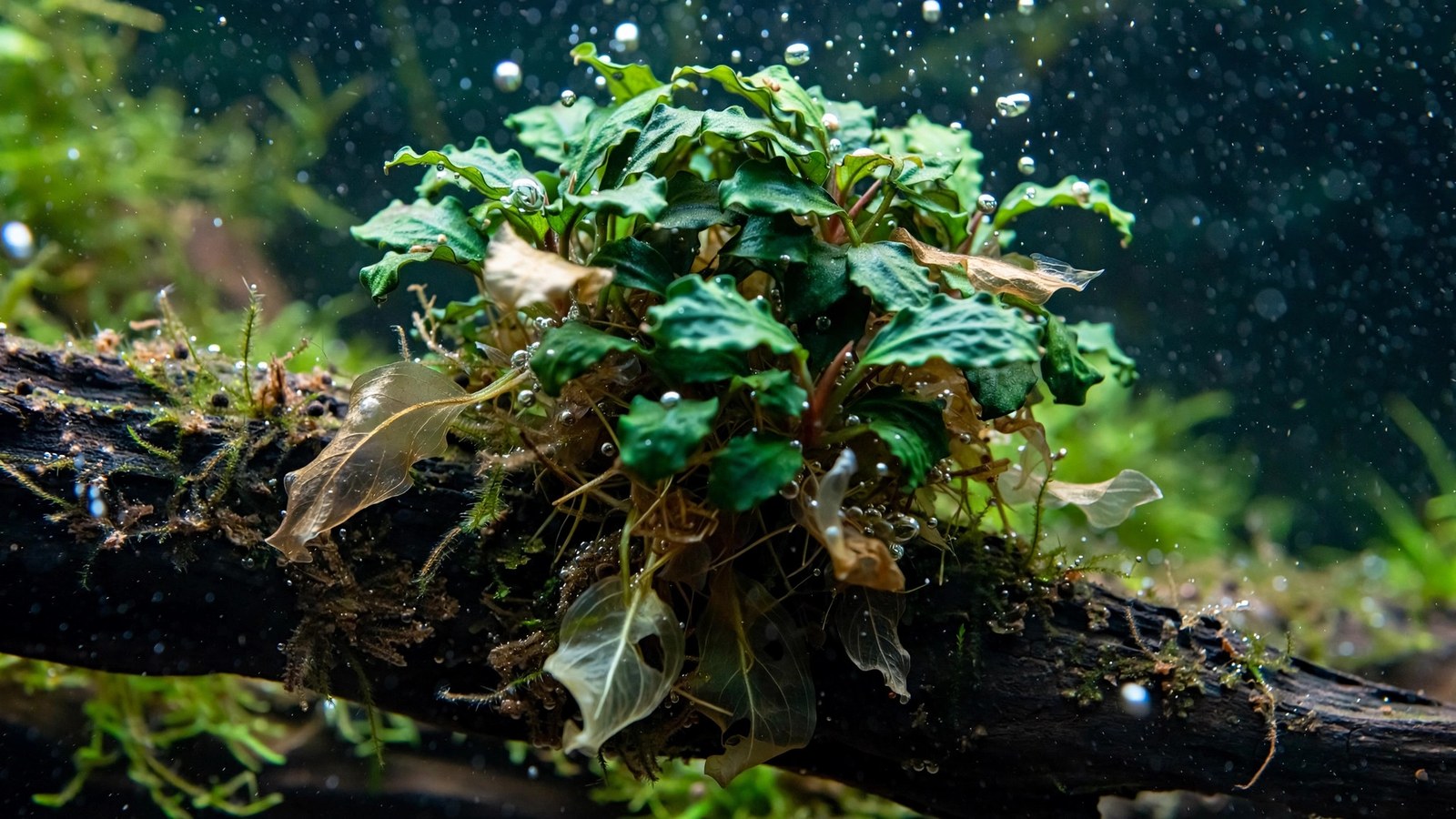
Nothing stings quite like watching a $30 clump of Bucephalandra dissolve two weeks after you wedged it into your new scape. Buce is sold as the tough, slow, bulletproof premium epiphyte — and a settled, mature clump really is hard to kill. But a fresh tank is the one place where this plant's patience runs out: ammonia it never met in the wild, water it hasn't learned yet, and leaves grown for air instead of water. Here's the part that saves you money and heartbreak: dissolving leaves and a dying plant are two different diagnoses. Most buce that melts in a new tank is not dying. It's protesting — and it takes the protest back if you give it stable water and time.
Melt or Rot? The 30-Second Rhizome Test
Before you change a single thing about your tank, answer one question: is this melt or rot? They look similar from across the room — brownish, dissolving foliage — but they mean opposite things, and treating rot like melt will cost you the plant.
Lift the clump gently and pinch the rhizome — the thick horizontal stem everything grows from — between your thumb and forefinger:
| Sign | Melt (recoverable) | Rot (danger) |
|---|---|---|
| Rhizome feel | Firm, springy, holds its shape | Soft, squishy, or hollow-feeling |
| Rhizome color | Green-brown, solid | Dark brown to black, sometimes greyish and translucent |
| Leaf damage pattern | Edges turn translucent first, then the whole leaf goes glassy and slimy | Brown spreads along the rhizome itself; leaves detach with the slightest touch |
| Smell | None | Sour or rotten |
| New growth | May still be present at the rhizome tips | None; the growing tips have dissolved too |
Melt is the plant sacrificing leaves it can't use anymore. The engine — the rhizome — is intact, and it will rebuild. Rot means the engine itself is dying, and it spreads: rotting rhizome tissue infects neighboring healthy tissue, so rot must be cut out aggressively. If you find mush, trim with sharp scissors at least a centimeter past the healthy-looking tissue, dab the cut end in clean tank water, and reattach only the firm portion.
Cause 1: Ammonia From Fresh Aquasoil (The Usual Suspect)
If your tank is under two months old and sits on fresh aquasoil, you can stop reading the other causes. Ammonia is the single most common reason bucephalandra melts in new setups, and it catches people precisely because everything looks fine — clear water, no algae yet, maybe even happy stem plants.
Nutrient-rich aquasoils like ADA Amazonia and Tropica Aquarium Soil leach ammonia as they settle in. This is by design — it's what feeds rooted plants — but the leach period commonly lasts 3–6 weeks, with spikes that can persist longer in heavily stocked or over-fed tanks. A reading your fish tolerate can still punish buce. Bucephalandra evolved as a rheophyte on the banks of fast-flowing Borneo streams: constantly flushed, low-nutrient water. A stagnant, freshly filled tank with free ammonia is the opposite of its native habitat, and hobbyists consistently report it as the most ammonia-sensitive of the common rhizome plants — more so than Anubias sitting in the same tank.
Tissue-culture buce is the most vulnerable of all. The plantlets are small, tender, and raised in sterile gel — they have no established microbiome and no reserves, so an ammonia wave that a mature clump shrugs off can dissolve a tissue-culture cup overnight.
The fix is unglamorous but effective. Test with a liquid test kit — not strips — and work toward a genuine 0 ppm ammonia reading. Until you get there, do 40–50% water changes two to three times a week for the first month; aquasoil ammonia is diluted away, not "used up" faster by waiting. Skip livestock until readings hold at zero, and resist the urge to "help" with extra fertilizers — a fresh aquasoil tank already has more nitrogen than everything in it can use. A deep dive into how aquasoil ammonia interacts specifically with bucephalandra is worth reading over at Ariumology's aquasoil ammonia guide.
Cause 2: The Emersed-to-Submerged Switch
Nearly all commercial bucephalandra is grown emersed — in humid air, not underwater. Emersed leaves are stiffer, often rounder, and built for a world of unlimited CO2. They cannot live underwater indefinitely, and your plant knows it. When you submerge the clump, the plant starts shedding those air-leaves and growing softer, often more colorful submerged leaves in their place.
This transition melt is completely normal and has a signature: it's the older, outer leaves that go, while the center stays green — and, crucially, while new leaves keep appearing. Expect the swap to take 2–6 weeks depending on the variety and your conditions. You can tell emersed leaves by their stiffness; the new submerged leaves feel thinner and more flexible.
The line that matters: if only old leaves are melting, relax. If new leaves melt too, it's not transition — go back to Cause 1 and Cause 3. A surprisingly common trap is mistaking transition melt for a crisis and "rescuing" the plant by moving it, re-gluing it, or changing the water chemistry — every one of those resets the adaptation clock. During transition, trim fully melted leaves so they don't rot and feed ammonia back into the tank, and leave everything else exactly where it is.
Cause 3: Liquid Carbon Dosing
Glutaraldehyde-based liquid carbon products — Seachem Excel, EasyCarbo, and their many cousins — are a documented melt trigger for sensitive plants, and bucephalandra sits near the top of the casualty list alongside Vallisneria and mosses. The mechanism doesn't matter much to you; what matters is the pattern: buce that was fine starts melting within days of starting or increasing liquid carbon, sometimes even from spot-dosing algae near the clump.
New tanks make this worse. A fresh setup is already asking the plant to adapt to new water, new light, and new flow. Adding a mild biocide on top is the classic "one stress too many" — hobbyists report losing entire clumps to doses that established tanks tolerate.
If you're dosing liquid carbon and your buce is melting, stop the dosing first and ask questions later. You can restart it weeks after the plant stabilizes if you must, but many buce keepers simply never dose it near their rhizome plants again. Real injected CO2, by contrast, is well tolerated and genuinely helps — it's the liquid substitute that's the problem.
Cause 4: Buried Rhizome and Rough Handling
Bucephalandra is an epiphyte. In the wild it clings to rocks and wood at the waterline; it does not grow with its rhizome in soil. Bury the rhizome in substrate and it rots from the bottom up — the exact rot described in the test above. Glue or tie the clump to hardscape with the rhizome fully exposed, and let the fine roots find their own way down.
Rough handling is the quieter killer. Buce tissue is slow to heal: a crushed rhizome section from careless tweezers, or a clump that's been pried off and re-glued three times in a month, will melt at the wound sites while an untouched clump in the same tank stays perfect. This is also why "I just moved it to a better spot" so often precedes a melt episode. Pick the spot once, attach it properly, and commit.
The Recovery Timeline: What Patience Actually Looks Like
Here's where most people give up: they fix the ammonia, stop the Excel, trim the mush — and three weeks later the plant still looks like a brown stub. That's not failure. That's bucephalandra. It is one of the slowest-growing plants in the hobby, producing roughly one leaf every 1–2 weeks in decent conditions. Recovery is measured in leaf-counts, not days.
What recovery actually looks like, in order:
| When | What you'll see |
|---|---|
| Week 1–2 | Melt stops spreading. No new damage is itself the first good sign. |
| Week 2–4 | Tiny red or purple spikes emerge from the rhizome tips — the new leaf buds. |
| Week 4–8 | Spikes unfurl into small reddish leaves that harden and darken to green. |
| Month 2–3 | A visible new flush: several leaves per rhizome section, clump filling back in. |
Two honest caveats. First, melted leaves never un-melt — judge recovery only by new growth, not by the old foliage looking better. Second, small tissue-culture plantlets that lost everything sometimes take the full three months just to show their first spike. If the rhizome is firm, it is still alive, and alive buce almost always comes back.
Rescue Protocol: What to Do This Week
If your buce is melting right now, work this list in order. Each step takes minutes; together they cover every common cause.
- Test the water. Liquid kit: ammonia, nitrite, nitrate. You're aiming for 0 ppm ammonia and 0 ppm nitrite. Anything above zero is your prime suspect.
- Change the water. 40–50% every 2–3 days until ammonia reads zero and stays there. Use dechlorinated water matched to tank temperature.
- Stop liquid carbon. Pause all glutaraldehyde dosing immediately. You can revisit it after the plant has fully recovered.
- Trim the dead. With sharp, clean scissors, remove only fully melted, slimy leaves. Leave anything half-green — it's still photosynthesizing for the rhizome.
- Check the rhizome. Firm? Leave it attached exactly where it is. Mushy sections? Cut past healthy tissue and reattach only the firm part, rhizome exposed.
- Hands off for four weeks. No moving, no re-scaping around it, no parameter experiments. Watch the rhizome tips for red spikes.
Adding Buce to a New Tank the Safe Way (Next Time)
Buce and brand-new tanks can coexist — you just have to sequence it right. The expensive lesson from every melt thread is the same: the plant went in too early.
Option A: wait. Let the tank mature 6+ weeks — cycled filter, aquasoil ammonia exhausted, parameters stable — then add buce. This is the boring advice and the one that works.
Option B: dark start. Set up the hardscape and substrate, fill the tank, and run it with the lights off for 2–4 weeks while doing large weekly water changes. The aquasoil's ammonia leach happens without plants to damage, and you add buce to a tank that's already past the worst of it. This is also exactly what several experienced UKAPS keepers recommend specifically because of buce's ammonia sensitivity.
Option C: plant ammonia sponges first. Fill the new tank with fast-growing stems and floaters, which drink ammonia greedily, then add buce once tests read zero. The helpers can be removed or thinned later.
Whichever route you take: buy established, submerged-grown clumps when you can (they skip the emersed transition entirely), keep the rhizome exposed on hardscape, and give a new clump a week of observation before you glue it into the centerpiece position.
Frequently Asked Questions
Will my bucephalandra grow back if all the leaves melted?
Yes — if the rhizome is firm. The leaves are expendable; the rhizome is the plant. A firm, solid rhizome will push new leaf spikes even after losing every leaf, typically starting within 2–4 weeks of stable conditions. A mushy, hollow rhizome will not recover.
How long does bucephalandra take to recover from melt?
Expect the first tiny red leaf spikes in 2–4 weeks, roughly one new leaf every 1–2 weeks after that, and a visibly full clump in 2–3 months. Buce is one of the slowest growers in the hobby, so judge progress in new leaves, not days.
Should I trim melting buce leaves?
Trim only fully melted, slimy leaves — they rot and feed ammonia back into the tank. Leave anything half-green alone; it's still feeding the rhizome. Never strip a struggling clump bare.
Can ammonia kill bucephalandra?
Ammonia is the most commonly reported killer of buce in new tanks. Fresh aquasoil can leach ammonia for 3–6 weeks, and buce — adapted to clean, flowing streams — is unusually sensitive to it. Keep ammonia at a true 0 ppm with a liquid test kit and large, frequent water changes until the leach period passes.
Is buce melt contagious to other plants?
No. Melt is a stress response, not a disease — it doesn't spread from plant to plant. If several species are melting at once, they share a cause (usually water conditions), not an infection. Fix the water and each plant recovers on its own schedule.
Does liquid CO2 (Excel) melt bucephalandra?
It frequently does. Glutaraldehyde-based liquid carbon is a known melt trigger for buce, especially in new or stressed tanks. Stop dosing while the plant recovers; injected CO2 gas is fine and genuinely helpful.