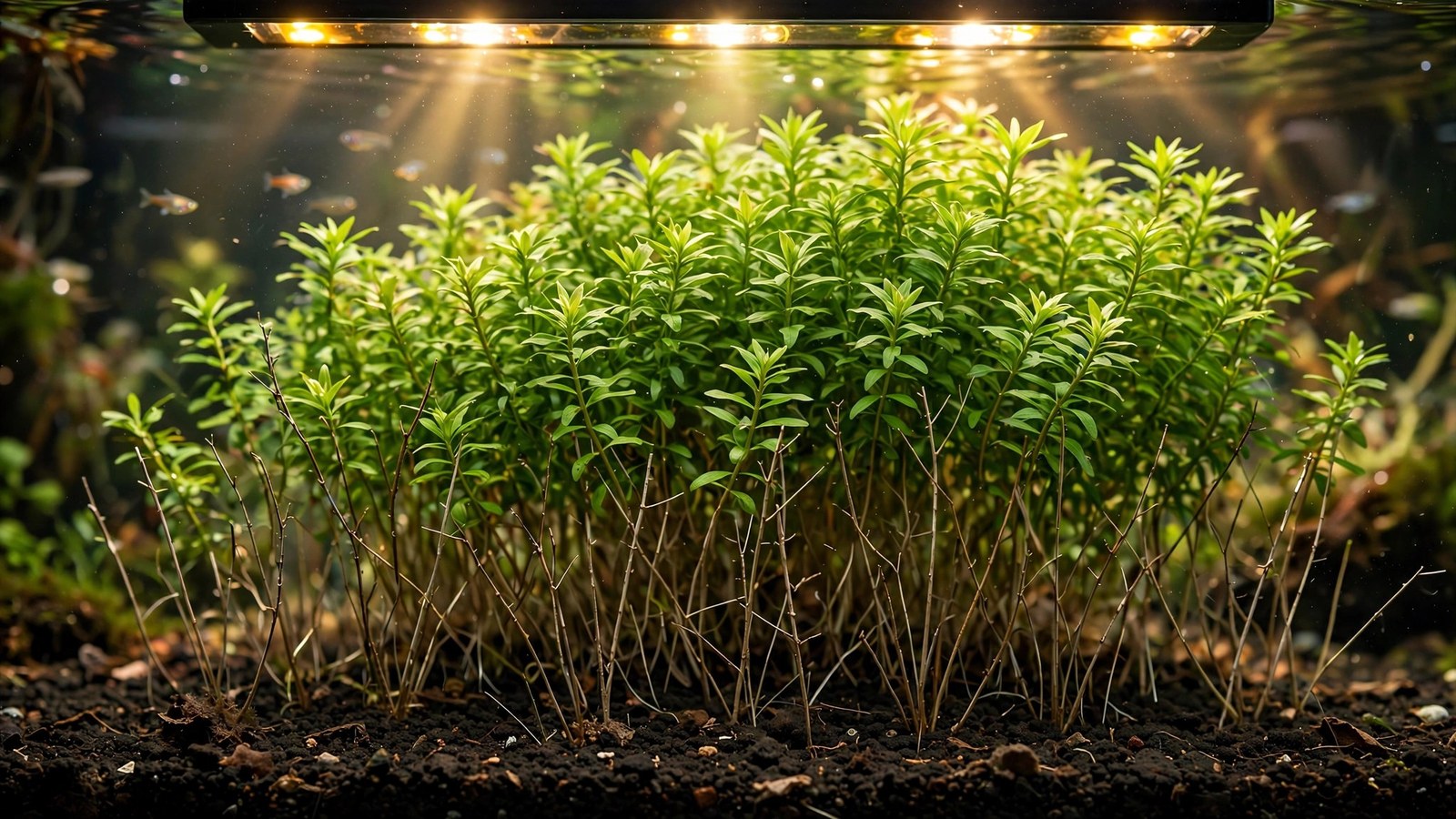
Your stem plants look like two different plants glued together: a lush, glowing bouquet up top and bare, twiggy sticks below. The first time you see it, it feels like something is wrong. And in a way, something is — but probably not what you think. Bare lower stems with healthy tops is the single most common stem-plant complaint in planted tanks, and it is rarely a disease or a pest. It is your plant doing exactly what stem plants evolved to do.
The short answer: Stem plants shed their lower leaves when those leaves stop earning their keep — either because dense growth above shades them out, or because the plant is rationing limited mobile nutrients (nitrogen, potassium, magnesium) to the growing tips. Old, repeatedly trimmed stems also simply run out of vigor over time. The reliable fix is to cut off the healthy tops, pull out the exhausted bottoms, and replant the tops. Diagnosis takes about five minutes: the pattern of damage tells you which cause you are dealing with.
Why Stem Plants Shed Their Lower Leaves First
Aquatic stem plants are not trees. Trees invest in woody trunks that last for decades; stem plants are closer to garden herbs, running a perpetual cycle of new growth at the tips and abandonment of whatever no longer contributes. A leaf that sits in shade below a dense canopy cannot photosynthesize enough to pay for its own maintenance, so the plant dismantles it, salvages the mobile nutrients inside, and ships them upward to the growing tip where light is plentiful.
This is why the pattern you are seeing — bare at the bottom, thriving at the top — is so diagnostic. The plant is telling you it is triaging resources. The tops get everything: light, CO₂, fresh nutrients. The lower leaves get whatever is left, and when the budget runs tight, they are the first expense cut. The 2Hr Aquarist team describes this plainly: lower portions of stem plants naturally deteriorate over time and will not recover, so regularly trimming and replanting the healthy tops is part of normal stem-plant maintenance, not a rescue procedure.
That single insight reframes the whole problem. You are not fighting a disease. You are managing a maintenance cycle. The only real question is what is forcing the triage — and there are three usual suspects.
How to Diagnose Which Cause Is Yours
Run through this quick checklist before you change anything. The way the leaves look as they fall tells you almost everything.
| What you see | Most likely cause | Fix |
|---|---|---|
| Oldest lower leaves turn pale yellow evenly, then drop; tips stay green and growing | Mobile nutrient deficiency (nitrogen first, then potassium/magnesium) | Raise macros; keep NO₃ at 10–20 ppm; dose a complete liquid fertilizer |
| Lower leaves look healthy and green but still detach; bush is dense or stems are packed tight | Self-shading / overcrowding | Thin the bunch; space stems 1–2 cm apart; cut and replant tops |
| Lower stems are thin, weak, and ragged with holes; upper growth is great; stems have been trimmed many times | Old-stem decline after repeated trims | Discard old stems and roots; replant fresh tops with enriched substrate |
| Newly planted stems shed lower leaves in the first 1–2 weeks | Transition stress / emersed-to-submerged adjustment | Wait it out; keep water stable and nutrients steady; trim and replant once new submerged growth appears |
Two causes can overlap — a nitrogen-lean tank with a packed bush will show both yellowing and shading. Start with whichever symptom appeared first.
Cause 1: Self-Shading and Overcrowding
This is the most common cause in otherwise healthy tanks, and it catches people off guard because their lighting is genuinely good. The problem is geometry, not the fixture. As a stem bunch grows taller and denser, the top canopy intercepts most of the light. The bottom 10 cm of stems can receive a small fraction of the PAR the tops enjoy. Leaves that cannot photosynthesize enough to survive simply senesce and drop.
The tell-tale sign is that the falling leaves look fine — still green, no yellowing, no pinholes — and the tips look fantastic. If that matches, fertilizer will not save those lower leaves. They are dying of darkness, not hunger.
Prevention starts at planting. Stems planted touching each other look lush on day one and become a shading disaster by week six. Plant individual stems roughly 1–2 cm apart so light and flow reach down into the bunch. Trimming strategy matters too: repeated "hedge trimming" (cutting the top off and leaving the base) makes the bush branch and get denser, which shades the bottoms faster. After about three trim cycles on the same stems, the lower portions are usually deteriorating enough that cutting and replanting the tops is the better move, a point the 2Hr Aquarist's replanting guide makes explicitly.
Cause 2: Mobile Nutrient Deficiency
When the tank runs low on nitrogen, potassium, magnesium, or phosphorus — the "mobile" nutrients plants can relocate within their own tissue — the plant does exactly that. It strips the old lower leaves of these elements to keep the growing tips alive. The result: the classic pattern of healthy tops over yellowing, dropping lower leaves.
Nitrogen is the usual suspect. It is highly mobile, and stem plants burn through it fast. The visual signature is unmistakable once you know it: the oldest leaves yellow evenly across the whole leaf (not between the veins), get thinner, and eventually drop, while the top keeps growing. A little residual nitrate in the water column is healthy in a planted tank — chasing zero is a classic beginner mistake. A commonly cited target range is roughly 10–20 ppm NO₃.
Potassium deficiency shows up differently: small pinholes in older leaves, dark dots that expand, brown edges. Magnesium deficiency causes interveinal yellowing on old leaves — green veins, yellow tissue between them. All three are mobile-nutrient patterns, and all three attack the lower leaves first.
The fix is to feed the system properly rather than playing whack-a-mole with single nutrients. A complete liquid fertilizer that covers macros and micros takes the guesswork out: a comprehensive liquid like Seachem Flourish ★4.7 dosed to the label gives stems the water-column supply they drink from. Check your nitrate first with a test kit — if you are at zero despite heavy planting, that lean-water confirmation makes the diagnosis nearly certain. And be honest about whether your fish load actually covers demand: a heavily planted, lightly stocked tank almost never gets enough nitrogen from fish waste alone.
Cause 3: Old Stems Reaching the End of Their Cycle
Even with perfect light, rich dosing, and good spacing, stem plants have a lifespan per stem. Each time you hedge-trim a stem, the plant branches from the cut — but the base keeps aging. The lower stems get thinner, weaker, and less able to push side shoots. Holes appear in the old leaves, they rag up, and eventually whole sections go bare even though the canopy above is thriving. The Nature Aquarium knowledge base documents this well: most stem plants will face lower-stem deterioration at some point no matter how good the parameters are, so replanting the tops is a necessity, not a sign of failure.
Species differ in how fast this happens. Fast-growing stems like rotala, ludwigia, and hygrophila can need a full replant every 2–3 months in a high-energy tank. Slower, sturdier stems like bacopa can go longer. One reliable rule: if a bunch has survived three straight trim cycles and the bottoms are bare, it is replant time, not trim time. Treating replanting as scheduled maintenance — the way you would change a filter's media — removes all the anxiety from this symptom.
The Fix: Cut and Replant the Healthy Tops
This is the one procedure that resolves all three causes, and it is simpler than it looks. Set aside twenty minutes after a water change.
1. Cut the healthy tops. Snip the top 10–12 cm (about 4–5 inches) of each healthy stem, just above a leaf node. Use sharp scissors — clean cuts heal fast; crushed stems rot. A dedicated set of long aquascaping scissors makes this vastly easier than fishing around with house scissors.
2. Pull out and discard the old stems and roots. Slide the old bottoms out of the substrate slowly, shaking gently at substrate level to drop trapped detritus back into the bed rather than into the water column. Do not replant them — they are spent.
3. Enrich the substrate. This is the step most people skip, and it is why the second generation often looks worse than the first. If your aquasoil is older than about 3 months, or your substrate is inert sand or gravel, it is depleted — nitrates leach out of the substrate into the water column and are not replaced. Push fresh root tabs like Seachem Flourish Tabs ★4.6 into the bed where the new stems will go, or mix in some fresh aquasoil. Root tabs matter here specifically because stem plants are heavy root feeders during re-establishment.
4. Replant the tops. Plant the cuttings 1–2 cm apart at a slight angle. They will sprout roots from the buried nodes within days — no, you do not need roots before planting; new roots form quickly on their own.
5. Do a proper water change. Stirred-up detritus feeds algae on wounded cuttings. Vacuum up floating debris and change the water until it runs crystal clear.
Affiliate disclosure: this site participates in the Amazon Associates program. If you buy a product through the links above, I may earn a commission at no extra cost to you — it helps keep these guides free and independent.
Keeping Lower Stems Full Going Forward
Replanting fixes the symptom; the habits below stretch the time between replantings.
- Keep nitrates non-zero. Test weekly for a month after fixing the issue. If NO₃ keeps crashing to zero, raise your macro dosing — your plant mass has outgrown your current schedule.
- Light the bottoms, not just the tops. A photoperiod of 7–8 hours with good intensity beats 10+ hours of weak light for penetrating a dense bush. Trim the canopy before it becomes a light-proof lid.
- Feed the substrate on a calendar. In heavy stem tanks, refresh root tabs every 3–6 months. Write the date on the tank stand with a dry-erase marker so you actually do it.
- Rotate trims and replants. You can hedge-trim a healthy bush once or twice. When you catch yourself trimming the same bunch a third time, switch to cut-and-replant instead — the bottoms are already declining.
- Choose sturdier species where you are lazy. If you hate replanting, lean toward bacopa, lobelia, or hygrophila rather than the fastest rotala varieties. They hold their bottoms noticeably longer.
For the full mechanics of trimming technique and planting, see our guides on how to trim aquarium stem plants and how to plant stem bunches from the store bunch to rooted stems.
Frequently Asked Questions
Is it normal for stem plants to lose their lower leaves?
Yes — some degree of it is the normal stem-plant lifecycle, especially in dense bunches. Aquatic stem plants continually grow from the tips and retire old shaded growth below. It only becomes a problem when the bare section grows long while the plant is young, or when yellowing points to a nutrient deficiency. In those cases, diagnose with the table above and cut-and-replant.
Will the bare lower stems grow leaves again if I add fertilizer?
No. Once a stem section has been stripped of its leaves, it will not regenerate them — the plant has already reallocated those resources to the tips. Fertilizer corrects the deficiency so the next generation of stems stays leafy, but the current bare bottoms should be cut away and the healthy tops replanted.
Should I trim the tops or pull the whole stem out?
Both: cut the healthy top off first, then pull out and discard the old lower stem and its roots. Replant the cuttings. Replanting tops into exhausted substrate is the key step — enrich the substrate with root tabs or fresh aquasoil at the same time, since depleted substrate is a common hidden cause of weak second-generation growth.
How often should I replant stem plants?
Fast growers in high-light, CO₂-injected tanks typically need a full replant every 2–3 months. After roughly three straight hedge trims, most species are ready for a replant rather than another trim. Slower stems in low-energy tanks can go considerably longer.
Can low light alone cause lower leaves to drop?
Yes, if the lower leaves are starved of light by the canopy above — that is self-shading, covered above. But if your whole fixture is weak and even the tops look leggy and pale, the whole plant is light-starved and the fix is better lighting, not replanting. Tops that look genuinely good while bottoms go bare point to shading or nutrient rationing, not a weak fixture.