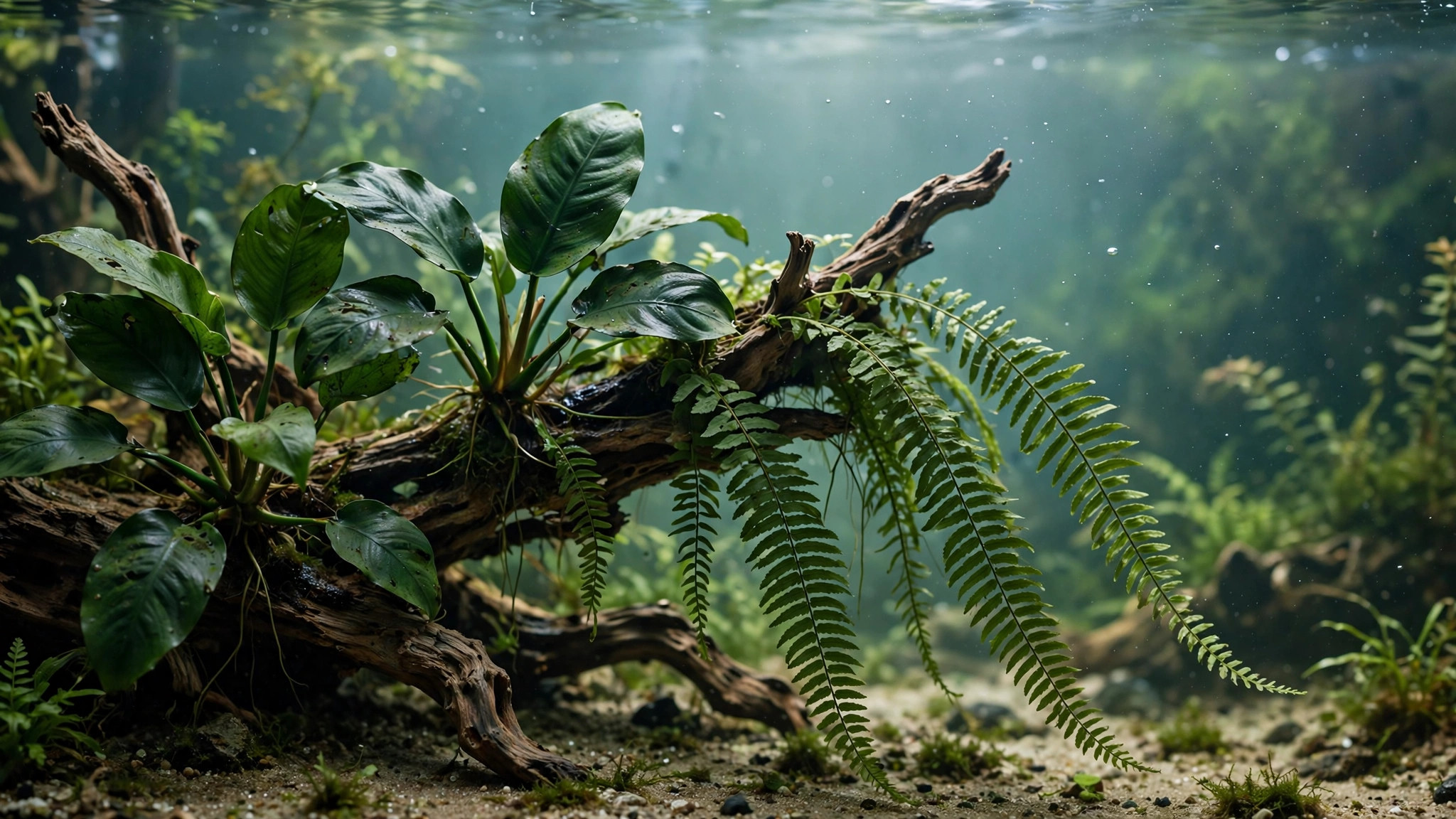
The most common way people kill Anubias and Java fern with kindness is a fertilizer bottle: dose a premium all-in-one exactly as the label says — a regimen designed for fast stems — and a month later your slow plants wear coats of green dust algae. The plants weren't broken. The dose was built for somebody else's tank.
Anubias and Java fern are epiphytes: they drink from the water, not the substrate, and they grow so slowly that a full-strength weekly dose mostly feeds algae. The fix is simple — a lean liquid fertilizer, dosed lighter than you think.
Quick answer: Use a gentle liquid fertilizer at one-quarter to one-half of the label rate, once a week after your water change. These epiphytes feed from the water column, not roots, so root tabs are wasted on them. Start lean, watch new growth for two to three weeks, and increase only on real deficiency signs. Heavy dosing on slow growers feeds algae, not plants.
Why Slow Growers Feed Through Their Leaves
These are epiphytes: in the wild they grow attached to rocks and driftwood, their thick rhizomes anchoring to hardscape while fine roots grip rather than feed. Nutrients arrive dissolved in the water washing over them — the substrate beneath is nearly irrelevant. And Anubias can take three weeks to unfold one leaf. Low demand isn't a weakness; it's the strategy. A regimen built for fast stems delivers ten times what these plants can use, and the leftover goes straight to algae.
Why Heavy Dosing Backfires on Slow Growers
Algae's unfair advantage is speed: green spot and dust algae colonize a leaf in days, while your Anubias needs weeks to grow it. The classic symptom is Anubias leaves wearing dusty-green coats or brown-black tufts of brush algae, worst on the oldest leaves. Wet Web Media's long-running Java fern FAQ documents the same pattern — heavy feeding plus bright light turns Java fern into an algae billboard.
Bright light makes it worse, but fertilizer is the fuel. The beginner trap loops: heavy dose → algae → assume the plants are starving → dose more. The correct response is almost never more fertilizer. It's less.
Two Fertilizer Styles That Actually Work
Everything that works for these plants is a liquid dosed into the water column. Two styles suit slow growers best:
| Style | Best for | How to use on slow growers |
|---|---|---|
| Comprehensive micro blend (e.g., Seachem Flourish) | Stocked tanks where fish waste supplies nitrogen and phosphorus | Quarter to half dose weekly; covers the traces the tank lacks |
| Budget all-in-one (e.g., API Leaf Zone) | Shrimp or lightly stocked tanks low in all nutrients | Start at the label's minimum; even lean all-in-ones overshoot slow growers at full dose |
For most Anubias and Java fern tanks, a gentle comprehensive liquid like Seachem Flourish ★4.7 is the sweet spot: a trace-heavy formula that fills the gaps fish waste and tap water don't (iron, manganese, calcium) without piling on macros a slow tank can't use.
In a very lightly stocked tank — shrimp-only, few fish — a simple affordable all-in-one like API Leaf Zone ★4.6 covers iron and potassium cheaply at lean doses.
Affiliate disclosure: the links above are Amazon affiliate links — AquaVerdia earns a small commission on qualifying purchases at no extra cost to you.
Already own a concentrated all-in-one? Just dose it at a quarter to a third of the label rate — the lean-dosing method below applies to any bottle. Aquarium Co-Op's own fertilizer chooser makes the same point: match the product to bioload and plant mass, and dose to what the plants actually consume.
The Lean-Dosing Method
Forget the label's dosing chart — it was written for average community tanks, not slow-grower tanks. Use this instead:
- Start at one-quarter dose, right after your weekly water change.
- Wait two to three weeks — one full Anubias leaf cycle. Judge only new growth; old leaves never heal.
- Ramp only on evidence. If new leaves emerge pale or stunted, move to one-half dose. Most slow-grower tanks stabilize at half dose or below.
- Back off on algae. Dust or spot algae within a week of an increase means return to the previous dose and hold.
Reading the Leaves: What Deficiencies Actually Look Like
Slow growers show hunger slowly, so learn to read them. Pinholes in older leaves are the classic potassium deficiency — Java fern and Anubias are famously potassium-hungry. Existing pinholes never heal, but new leaves come in clean once potassium is covered.
Pale or yellowing new leaves point to iron or nitrogen shortage — bump the dose up a notch. Stunted, twisted new growth suggests a broader micronutrient gap. Rule out the confounders first: too much light, or a buried, mushy rhizome that no fertilizer can fix.
What Never to Do
First, never bury the rhizome. It must sit above the substrate, tied to wood or rock. A buried rhizome rots in weeks, and the melting leaves look exactly like a deficiency — prompting the classic wrong fix of more fertilizer.
Second, never pack root tabs against the rhizome. Tabs are for heavy root feeders like Amazon swords and crypts. Against an epiphyte rhizome they do nothing for the plant and can burn or rot it directly.
FAQs
Can I use root tabs for Anubias and Java fern?
No — save root tabs for Amazon swords and crypts. These epiphytes absorb nutrients from the water column, so buried tabs go unused, and a tab pressed against a rhizome can burn or rot it.
How often should I fertilize slow-growing plants?
Once a week after the water change, at one-quarter to one-half of the label dose. Slow growers can't use daily schedules built for fast stems.
Why is my Java fern getting pinholes in its leaves?
Pinholes in older leaves signal potassium deficiency — both plants are heavy potassium consumers. A comprehensive liquid fertilizer usually covers it; if pinholes persist on new leaves, a potassium-specific supplement is the fix. Damaged leaves won't heal — watch new growth.
Do Anubias and Java fern need CO2?
No. Both thrive in low-tech tanks without injected CO2. In slow-grower tanks, fertilizer and placement matter far more than carbon.