Most aquarium plants do not die because their owner bought the wrong fertilizer — they die because the bottle sits unopened while the plants slowly starve. If your dosing schedule is "remember once a month and feel guilty," this guide is for you.
The fix is not discipline. It is fewer decisions: one slow-release product you bury and ignore for months, and one all-in-one liquid dosed after your water change. That is the whole plan.
In short: the best aquarium plant food for forgetful beginners is slow-release root tabs (replaced every 2–4 months) plus an all-in-one liquid dosed weekly after your water change. Root tabs feed heavy root-feeders like Amazon swords and crypts for months unattended; the weekly liquid dose covers everything else. Miss a week and low-tech plants barely notice.
Why forgetful beginners starve their plants
Your plants eat every day. In an inert gravel or sand substrate there is no reserve of nutrients, and fish waste supplies some nitrogen but almost no potassium, iron, or trace elements. A tank fed once in a blue moon is running on fumes most of the time.
The cruel part is the delay. A plant that misses this week's feeding does not look sick tomorrow — the yellowing shows up three weeks later, long after you have forgotten the link. The fix is products whose schedules survive your memory.
The two rules of forget-proof feeding
Rule one: fewer doses beat perfect doses. A weekly all-in-one at label strength outperforms a three-bottle routine you abandon in week two.
Rule two: attach feeding to an existing habit. Dose your liquid fertilizer the minute your water-change bucket is empty. One established routine carries the new one — a phone alarm for "Tuesday ferts" dies the first time you are busy; a bottle stored next to your water-change gear does not.
Disclosure: product links below are affiliate links. If you buy through them, AquaVerdia may earn a small commission at no extra cost to you.
Root tabs: the set-and-forget foundation
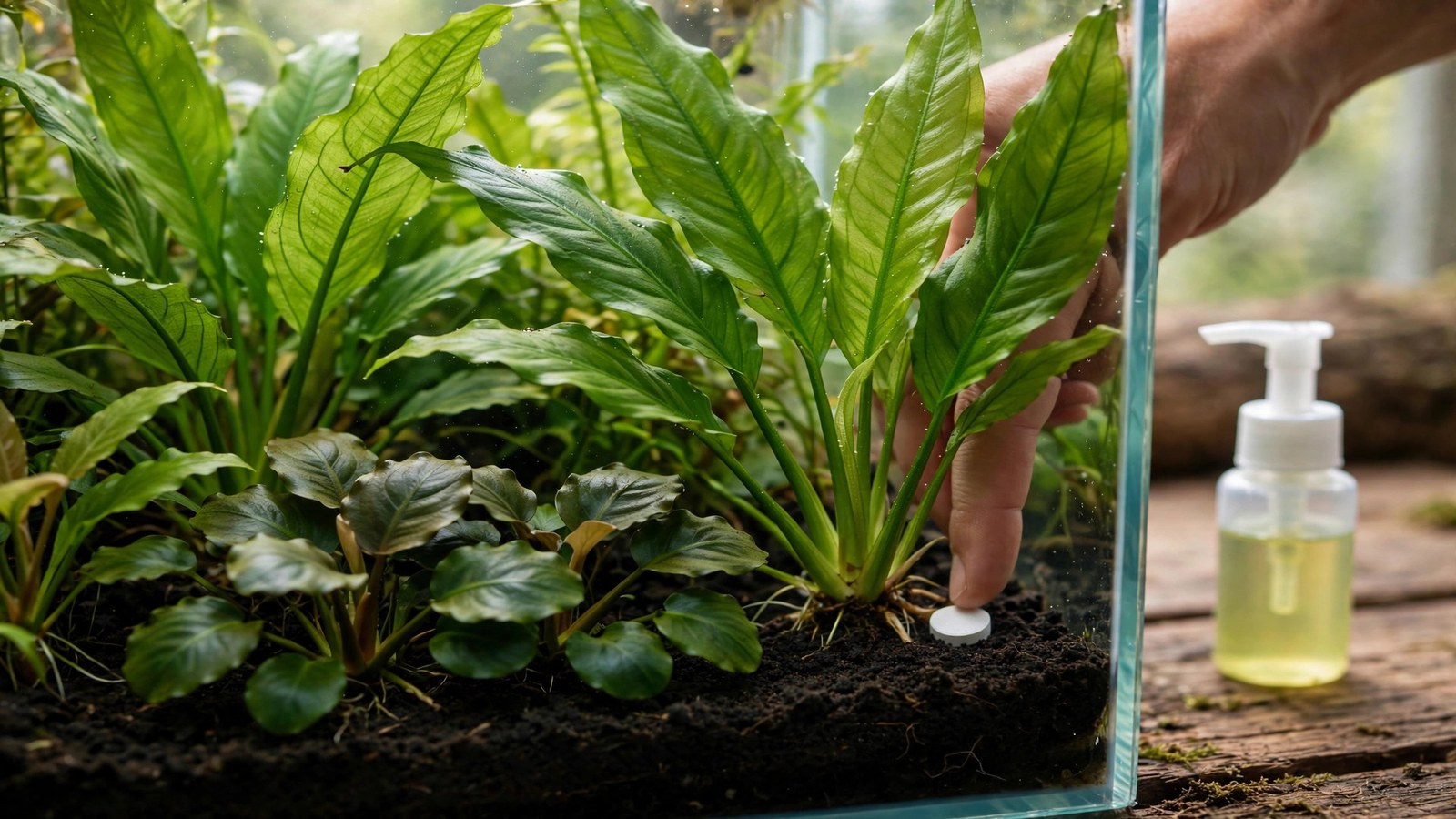
Root tabs are compressed fertilizer pellets you push deep into the substrate near plant roots. They dissolve slowly over 2–4 months, feeding heavy root-feeders — Amazon swords, crypts, vallisneria, aponogetons — exactly where they eat. For a forgetful beginner, this is the highest-value move in the hobby: feeding your plants once a season, near enough.
Press one tab every 4–6 inches in a ring around each root-feeding plant, about an inch below the surface. Replacing them late is fine — a depleted tab is inert, not harmful.
Seachem Flourish Tabs ★4.6 are the long-standing standard: a simple iron- and potassium-rich tab with no phosphate spike, safe to use around shrimp. Bury one near the crown of each sword or crypt and you will not have to think about those plants' roots again for months.
One all-in-one liquid for the water column
Root tabs do nothing for plants that feed from the water column — anubias, java fern, mosses, floaters, and most stem plants drink through their leaves. The beginner-friendly answer is an all-in-one: one bottle with both macros (nitrogen, phosphorus, potassium) and micros (iron and traces). One bottle, one dose, one thing to remember.
Dose it right after your weekly water change — the change strips dissolved nutrients, so replenishing immediately resets the tank to a known baseline. Start at half the label dose for two weeks while you watch your plants, then go full strength if growth looks hungry.
NilocG Thrive All-in-One ★4.6 is a concentrated all-in-one many beginners use: a single measured dose covers a typical tank and the bottle lasts for months. In shrimp tanks, stick to label strength — invertebrates are the one audience where overdosing genuinely matters.
Match the food to your plants
| Plant type | Feed it with | How often |
|---|---|---|
| Heavy root feeders (Amazon swords, crypts, vallisneria) | Root tabs | Replace every 2–4 months |
| Water-column feeders (anubias, java fern, floaters, mosses) | All-in-one liquid | Weekly, after water change |
| Mixed planted tank (the usual beginner setup) | Both | Tabs quarterly, liquid weekly |
| Only slow growers in a lightly stocked tank | Liquid at half dose | Weekly or even biweekly |
If you buy only one product for a mixed tank, choose the all-in-one liquid — it helps every plant a little, while tabs only help root-feeders.
Build a system that forgives missed weeks
The honest math: a low-tech tank with moderate light can go two to three weeks without liquid dosing before anything visibly suffers. Nutrient reserves in the substrate and the plants' own tissues buffer short gaps — your system only has to survive your average week, not your worst one.
Three forgiveness upgrades, laziest first: keep easy plants (anubias, java fern, crypts forgive more than demanding stems), keep the light moderate (slower growth means slower nutrient burn), and consider a peristaltic auto-doser if you travel often. Miss a week and just resume the normal dose — never double it to "catch up," because excess nutrients feed algae, not plants.
Frequently asked questions
Can aquarium plants survive if I never fertilize?
Low-demand plants like anubias, java fern, and java moss can coast for months on fish waste and tap-water minerals — but "survive" is not "thrive." Growth stalls, new leaves come in pale, and algae eventually outcompetes weakened plants. Tabs plus a weekly all-in-one costs a few minutes a month and changes the outcome completely.
What happens if I forget to replace root tabs?
Nothing dramatic — depleted tabs are inert; they just stop feeding. Older leaves yellow first as the plant cannibalizes mobile nutrients from old growth. Push fresh tabs in and the next flush comes back green. No catch-up protocol needed.
Should I double the dose after missing a week?
No — resume the normal dose. A double dose raises dissolved nutrients faster than plants can use them, which invites algae. Consistency beats compensation.
Are all-in-one fertilizers safe for shrimp and snails?
At label doses, yes — reputable all-in-ones keep trace metals within invertebrate-safe concentrations. The danger zone is overdosing. With a sensitive colony, start at half strength and watch the livestock for a week before going full dose.