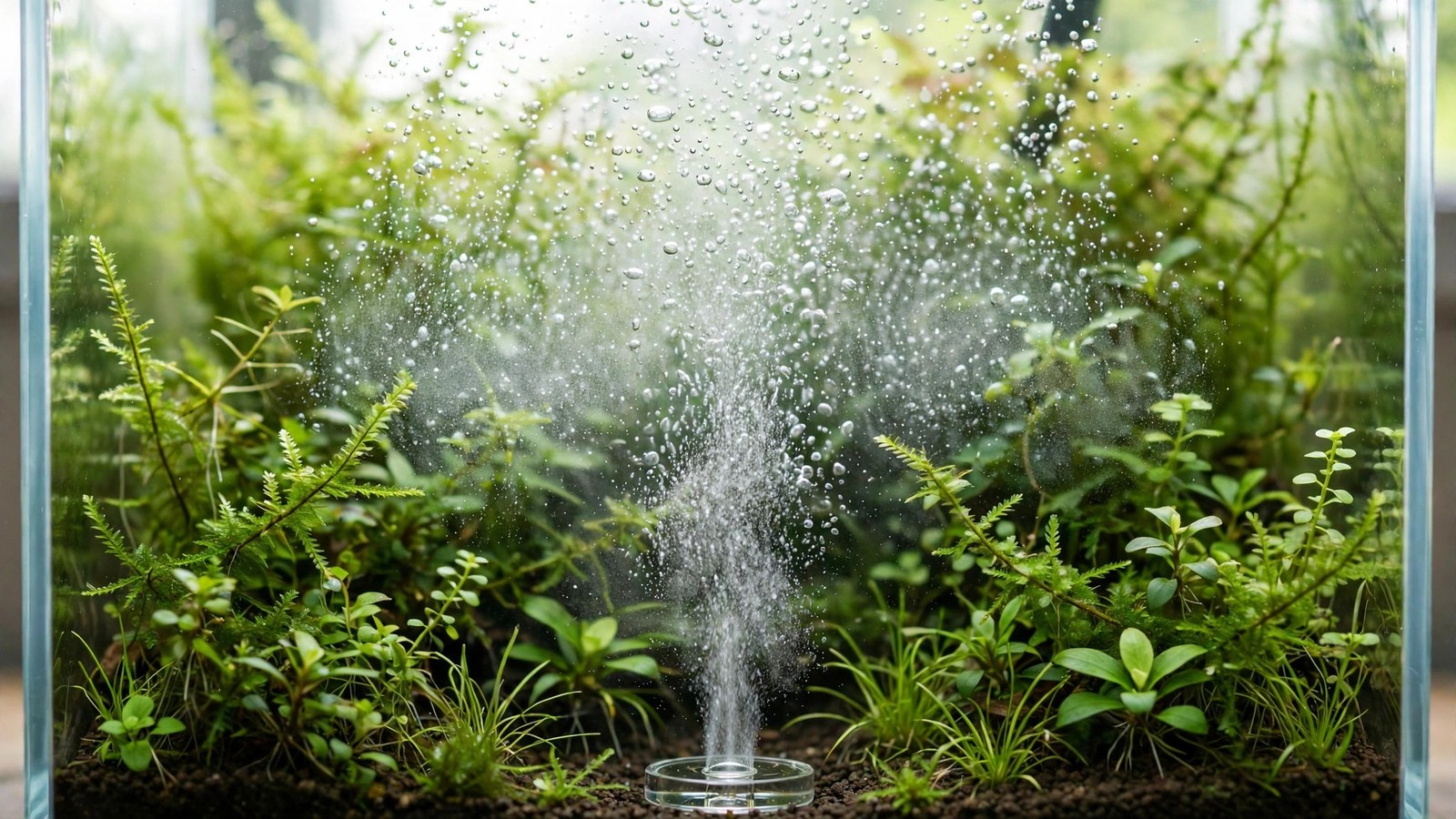
A diffuser sized for a 55-gallon tank in a 5-gallon cube is like firing a cannon in a closet. Bubbles blast across the scape, CO2 levels spike within the hour, and your shrimp are at the surface by evening. Nano planted tanks don't need less CO2 gear — they need right-sized CO2 gear. The diffuser is where that sizing matters most, because it's the one piece of equipment that sits inside your scape, and an oversized ceramic disc in a 6-gallon tank is both an eyesore and a gas-efficiency problem.
A nano CO2 diffuser should have a ceramic disc sized for the water volume — 8–12 mm for tanks under 10 gallons — placed low, opposite your filter outflow, and tuned to roughly 1 bubble every 2–3 seconds as a starting point. In-tank ceramic diffusers beat inline types for nano setups, and a drop checker is nearly mandatory since small water volumes swing gas levels fast.
Why nano tanks need their own diffuser
In a large tank, a diffuser is a small accessory tucked behind plants. In a nano tank under 10 gallons, it's a visible centerpiece of your aquascape — and a much bigger risk. The reasons come down to geometry and gas dynamics.
First, equipment visibility. A standard 25 mm ceramic disc and its glass stem dominate a 30 cm cube. Aquascapers solved this with "tiny" and "curved" models whose whole footprint is barely wider than a pencil eraser. Second, gas sensitivity: the same bubble rate that nudges a 40-gallon tank barely registers will saturate a 5-gallon tank in a couple of hours. Oversized discs produce coarser bubbles that burst at the surface instead of dissolving, wasting gas and giving you no precision. Third, filtration reality: most nano tanks run on hang-on-back filters, sponge filters, or small internal filters — not external canisters — so inline diffusers and atomizers, which need canister filter plumbing, are off the table for most setups.
The good news: the nano diffuser market is mature, and the best models are inexpensive. You're not compromising by going small — you're buying gear actually engineered for your tank.
What to look for in a nano CO2 diffuser
Five things separate a good nano diffuser from a generic one:
1. Disc size matched to volume. This is the whole game. Aquario's sizing guide is the industry benchmark: an 8 mm disc for up to 8 gallons, a 12 mm disc for up to 13 gallons. A bigger disc in a nano tank just means wasted gas and a visual wart.
2. Bubble fineness. Fine, milky mist dissolves; big bubbles rise and pop. Look for "nano mist" or fine-pore ceramic descriptions. Budget discs often start fine and coarsen within a couple of months as algae and biofilm clog the pores — cleaning discipline (below) matters as much as the brand.
3. In-tank footprint. Curved (U-shaped) and "special" compact models route tubing over the rim with no suction cups and keep the disc tiny. In a 30 cm tank, the difference between a bulky disc-and-suction-cup setup and a slim curved model is the difference between gear that disappears and gear you see every time you look at the tank.
4. Working pressure compatibility. Fine ceramic discs need roughly 20–30 psi to push gas through. Match the diffuser to your CO2 source: a paintball-style mini regulator or a compact pressurized kit handles this fine, while some DIY yeast or citric-acid setups can't reach the needed pressure — if you run DIY CO2 in a nano tank, choose a diffuser rated for low pressure or upgrade the source.
5. Maintainability. Ceramic discs clog; it's physics, not failure. Models with replaceable discs (screw-open domes) or that tolerate a diluted-bleach soak without damage will stay fine for years. Discs that can't be cleaned get replaced every few months — factor that into the real cost.
The best nano CO2 diffusers, ranked
These picks all satisfy the nano criteria above: sized discs, fine mist, small footprint, and broad availability. Each fits tanks under 10 gallons without overwhelming the scape.
1. Aquario Neo Tiny — best overall for nano tanks
The Aquario Neo Tiny is the benchmark other nano diffusers get judged against. Its 8 mm ceramic disc is sized for tanks up to 8 gallons, and the clear acrylic construction makes the whole unit nearly invisible against glass. The brand's "special" models shrink the diffuser body further while keeping the fine-mist pore structure that aquascapers praise for producing some of the finest bubbles available. For rimless nano cubes, the curved version routes tubing neatly over the rim with no suction cups at all. Reviews consistently highlight the ultra-fine mist and the way the diffuser simply disappears into the scape.
2. fibst Stainless Steel — best durable pick
If you've ever snapped a glass diffuser during a water change, the fibst CO2 diffuser is your answer. Its 304 stainless steel body and U-shaped hanger hook over the tank rim, and the ceramic disc sits in a screw-open dome — so you can disassemble it to clean or replace the disc instead of throwing the whole unit away. fibst backs the ceramic disc with a 6-month warranty and other parts for 24 months, which is unusual in this category and a real signal of build confidence. Note the smallest size starts at the 10-gallon end of the range, so it fits a 10-gallon nano better than a 3-gallon pico.
3. Fluval Mini Pressurized 20 g CO2 Kit — best all-in-one for beginners
If you don't yet own any CO2 gear, buying a diffuser alone is only half the purchase — you still need a regulator, tubing, and a CO2 source. The Fluval Mini Pressurized 20 g CO2 Kit bundles a mini regulator, ceramic diffuser, tubing, and a disposable 20 g CO2 cylinder in one box, sized specifically for nano and desktop tanks. It removes the compatibility guesswork (regulator pressure matched to the diffuser) and is the fastest route from "thinking about CO2" to running a planted nano tank the same afternoon. Refill cylinders are widely available once the 20 g cartridge runs out. Availability note: the Fluval Mini kit was showing as currently unavailable on Amazon when this guide was last checked — the FZONE Desktop 45g CO2 System ★4.2 is the in-stock all-in-one alternative, with a mini regulator, disposable 45 g cartridge, and nano diffuser in one box.
4. Fluval Ceramic CO2 Diffuser (A7548) — best compact glass-style pick
The Fluval Ceramic CO2 Diffuser (A7548) is a compact ceramic disc diffuser from one of the most widely stocked aquarium brands, which means replacement parts and spare discs are easy to find wherever you shop. It's a straightforward, no-frills in-tank ceramic diffuser that pairs with any standard pressurized CO2 setup and any brand of tubing. If the Aquario Tiny is out of stock or you prefer buying from a mainstream brand your local fish store carries, this is the reliable fallback.
| Pick | Disc / size | Rated for | Best when you want |
|---|---|---|---|
| Aquario Neo Tiny | 8 mm ceramic, acrylic | Up to ~8 gal | The finest mist and the smallest footprint in a nano scape |
| fibst stainless | Small ceramic dome, steel body | ~10 gal and up | Durability and a cleanable, replaceable disc |
| Fluval Mini 20 g kit | Included ceramic diffuser | Nano / desktop tanks | A complete CO2 system in one box, no matching parts needed |
| Fluval Ceramic A7548 | Compact ceramic disc | Small–medium tanks | A mainstream-brand diffuser with easy-to-find spares |
Sizing, placement, and bubble rates for tanks under 10 gallons
Getting the hardware right is step one; tuning it is step two. Use this as your starting map, then let a drop checker (below) have the final word.
| Tank size | Disc size | Starting bubble rate | Notes |
|---|---|---|---|
| 3–5 gallons | 8 mm (Tiny) | 1 bubble / 3 sec | Watch livestock closely the first week |
| 5–8 gallons | 8–12 mm | 1 bubble / 2 sec | The sweet spot for most nano setups |
| 8–10 gallons | 12 mm (Small) | 1 bubble / 1–2 sec | Consider the 10-gallon end of steel models |
Placement: mount the diffuser low — near the substrate, in the bottom third of the tank — and on the opposite side from your filter outflow. Rising bubbles get caught by the cross-tank current and carried in a slow arc, maximizing the time each bubble spends in the water. Placing it directly under the outflow blasts the mist out in one direction; placing it in a dead corner lets bubbles rise straight up and escape. You want the mist to look like drifting smoke, not a fountain.
Timing: run CO2 on a timer, starting 1 hour before lights-on and stopping 1 hour before lights-off. Plants only use CO2 while photosynthesizing; running it at night just wastes gas and stresses fish. A solenoid on a cheap outlet timer automates this completely.
CO2 safety in small tanks
Small water volumes are unforgiving. A 1-bubble-per-second change that shifts a 40-gallon tank's CO2 by a few ppm can double it in a 5-gallon tank. That makes three pieces of safety gear nearly mandatory for nano CO2:
A drop checker. This small glass bulb holds indicator solution that turns blue (too little CO2), green (about right), or yellow (too much). It lags the tank by 1–2 hours, but it's the only objective read on dissolved CO2 most hobbyists can afford. Aim for lime green by mid-photoperiod.
A solenoid on a timer. Manual CO2 means the gas runs while you sleep. A solenoid valve between the regulator and diffuser shuts gas off at night automatically — it's the single best livestock-safety purchase in CO2 injection.
Surface agitation at night. Run your filter normally (a little surface ripple is fine even during the photoperiod); overnight, the plants switch from producing oxygen to consuming it, and dissolved CO2 keeps outgassing. A timer on a small air pump or a slightly raised lily pipe at night prevents the pre-dawn oxygen crash that kills shrimp.
Watch your livestock the first week: shrimp gathering at the surface, fish breathing hard at the top, or any deaths within hours of a rate change mean back the bubble rate down immediately.
Cleaning and maintenance
Every ceramic disc clogs eventually. Algae, biofilm, and mineral deposits fill the pores, the mist coarsens, and you find yourself raising the bubble rate to compensate — which wastes gas and masks the problem. The fix takes ten minutes:
Remove the diffuser and soak the disc in a diluted bleach solution (roughly 1 part bleach to 20 parts water) for 10 minutes, scrub the disc gently with a soft toothbrush, rinse thoroughly, then soak in dechlorinated water before reinstalling. Never use soap, and never bleach a disc while it's in the tank. With a 4–6 week cleaning rhythm, a quality ceramic disc lasts years. If the mist never refines after a proper cleaning, the disc is spent — this is where screw-open models like the fibst earn their keep, since you replace a disc, not the whole diffuser.
One more maintenance habit: check your tubing monthly. CO2 degrades standard airline tubing over time, making it brittle and leaky — use proper CO2-proof tubing (usually polyurethane) and replace it if it yellows or stiffens.
Frequently asked questions
Can I use a nano diffuser with DIY CO2 (yeast or citric acid)?
Sometimes. Fine-pore ceramic discs need roughly 20–30 psi, which pressurized systems deliver easily but DIY generators often can't sustain reliably. If your DIY setup can't push through the disc, you'll get nothing — use a diffuser rated for low pressure or switch to a mini pressurized kit.
How many bubbles per second for a 5-gallon planted tank?
Start at about 1 bubble every 2–3 seconds and give it a full day before touching the needle valve. Let the drop checker confirm: lime green by midday means you're in the right zone. Every tank differs, so the checker — not a fixed number — is the real answer.
Are inline diffusers better for nano tanks?
Not usually. Inline diffusers need an external canister filter to plumb into, and most tanks under 10 gallons don't run one. In-tank ceramic diffusers are simpler, cheaper, and sized for the job. Inline shines at larger volumes where hiding equipment matters more.
How long does a CO2 diffuser disc last?
Years, with cleaning. A quality ceramic disc cleaned every 4–6 weeks in diluted bleach keeps producing fine mist for a very long time. Replace the disc (or the unit) only when a proper cleaning no longer restores the fine mist.
Do I really need a drop checker on a nano tank?
Yes — more than on a big tank, arguably. Small volumes swing gas levels fast, and you can't see dissolved CO2. A drop checker is inexpensive insurance against gassing your livestock.
Is CO2 injection safe for shrimp in a nano tank?
Yes, when tuned conservatively. Shrimp are the canary: start low, use a drop checker, put the CO2 on a timer, and keep nighttime surface agitation. Well-tuned CO2 grows the plants shrimp graze on — the danger is overdosing, not CO2 itself.