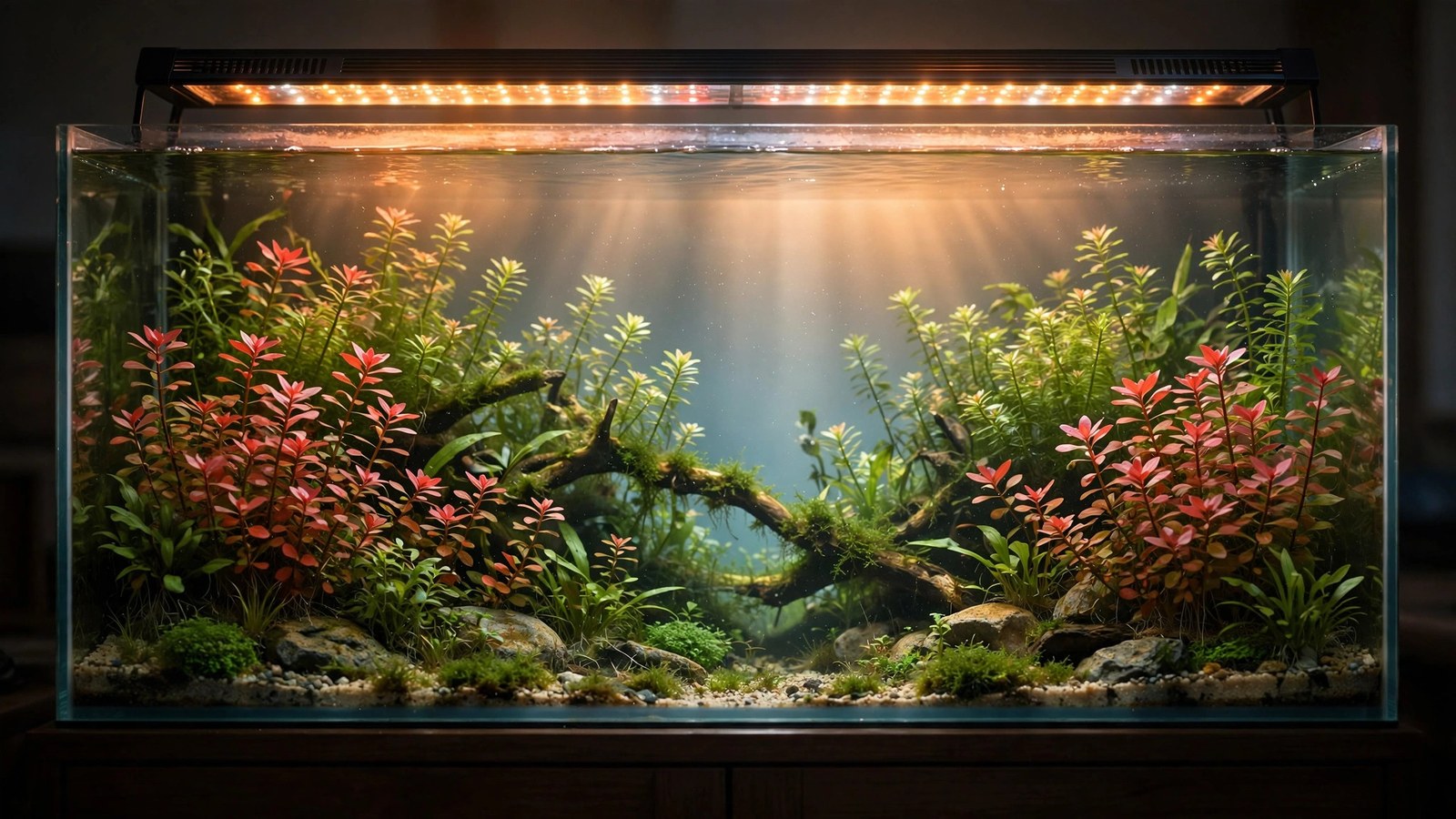
Here is the uncomfortable truth behind this search: no plug-in aquarium timer genuinely ramps your light up at dawn and dims it down at dusk. A timer is a switch — it cuts or restores power, and power is binary. Ramping and dimming have to happen inside the light fixture (or an inline controller), where circuitry can fade the LEDs gradually. If you buy a fancy "ramping timer" expecting it to fade a basic LED bar, you will be disappointed when the light snaps on at full blast exactly as before.
That does not mean sunrise and sunset lighting is out of reach — it is easier and cheaper than ever. You just need to shop for the right thing: either a fixture with scheduling built in, or a plain timer for a plain light and honest expectations. Here is exactly how each option works and the two products worth your money.
The short answer: If you want ramp-up and dimming, buy a light with built-in scheduling — a plug timer can only switch power on or off. The budget pick is the hygger 24/7 LED, with a preset dawn-to-dusk cycle, 15-minute sunrise/sunset ramps, and 10-level dimming at a fraction of premium-fixture cost. If your light is simple and on/off is enough, a BN-LINK 7-day digital timer is all you need. Never stack a plug timer on a light that already has scheduling — the two schedules will fight.
Why a Plug Timer Physically Cannot Ramp or Dim
LED dimming works by pulse-width modulation (PWM): the fixture's controller flickers the diodes thousands of times per second, varying the on/off ratio to change brightness. A ramp is just that process automated — 0% rising to 100% over 15 or 30 minutes.
A plug timer sits upstream of all that, on the mains side. When it switches, it either gives the light full wall power or nothing at all. There is no in-between for it to modulate, and no way for it to tell the fixture's controller to fade. The moment power arrives, the fixture boots at whatever brightness it was set to — instantly. This is why every "timer with dimming" listing that is actually just an outlet timer is misleading: the dimming claim belongs to the light it is paired with, not the timer.
Two practical consequences follow. First, if sunrise/sunset matters to you, your money goes toward the light, not the timer. Second, a plain plug timer remains a perfectly good purchase — it is just an on/off device, and for a basic non-dimmable LED it is exactly what consistency requires. Our guide to aquarium light timers covers that role in depth; this article is about getting the ramp.
The Two Real Ways to Get Sunrise and Sunset
1. Built-in fixture scheduling (the budget route)
Many mid-range LED fixtures now ship with an onboard controller that combines a clock, a dimmer, and preset programs. The best-known pattern is the "24/7 mode": the light runs a fixed dawn-to-dusk script — dim warm-orange glow at 6:30 AM, gradually brightening to full daylight, then fading through blue sunset tones to moonlight before switching off around 10:30 PM. Alongside the preset, a DIY mode lets you set your own on/off times, colors, and brightness steps.
What to look for on the spec sheet: a ramp time (15 minutes is the common standard), dimming levels (10 steps is plenty — you do not need 100), a memory function (the schedule must survive power cuts), and IP68 waterproofing since the controller lives inches above water. No app, no Wi-Fi, no account — which is a feature, not a limitation, because there is nothing to become obsolete or stop syncing.
2. App-controlled fixtures (the premium route)
Premium fixtures like the Fluval Plant 3.0 and Chihiros WRGB II put the scheduling in a phone app. Instead of presets, you place time points on a 24-hour curve and set intensity (often per color channel) at each one — true custom sunrise, midday peak, afternoon dip, sunset, and a defined night. This is the only route that gives you genuinely custom curves, like a gentle 6-hour low-light siesta midday for algae control.
The tradeoff is cost — typically two to four times a preset-mode light — plus app dependency. If the manufacturer stops updating the app, your expensive light keeps its last schedule but loses configurability. For most hobbyists, presets plus DIY mode are enough; buy the app route only if you will actually use custom curves.
| Approach | Ramp & dimming | Scheduling | Typical cost tier | Best for |
|---|---|---|---|---|
| Fixture with built-in 24/7 + DIY mode | Yes — 15-min ramps, stepped dimming | Preset dawn-to-dusk + custom on/off | Budget–mid | Most planted tanks |
| App-controlled fixture | Yes — custom curves, per-channel | Unlimited time points | Premium | Tinkerers, high-tech scapes |
| Plug timer + basic LED | No — instant on/off only | 7-day on/off programs | Cheapest | Simple lights, CO2 solenoid sync |
Our Picks: The Two Products Worth Buying
As an Amazon Associate I earn from qualifying purchases — the links below are affiliate links, which means I may earn a commission if you buy through them, at no extra cost to you. I only recommend products that fit the article's advice; both picks below were verified live and in stock at the time of writing.
Best preset sunrise/sunset: hygger 24/7 LED Aquarium Light
hygger Auto On Off LED Aquarium Light (18–24 inch, Dimmable 7 Colors Full Spectrum) ★4.4 is the honest answer to this keyword at the budget end. It combines the timer and the ramp in one fixture: a 24/7 preset cycle with 15-minute sunrise and sunset ramps, a DIY mode for custom timing and color, 7 color choices, 10 dimming levels, a memory function that keeps your program through power cuts, and an IP68 waterproof aluminum housing. The 18-inch model puts out 1290 lumens across 6500K white plus blue, red, green, and RGB diodes — enough for low to medium-light planted tanks.
Be realistic about its limits: 15-minute ramps are fixed (you cannot stretch them to an hour), the DIY mode programs time blocks rather than smooth curves, and at this brightness it will not drive demanding carpet plants or red stems that need high PAR. For anubias, java fern, crypts, swords, and most stem plants, it is plenty — and it needs no separate timer at all.
Best simple on/off timer: BN-LINK 7-Day Digital Timer
If your light is a basic non-dimmable LED, do not pay for features you cannot use — buy switching. The BN-LINK Indoor 7-Day Programmable Digital Timer Outlet ★4.7 gives you what actually matters: 7-day programming with multiple on/off programs per day (so you can run a split siesta photoperiod), minute-level precision, and dual outlets — one for the light, one for a CO2 solenoid on the same clock. It is the same workhorse timer recommended in our aquarium light timer guide, and it costs about the same as a bottle of fertilizer.
What it will not do — and no plug timer will — is ramp or dim. Pair it with the right expectation: rock-solid consistency, which is the single biggest algae-prevention upgrade most tanks are missing.
Honorable mentions (no affiliate link)
Two more categories deserve mention without a specific product recommendation. Smart plugs (TP-Link Kasa, Tapo) are fine timer substitutes with easier phone-based programming and remote override — but confirm the schedule is stored locally so it survives internet outages, and they still cannot dim. Premium app-controlled fixtures (Fluval Plant 3.0, Chihiros WRGB II) are the true "timer with ramp up and dimming" at the top end, with per-channel custom curves — worth it only if you will program beyond presets.
How to Program a Ramp Schedule That Works
Whether you use a preset 24/7 mode or a custom curve, the same principles apply:
- Anchor the peak to your viewing hours. If you are home 6–10 PM, run the bright block then. Plants do not care about wall-clock time — only consistency.
- Keep ramps to 15–30 minutes each end. Shorter looks abrupt; much longer extends dim-light hours that algae tolerate better than your plants do.
- Count only full-intensity hours toward your photoperiod. A 10-hour day with 30-minute ramps is effectively ~9 hours of growing light. Target 8–10 hours total for most setups — see our photoperiod duration guide for the breakdown by tech level.
- Program moonlight deliberately or disable it. A dim blue night mode is pleasant for evening viewing but it is still light. Cap it at 30–60 minutes, or you are silently adding hours to the photoperiod.
- Test the memory. Unplug the fixture for a minute after programming and confirm it resumes the schedule. A "smart" light that forgets its program in a power cut is worse than a dumb one.
Ramp, CO2, and the Siesta: Putting It Together
Ramping interacts with two other schedule decisions. First, CO2 timing: with a preset 24/7 light, run your solenoid on a plug timer that starts 1–2 hours before the ramp-up begins and stops about an hour before the ramp-down ends — dissolved CO2 must already be at target levels when full light hits, and injecting into fading light wastes gas. Our CO2 solenoid timer setup walks through the wiring.
Second, the siesta: some keepers split the photoperiod into two blocks with a midday dark period to suppress algae. This works with plug timers easily, but most preset 24/7 modes cannot do it — their script is a single dawn-to-dusk arc. If a siesta is part of your plan, you need either the DIY time-block mode or an app-controlled fixture with custom time points. Pick the hardware for the schedule you actually intend to run, not the other way around.
Frequently Asked Questions
Can any outlet timer dim an LED aquarium light?
No. Outlet timers switch mains power, which is all-or-nothing — they cannot modulate brightness. Dimming requires PWM control inside the fixture or an inline dimmer controller. Any "timer" advertising dimming is either a light fixture with a built-in timer or is describing a paired dimmable light, not the timer itself.
Is the ramp on a preset 24/7 light enough for a planted tank?
For low to medium-light setups, yes. A 15-minute sunrise/sunset ramp plus 10-step dimming (like the hygger's) gives you gentle transitions and brightness control that suits anubias, ferns, crypts, swords, and most stems. It will not replace a high-PAR fixture for demanding carpets or red plants — ramp features do not increase maximum intensity, they only shape how you reach it.
Should moonlight mode count toward my photoperiod?
Yes, partially. Dim blue light is still photosynthetically usable, and algae are less picky about spectrum than your plants. Treat moonlight as viewing ambiance, not free hours: cap it at 30–60 minutes in the evening. If you leave an all-blue night mode running for hours, you have effectively extended the photoperiod and should expect algae to notice before your plants do.
Can I use a smart plug like Kasa or Tapo instead of a timer?
Yes, for on/off scheduling — smart plugs are just app-programmed timers. They are easier to program and let you override remotely, but they cannot ramp or dim either. Verify the schedule is stored locally on the plug so it survives internet outages, and never stack one on a light with built-in scheduling.
Will adding a timer mess up my CO2 schedule?
Only if the two drift apart or you wire them to the same on/off moment. CO2 should start 1–2 hours before full light and stop about an hour before lights-out, both off all night. Use the timer's second outlet or program for the solenoid, check both clocks against your phone every month or two, and verify everything after any power cut.
Do fish actually benefit from sunrise/sunset ramping?
Modestly, and it is worth having. Fish startle less when light fades in rather than snapping on — you will see less darting and hiding at "dawn," and shy species settle faster. It is a welfare nice-to-have rather than a requirement: no fish needs ramping, but every tank is calmer with it. The bigger beneficiary is you — a tank that wakes up gradually is simply more pleasant to live with.