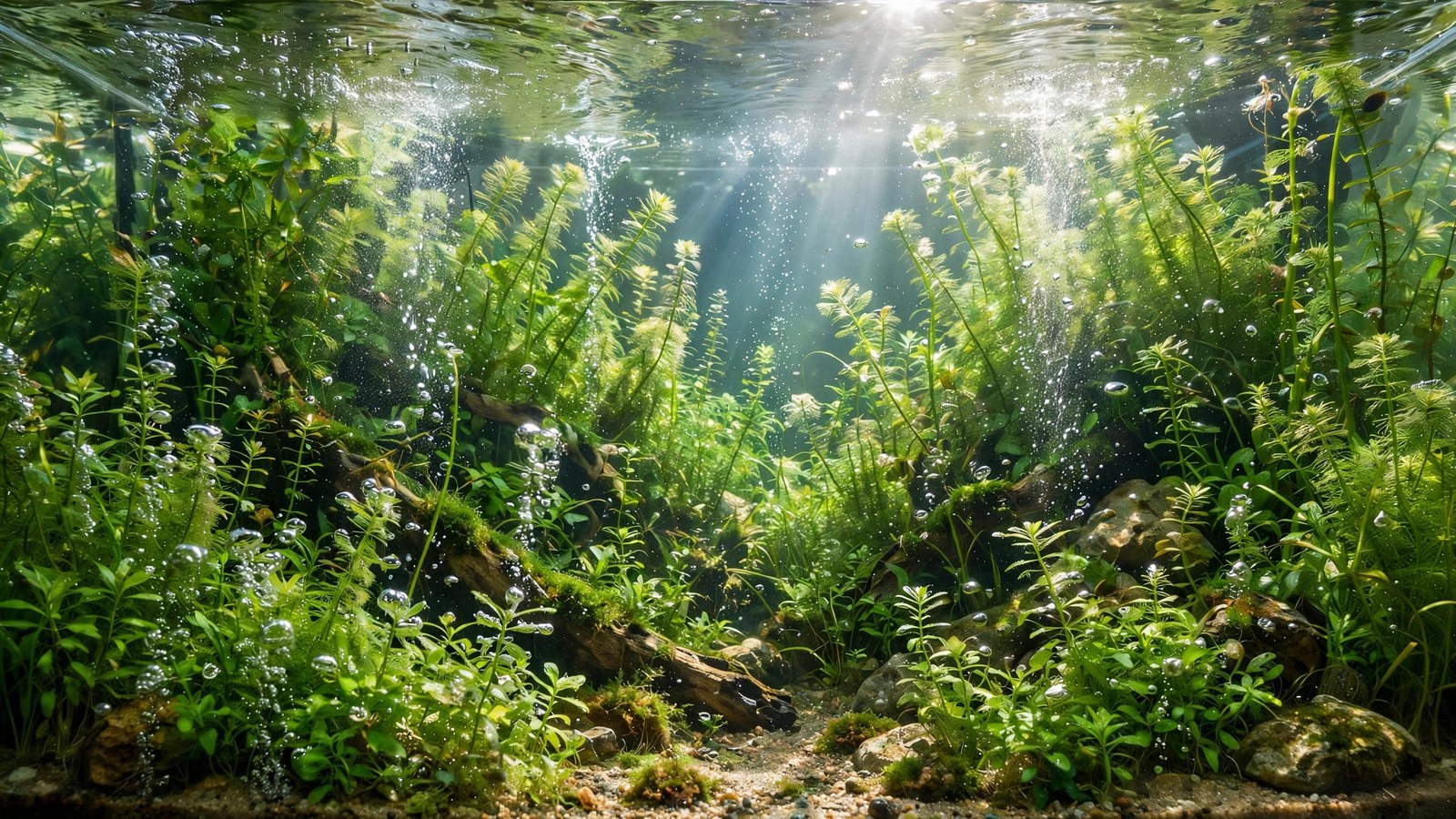
Your tank looks like a champagne glass — fine streams of oxygen bubbles rising off every leaf — and yet nothing has grown in a month. No new leaves, no longer stems, just the same plants sitting there, sparkling and frozen. It feels like a contradiction. It isn't. Pearling and growing are two different processes, and your tank is doing one while failing at the other. Here's how to find the missing piece.
Short answer: pearling only proves photosynthesis is running — it says nothing about whether your plants have the raw materials to build new tissue. Growth is governed by the limiting factor: the single scarcest nutrient or resource. If light, CO2, nitrogen, potassium, iron, or any one essential is missing, growth stalls even while leaves pearl beautifully. Diagnose which one is short — usually a nutrient — supply it, and growth restarts within 2–3 weeks.
What Pearling Proves — and What It Doesn't
Pearling is visible oxygen. During photosynthesis, plants split water and release O2; when that oxygen is produced faster than it can dissolve into already-saturated water, it forms visible bubbles on leaf surfaces. That tells you exactly two things: your light is strong enough to drive vigorous photosynthesis, and your carbon supply is adequate. Nothing more.
Growth is a separate chemical process. Photosynthesis makes sugars, but a plant cannot build a new leaf from sugar alone — it needs nitrogen for proteins and chlorophyll, phosphorus for energy transfer, potassium for cell regulation, iron for chlorophyll synthesis, magnesium for the chlorophyll molecule itself, and a dozen more elements in smaller amounts. If even one of those is missing, the assembly line halts while the photosynthesis engine keeps running. The result is exactly what you're seeing: bubbles without biomass.
This is also why pearling is not a health certificate. Plants pearl with potassium-deficiency pinholes in their leaves, with iron-chlorotic new growth, and sometimes even while slowly starving. Pearling answers "is photosynthesis running?" — it never answers "does this plant have everything it needs?" Treat it as a useful process-of-elimination clue: since light and carbon are covered, your suspect list shrinks to nutrients, delivery, and timing. That's a shorter, cheaper investigation.
Liebig's Barrel: the One-Nutrient Rule
In the 1840s, Justus von Liebig described a principle that explains your tank perfectly. Picture a wooden barrel built from staves of different heights: the barrel can only hold water up to the shortest stave. The staves are everything your plants need — light, CO2, nitrogen, phosphorus, potassium, iron, calcium, magnesium, trace elements — and the shortest one sets the water level. Growth is capped by the single scarcest input, no matter how abundant the rest are.
Two consequences follow. First, adding more of something you already have plenty of does nothing — extra light when iron is the limiter just grows algae faster. Second, you don't need to fix everything: raising the shortest stave is the whole job. That's why this guide works through a sequence instead of handing you a shopping list. You're hunting for one culprit, and the symptoms usually name it.
One nuance worth knowing: a nutrient can be "the shortest stave" even when it's technically present — if another element blocks its uptake (excess potassium can interfere with magnesium absorption, for example), or if it's in the wrong place (nutrients locked in the substrate where a water-column feeder can't reach them). So the diagnosis has three layers: what is missing, where it needs to arrive, and how you confirm it. Steps below.
Step 1: Read the Leaves — the Fastest Diagnostic You Own
Before you buy anything, spend five minutes looking at which leaves are unhappy and how. The single most powerful distinction is old leaves vs. new leaves:
- Damage on old, lower leaves first points to mobile nutrients — nitrogen, phosphorus, potassium, magnesium. The plant can relocate these from old tissue to new growth, so the old leaves sacrifice themselves first.
- Damage on new growth first points to immobile nutrients — iron, calcium, boron, manganese. These can't be moved once deposited, so deficiencies show where tissue is being built right now.
Match what you see to the table below, drawn from widely used aquatic-plant deficiency references:
| Symptom | Which leaves | Likely deficiency | What it means |
|---|---|---|---|
| Uniform yellowing, stunted overall | Old leaves first | Nitrogen (N) | The most-consumed nutrient; common in heavily planted, lightly stocked tanks |
| Dark green or purplish leaves, tiny new growth | Old leaves first | Phosphorus (P) | Rare in stocked tanks; check if you use phosphate-absorbing media |
| Pinholes, ragged edges, yellow margins | Old leaves first | Potassium (K) | Extremely common — many "complete" fertilizers are weak on potassium |
| Yellowing between veins, veins stay green | Old leaves first | Magnesium (Mg) | Check GH; soft water is often Mg-poor |
| Pale or yellow new leaves | New leaves first | Iron (Fe) | High pH locks iron out; chelated iron is the fix |
| Twisted, deformed new growth | New leaves / tips | Calcium (Ca) | Low GH water; remineralize if using RO |
| Dying growing tips, brittle points | New growth | Boron (B) | Usually covered by a good trace mix |
| Compact, stunted, oddly small leaves | Whole plant | General / light | But you pearl, so light isn't it — look to nutrients |
A plant showing no symptoms at all, but simply not growing, is still telling you something: the limiter is probably a macronutrient running just low enough to halt expansion without triggering visible deficiency — nitrate drifting near zero in a heavily planted tank is the classic version. That case is solved by testing and dosing, covered in Step 3.
Step 2: Check the Delivery Route — Roots vs. Water Column
Even the right nutrient fails if it arrives at the wrong door. Aquarium plants feed through two channels, and species are strongly biased toward one:
| Feeding style | Examples | What they need |
|---|---|---|
| Heavy root feeders | Amazon swords, cryptocorynes, vallisneria, aponogetons, dwarf sagittaria | Nutrient-rich substrate or root tabs; liquid dosing alone often isn't enough |
| Water-column feeders | Anubias, java fern, bucephalandra, mosses, floating plants, most stem plants | Liquid fertilizer in the water column; root tabs won't reach them |
This is where many "pearling but not growing" mysteries resolve. A classic setup: a beautiful tank with inert gravel, a thriving water-column-dosed stem section — and a giant Amazon sword that pearls a little and hasn't grown a leaf in two months. The water has nutrients; the sword's roots don't. Conversely, aquasoil tanks that are 18+ months old are often exhausted — the soil's nutrient bank is spent, root feeders stall while water-column feeders on liquid dosing keep thriving.
Match the fix to the feeder: push root tabs near heavy root feeders every 2–3 months, and dose the water column for everything else. If you use an all-in-one liquid but your swords and crypts are the only stalled plants, the liquid isn't the problem — the missing root nutrition is.
Step 3: Test, Then Dose — One Change at a Time
If the leaves don't name a suspect, test before you guess. A freshwater master test kit ★4.8 covers the two readings that matter most here: nitrate and phosphate. The pattern you're looking for:
- Nitrate near 0 ppm in a planted tank is a red flag, not a victory. Heavily planted tanks with light fish loads burn through nitrate fast; aim to hold 10–20 ppm.
- Phosphate near 0 similarly halts growth; 0.5–2 ppm is a comfortable range.
- Both fine but still no growth? The limiter is almost certainly potassium, iron, or a trace element — the things basic test kits don't measure. That's the all-in-one fertilizer's job.
Then dose — and dose completely. The single most reliable fix for "pearling but not growing" is switching to a true all-in-one liquid fertilizer that includes macros (N, P, K) plus micros and traces. Many beginners dose a micro-only supplement and assume they're covered; those products supply traces but almost no nitrogen, phosphorus, or potassium — precisely the macros that run out first. Dose to the label for two to three weeks, change nothing else, and watch the new leaves.
A reliable all-in-one here is NilocG Thrive ★4.6 — one pump per 10 gallons, one to three times weekly, delivering a full macro and micro spread in each dose. It's the standard upgrade path for exactly this situation: pearling confirms your light and CO2 are doing their jobs, so the remaining gap is complete nutrition. (As an Amazon Associate I earn from qualifying purchases — I recommend it because it solves the specific deficiency pattern this article diagnoses, not because it pays.)
The "one change at a time" rule matters more than the brand. Change the fertilizer or add root tabs or adjust the photoperiod — never all three in one weekend. Tanks respond on a two-to-three-week delay, and overlapping changes make it impossible to learn which stave you raised. Patience isn't just a virtue here; it's the diagnostic instrument.
The Three Fixes That Actually Restart Growth
Put the diagnosis together and you'll land on one of these three scenarios, each with a concrete fix:
1. The macro gap (most common). Pearling, healthy-looking leaves, zero extension growth, nitrate testing near zero. Cause: fish waste and micro-only fertilizers can't keep up with plant demand. Fix: a true all-in-one dosed on schedule; expect measurable new growth in 2–3 weeks. This is the majority of cases.
2. The root-feeder stall. Water-column plants thrive; swords, crypts, and vals sit frozen — often in inert substrate or exhausted aquasoil. Cause: nutrients aren't reaching the roots. Fix: root tabs pushed into the substrate around each plant every 2–3 months, or a substrate refresh for very old aquasoil. Pearling on these plants may even increase as the roots finally feed.
3. The silent trace lockout. Dosing regularly, tests read fine, but new growth is pale, twisted, or tiny. Cause: a micronutrient issue — high pH locking out iron, exhausted traces in old water, or RO water with no remineralization. Fix: check pH (iron availability drops sharply above pH 7.5), consider chelated iron, and if you use RO water, remineralize to a GH of 4–8. Verify your CO2 is genuinely at target too — a drop checker that never quite reaches green means carbon is secretly the limiter despite the pearling.
If none of the three fits after an honest 3–4 weeks — you dose completely, roots are fed, tests are sane, and still nothing — look at the actual carbon situation and water temperature. Growth effectively pauses below about 20°C (68°F) for most tropical species and above 30°C (86°F) for many; pearling continues in both ranges, which is exactly the mismatch you're seeing.
Frequently Asked Questions
Can plants pearl and still be dying?
Yes. Pearling measures today's photosynthetic rate, not overall health. Plants with advanced deficiencies, algae-covered leaves, and even partially melted tissue can pearl as long as intact chlorophyll is photosynthesizing under strong light. Always judge by growth form and new leaves, never by bubbles alone.
My plants pearled for months and just stopped growing — what changed?
The most common change is invisible: a nutrient that was marginally sufficient ran out. Aquasoil depletes over 12–18 months, fish loads change, and fast growers consume more as they get bigger. Test nitrate and phosphate first; if both read zero or near-zero, you've found it.
Will adding more light make stalled plants grow?
No — and this is the trap. If the limiter is a nutrient, extra light just gives algae more energy while your plants stay capped. Light is only the answer when light is the shortest stave, and pearling already proved it isn't. Fix nutrition first, then reassess.
How long after fixing the deficiency will growth restart?
Expect the first clean new leaves within 2–3 weeks of a correct fix, with normal growth rates resuming by week 4–6. Old damaged leaves won't recover — trim them so you can clearly see the new, healthy growth coming in.
Do I need CO2 injection if my plants already pearl?
Pearling in a non-CO2 tank means light is strong and oxygen saturates — it doesn't mean carbon is optimal. But carbon is rarely the limiter when pearling is vigorous; nutrients are. Only revisit CO2 if nutrition is fully covered and growth still stalls.
Is an all-in-one fertilizer enough, or do I need separate macros and micros?
For most tanks, a good all-in-one is enough and far easier to dose consistently. Separate macro/micro dosing (EI-style) makes sense for high-tech, heavily planted tanks where you want to tune individual nutrients — but consistency beats precision for the vast majority of hobbyists.