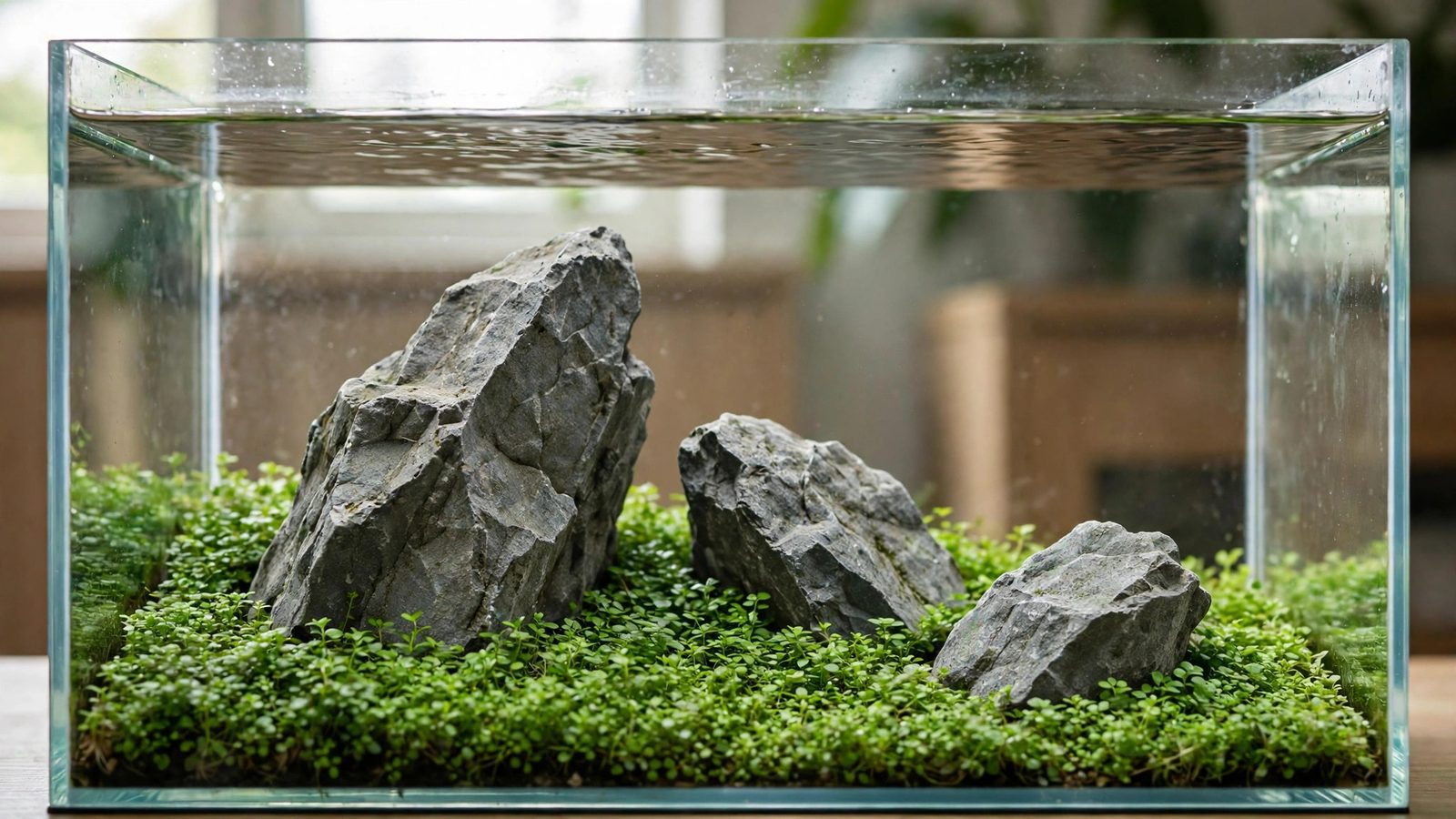
One wrong stone ruins an Iwagumi before the first plant goes in. Beginners grab any grey rock at the shop and end up with a layout that reads like rubble, not a mountain. The fix is learning to read rock the way contest scapers do — and few stones reward that skill like manten stone. This guide shows you how to identify genuine Manten, buy it at fair per-pound prices, clean it safely, and place it in Iwagumi and mini-mountain layouts that look carved by nature.
Is manten stone good for aquascapes? Yes — it is one of the finest hardscape rocks for Iwagumi and mini-mountain layouts. Glass Aqua confirms Manten is inert, meaning it will not impact water chemistry, so it is safe even for sensitive freshwater life. Its rugged, craggy texture and grey-to-brown-red palette read as real mountains at miniature scale, and the famous inconsistency between pieces is what makes finished layouts look natural rather than staged.
Why Aquascapers Reach for Manten
Manten comes from high-elevation mountainsides in Japan, where centuries of erosion and pressure carved its signature rugged edges and deep, layered texture. No two pieces match — light grey, warm brown, even hints of red — and that inconsistency is exactly the point: placed well, a few stones read as an entire mountain range.
One fact simplifies everything else: Manten is inert. Retailers including Glass Aqua confirm it won't impact water chemistry, so there's no pH or GH anxiety — it's a safe choice even for sensitive shrimp and soft-water fish.
That combination of character and chemistry is why this stone owns the classic Iwagumi aquascape layout: grey tones that harmonize with green carpets, and texture dramatic enough to carry a minimalist design of just three to five stones.
Manten vs the Other Great Stones
Manten sits in a crowded field of grey-to-brown hardscape rocks. The short version: more character than Dragon Stone, less chemistry homework than Seiryu.
| Stone | Color | Texture | Water chemistry | Best for |
|---|---|---|---|---|
| Manten | Light grey to brown-red | Rugged, craggy, naturally layered | Inert — no pH/GH shift | Iwagumi, mini-mountain chains |
| Dragon Stone | Clay brown | Porous, honeycombed with holes | Inert | Nature-style accents, cave groupings |
| Seiryu | Blue-grey with white veining | Sharp, angular, striated | Can raise pH/GH — test first | High-contrast Iwagumi |
| Frodo | Dark grey-brown | Fine-grained, layered | Generally inert | Moody mountain scenes |
Still torn? The full Dragon Stone vs Seiryu stone hardscape comparison covers the pH and GH testing Seiryu demands. Manten gives you Seiryu-level drama with none of that homework.
Buying Manten: What to Look For
Manten sells by the pound, and prices vary widely. At time of writing, Glass Aqua and Pet Zone SD list Manten around $19.99, Aqua Lab Aquaria sells it near $9.00 per pound, and Fitz's Fish Ponds has offered it near $3.99 per pound — shopping around genuinely pays. Hardscape sales are typically final, so buy from a retailer whose product photos match the tone you want.
Glass Aqua's rule of thumb: roughly 2 lb of stone per gallon of water. Order more than you plan to use — natural stone varies, specific pieces can't be guaranteed, and the extras become your next tank's hardscape.
Cherry-pick in three roles: one dominant Oyaishi (main stone) with a strong face, two to four smaller support stones in the same color tone, and a few pebbles as foothills. Wet the stone to preview its true color — Manten darkens noticeably when wet, and dry photos mislead.
Browse Glass Aqua's Manten stone listing to calibrate your eye on real pieces before ordering anywhere. And plan the composition before buying plants — the hardscape-first scaping method lets the stone dictate the layout. On a tight budget, single-stone layouts show how much drama one great Oyaishi can carry.
Cleaning and Prepping the Stones
New Manten arrives dusty. Rinse each piece under running water and scrub with a stiff brush, working the bristles into the deep crevices — those cracks are also where you'll later tuck moss, so they need to be clean. Inspect for loose fragments, then soak overnight to confirm the water stays clear.
Placing manten stone in Iwagumi and Mini-Mountain Layouts
Iwagumi runs on odd numbers and one hero. Set the Oyaishi off-center — roughly at the golden ratio — and bury at least a third of its height so it looks rooted, not dropped. Secondary stones lean slightly toward the main stone, echoing its angle like ridges running off a peak, all tilting toward a common sightline so the formation feels carved by the same wind and water.
For mini-mountain chains, scale the idea up: five to nine stones of descending size stepping across the tank, tallest at the back corner, with open sand in front as the "valley." Keep negative space generous — Manten's craggy detail needs breathing room, and crowding is what turns mountainscapes into rubble. Manten also anchors nature-style aquariums beautifully, supporting driftwood or breaking up a planted slope.
Red Manten and Planting Around Stone
Red Manten is the warm-toned variant — rich red-brown with the same rugged, layered texture — stocked by retailers like Buce Plant, whose hardscape collection lists Red Manten alongside standard grey. It pairs dramatically with green carpets and dark substrates; buy all pieces from one batch so the warm tone stays consistent.
Planting is where the layout comes alive. Wedge moss into the deep cracks for an aged look, tuck Anubias or Bucephalandra into crevices with rhizomes above the substrate, and run a low carpet up to the stone bases to sell the mountain-meets-meadow illusion. Our guide to attach aquarium plants to rocks covers the glue-and-thread techniques, and the triangle composition technique shows how to angle your planting around stone focal points once the hardscape is set.
Frequently Asked Questions
Is Manten stone safe for fish and shrimp?
Yes. Retailers including Glass Aqua confirm Manten is inert — it won't raise pH or GH — making it safe for sensitive shrimp and soft-water species. Rinse and soak new stones before use, and test your water after any hardscape change.
How much Manten stone do I need for my tank?
Budget roughly 2 lb per gallon of water for a good range of shapes and sizes. Order more than you plan to use, since natural stone varies and retailers can't guarantee specific pieces — leftovers make excellent hardscape for your next tank.
Does Manten stone change water chemistry?
No. Manten is inert and won't shift pH or GH, unlike Seiryu stone which can noticeably harden water over time in a setup. Still rinse new stones thoroughly to remove dust and sediment, and test your parameters after setup as good practice.
Can I boil Manten stone to clean it?
No. Boiling can crack Manten along its natural layers through thermal shock, which is both wasteful and hazardous. Scrub with a stiff brush under hot tap water instead, work the bristles into the deep crevices, and soak overnight to confirm the water stays clear.
What is Red Manten stone?
Red Manten is a warm red-brown variant of Manten with the same rugged, layered texture, stocked by retailers such as Buce Plant. It contrasts beautifully with green carpets and dark substrates. Buy all pieces from one batch so the tone stays consistent across your layout.
A Stone That Rewards Patience
Manten asks for two things: a careful eye at the shop and patience at the glass. Choose pieces with intent, place them with restraint, and let moss grow into the cracks — in six months your three grey stones will look like they've stood there for six thousand years.