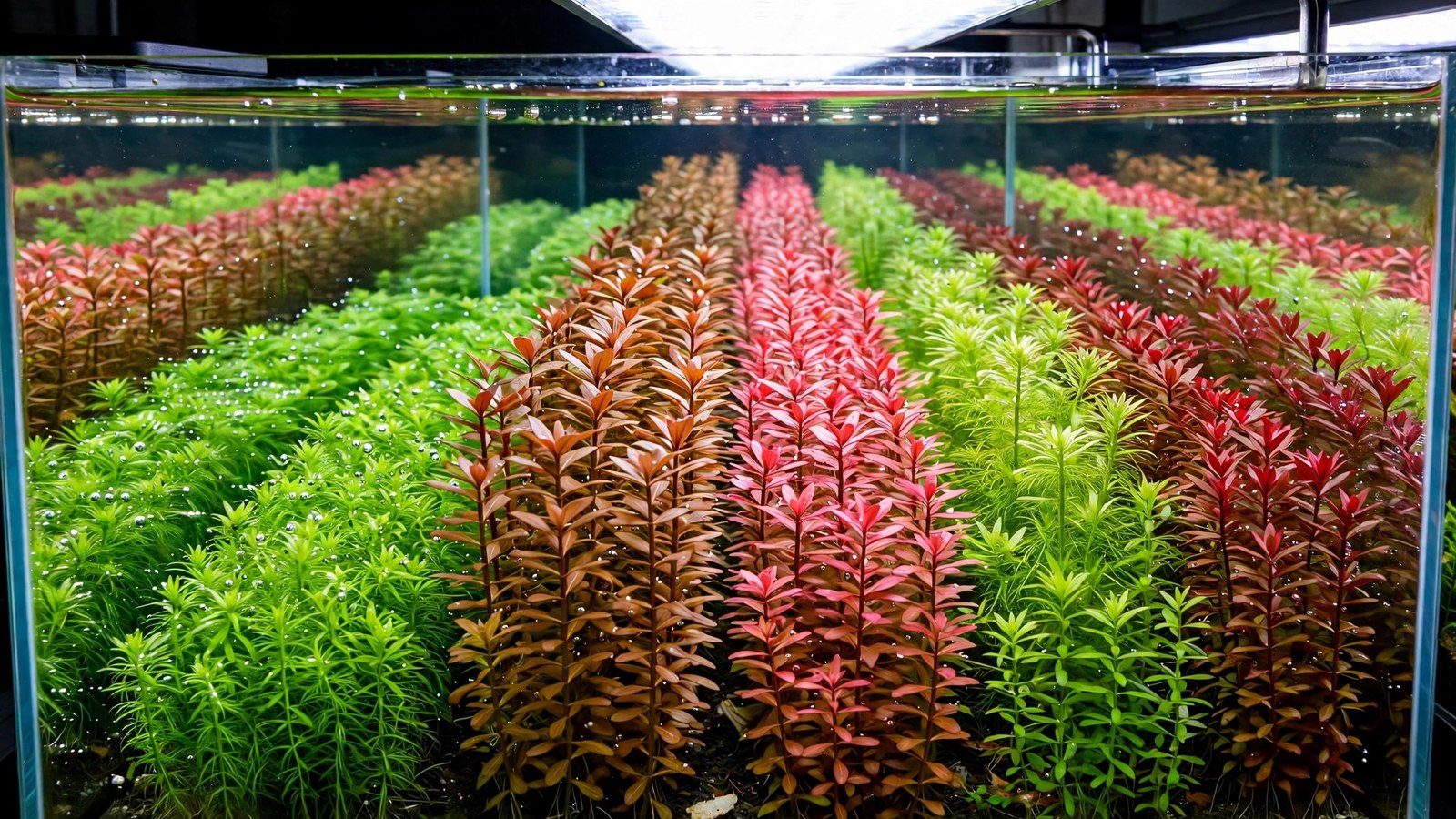
The classic Dutch tank is a gardener's tank: rows of stem plants, each group a different leaf shape and colour, trimmed into crisp streets running front to back. Traditionally those streets ran on injected CO2 and strong light, so beginners assume the style needs a gas cylinder. It does not — but the honest version is slower, greener, and pickier than contest photos suggest.
Here is the low-tech formula: the species that hold shape without CO2, the colour limits to accept, and the trimming rhythm that replaces CO2.
Direct answer: Yes — with fast, undemanding stems: Hygrophila polysperma, Ludwigia repens, Rotala rotundifolia, Bacopa caroliniana and Limnophila sessiliflora, in dense single-species groups under moderate light for 8 hours a day, with steady liquid and root-tab feeding. Expect green streets with bronze and pink-green accents, not deep scarlet, and trim and replant tops every 1 to 2 weeks.
What Makes a Tank Dutch
A Dutch aquascape is judged on planting, not hardscape. The classic rules call for at least 80% of the substrate planted, single-species groups arranged as contrasting streets, and height steps from low front plants to tall back stems. Rock and wood are accents at most; the plants are the architecture.
None of that requires gas. CO2 used to buy speed and colour intensity, not structure. Without it, pick species that stay dense at a slower rate, and build contrast from leaf shape — fine Rotala against broad Bacopa, feathery Limnophila against bold Hygrophila — rather than scarlet alone. See our Dutch style guide for the classic layout.
The Plant List That Actually Holds Streets
Every plant below grows without injected CO2 in a mature, fed tank. Plant each species in a group of at least 5 to 7 stems, 2 to 3 cm apart, so the group fills in as one block. Buy more stems than you think you need: a thinly planted street never looks Dutch, and sparse groups invite algae.
| Plant | Role in the street | Growth without CO2 | Colour to expect |
|---|---|---|---|
| Hygrophila polysperma | Background workhorse | Fast | Bright to deep green |
| Ludwigia repens | Mid-to-background accent | Moderate to fast | Green, bronze-red undersides |
| Rotala rotundifolia | Fine-textured contrast | Moderate | Green, pink-green tips |
| Bacopa caroliniana | Bold-leaf midground | Slow to moderate | Green, sometimes bronze |
| Limnophila sessiliflora | Feathery background filler | Fast | Light green |
| Cryptocoryne wendtii | Midground anchor | Slow | Green to bronze-brown |
Build back to front: tall Hygrophila and Limnophila at the back glass, Ludwigia and Rotala in the middle, Bacopa and Cryptocoryne in front, Staurogyne repens as a low foreground hedge. Run each street front-to-back, 8 to 12 cm wide, leaving one diagonal gap of low planting as a visual path.
Reds Without CO2: The Honest Limits
Here is the trade-off, stated plainly. In a low-tech tank, Ludwigia repens keeps green tops and reddish undersides, and Rotala rotundifolia blushes pink-green at the tips. You will not get the deep scarlet of Alternanthera reineckii or Ludwigia 'Super Red' — without gas those plants revert to green-bronze, grow leggy, and drop lower leaves.
Design around that: use leaf-shape contrast and one bronze group — Ludwigia repens or Cryptocoryne wendtii 'Brown' — as your warm accent. A plant that needs CO2 to stay red does not belong here.
Feeding and Light: The Low-Tech Engine
Without injected CO2, carbon is the limiting factor, so everything else must be steady, not strong. Run the light 8 hours a day on a timer at moderate intensity — extra light without extra carbon feeds algae, not streets. A weekly 30% water change replenishes trace elements fast stems deplete.
Feed both ways: stems pull most nutrition from the water column, while Cryptocoryne needs food at its roots. A comprehensive liquid such as Seachem Flourish ★4.7 dosed lightly once or twice a week covers the water column. As an Amazon Associate, AquaVerdia earns from qualifying purchases through links on this page, at no extra cost to you.
Push a Seachem Flourish Tabs ★4.6 beside each Cryptocoryne, replacing them every 3 to 4 months. Pale new growth points to iron shortage; pinholes in older leaves point to potassium.
The Trimming Rhythm That Replaces CO2
Trim every 1 to 2 weeks once established, hardest on the fast streets. Cut a stem two-thirds up, replant the healthy top beside the old stump, and let the stump sprout side shoots — that is how a thin row becomes a dense block. After two or three cycles the bottoms go bare: pull them out and let the replanted tops take over.
Use curved scissors, not your fingers: a clean cut heals fast, while a crushed stem rots and invites algae. A kit such as the hygger 6-in-1 Long Aquarium Aquascaping Tools Kit ★4.6 keeps long tweezers and curved scissors together, which matters when trimming a dozen streets in one session.
Three errors undo a low-tech Dutch tank faster than any plant choice. One stem of everything gives you a shop display, not a scape. Raising the light to force reds gives you algae, not colour. Topping without replanting leaves bare stalks with a green cap. Give the tank 8 to 12 weeks before judging it — Cryptocoryne sulks for a fortnight, and the first month is mostly unseen roots. The Buce Plant low-tech guide agrees.
Frequently Asked Questions
Can you do a Dutch aquascape without CO2 at all?
Yes, with the right plants: Hygrophila, Ludwigia repens, Rotala rotundifolia, Bacopa and Limnophila all grow without injected CO2, trading speed and scarlet for a slower, greener tank that still reads as Dutch.
Which Dutch plants stay red without CO2?
None stay deep red. Ludwigia repens keeps bronze-red undersides and Rotala tips go pink-green, but true scarlet species need CO2 and high light, and revert to green-bronze without it.
How often should you trim a low-tech Dutch tank?
Every 1 to 2 weeks once established. Top fast stems, replant the tops, and remove bare bottoms after two or three cycles — trimming keeps streets dense when CO2 is not pushing growth.
What light do Dutch plants need without CO2?
Moderate light — 30 to 50 PAR at the substrate — for 8 hours a day. Stronger light without CO2 feeds algae, not colour.