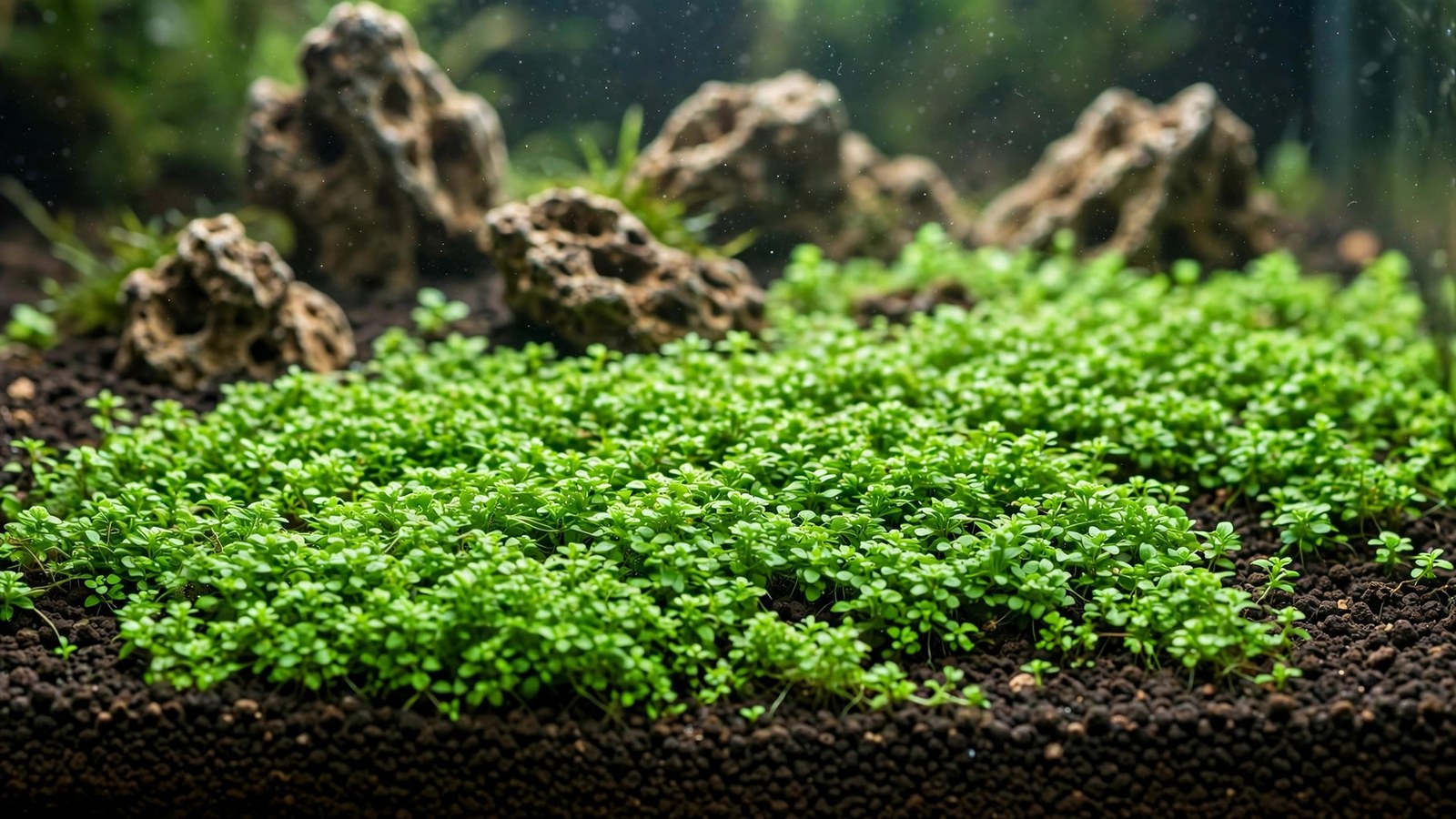
Your carpet looked perfect on planting day. Tiny pots of Monte Carlo, every node pressed into the substrate, CO2 cranked, light on a timer. Two weeks later the foreground is a sad archipelago of floating tufts and brown stubble, and you're fishing sprigs out of the filter intake. Nine times out of ten, the light and CO2 weren't the problem — the granules were. Carpeting plants live or die by the substrate, and when aquarists pit Fluval Stratum vs UNS Controsoil for carpeting plants, the deciding factor is rarely the brand name. It's granule size, and most people buy the wrong one.
Short answer: For carpeting plants, UNS Controsoil in the Extra Fine grade is the stronger choice because its ~1 mm granules grip delicate carpeting roots far better than Fluval Stratum's larger, looser pellets. Fluval Stratum still grows easy carpets like dwarf hairgrass and Monte Carlo well, costs less per bag, and suits beginners. For demanding carpets like HC Cuba or glosso, Controsoil Extra Fine wins on anchoring, nutrient content, and granule longevity.
Why carpets are substrate-picky
Stem plants forgive a lot. Their roots dive several centimeters down and wrap around anything. Carpeting plants — Hemianthus callitrichoides (HC Cuba), Micranthemum tweediei (Monte Carlo), Glossostigma elatinoides, dwarf hairgrass — spread sideways through the top centimeter of substrate on thread-thin roots. If the grains are too big, the roots can't get purchase between them, and the first water change or hungry shrimp lifts the whole runner mat.
Carpets also root shallow, which means they draw a meaningful share of their nutrients from the substrate right around the crown rather than deep in the bed. An active aquasoil with real nutrient content feeds the spreading runners for months. That's why carpeted layouts are the one place where the aquasoil you choose genuinely changes the outcome, while in a stem-plant jungle almost any active soil behaves similarly.
Fluval Stratum at a glance
Fluval's Plant and Shrimp Stratum is volcanic soil ground into soft, rounded pellets. It buffers the water to a neutral-to-slightly-acidic pH, leaches very little ammonia compared to heavy-hitting soils like ADA Amazonia, and carries a modest nutrient charge that gets carpets through the first few months without heavy dosing. It's widely stocked, comes in 4.4 lb and 8.8 lb bags, and is one of the most forgiving soils for a first planted tank.
The trade-offs matter for carpets. The pellets are noticeably larger than Controsoil's fine grades — roughly in the 2–5 mm range — so delicate roots have more gaps to bridge, and the granules are soft: they crush easily if you rescape, and in most tanks they start breaking down toward a fine mush somewhere around the 12–18 month mark. Disturbing the bed aggressively (deep vacuuming, yanking rooted carpets) clouds the water, because the softened pellets don't hold together like fired clay.
None of this makes Stratum a bad carpet soil. Easy carpets — Monte Carlo, dwarf hairgrass, Sagittaria subulata — root into it happily, especially in low-tech setups where the lighter nutrient load is actually an advantage: less excess to feed algae while the tank matures. The catch is that once the pellets soften, the bed loses the pore structure that oxygenates the root zone, and older carpets on tired Stratum thin out from the center.
UNS Controsoil at a glance
Ultum Nature Systems' Controsoil is Japanese volcanic ash and soil, and its signature move is that it comes in three distinct granule grades instead of one: Extra Fine (~1 mm), Fine (~3 mm), and Normal (~5 mm), in black or brown. For carpeting plants, the Extra Fine grade is the whole argument. One-millimeter grains pack tight enough that HC Cuba nodes — which are barely 1–2 mm across — settle between the grains instead of perching on top of them. Monte Carlo's fine rootlets braid through it like soil through a seed tray.
Nutrient-wise Controsoil carries a heavier charge than Stratum, closer to a true planted-tank soil, while still leaching only a low amount of ammonia. Hobbyists regularly report adding livestock within days of setup on Controsoil, versus the weeks of dark cycling a heavy Amazonia bed demands. It buffers pH to slightly acidic (below 7.0) and softens water, which suits soft-water carpets and Caridina shrimp alike. The granules are also structurally tougher: they hold their shape through two to three years in most tanks, roughly double Stratum's useful life, and surface-siphoning doesn't turn the bed to mud.
The price of admission is higher — Controsoil costs more per liter than Stratum at most retailers — and the bags come in 1, 3, and 10 liters, which actually suits nano and foreground-only layouts nicely. A 3-liter bag of Extra Fine is exactly enough to lay a proper carpet bed in a 5–10 gallon tank.
Head-to-head: the six things that matter for carpets
1. Granule size and runner anchoring. This is the fight, and Controsoil Extra Fine wins it outright. A carpet is only as secure as the smallest roots of the species you're planting. HC Cuba and glosso have roots so fine that 2–5 mm pellets behave like boulders — the plantlets sit on top and any current peels them off. One-millimeter grains swallow the nodes whole. If you're planting dwarf hairgrass or Monte Carlo, both soils anchor fine, and the difference narrows.
2. Nutrient content. Controsoil ships richer. In practice that means a Controsoil carpet bed feeds spreading runners for the better part of a year before root tabs become necessary, while Stratum's lighter charge starts asking for help around month three to six in high-tech tanks. In low-tech, low-light setups the ranking flips: Stratum's restraint is gentler, with less excess to spike algae during the fragile first month.
3. Ammonia leaching and cycling. Both are low-leach soils — neither forces the multi-week fishless-cycle ritual that Amazonia does. Controsoil's release is low enough that many aquarists add shrimp and fish within days, testing as they go. Stratum behaves similarly, though its richer initial days can cloud if you skip water changes in week one. Either way, plant densely from day one and change water twice weekly for the first month.
4. pH and KH buffering. Both push the tank toward soft, slightly acidic water — the environment carpeting plants and most tropical livestock prefer. Controsoil buffers a touch harder, which matters if your tap water is liquid rock; it will hold KH down longer. If you keep hard-water species, neither is ideal, but that's a livestock question, not a carpet question.
5. Longevity. Stratum's soft pellets begin collapsing in roughly a year to eighteen months of active use, especially under heavy root growth and frequent rescaping. Controsoil's harder-fired granules typically keep their structure for two to three years. For a carpet that takes four to six months to fully fill in, that extra year of bed life is the difference between one scape and a premature teardown.
6. Cost. Stratum is the cheaper bag on the shelf, and it's sold everywhere. Controsoil runs more per liter — but because carpeting layouts need surprisingly little soil (a foreground bed, not a full-depth slope), the actual price gap on a nano carpet tank is a few dollars. Don't pick a carpet soil on sticker price; pick it on granule size.
| Feature | Fluval Stratum | UNS Controsoil |
|---|---|---|
| Finest granule grade | ~2–5 mm pellets (single grade) | Extra Fine ~1 mm (three grades) |
| Nutrient load | Light–moderate | Rich |
| Ammonia leach | Low | Very low |
| pH buffering | Neutral to slightly acidic | Slightly acidic, KH-lowering |
| Bed lifespan | ~12–18 months | ~2–3 years |
| Clouds when disturbed | Yes, once pellets soften | Minimal |
| Do not rinse | Correct — breaks pellets | Correct — breaks granules |
The verdict: which soil for your carpet
Buy UNS Controsoil in the Extra Fine grade if your goal is a demanding carpet — HC Cuba, glosso, or a competition-style Monte Carlo lawn — in a high-tech tank with CO2. The 1 mm grains are the closest thing to planting into seed-starter mix, the richer nutrient charge carries the fill-in phase, and the harder granules outlive the scape. The UNS Controsoil Extra Fine in the 3-liter bag ★4.6 is the exact size for a proper carpet bed in a 5–10 gallon tank, which covers most foreground layouts.
Buy Fluval Stratum if you're carpeting an easy species on a budget, running low-tech, or setting up your first planted tank. Monte Carlo and dwarf hairgrass root into it perfectly well, the lighter nutrients are kinder during cycling, and the Fluval Plant and Shrimp Stratum in the 8.8 lb bag ★4.7 covers a 20-gallon tank's foreground for noticeably less money. Just go in knowing you'll likely rebuild the bed around the 18-month mark.
Affiliate disclosure: AquaVerdia is reader-supported. As an Amazon Associate I earn from qualifying purchases — if you buy through the links above, it costs you nothing extra and keeps the guides coming. I only recommend products I've verified as live and purchasable.
A third option worth knowing: many experienced scapers lay a base of Stratum or Controsoil Normal for depth and slope, then top the foreground with an inch of Controsoil Extra Fine as the working layer. You get the deep bed cheap and the fine working surface where the runners actually live.
Setting up a carpet bed, step by step
Whichever soil you choose, the technique is the same. Pour it dry — never rinse aquasoil — and shape a bed that's at least 4–5 cm deep in the foreground, sloping deeper toward the back. A thin bed is the second most common carpet killer after coarse grains: roots hit glass and stall.
Mist the dry bed, then plant tissue-culture or potted carpets in small clumps no wider than your thumbnail, spaced about 2–3 cm apart. Small clumps root faster than big mats, and the spacing gives runners room to knit together — a full fill-in takes 6–12 weeks with CO2, and roughly double that without.
Fill slowly by pouring water over a plate or plastic bag so the jet doesn't crater the fine grains. Expect mild cloudiness on Controsoil (it clears through filtration) and light haze on Stratum — if it turns milky, your flow disturbed softened pellets, and patience plus fine filter floss is the fix.
Once flooded, run CO2 from day one if you have it (a drop checker reading green by lights-on), keep light moderate rather than blasting — high light on an uncycled carpet bed grows algae, not plants — and dose a lean all-in-one liquid fertilizer from week two. Trim the carpet's first growth low once it knits; the cut forces horizontal runners instead of vertical leggy stems.
Frequently asked questions
Can I mix Fluval Stratum and UNS Controsoil in one tank?
Yes. A common approach is Stratum (or Controsoil Normal) as the deep base layer with Controsoil Extra Fine as the top inch in the foreground where carpets plant. Don't blend them into a uniform mix — you'll lose the fine working surface the carpets need.
Does Controsoil Extra Fine compact and cause anaerobic spots?
Not if the bed stays under ~5 cm and you surface-siphon debris during water changes. The 1 mm grains are porous volcanic ash, not sand; water circulates through them. Problems start when people pile it 8+ cm deep with no maintenance.
Why is my carpet floating off Fluval Stratum?
Usually two causes: the clumps were planted too large (big mats root slowly and peel), or the pellets had already softened and the roots lost their grip. Replant as thumbnail-sized clumps into fresh soil, or switch the foreground to a finer grade.
How long does each soil feed plants before root tabs are needed?
Controsoil's richer charge typically carries carpets 9–12 months in high-tech tanks; Stratum's lighter charge usually asks for supplementation around month 3–6. Watch for runner growth slowing and new leaves paling — that's the bed telling you it's dinner time.
Can I grow a carpet on either soil without CO2?
Yes, but choose the species honestly. Monte Carlo, dwarf hairgrass, and Sagittaria subulata carpet slowly without CO2 on either soil. HC Cuba without CO2 is a patience test most people lose — give it injected CO2 and Controsoil Extra Fine, or pick an easier species.
Is Controsoil safe for shrimp right away?
Its ammonia release is low enough that many keepers add shrimp within days, but "many" isn't "yours." Test ammonia and nitrite first — zero on both for 48 hours before any livestock goes in, regardless of what the soil promises.
External references: UNS's Controsoil substrate overview documents the three granule grades, and Buce Plant's Controsoil product page lists the Extra Fine (~1 mm) grade as the intended choice for foreground carpeting plants.