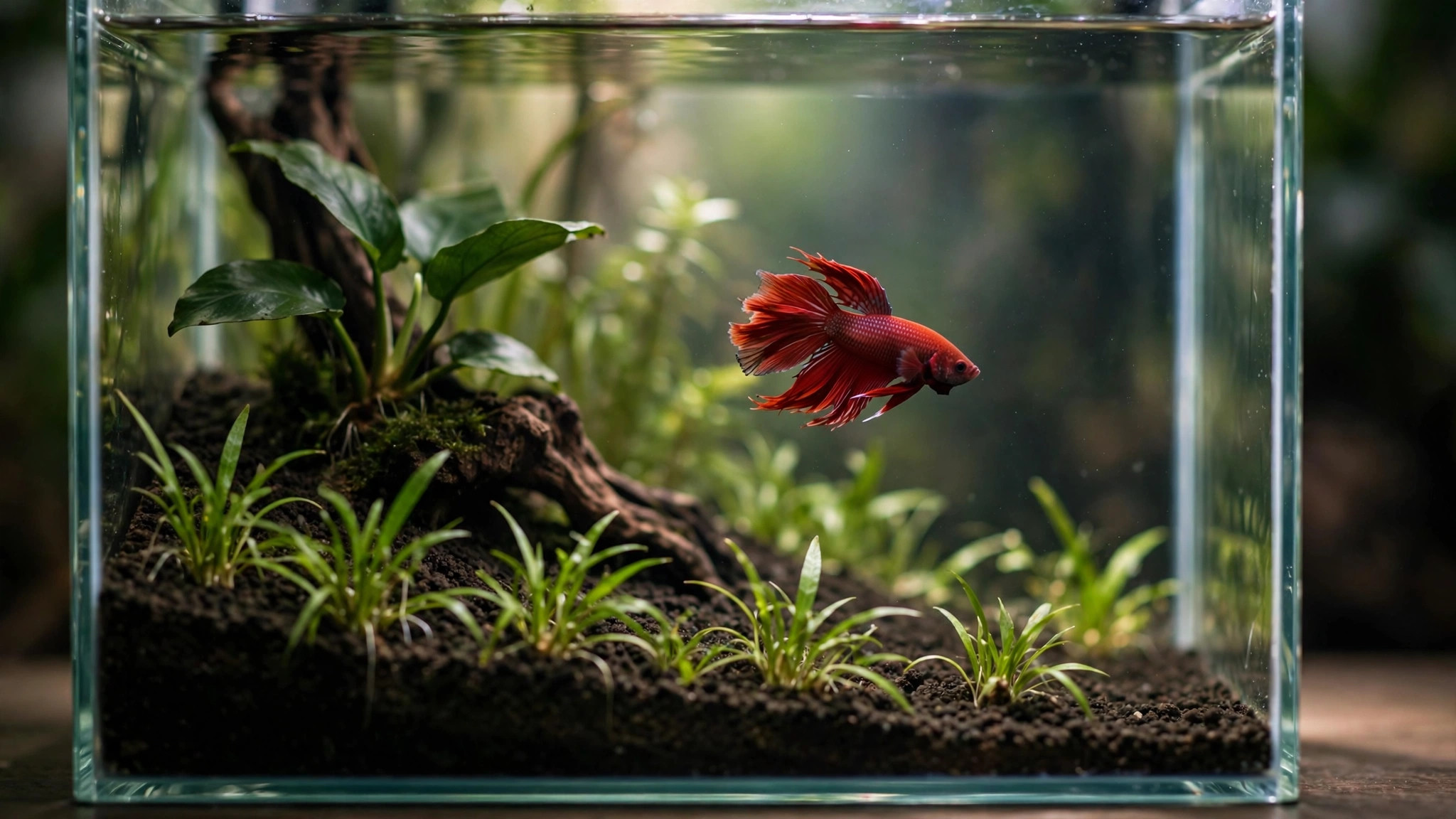
A five-gallon tank is the best beginner betta home there is — and the worst place to get substrate wrong. In a 40-gallon a mediocre substrate is a nuisance you dilute away with water changes. In five gallons the same mistake concentrates: leached ammonia has almost no water to hide in, pH swings land twice as hard, and the gravel your betta's fins drag across daily sits right under his nose.
The good news: choosing the best substrate for 5 gallon betta planted tank setups is a one-time, ten-minute decision. Here is the winner, the honest runner-up, the exact bag size, and what to do in the first month.
The short answer: The best substrate for a 5-gallon betta planted tank is Fluval Plant and Shrimp Stratum — one 4.4 lb bag fills a standard 5.5-gallon to about 2 inches. It is soft on fins, feeds rooted plants without CO2, and gently buffers water toward the slightly acidic range bettas and plants prefer. If you would rather keep things inert, use smooth sand with Seachem Flourish Tabs under root feeders.
Why the substrate decision hits harder in 5 gallons
Substrate anchors plants, feeds roots, and shapes water chemistry. In five gallons that third job dominates — leached ammonia dissolves into barely 19 liters, with no volume to absorb the shock.
Then there is betta biology: bettas rest near the bottom, and long fins sweep the bed constantly. Smooth substrate is invisible to them; rough substrate is sandpaper on silk, and every micro-tear invites fin rot.
The two camps: active aquasoil vs inert substrate
Active aquasoils — baked volcanic soils like Fluval Stratum — arrive loaded with nutrients, pull pH slightly acidic, and release some ammonia early. Inert substrates — sand, gravel, calcined clays — change nothing; all nutrition must come from the water column and root tabs, as the Rooted Tank substrate guide shows.
Neither camp is wrong — but in a 5-gallon betta tank each has a clear standard-bearer:
| Substrate | Feeds plants? | pH effect | Fin safety | Best for |
|---|---|---|---|---|
| Fluval Stratum (active) | Yes, ~12–18 months | Buffers toward 6.5–7.0 | Soft, rounded grains | Crypts, swords, carpets, stems |
| Smooth sand + root tabs (inert) | Yes, with tabs every 3–4 months | None | Very safe if smooth | Epiphyte-heavy tanks, tight budgets |
Disclosure: this article contains affiliate links. If you buy through them, I earn a small commission at no extra cost to you — it keeps the guides coming and the tanks running.
Best pick: Fluval Stratum
For this exact tank, Fluval Plant and Shrimp Stratum ★4.7 is the clear winner. The soft, rounded grains spare trailing fins. One 4.4 lb bag lands at roughly 2 inches in a standard 16×8-inch footprint. It feeds crypts, swords, and dwarf sagittaria without CO2, buffers pH into the 6.5–7.0 sweet spot, and its porous grains give beneficial bacteria badly needed real estate.
Two caveats: Stratum releases a mild ammonia pulse in its first week or two — cycle 2–4 weeks before adding the betta. And the light grains let fresh stems pop up until roots grab — plant deeply. Its nutrients last roughly 12–18 months; after that, push root tabs into it rather than tearing the tank down.
The inert alternative: smooth sand plus root tabs
If your plants are mostly epiphytes — Anubias, Java fern, mosses, floaters — they feed from the water column, so the substrate is decoration. Then smooth inert sand is the smart buy: clean-looking, easy to vacuum, and the gentlest surface a betta can rest on. Pick smooth aquarium or pool-filter sand, rinse until clear, and fingertip-test every candidate.
Root feeders still need food: press Seachem Flourish Tabs ★4.6 into the sand near each crown and replace them every 3–4 months. It is the cheapest planted-betta setup, and it sidesteps aquasoil's early ammonia pulse entirely.
Substrates to avoid in a betta tank
Sharp gravel. Chipped, angular pet-store gravel shreds trailing fins and invites fin rot — the most common substrate mistake in betta tanks.
Crushed coral and aragonite. These buffer pH up, often past 7.6 — the opposite of what bettas and plants want. Save them for cichlid and marine tanks.
High-ammonia aquasoils with the fish already in. Rich soils like ADA Amazonia are excellent products misused: their heavy early ammonia leach spikes hard in five gallons. Fishless-cycle first, no exceptions.
Uncapped dirt or mineralized topsoil. Soil layers go anaerobic fast in small footprints, and one rescape turns the tank into a mud storm.
Setup: depth, planting, and the first month
Aim for 1.5–2 inches in front, 2.5–3 inches at the back. Do not rinse aquasoil — rinsing crushes the grains; the cloudiness settles in a day. Do rinse sand. Plant before filling, then fill slowly over an upturned saucer.
With Stratum, change 25–30% of the water twice a week for the first two weeks, then weekly. Add the betta only after ammonia and nitrite read zero for a full week — typically week 3 or 4. Push a root tab beside each heavy root feeder at planting, even in aquasoil.
FAQ
How much substrate do I need for a 5-gallon tank?
One 4.4 lb bag of Stratum fills a standard 5.5-gallon to roughly 1.5–2 inches — buy the same volume in sand.
Will Fluval Stratum lower the pH too much for my betta?
No — it buffers gently toward 6.5–7.0, inside the betta range of 6.5–7.5 and close to their natural habitat. It will not crash pH the way heavier buffering soils can in very soft water.
Can I just use play sand or pool filter sand?
Yes, if smooth and well rinsed. Both are inert — add Flourish Tabs under crypts, swords, and other root feeders every 3–4 months. Reject any sand that fails the fingertip test.
How long does aquasoil last before it needs replacing?
The nutrient charge lasts roughly 12–18 months; the structure holds up about two years. You rarely need a full replacement — fresh root tabs extend its productive life well beyond that.