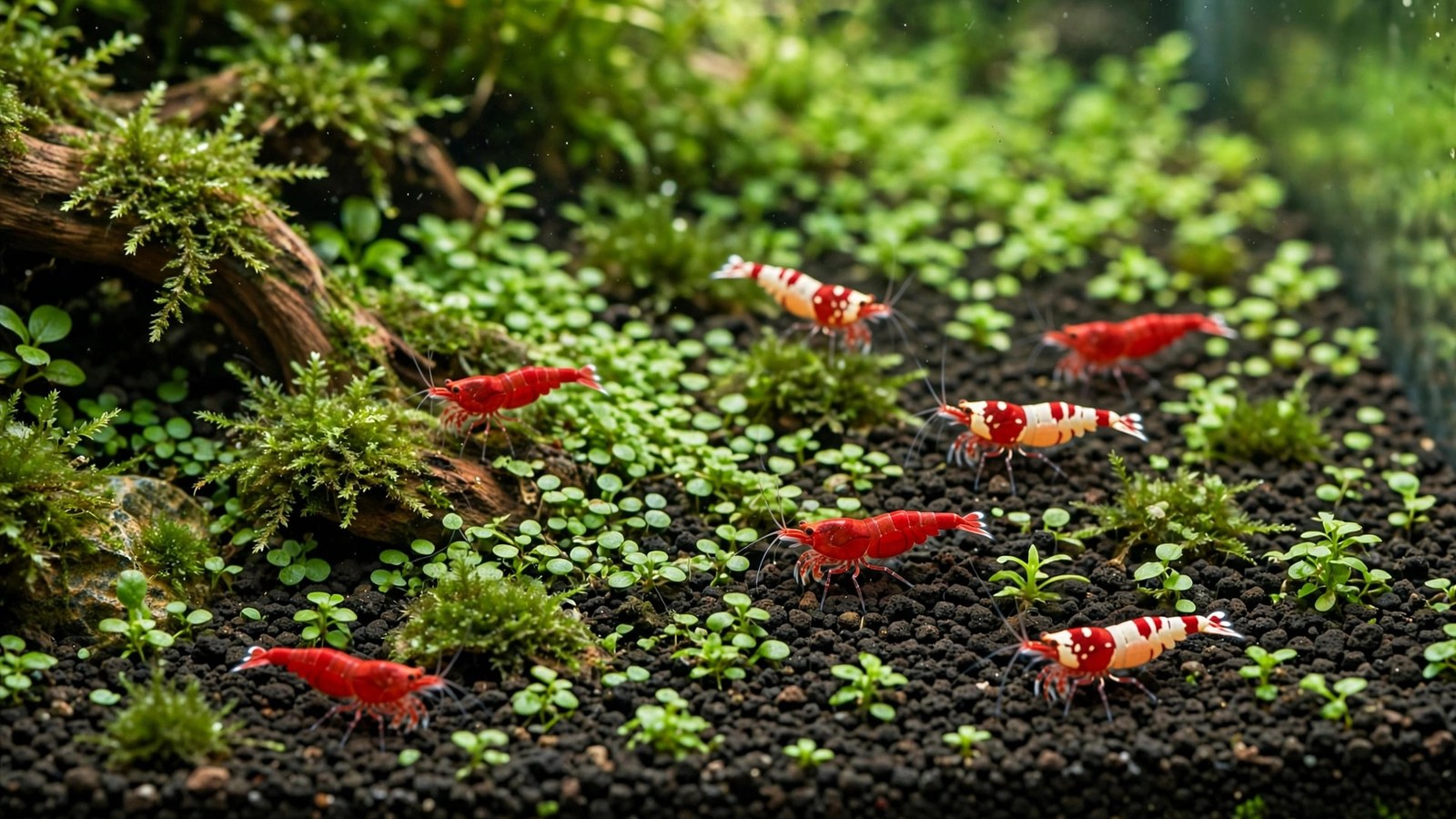
A single bad molt can end a colony. One morning your crystal reds are grazing; the next, a white ring on a carapace and three dead adults — and the only thing you changed was topping off with tap water. This is the failure mode a buffering aquasoil exists to prevent: it drags carbonate hardness (KH) to near zero and holds pH down in the soft, acidic band that Caridina shrimp were collected from. Not every "shrimp soil" buffers with the same strength, and the wrong pick can cost you a year of breeding.
Bottom line: ADA Aqua Soil Amazonia Ver. 2 buffers the hardest (pH ~5.8–6.2 over RO water) and leaches the least ammonia of the Amazonia line; Fluval Plant and Shrimp Stratum buffers gently (pH ~6.4–6.8) and is the safest for beginners and Neocaridina; UNS Controsoil sits in the middle with a fine, uniform granule ideal for shrimplets. All need RO remineralized water and a 3–4 week cycle before shrimp go in.
Why Shrimp Tanks Need a Buffering Aquasoil
Caridina shrimp — Crystal Red, Crystal Black, Blue Bolt, King Kong — evolved in soft, acidic streams. In captivity they are kept successfully only when three numbers stay boringly stable: pH in the low 6s, KH near zero, and TDS low enough that molting minerals stay available in the right ratio. Neocaridina (cherry shrimp) forgive pH drift; Caridina punish it. A pH swing of 0.4 in a day is enough to trigger failed molts — the infamous "white ring of death," where the carapace splits in the wrong place and the shrimp dies half out of its old shell.
Active aquasoils buffer because their volcanic-clay granules carry humic acids and a cation-exchange surface that pulls carbonates out of the water column. Strip the KH and the water loses its alkaline "push," so pH settles in the 5.8–6.5 band and stays there. This is not a one-time trick: the exchange sites keep working for months, which is why a buffered soil is the cheapest insurance a Caridina keeper buys.
Note the exception: Sulawesi shrimp want the opposite — alkaline, hard water — and should never sit on buffering soil. Inert sand or crushed coral serves them. For every Caridina species, though, a buffering aquasoil over RO water remineralized for soft-water shrimp is the standard recipe.
What "Buffering Strength" Really Means
Buffering strength is two things: how far the soil pulls pH down, and how long it keeps doing it. Both depend on your starting water, which is why soil comparisons only make sense over RO (reverse-osmosis) water — tap water with 6+ dKH will exhaust any soil's buffering in weeks rather than months.
With RO remineralized to GH 4–6 and KH 0, the three mainstream soils land roughly like this after the initial leaching phase settles:
| Soil | Typical settled pH (over RO) | Buffering lifespan | Ammonia leach |
|---|---|---|---|
| ADA Aqua Soil Amazonia Ver. 2 | ~5.8–6.2 | ~18 months | Low (Ver. 2 revision) |
| Fluval Plant and Shrimp Stratum | ~6.4–6.8 | ~12–14 months | Low–moderate |
| UNS Controsoil (normal) | ~6.0–6.5 | ~14–18 months | Moderate |
Treat the pH column as a range, not a promise. Water changes with remineralized RO, feeding load, leaf litter, and driftwood all nudge the numbers. What matters is the order: Amazonia pulls hardest, Fluval pulls gentlest, Controsoil lands between. If your tap water runs alkaline (pH 7.6+, KH 6+), the hardest buffer buys you the most margin — but you should still start from RO water rather than asking the soil to fight your tap forever.
The Three Best Buffering Aquasoils, Compared
These are the three soils shrimp keepers actually argue about, ranked by what each does best. All three are genuine aquasoils with real buffering capacity — no inert sand posing as soil here.
1. ADA Aqua Soil Amazonia Ver. 2 — the strongest buffer
Amazonia is the reference standard everything else gets measured against. Ver. 2 keeps the famous buffering and plant-growth reputation of the original while releasing far less ammonia in the first weeks — which is exactly what matters when the end goal is shrimplets, not an aquascaping contest entry. Over RO water it settles pH in the high 5s to low 6s and holds it there for around 18 months in a typical shrimp tank. It is also the richest of the three, so rooted plants and carpets grow on it with minimal added fertilizer.
The trade-off is the ammonia. Even Ver. 2 leaches measurable ammonia for roughly 2–3 weeks, and the original Amazonia runs hotter (4–6 weeks). Plan a full dark-start cycle and heavy water changes early. Never shortcut this for shrimp: ammonium at pH 6 is mostly the less-toxic NH4+ form, but nitrite during the cycle is lethal to shrimp at trace levels.
ADA Aqua Soil Amazonia Ver. 2 (9 L) ★4.7 is the right bag size for a 10–20 gallon shrimp tank at 2–3 inches of depth. Smaller bags exist for nano setups.
2. Fluval Plant and Shrimp Stratum — the gentle, beginner-safe buffer
Fluval Stratum is the soil with "Shrimp" in the name, and it behaves like it. It buffers to a milder pH — mid 6s over RO — which sits comfortably inside the Caridina window without plunging to the high 5s that can stress some colonies. Its granules are light and porous, giving baby shrimp plenty of biofilm surface, and its initial ammonia release is the mildest of the three, so the cycle is the most forgiving.
The trade-off is strength and longevity. Its buffering exhausts sooner — typically around a year to 14 months — and in hard-water areas it can lose the fight earlier. It also crumbles faster than ADA if you replant aggressively; plant once and leave it alone. For a first Caridina tank, or a Neocaridina colony you want to nudge into softer water, this is the lowest-risk pick.
Fluval Plant and Shrimp Stratum (8.8 lb bag) ★4.7 covers a standard 10-gallon shrimp tank at roughly 2 inches of depth.
3. UNS Controsoil Extra Fine — the shrimplet-friendly middle ground
Controsoil is the soil serious breeders quietly stock. Its buffering lands between Amazonia and Fluval (low-to-mid 6s), it holds that range for well over a year, and — the real reason it is here — the Extra Fine grade uses uniform ~2 mm granules. Shrimplets are terrible swimmers; a smooth, fine surface means they graze and find biofilm without getting trapped between chunky granules. It is also engineered to stay granular rather than turning to mud, so the substrate keeps water flowing through it in year two instead of compacting.
Moderate ammonia leach means the same 3–4 week cycle as the others. One 3-liter bag suits a 5-gallon nano; buy two for a 10-gallon.
UNS Controsoil Freshwater Substrate (3 L, Extra Fine, Black) ★4.6 — black shows off red and blue shrimp the best.
Which Soil for Which Shrimp
Caridina (Crystal Red/Black, Taiwan Bees, Blue Bolt, King Kong): buffering is non-negotiable. ADA Amazonia Ver. 2 gives the deepest, longest-lasting low-pH window — the breeder's choice. UNS Controsoil is the balanced alternative with the better granule for breeding tanks full of shrimplets. Fluval Stratum works for hardier Caridina lines but gives you less margin on pH stability.
Neocaridina (cherry, rili, yellow, blue dream): cherries thrive in pH 6.5–7.5 and tolerate KH 2–8, so buffering is optional. If you keep them anyway on a buffering soil, Fluval Stratum is the natural fit — its gentle pull lands right in their comfort zone, and its low ammonia release makes the tank shrimp-safe sooner. Do not chase the 5s for cherries; there is no benefit and it shortens the soil's useful life.
Mixed colonies or breeding projects: when shrimplets are the goal, pick the soil by granule and stability, not by pH extremes — UNS Controsoil Extra Fine, with Amazonia Ver. 2 underneath for plants if you want the richest of both worlds (soil blending works if the finer grade stays on top).
Ammonia Leach: Cycling a New Aquasoil Shrimp Tank
Every fresh aquasoil releases ammonia — that is how it feeds plants, and it is also how it kills shrimp added too early. The standard routine:
- Week 1–2: fill with RO water, run the filter, dose a starter bacteria culture. Perform 50% water changes every 2–3 days to export leached ammonia. This is the dark-start window — no lights, no livestock.
- Week 3: add hardy plants (anubias, java fern, mosses — never tissue-culture carpets yet, they melt in fresh soil). Drop water changes to 30% twice weekly.
- Week 4+: test ammonia and nitrite. Add shrimp only after both read 0 ppm for at least a week straight, with nitrate present (proof the cycle is working). With Amazonia Ver. 2 or Fluval Stratum this is often week 3–4; with original Amazonia, expect week 5–6.
Useful references for the chemistry: ADA's own soil documentation (adana.co.jp), Fluval's Stratum product page (fluvalaquatics.com), and the dark-start cycling method explained at 2hraquarist.com.
How Long the Buffering Lasts — and What Exhaustion Looks Like
In a shrimp tank on RO water, expect 12–18 months of active buffering, with Amazonia at the long end and Fluval at the short end. Hard tap water, heavy feeding, and big water changes shorten this — every carbonate you pour in consumes exchange sites.
The exhaustion signals, in order: pH creeps up while KH still reads 0 (the soil is losing), then KH starts registering above 0 (the soil has lost), then breeding slows and molts go wrong. When pH rises above 6.6 with zero KH in your source water, the soil is done.
Replace exhausted soil in stages — a third of the substrate at a time, weeks apart — never all at once. A full swap crashes the biofilter and the colony with it. Some keepers extend soil life with remineralized RO water changes and a thin fresh-soil cap, but treat that as a bridge, not a cure.
Disclosure: the product links above are Amazon affiliate links — as an Amazon Associate, AquaVerdia earns from qualifying purchases at no extra cost to you. I only recommend soils I would put in my own shrimp tanks.
Frequently Asked Questions
Does aquasoil lower pH permanently?
No. Buffering soils strip KH and hold pH down for about 12–18 months, then gradually exhaust. After that the tank drifts back toward your source water's pH unless you replace the soil in stages.
Can I use aquasoil with tap water for shrimp?
You can, but hard tap water exhausts buffering in months instead of a year-plus. For Caridina, RO water remineralized with a shrimp-specific GH remineralizer is the standard — the soil then only has to maintain the pH, not fight your tap.
Which aquasoil is best for Crystal Red Shrimp specifically?
ADA Aqua Soil Amazonia Ver. 2. Crystal Reds do best at pH 5.8–6.2 with KH 0, and Amazonia holds exactly that band the longest. Cycle it fully first — its ammonia leach is the one real hazard.
Is Fluval Stratum good for Caridina shrimp?
Yes, with a caveat. It buffers to the mid 6s, inside the Caridina comfort range, and cycles the fastest. Its buffering exhausts sooner than Amazonia's, so test pH quarterly and plan replacement around month 12–14.
How deep should aquasoil be in a shrimp tank?
Two to three inches for planted shrimp tanks — deeper beds hold more buffering material and root plants better. Shrimp-only tanks do fine at 1.5–2 inches. Below 1.5 inches the soil exhausts noticeably faster.
Can I mix two aquasoils in one shrimp tank?
Yes, if you layer deliberately: the richer soil (Amazonia) underneath, the finer grade (Controsoil Extra Fine) on top. Avoid stirring them together — mixed granule sizes compact faster and trap debris.