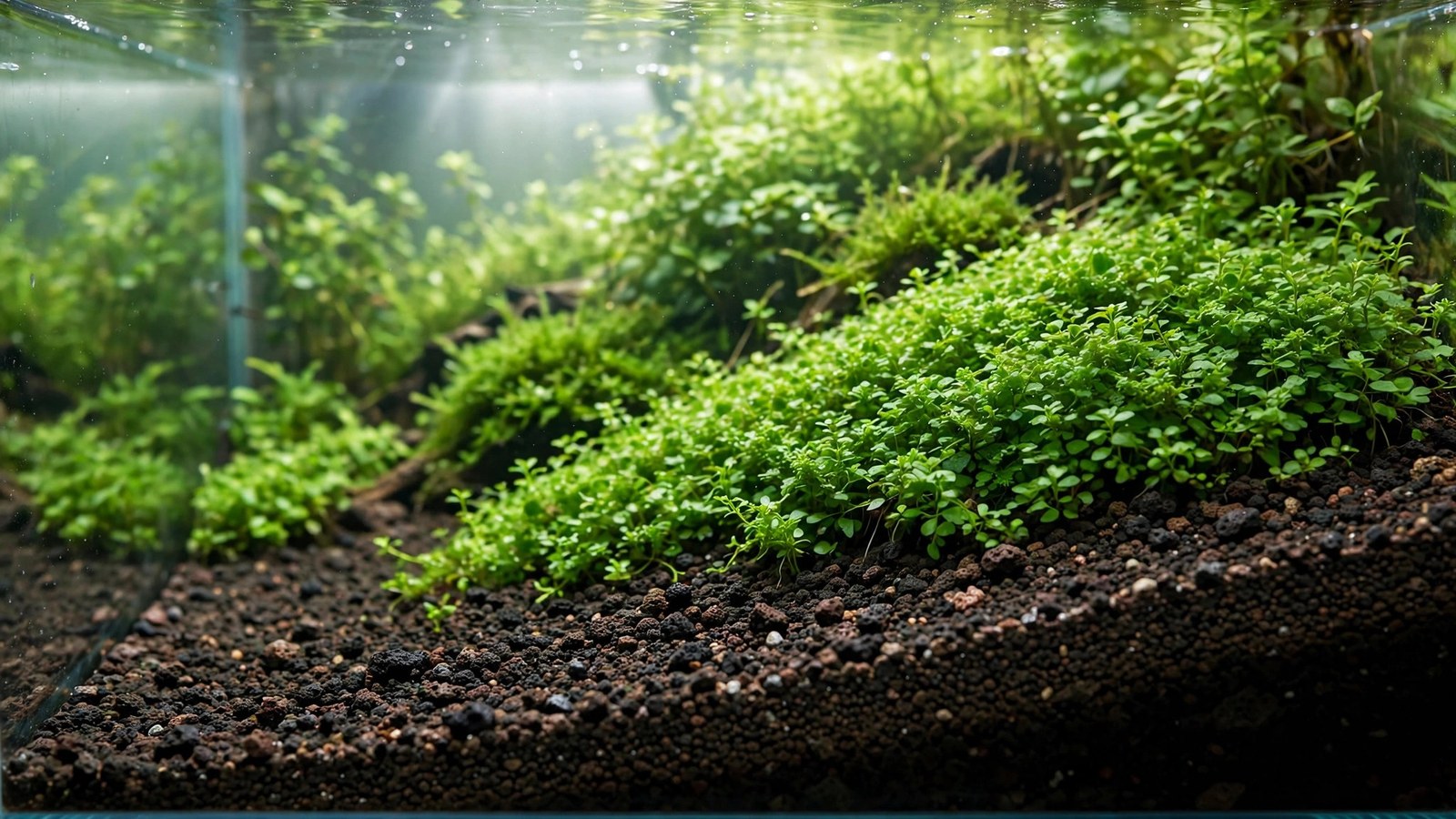
Two years into your first aquascape, the carpet stalls. The stem plants that once doubled weekly now creep. Your first instinct is the light, then the fertilizer — but the real culprit is often the thing you buried and forgot: the aquasoil has run out. When that happens, the question that decided your tank's future was asked the day you set it up, bag in hand, at the fish store: ADA Amazonia or Tropica Aquarium Soil — and which one actually lasts longer?
There is no blowout winner. In real tanks, ADA Amazonia typically delivers 2–3 years of useful life and Tropica Aquarium Soil 1–2 years — but they fade differently: ADA exhausts its nutrient stores first while its granules hold up, whereas Tropica starts gentler and ages more evenly. The far bigger factor is your water: soft, low-KH water can stretch either soil's buffering to about two years, while hard alkaline water can burn it out within months. For most buyers, ADA wins for maximum first-year growth; Tropica wins for an easier, calmer startup. And both last far longer if you recharge instead of replacing them.
What "lasting" really means for an aquasoil
Ask five aquarists how long their soil lasted and you will get five different answers, because an aquasoil dies three separate deaths — and they don't happen at the same time.
Death 1: nutrient depletion. The baked granules are loaded with nitrogen, phosphorus, potassium, and trace elements. Hungry root-feeders — Amazon swords, crypts, carpeting plants — mine those stores aggressively. Under heavy growth, noticeable depletion can set in as early as month 6–10; in a calm, lightly planted tank, the stores stretch much further. This is the death that makes growth stall.
Death 2: buffering exhaustion. Both ADA and Tropica soils actively pull carbonate hardness (KH) and pH down. This is ion exchange: the granules grab calcium and magnesium ions out of the water until their exchange sites are full. Every water change in hard water spends a little more of that capacity. In near-zero-KH soft water, buffering can last around two years; in hard, alkaline water, it can be spent in a matter of months — sometimes weeks. This is the death that makes pH start swinging.
Death 3: structural breakdown. The granules themselves soften and crumble into mud. This is the only death that is truly fatal, because muddy soil compacts, goes anaerobic, and can't be recharged — it has to come out. Both premium soils are baked hard enough that this typically takes 2–4 years with normal handling, and much sooner if you deep-vacuum or crush the bed under heavy rockwork.
Understanding this split is the whole trick to the comparison below: ADA and Tropica don't differ much in when they die. They differ in how — which death arrives first, and what you can do about it.
ADA Amazonia: how long it really lasts
ADA Aqua Soil Amazonia is the soil that built modern aquascaping, and it is the richest of the two — which is exactly why it burns brightest and fades fastest.
The startup: brutal but short. Amazonia releases a heavy ammonia load for the first 3–6 weeks. This is by design: the ammonia feeds the nitrogen cycle and then the plants. The correct protocol is fishless cycling with daily or near-daily large water changes until ammonia and nitrite read zero. Skip this and you get an algae farm. If that workload sounds miserable, Amazonia Light and Amazonia Ver.2 release less ammonia and are more forgiving — Ver.2 is the current formula most new bags carry.
The golden year. Months 1–12 are Amazonia's prime. The organic-rich granules (humic acids, high nitrogen content) drive the explosive growth Amazonia is famous for. Carpets knit fast, stems need weekly trimming, and many aquarists run little or no water-column fertilizer during this phase because the soil does the heavy lifting.
The fade. Somewhere between month 6 and month 18 — faster in heavily planted, high-light tanks — growth visibly slows. This is nutrient depletion, not a crisis: the granules are still structurally sound, and the soil continues buffering pH well past this point. Long-term scapers report the physical granules holding up remarkably well — one well-documented long-term tank showed roughly 90% of granules still intact after three years. So what "dies" first in Amazonia is the nutrient charge, typically giving a useful lifespan of 2–3 years before recharging becomes mandatory rather than optional.
Buffering: Amazonia pulls pH toward ~6.0–6.8. In soft water it can hold that for close to two years; every water change in hard water spends the capacity faster. If you keep Caridina shrimp or other soft-water livestock, this long buffering tail is part of what you're paying for.
Variants worth knowing: Normal type (standard granules) vs. Powder type (fine grains for carpeting plants and nano tanks — lay it as a thin cap over Normal, never as the whole bed in a large tank); Amazonia Light (lighter color, gentler ammonia); Ver.2 (current formula, milder startup than the original).
Tropica Aquarium Soil: how long it really lasts
Tropica Aquarium Soil is the European answer to Amazonia — Danish-made, volcanic-based, and engineered for the same job with a calmer temperament.
The startup: noticeably easier. Tropica's ammonia release is milder than ADA's, which is its single biggest practical advantage. The standard protocol is still serious — 25–50% water changes twice a week for the first four weeks, and no livestock until the cycle is established — but beginners consistently report fewer algae disasters and a shorter path to stability. Ammonia can still spike toward 4 ppm in the first week in a fresh, deep bed, so "milder" does not mean "instant."
The golden year. Like Amazonia, Tropica peaks in year one: complete nutrition in the granules, 2–3 mm grain size that's easy to plant into, and active pH/KH buffering. Tropica specifically markets red-color enhancement, and its non-uniform grain size gives a more natural look than ADA's uniform pellets. Growth is vigorous — just a touch less explosive than Amazonia's peak, which many low-tech aquarists actually prefer because it means less trimming.
The fade. Tropica's useful lifespan is generally quoted at 1–2 years of peak performance. Its nutrient charge depletes on a similar curve to ADA's, and its buffering fades on the same water-dependent schedule. Where Tropica arguably edges ahead is granule integrity: hobbyists widely report it holding its shape very well over time, with less crumbling under replanting than some competitors.
One product-line trap to avoid: Tropica sells two different products with confusingly similar names. Aquarium Soil is the complete standalone substrate (also in a Powder variant) — that's the one in this comparison. Plant Growth Substrate is a concentrated base layer meant to sit under gravel, at about 1 cm plus 3–4 cm of gravel cap. Buying the base layer by mistake and using it as a full bed is a classic beginner error.
Availability caveat: Tropica is harder to find in North America than ADA and goes out of stock frequently. If you can't reliably source a second bag for future top-ups, factor that into your choice — consistency between batches matters when refreshing a bed.
Head to head: ADA Amazonia vs Tropica, lifespan compared
| Factor | ADA Amazonia (Ver.2) | Tropica Aquarium Soil |
|---|---|---|
| Startup ammonia | Heavy, 3–6 weeks; strict fishless cycling needed | Milder; 4 weeks of twice-weekly 25–50% water changes |
| Peak growth window | Months 1–12 — the most explosive of any soil | Months 1–12 — vigorous, slightly gentler |
| Nutrient depletion | Noticeable by month 6–10 in heavy tanks | Similar curve; quoted useful life 1–2 years |
| Buffering lifespan | ~2 years in soft water; months in hard water | Same water-dependent curve |
| Granule durability | Excellent (~90% intact at 3 years reported) | Excellent; widely praised for holding shape |
| Overall useful life | 2–3 years before mandatory recharging | 1–2 years before mandatory recharging |
| Ease of startup | Demanding — the price of maximum richness | More forgiving — the beginner-friendly pick |
| Availability (US) | Widely available online | Patchy; frequently out of stock |
Read the table honestly and the verdict is humbling: the two soils are far more alike in longevity than their marketing suggests. ADA's edge is real but narrow — a somewhat longer nutrient tail and wider availability. Tropica's edge is real too — a calmer first month that saves beginners from the most common way new tanks fail. Neither soil will outlast the other by a margin that matters if your water and maintenance habits are the same.
The KH factor: your water decides more than the brand
If you take one idea from this article, make it this one: the lifespan of your soil's buffering is set by your tap water, not by the logo on the bag.
Aquasoils buffer through ion exchange — the granules have a finite number of exchange sites, and every liter of hard water that passes through spends some of them. With near-zero-KH water (RO water or naturally soft tap), those sites empty slowly: expect roughly two years of stable, soil-driven pH. With moderately hard tap water, that same capacity can be gone in a few months. With very hard, alkaline water, some aquarists report the buffering effect fading in weeks.
The same logic applies to nutrients: a densely planted, high-light, CO2-injected tank mines the soil's stores far faster than a calm low-tech tank. Two aquarists can buy the same bag and get 8 months versus 3 years of peak performance purely from stocking and dosing choices.
How to make either soil last twice as long
Longevity is mostly maintenance. These five habits separate the aquarists who replace soil every 18 months from the ones still running the same bed at year four:
1. Start dosing the water column by month 6. The moment peak growth passes, supplement with a balanced liquid fertilizer. This takes the load off the soil's remaining stores and is the single highest-leverage thing you can do. Think of soil nutrients as the battery and water-column dosing as plugging into the mains.
2. Build the bed deep enough. Aim for 5–7.5 cm (2–3 inches), deeper at the back for slopes. A deeper bed is a bigger nutrient reservoir — roughly 1 liter of soil per gallon of tank volume is the working rule of thumb. Shallow beds exhaust faster and give roots nowhere to go.
3. Never deep-vacuum, never rinse before use. Hover the siphon over the surface to lift detritus; plunging into the bed crushes granules and clouds the tank. And don't rinse new soil — you'll wash the nutrients you're paying for straight down the drain.
4. Recharge with root tabs instead of replacing. When growth slows in year two, push root tabs into the bed around heavy root-feeders. This restores the nutrient charge in place — no tear-down, no new cycle, no algae bloom from a fresh ammonia spike.
5. Don't cap aquasoil with sand. A sand cap blocks the exchange between soil and water column, so water-column dosing can't recharge the bed — and the plants still mine the soil's stores. Capped beds exhaust faster and are harder to revive. If you want sand aesthetics, keep the sand in a separate foreground zone.
Recharge or replace? Reading the signs
Not every tired-looking tank needs new soil. Learn to tell the three deaths apart:
Recharge when: growth has slowed but the granules still feel firm and round between your fingers, pH is roughly stable, and plants respond to fertilizer. Push root tabs deep into the bed around swords, crypts, and carpet edges, and run a consistent liquid dosing schedule. Many "dead" soils come roaring back within weeks — the structure and bacteria colonies are still there; only the nutrient charge was empty.
Replace when: the granules have turned to soft mud that clouds the water at a touch, the bed has compacted into a dense layer, or you get persistent anaerobic smells (rotten egg) from deep in the substrate. At that point no amount of fertilizer fixes the physics — the bed can't breathe. Replace in sections over a few weeks rather than all at once to protect your bacteria colonies, and expect a mini-cycle.
Which should you buy?
After all the lifespan analysis, the buying decision is simpler than the debate suggests:
Choose ADA Amazonia if you want maximum growth in year one, run CO2 and high light, keep soft-water livestock like Caridina shrimp that benefit from long buffering, or value wide availability for future top-ups. The current Ver.2 formula keeps the richness with a more manageable startup than the original.
Choose Tropica Aquarium Soil if you want the easiest first month, run low-tech or are new to aquasoils, prefer a more natural mixed-grain look, or want strong red coloration. Just buy from a retailer you trust and consider grabbing a spare bag — stock is the weak link, not the soil.
As an Amazon Associate I earn from qualifying purchases — the product links below are the exact listings I verified as live and available while researching this guide.
ADA Aqua Soil Amazonia Ver.2 (9L) — the standard choice for tanks around 15 gallons and up; one 9L bag gives roughly 4 inches of depth across a square foot. Check the ADA Amazonia Ver.2 9L listing on Amazon ★4.7.
ADA Aqua Soil Amazonia Ver.2 (3L) — the same soil in a smaller bag for nano tanks, shrimp cubes, or for topping up an existing bed without buying a full 9L. Check the ADA Amazonia Ver.2 3L listing on Amazon ★4.7.
Whichever bag you open, the longevity playbook is identical: cycle it properly, dose the water column from month six, recharge with root tabs in year two, and judge the soil by its granules — not the calendar. Do that, and the brand on the bag matters far less than the care in the maintenance.
Frequently asked questions
Does ADA Amazonia or Tropica soil last longer?
ADA Amazonia lasts slightly longer overall — roughly 2–3 years of useful life versus 1–2 for Tropica Aquarium Soil — but the difference is narrow and both fade on similar timelines. Your water's KH and your dosing habits affect lifespan far more than the brand choice.
Can I reuse old aquasoil instead of replacing it?
Yes, if the granules are still firm. Siphon off the crumbled fines, keep the intact granules, and recharge the bed with root tabs and water-column fertilizer. Only soil that has broken down into mud needs to come out — depleted nutrients alone are not a reason to replace.
How do I know when my aquasoil is exhausted?
The classic signs are stalled plant growth despite good light and CO2, pale new leaves, and pH that starts swinging between water changes as buffering fades. If the granules still feel solid, recharge with root tabs first — replacement is only needed when the granules themselves have crumbled.
Does hard water really kill aquasoil faster?
Yes — specifically it kills the buffering capacity faster. Hard, alkaline water spends the soil's ion-exchange sites quickly, sometimes within months, while near-zero-KH water can preserve buffering for around two years. Nutrient depletion is less water-dependent and more driven by plant density and growth rate.
Should I cap ADA Amazonia or Tropica soil with sand?
No. Capping blocks the soil-water exchange that lets water-column fertilizer recharge the bed, so the soil's nutrient stores get mined with no way back in. Capped aquasoil exhausts faster and is harder to revive. Keep sand in separate zones if you like the look.
Is Amazonia Ver.2 different from the original Amazonia?
Ver.2 is ADA's current formula with a milder ammonia release at startup, making the cycling period more forgiving while keeping the nutrient richness the original was known for. For new setups, Ver.2 is the easier and generally better choice.