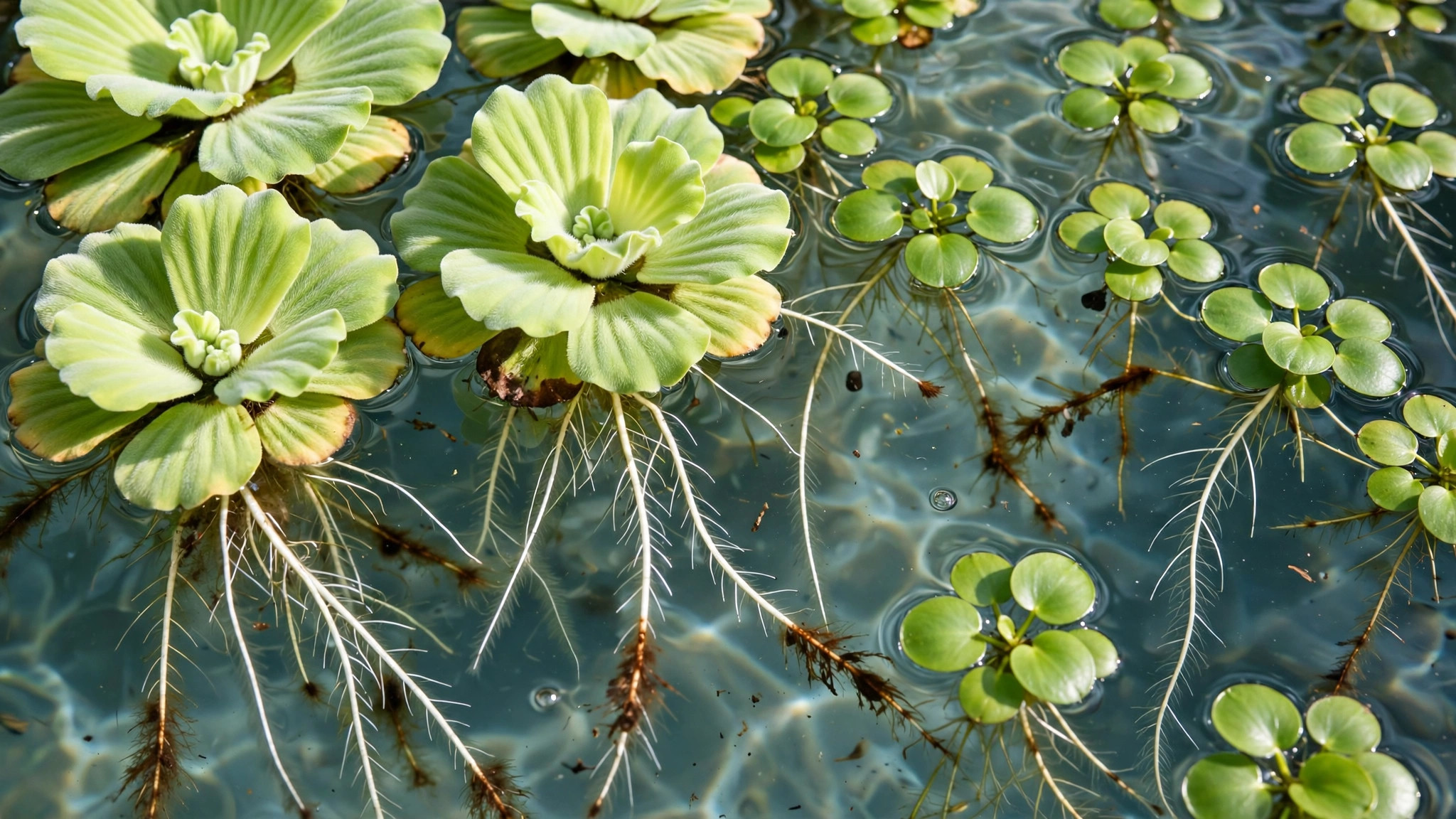
You bought a mat of frogbit with long, feathery white roots — and a month later those roots look like frayed brown string. Floating plant roots dangle straight into the water column, so they react first when nutrients run low or water quality slips, days before the leaves show it.
The reassuring part: brown roots on floaters are usually fixable, not fatal. The browning is a symptom — algae film, nutrient starvation, or decay — and each cause has a distinct fix. Here is how to diagnose yours and turn it around within two weeks.
The short answer: Floating plant roots turn brown most often because of a water-column nutrient deficiency — floaters feed entirely from the water, so when nutrients run low, older roots die back first. The second most common cause is a diatom (brown algae) coating, typical in new tanks. Genuine root rot is rarer. Diagnose by feel: firm but brown means algae or deficiency; soft and mushy means rot.
First, read the roots before treating anything
Lift one plant and run a fingertip along its roots — what you feel matters more than what you see:
- Firm roots with a brown film that wipes off — diatoms or detritus on a live root. Most common in tanks under three months old.
- Firm roots, uniformly brown, no new white tips — starving. Old roots die back when the water column lacks nutrients.
- Soft, translucent, or mushy roots — decay, usually after a cycle crash or a dense surface mat blocking gas exchange.
- Brown only on the oldest roots while new white tips grow — normal turnover.
Cause 1: Water-column nutrient deficiency
Floating plants — frogbit, water lettuce, red root floater, duckweed — pull all their nutrition from the water. When it runs lean, they sacrifice their oldest roots first. The telltale pattern: roots browning alongside pale or yellowing leaves, with new leaves emerging smaller than the old ones. It hits hardest in very clean tanks — heavy filtration, big water changes, few fish, no fertilization. Paradoxically, pristine water starves floaters.
The fix is a weekly all-in-one liquid fertilizer dosed to the water column right after your water change, starting at half the label dose for the first two weeks. A gentle comprehensive liquid like Seachem Flourish ★4.7 suits low-tech tanks; fast-growing floaters covering the surface usually do better on a full all-in-one with meaningful nitrogen and potassium.
Affiliate disclosure: links in this article to Amazon are affiliate links — if you buy through them, AquaVerdia may earn a small commission at no extra cost to you.
Cause 2: Diatom coating on the roots
Brown algae — diatoms — dust everything in new tanks, including floating plant roots. If the root is firm and the brown wipes away to reveal pale root underneath, you have diatoms, not dying roots. They feed on the silicates and ammonia typical of tanks under three months old and fade on their own as the tank matures. To speed it up: wipe the film off with a soft toothbrush dipped in tank water and keep up weekly 25–30% water changes. Skip chemical algaecides — they stress floaters like frogbit more than the diatoms.
Cause 3: Poor water quality and true root rot
Real root rot is less common than deficiency or diatoms, but it happens — usually after a cycle crash or under a solid floating mat that blocks gas exchange, letting dissolved oxygen dip overnight. Roots turn soft and translucent rather than just brown. Test before treating: an API Freshwater Master Test Kit ★4.8 checks ammonia, nitrite, nitrate, and pH. If ammonia or nitrite read above zero, change 30–40% of the water daily until both read zero, trim all mushy roots with scissors, and thin the mat so about a third of the surface stays open for gas exchange.
Conversely, nitrates near zero in a planted tank confirms the deficiency diagnosis — dose liquid fertilizer. Nitrates over 40 ppm point to poor water quality instead, where more water changes beat more fertilizer.
Diagnose it at a glance
| What you see | Likely cause | First move |
|---|---|---|
| Brown film wipes off, roots firm | Diatoms | Gentle wipe, weekly water changes |
| Uniform browning, pale leaves, no new root tips | Nutrient deficiency | Start weekly liquid fertilizer |
| Soft, mushy, smelly roots | Root rot from water quality | Trim damage, water changes until ammonia/nitrite are zero |
| Only oldest roots brown, new white tips growing | Normal turnover | Nothing needed |
| Roots brown plus wet, rotting leaf undersides | Condensation on leaves | Vent the lid, keep leaf surfaces dry |
Your two-week recovery plan
Day 1: trim every mushy root and brown leaf with scissors, do a 25–30% water change, and test ammonia, nitrite, and nitrate. Day 2: start weekly liquid fertilizer after each water change. Week 1: leave the plants alone — constant fiddling breaks the fine new roots they are growing. Week 2: look for new white root tips and greener new leaves. If new growth is healthy, the old brown roots were the symptom, not the disease.
Expect full recovery in three to four weeks for frogbit and water lettuce; red root floater takes about six. If nothing has regrown after a month, retest the water and adjust the fertilizer dose.
Frequently asked questions
Can brown roots turn white again?
No — once a root has died and browned, it does not regenerate. What matters is new growth: healthy white tips from the crown. Trim the dead roots once new growth is established.
Should I use root tabs for floating plants?
No. Root tabs dissolve into the substrate where floaters' roots never reach. Floaters feed entirely from the water column, so only liquid fertilizers dosed into the water help them.
Are brown roots dangerous to my fish?
Not directly — some species even graze on them. The underlying cause, like an ammonia spike, is what can affect livestock, so test the water and treat that.
How fast should floating plant roots grow?
Healthy frogbit and water lettuce roots can extend several centimeters in a week. Slow, stubby growth with browning usually points back to a nutrient shortage.