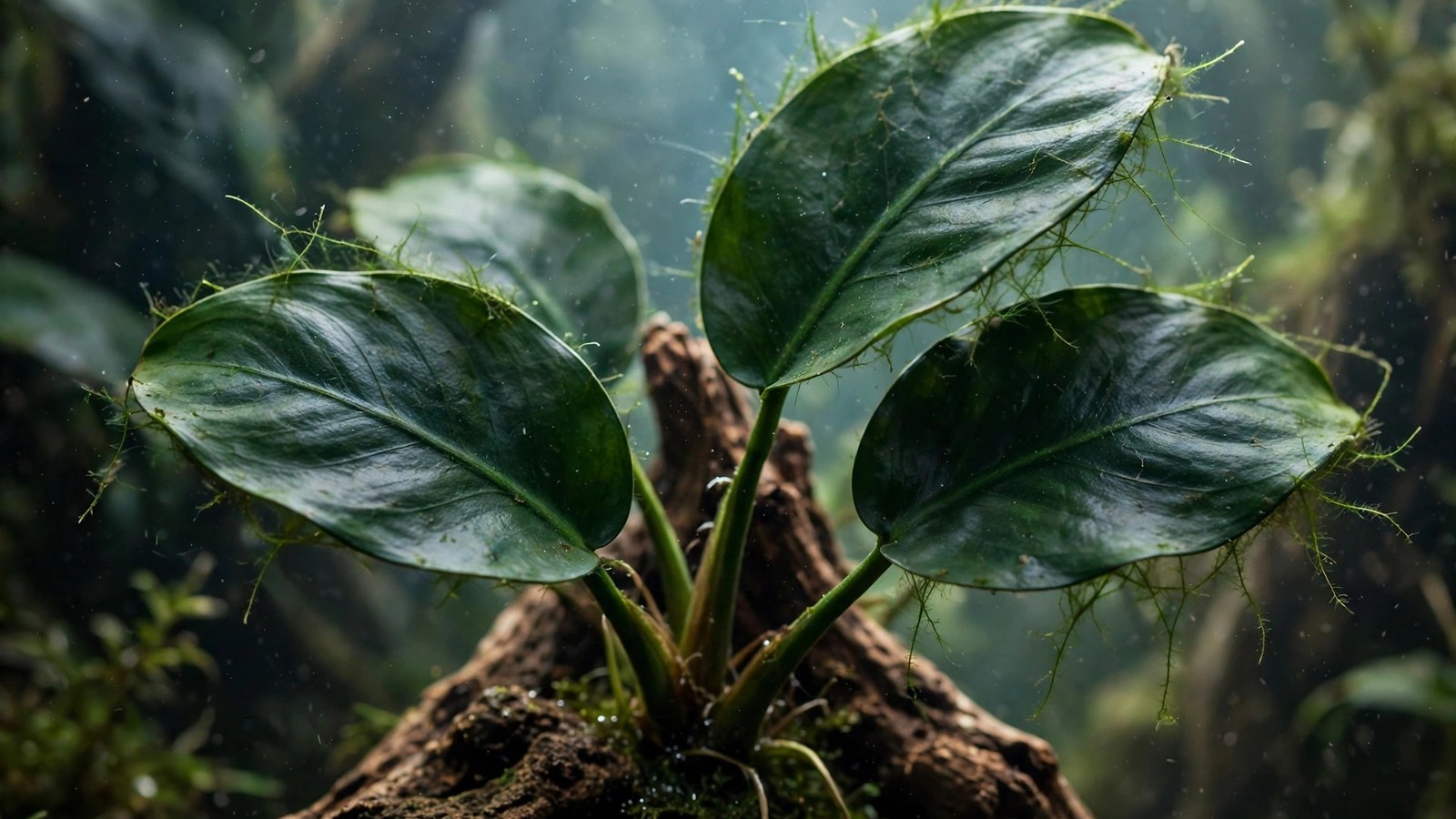
Hair algae on Anubias feels personal in a way algae on a stem plant never does. A stem plant sheds a coated leaf within weeks; an Anubias leaf can live for months, so every strand that lands on it has months to dig in. That long leaf life is why your Anubias looks furred while fast growers beside it look clean.
The good news is that Anubias is tough enough to be cleaned properly. Its thick, waxy leaves survive toothbrush work and peroxide dips that would shred a delicate stem plant. Clean the leaves in the right order, then fix the light and flow that invited the algae, and the same leaves can stay clean for months.
Why Anubias collects hair algae
An Anubias leaf is a long-term surface in a tank full of short-term ones. It grows slowly, so it cannot outgrow a coating the way a stem plant does, and its broad, flat shape catches both light and settling detritus — and detritus on a leaf feeds algae exactly where it is anchored. Leaves in still corners and under direct filter outflow are usually worst: the first collects debris, the second gets blasted with nutrient-rich water. The 2Hr Aquarist Anubias guide makes the same point — bright light exposes any weakness in nutrient supply, and on a slow plant with long-lived leaves, algae exploits the gap first.
Two mistakes make it worse. Starving the tank to starve the algae backfires: hungry Anubias grows even slower, while algae, which needs far less, carries on. And ripping out every coated leaf wastes the plant — a leaf with light fuzz is still photosynthesizing and worth saving. Check the rhizome too: a firm, green rhizome means the plant is fine even when its leaves look terrible, while a soft, mushy rhizome is rot, not algae.
Triage every leaf first
Before you touch a bottle, sort the plant leaf by leaf. This takes five minutes and prevents the two classic errors: dipping a plant that only needed a brush, and brushing a leaf that was already dead.
- Light fuzz, leaf still green underneath: clean it in place. Toothbrush work alone clears this.
- Thick mat, leaf green at the base: dip it, after brushing off everything loose.
- More algae than leaf, or yellowing and soft: trim it. Cut the petiole at its base and remove the leaf from the tank.
- Rhizome soft or black: stop. Trim back to firm tissue and deal with the rot first.
Manual removal without damaging leaves
The product links in this guide are affiliate links: if you buy through them, the site earns a small commission at no extra cost to you.
Manual removal is unglamorous and it does the most work. Do it during a water change, with the siphon running, so every freed strand gets sucked out instead of resettling on the next leaf. Twirl a clean, soft toothbrush through the strands — hair algae winds up like spaghetti — then siphon the cloud before it drifts. For the film left behind, wipe each leaf gently, stroking from petiole toward tip, never scrubbing back and forth. Anubias leaves are tough but not armour: abrasive pads and dry scrubbing tear the waxy surface, and a torn leaf collects algae faster than a dirty one did.
A kit that puts tweezers, curved scissors, and a spatula in one place covers both the cleaning and the trimming here — the hygger 6-in-1 Long Aquarium Aquascaping Tools Kit ★4.6.
| Method | Best for | Watch out for |
|---|---|---|
| Toothbrush + siphon | Light fuzz, routine care | Loose strands resettle without the siphon |
| Peroxide dip (out of tank) | Thick mats on a detachable rhizome | Long dips pale the leaves; rinse well |
| Peroxide spot dose (in tank) | Plants glued to hardscape | Keep the dose low, filters off |
| Liquid carbon spot dose | Stubborn patches | Harsh near shrimp and Vallisneria |
| Trimming the leaf | Leaves that are more algae than plant | Never remove over a third of the plant |
The hydrogen peroxide dip, step by step
Anubias tolerates peroxide better than most plants because its leaves are thick — but "tolerates" is not "invulnerable," so keep the dip short, dilute, and out of the tank. Use ordinary drugstore 3% hydrogen peroxide, mixed fresh each time; an old bottle that no longer fizzes has lost its strength.
- Remove the plant. Lift the whole rhizome off its wood or rock. If it is glued down and will not come off without tearing, use the in-tank spot dose below instead.
- Brush first. Twirl off everything loose over a bucket, so the dip only deals with what is attached.
- Mix the dip. Combine 1 part 3% peroxide with 3 parts tank water.
- Dip for 3–5 minutes. Submerge leaves and rhizome, swirling gently. Fine bubbling on the algae means it is working.
- Rinse thoroughly. Rinse in clean, dechlorinated water, then reattach the rhizome exposed, not buried.
- Wait 48 hours. Treated algae turns pink or white and dies back within two days. Brush off the dead strands at your next water change; do not re-dip the same plant twice in one week.
If the plant cannot be removed, spot-dose in the tank instead: switch filter and powerheads off, syringe 3% peroxide directly onto the algae at 1–2 ml per 10 gallons in total, wait 15 minutes, then switch the filter back on. That dose is far below dip strength, so expect two or three sessions, days apart. Never pour peroxide into the tank at dip concentration, and never dose directly onto shrimp, snails, or mosses.
Liquid carbon as an alternative
Glutaraldehyde-based liquid carbon, spot-dosed the same way, also kills hair algae, but it is harsher: use half the label dose near shrimp and keep it off Vallisneria.
Stop it coming back: light, flow, and feeding
A cleaned leaf in an unchanged tank is a two-week reprieve. Cut the photoperiod to 6 hours a day and hold it until you have had two full algae-free weeks; only then add 30 minutes a week back toward your normal schedule. Move the Anubias into shade — under taller plants or behind hardscape — and out of the direct blast of the filter outlet. Anubias in moderate, indirect light grows just as well and gives algae far less to work with; the site's hair algae removal guide covers the same light reset for tanks where the problem is not limited to one plant.
Keep feeding the plant, too. A lean liquid fertilizer at half to full strength keeps Anubias growing steadily without handing algae a feast — a comprehensive liquid like Seachem Flourish ★4.7 suits slow epiphytes because it feeds through the water column, which is where Anubias drinks from. Add competition and grazers as well: fast-growing stems or floaters soak up surplus nutrients, Amano shrimp genuinely eat hair algae, and a weekly siphon of detritus off the leaves leaves the next fuzz nowhere to start.
Frequently asked questions
Will hydrogen peroxide kill my Anubias?
Not at the dip in this guide. Anubias leaves are thick enough to handle a short, diluted dip, and most plants come through with no damage beyond the algae dying off. What harms Anubias is overdoing it: long soaks, undiluted peroxide, or repeated dips in the same week can pale or melt leaves. Stick to 3–5 minutes and rinse well.
Can I dip Anubias without removing it from the tank?
You can spot-dose it in place, but you cannot dip it in place — a dip is a stronger solution than a tank can safely hold. If the rhizome is glued to hardscape, use the in-tank spot dose: filters off, 1–2 ml of 3% peroxide per 10 gallons applied directly to the algae, 15 minutes, filters back on.
Why does the algae come back after I clean the leaves?
Because cleaning removes algae, not its cause. If light, photoperiod, and filter flow are unchanged, new strands settle on the same leaves within days. Clean first, then cut light to 6 hours, move the plant into shade and out of direct flow, and keep the plant fed.
Should I just trim off every algae-covered leaf?
No. Anubias replaces leaves slowly — a new leaf every 4–6 weeks — so stripping the plant sets it back for months. Trim only leaves that are mostly algae, yellowing, or soft, and never more than a third of the plant at once. A green leaf under a fuzz of algae is still a working leaf.